
Why do some birds
Stand on only one leg instead of two?
Please tell me

Why do some birds
Stand on only one leg instead of two?
Please tell me
Here is a brief excerpt from my book “88 DAYS IN INDIA: A JOURNEY OF MEMORY AND DISCOVERY”, In this sample, I am writing about pigeons in Jaipur (Rajasthan) and elsewhere:
“While we were being driven around the city, we passed areas where food and
water were being distributed to some of the city’s many pigeons. The provision
of food for pigeons (as well as street dogs and other animals) is commonly
found in many other cities and villages we have visited in India. In Jaipur, we
saw vendors selling passersby seeds for the birds. Earlier in 2024, when we
were in Istanbul, we saw similar vendors at an area (near the Spice Bazaar)
where pigeons were plentiful. As a child during the early 1960s, my parents
used to buy me cones full of corn for feeding the pigeons in the Piazza Signoria
in Florence (Italy). Long ago, I remember pigeon feed being sold in London’s
Trafalgar Square. However, now Londoners regard pigeons as pests, which
should not be fed. One of London’s former Mayors, Ken Livingstone, who
ended selling of pigeon food in the square in 2001, called pigeons: “rats with
wings”.

Although feeding pigeons has caused India’s population of these
creatures to increase to alarmingly high levels, Shreemoyee Chakraborty
(quoted in an article published by theprint.in in November 2024) noted:
“In India feeding pigeons is not just a habit; it has a religious and
cultural significance as well.”
In an online article about Vastu Shastra (published on vastulabh.com), it was
pointed out that:
“Pigeons have long been associated with Goddess Lakshmi, the deity
of wealth and prosperity. According to Vastu Shastra, pigeons are
believed to bring positive energy and good fortune into the home.
However, there are differing opinions and specific guidelines on how to
interpret their presence.”
So, it is likely that feeding these winged creatures in India has a good chance of
continuing despite the occasional attempts of some municipal authorities,
including in Jaipur, to reduce their population.“
If you wish to purchase a copy of this book, hasten to Amazon’s website:

See the canal
Enjoy the birds and many boats
Savour London’s sights

There were twenty six birds perched on a wire.
The farmer shoots one.
How many are left?
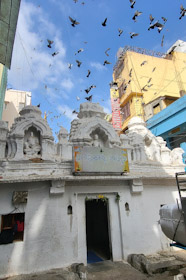
The bell tolls loudly
Within the holy mandir
Pigeons fly around
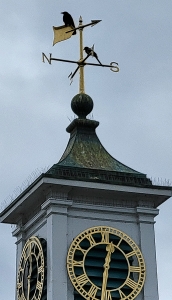
On a weathervane
Two birds perch perilously
Before the wind blows

LONDON’S HOLLAND PARK contains a lovely area – the Kyoto Garden. It is a well-maintained Japanese-style garden. I visit it frequently. Each time, I see something different there.
The garden is planted around a small pond in which there are several rocks, which look like miniature islands. Today, I saw a heron perched on the summit of one of these rocks. It stood still, moving its head slowly every now and then. It showed little interest in the many fish that swim in the pond. My wife noticed that there was a nest containing eggs just below the bird’s feet. The creature stood like a sentinel, guarding its future offspring.
I could see four eggs in the nest – there might have been more. In general, so I learned from Wikipedia, the various species of heron are monogamous and lay between three and five eggs. I have no idea what species I saw in the Kyoto Garden, but it is the first time I have seen a heron’s nest with eggs anywhere in Holland Park.
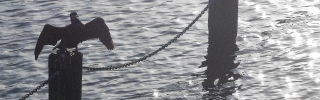
Black wings outstretch’d
A cormorant perching in the sun
A wondrous sight
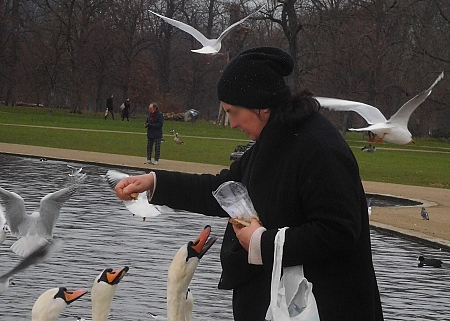
THE TEMPERATURE HAS dropped. Fear of the Omicron variant of the covid19 virus has meant that less people are out and about in London. This was the case in Kensington Gardens today, the winter solstice. The wildfowl that gather around its not so round Round Pond wait eagerly for visitors to distribute tasty morsels. Today, I saw a lady feeding the birds. So many were attracted to her that sometimes her head seemed lost in a cloud of noisy gulls. In front of her, swans extended their necks, attempting to reach her hands. Undaunted, this animal lover continued carrying out her kind gesture.
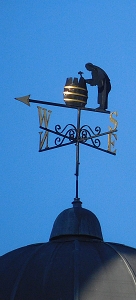
LOOK UP AND if your eyesight is reasonably up to scratch, you might well be lucky enough to see a weathervane on top of a church steeple or some other high point on a building. The ‘vane’ in weathervane is derived from an Old English word, ‘fana’, meaning flag (in German the word ‘Fahn’ means flag). Weathervanes are simple gadgets that indicate the direction of the wind. They usually consist of an arrow attached by a horizontal straight rod to a flat surface that catches the wind. The rod is mounted on a vertical support in such away that it can rotate as the wind catches the flat surface. The horizontal rod with the arrow rotates so that it offers the least resistance to the prevailing wind. Beneath the rotating arrow are often indicators that are labelled with letters denoting the four points of the compass. If, for example, the wind begins to blow from east to west, the horizontal rod will rotate so that the arrow is above the ‘E’ denoting east. Some weathervanes substitute the horizontal rod with a single flat asymmetric object that can catch the wind and rotate. Often the object seen above churches is a cock or other bird, whose beak will indicate the direction of the wind. I suppose that for birds wind direction is quite important.
The weathervane is not a recent invention. It was invented in the 2nd century BC both by the Greeks and the Chinese but separately. Some of the oldest Chinese weathervanes were shaped as birds and later, at least by the end of the 9th century AD, bird shaped vanes became used in Europe. Although avian weathervanes are still very common, a wide variety of other shapes have been used. Sundials, weathervanes, now archaic, only give an approximate indication of time and wind direction respectively. However, unlike sundials, which do not work when the sun is not shining, weathervanes work in all weather conditions and in day and night, although they are somewhat difficult to see at night-time. Despite their relative inaccuracy compared with modern instruments for measurements of wind, weathervanes are attractive adornments to buildings both old and new.
 yamey
yamey 