A postman and his spear

Happy New Year!

NEXT TO THE POST OFFICE on the corner of Bangalore’s Museum and State Bank of India Roads, there is a recently opened Museum of Communication. Housed in an old-fashioned Bangalorean bungalow, it is effectively a museum of the Indian postal services. This well laid out museum contains a variety of exhibits ranging from postage stamps to large pieces of mechanised equipment. I will describe a few of the many exhibits that interested me.

There is a photograph of the world’s highest post office (somewhere in the Himalayas). There is an enormous piece of equipment, which occupies the whole of a room. It was used for transmission of money orders. Several panels described the history of the Indian freedom struggle and that of the Indian Post.

Outside on the museum’s shady verandah, there is a collection of old letter boxes. They include boxes of various shapes, sizes, and colours. One of them bears the Portuguese words “CAIXA POSTAL”. Once upon a time, it must have been used in one of Portugal’s Indian colonies, but there was no information about its original location.

Outside the museum, and still in use, there is a hexagonal pillar box, very similar to one placed at the Bowring Institute in the late 1880s. Unlike the one at Bowring, which bears the British Indian postal insignia, the box near the museum has been modified to make it look like a post-Independence Indian Post pillar box.

Next to the entrance to the museum, also on the verandah, there is aalifesize model of an Indian postman of yesteryear. Wearing a green and white uniform (including a turban) with some red trim, he has a sack slung over his left shoulder. His right hand is stretche out in front of him. In it he holds a wooden shaft tipped with a sharp metal spear tip. Four small bells are attached to the base of this tip. A lantern hangs from his right wrist.

In the past, the postman mafe his way from village to village along paths through the jungle. The spear tip and its staff were used to ward off wild animals. The lantern was used to light his way, and the bells were rung to alert villagers to his arrival.

Visiting the museum was an interesting experience. Seeing the hardships that postmen used to face should make us pleased that we can now communicate using fax, email, and other modern inventions.

A fine old coffee house with waiters in turbans

WHEN I FIRST VISITED Bangalore in 1994, there was a coffee house on MG Road close to the now derelict Srungar Shopping Complex. This venerable ‘hole in the wall’ was a branch of the Indian Coffee House (‘ICH’) chain. In both appearance and atmosphere it reminded me of some of the older coffee houses I had seen in Yugoslavia when it was still a country.

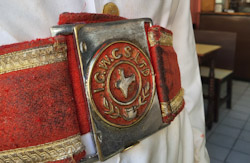
Customers sat at old wooden tables on wooden benches with upright hard backrests. Old Coffee Board posters hung on the walls. The waiters were dresses in grubby white jackets and trousers held up by an extremely wide red and gold belt with huge buckles that bore the logo of the ICB. These gentlemen wore white turbans with red and gold ribbons on their heads. On addition to rather average quality South Indian filter coffee, a variety of snacks and cold drinks were also available.

During the British occupation of India, admission to most coffee houses was restricted to European clients. In the late 1890s, the idea of establishing an ICH chain of coffee houses for Indian customers began to be considered. In 1936, the India Coffee Board opened the first ICH in Bombay’s Churchgate area By the 1940s, there were at least 50 branches all over what was then British India.

In the mid 1950s, the ICHs were closed by the Coffee Board. The Communist leader AK Gopalan (1904-1977) and the Coffee Board workers managed to get the Coffee Board to hand over the ICH outlets to them, and they formed a series of Indian Coffee Workers’ Co-operatives. The cooperative on Bangalore was formed in August 1957. There are now several branches in the city.

The MG Road branch, which opened in 1959, closed in 2009, at about the sane time as the nearby Srungar Complex began becoming closed for redevelopment, which has not yet happened.

The branch reopened in the Brigade Gardens complex on Church Street. Apart from being accommodated in a room which is rather nondescript compared to its former home, not much has changed as a result of the move to a new location. The furniture is that which was in the older site. Likewise, the old posters have been transferred. And the waiters are still attired in their stained white uniforms with belt, buckle, and turbans. The ‘atmosphere’ of the old ICH on MG Road has been recreated or maybe continued in the coffee house’s new premises. The quality of the coffee served has neither improved nor deteriorated. The ICH remains as popular as ever, and for me it is always a pleasure to enter this old-fashioned place in a city that is addicted to change.

A long way from Paris

BANGALORE IS ABOUT 4800 miles from Paris (France). The French capital is noted for its gourmet delights, but on the whole the same cannot be said for Bangalore. One exception to this statement is Sunny’s restaurant currently located on Lavelle Road.

Arjun Sajnani created Sunny’s at least 25 years ago. Then, it was in a tall narrow house on a lane leading off Lavelle Road. The kitchen was on the ground floor and there were dining areas in the two floors above it. Often, Arjuna could be standing, working in the kitchen. Back in those early days, Sunny’s was one of Bangalore’s few suppliers of imported Western European cheeses, such as genuine parmesan.

Later, Sunny’s shifted to larger premises on the corner of Lavelle and Vittal Mallya Roads, next to a petrol filling station. The dining area was elegant.

For a brief period, Arjun ran a restaurant serving delicious Sindhi dishes in his original premises. Sadly, he decided to discontinue this interesting eatery.

Even later, Arjun shifted his restaurant to its present location – a two storey villa constructed about 20 years ago. The balconies on the upper floor are supported by stout carved timber pillars which remind one of pillars that you can see in much older traditional South Indian edifices. Diners can sit at tables within the building, or in the garden surrounding it, or on the first floor balconies. At lunchtime on Christmas Day 2022, every table was occupied.

At each of Sunny’s different locations, the food has been magnificent. As our daughter correctly said, eating at Sunny’s is as good as eating in a good Parisian restaurant. Also, Sunny’s Italian food (mainly pasta and pizzas) is above average in quality.

Arjun is an actor and director of theater and films, in addition to being a restaurateur. Dramatic productions require many skills. The same is the case for running a restaurant. Some of the required skills are the same for restaurants and for stage/screen. A restaurateur has to perform well both in the kitchen and the dining room to satisfy his or her clientele. Arjun achieves this successfully. If you have never been to Sunny’s, give it a try!

From paper come plants

A TALL MINARET OVERLOOKS Ebrahim Saheb Street in Bangalore’s busy Commercial Street bazaar district. Not far from the lofty structure stands the premises of a printing firm called Sundaram. It is here at this efficient enterprise that I have often had visiting (business) cards printed.

Recently, I went to Sundaram’s to collect my latest batch of cards. While I was waiting to have them packed, I noticed a man in the shop, folding what looked like A3 sized sheets of plain white paper. He folded them in half lengthwise. I asked him what he was doing, and he replied:
“Seed papers”
I must have looked puzzled because the owner of the business added:
“You put them in the ground and plants will come. You leave them in the ground after plants have come. The papers have seeds in them.”
He told me that these seed papers were made in Coimbatore, a town south of Bangalore. Then, he went to the rear of his shop and brought me a few offcuts of the seed paper.

The paper is quite thick and rather stiff. It has a slightly rough surface. When you examine it you can see well spaced, small darkish thickenings. These spots are the seeds, which have been incorporated into the biodegradable paper.

Not being a gardener, I had not come across seed paper before. It has been around for many centuries. Until 1941, it used to be handmade in small batches, but after that year it began to be made on an industrial scale.

The paper can incorporate a variety of seeds from flowers to edible plants. I suppose that the advantages of seed papers include appropriate spacing of seeds and protection from consumption by birds etc.

When I entered Sundaram’s to pick up my cards, little did I expect to learn about seed paper, or to discover horticultural material being processed in a printing shop. It is surprises such as these that make visiting India so much fun.

Holy Communion and covid19

ST MARKS CATHEDRAL in Bangalore was constructed between 1808 and 1812. It is an elegant late Baroque church standing in its own spacious grounds. We visited it on Christmas Day 2022. There was a service in progress. The congregation was too large to be fully accommodated within the building. Many people were sitting outside the church, some of them under a canopy. The service was conveyed to those outside the building using loudspeakers and a giant television screen.

While the cleric began reciting the words associated with taking communion, he spoke of receiving the body of Christ. As he said that, I noticed a woman in the congregation opening a small container and taking a small flat white object from it, and then slipping it into her mouth.

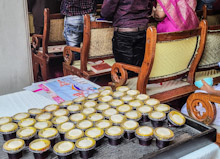
A man nearby asked if we wished to take communion, and then pointed to a table covered with small round plastic containers with lids. Each of these contains a communion wafer fragment and some “communion nectar”, which I imagine represents the blood of Christ.

At St Mark’s, it appears that Holy Communion is self-administered, rather than being handed out by a cleric, as is the case in most churches where I have witnessed Holy Communion. I wondered whether these little pots of Holy Communion ‘ingredients’ are an attempt to reduce the risk of transmitting disease in these times when the covid19 virus is so prevalent.

Still standing but for how much longer?

COMMERCIAL STREET IN Bangalore (Bengaluru) is one of the main arteries of a busy shopping district – a bazaar area – in the centre of the city. It is close to an area occupied by military establishments, descendants of a former British military base, to which Sir Winston Churchill (no friend of India) was attached briefly when he was a young man. Another main road, Kamaraj Road, in the area used to be known as Cavalry Road. And another reminder of the area’s military proximity is Infantry Road that runs into the Commercial Street area.

There is a network of narrow lanes that run through the bazaar district. These are lined with shops of varying sizes, tradesmen, artisans, cafés, and other businesses. Numerous motorcyclists and autorickshaws thread their way through the crowds of pedestrians thronging the streets. I suspect that only a small number of these people notice or are interested in the architecture of the buildings lining these lanes. I am one of that small minority.

Many of the buildings in the bazaar are either modern or post 1947. There are still some earlier edifices still standing. Some are gradually falling to pieces and others are in good condition.

Recently, I was taking pictures of some of the older buildings and their traditional decorative features when a man came up to me and said:
“Very old. Historic buildings. Old, very old.”
How old they are, I do not know, but it is likely that they were already standing when India became independent in 1947. I did not ask the man, who commented on the buildings’ age, exactly when they were built. One of my reasons for not doing so was a consequence of an instance in Junagadh (a city in Gujarat) some years ago. We were looking at an interesting mausoleum in the centre of Junagadh, wondering about its age, when we asked a bystander when it was built. He answered:
“I don’t know. I wasn’t born then.”

The few intact attractive, old buildings in the Commercial Street bazaar area are lovely to behold. Given how many of them have already been replaced, I wonder how much longer those remaining will survive.

An unusual letter box in Bangalore

A FRIEND IN BANGALORE, Mr Aggarwal, alerted me to the existence of an historic pillar box (letter box) in the city’s Bowring Institute. This private club has been located in its current position on St Marks Road since 1888, when it’s elegant clubhouse was constructed.

In front of the main entrance to the clubhouse, there is a hexagonal pillar box, which is still in use. This six-sided box is topped with six sloping triangular panels which meet at the highest point of the letter box.

The box bears a crest or emblem on the side where the slot for posting letters is located. This consists of a lion and a unicorn facing each other. Their forecast rest on a circle contains a cross. The circle is surmounted by a crown with two crosses. There is also a small crown with a cros on the lion’s head.

Below the crest, there is a diamond shaped lozenge containing the letters R, N, C, I (or possibly O). What these letters signified (or whether this was the manufacturer’s name) has not yet been revealed by an Internet search.

It had been suggested to me that the pillar box was a British East India Company (‘EIC’) letter box. This is unlikely to be the case because, from what I have managed to ascertain, the EIC crests included two lions facing each other, but no unicorns. Furthermore, by 1888 India was governed by the British Government rather than the EIC (which was in charge of governing India prior to 1857).

The letter box is believed to be contemporary with the construction of the Bowring clubhouse. In 1888, Queen Victoria was the Empress of India. The post box is therefore likely to have some connection with the British Indian postal service. I have yet to discover whether I am right about this. A quick search of the Internet did not reveal any examples of historic pillar boxes bearing the crest on the box at the Bowring Institute. If anyone knows more about this particular crest, please do inform me.

HAPPY CHRISTMAS

A Modulor in Bangalore

THE BOWRING INSTITUTE is a private members’ social club in central Bangalore (Bengaluru). It was established in 1868, and has been standing on its present site since 1888. The club has recently undergone a tasteful restoration and improvement. The old 19th century buildings can be seen in their full glory, looking as if they have only just been constructed.

One external wall of a club building has been adorned with a huge panel decorated with two Modulors. The Modulor is a symbol created by the great pioneer of 20th century architecture, Le Corbusier. It looks like a man with one arm raised and was designed by Le Corbusier to be “ a visual bridge between two scales: the metric and the imperial…” It was also connected with his philosophy that the proportions of structures should be related to those of the human body.

Le Corbusier had several connections with India. For example, he was intimately involved in the design of the city of Chandigarh and created a few wonderful buildings in Ahmedabad.

That said, I have yet to discover why the Modulor was placed twice on a panel at the Bowring Institute so long after its creator’s death. I would like to think that it is a fitting reminder of the considerable influence that Le Corbusier has had on 20th century Indian architects, including Balkrishna Doshi, whose studio and offices are in Ahmedabad.

If it ain’t broke …

THE KAMAT GROUP has been operating hotels and restaurants for about forty years, if not longer. One of the branches is opposite the Jumma Masjid in the busy Commercial Street district of Bangalore (Bengaluru) in South India. I have visited this eatery many times during the 28 years that I have been making visits to Bangalore.

We usually drop in, or rather ascend the steps to, the seating area of Kamat’s to have a cup of coffee after doing errands in the crowded lanes that form the bustling area through which Commercial Street runs.

The interior of Kamat never changes. It has probably looked as it does today ever since it opened sometime before my fist visit to Bangalore. Its walls are simply decorated with mirrors and polished woodwork. A wooden barrier runs along the midline of the rectangular seating area, which comprises basic tables and chairs.

Despite not having the latest, trendy internal decor, Kamat in Commercial Street attracts many customers. The owners have done nothing noticeable to modernise the place; to make it compete with the many much more glitzy places in the city. Clearly, they understand the maxim ‘if it ain’t broke don’t fix it’