Tagore and the oppression of women in traditional families in Bengal

THE BENGALI POLYMATH Rabindranath Tagore (1861-1941) is modern India’s most important cultural figure. In 1913, he was awarded the Nobel Prize for literature, and in 1915 he was honoured with a knighthood by King George V. Following the massacre at Jallianwala Bagh in 1919, which was instigated by a British military commander, he renounced the knighthood. Five years before this, Tagore, who did not tolerate injustice, wrote “Streer Patra” (‘A Wife’s Letter’), a short story that highlighted and questioned the domination of women by men in 19th and early 20th century families. Kolkata’s leading English language actress and two colleagues have created a play “I am Mrinal”, which is based on Tagore’s short story.

Piali Ray on stage

On the 9th of September 2025, I watched a performance of this play at London’s Nehru Centre. Piali Ray skilfully and convincingly acted all the roles in the play. These were: Mrinal, the wife of the second eldest son in the family; Bindu, an orphaned child, related to one of Mrinal’s in-laws; Mrinal’s brother-in-law’s wife; and Mrinal’s husband. Against everyone except Mrinal’s wishes, Bindu was accepted into the household.  Mrinal’s husband disapproves of Bindu’s presence in the joint family home, but childless Mrinal treasures this young girl’s presence. Mrinal’s husband is keen to evict Bindu, and eventually decides to marry her off to an insane man. In desperation, Bindu sets herself alight, and she dies. Then, Mrinal flees from Kolkata to Puri, where, at the end of the play, she writes a letter to her husband, explaining that she will never return to the domestic bondage that she had to endure for 15 years as his wife. Tagore’s story vividly illustrates the oppression of women in conventional Bengali families, and his feeling that this injustice needed to be combatted. It was written in 1914, the year the First World War commenced. It might not have been “the war to end all wars”, but after it was over, women in many parts of the world began to question their roles in society, and to improve their status.

During Piali’s performance, she switched roles effortlessly, and one was never in doubt as to whom she was portraying at any given moment. Even when she was playing the role of the husband, one forgot that she was not actually a man playing this part. She used a different tone of voice and set of gestures for each of the characters. Throughout the performance, there was music playing in the background. It impressed me that Piali’s movements on stage seemed to harmonize with the music. Her performance was not simply dramatic but also balletic.

It was fascinating watching this play not only because it gave an insight into the oppressive conditions experienced by women in traditional bourgeois Bengali joint families in the early 20th century, but also because it gave me a chance to watch a skilled actress conveying the story so beautifully.

Adam Yamey is the author of “88 Days in India: A Journey of Memory and Discovery” [https://www.amazon.co.uk/dp/B0FKTFBFM2],  and several other books about Indian topics.

A palace that was in Pakistan for less than two days

IN 1904 THE WASIF Manzil, a palace in Murshidabad (West Bengal,  India) was restored after an earthquake had badly damaged it in 1897. The palace was built for Sir Sayyid Wasif Ali Mirza Khan Bahadur (1875-1959), who became Nawab of Murshidabad in 1906. It was designed by a Britisher, Mr Vivian, and  a Bengali engineer, Surendra Barat.  This pleasant building is a mixture of architectural styles and includes some turrets with crenellations.


Visitors can explore the interior of Wasif Manzil, which now contains a museum. The exhibits include several wooden framed mirrors, which were imported from Belgium. There are also some glass topped display cases containing dust covered documents, several of which have obsequious addresses to Queen Victoria and some of her royal successors. By the time that Wasif Ali Mirza was living, Indian royalty was very much at the beck and call of the British rulers of India. It was in their interest to appear to be loyal supporters of the Imperial rulers of India.


On the fifteenth of August 1947, when land was divided between the newly formed Pakistan and independent India (by Cyril Radcliffe who only visited  India for the first tine in 1947), Murshidabad was allotted to Pakistan: it became part of East Pakistan (https://en.m.wikipedia.org/wiki/Murshidabad_district).

Thus, the Wasif Manzil stood on Pakistani territory.  However, less than two days later, there was a territorial land swap: Murshidabad, then in Pakistan, was exchanged for Khulna, then in India. Thus Murshidabad became part of India  and Khulna became part of East Pakistan  (now Bangladesh).


Because of a brief period in the second half of August 1947, the Wasif Manzil was in Pakistan for less than two days.

Mrs Warren Hastings and a diamond dealer in Bengal

AS EARLY AS THE SEVENTEENTH century, the French,  Dutch,  and English set up factories (trading stations) at Cossimbazar, which is beside the Hooghly River in the north part of West Bengal.  It existed before what is now Murshidabad became capital of Bengal. Today, what was once an important trading centre, where European merchants acquired goods to bring from India to Europe, is now no more than a rustic village.


Cossimbazar is home to a small cemetery, the Old English Cemetery, which contains the graves of  about 30 Brits who died between 1730 and  about 1800.  Within this small graveyard, which is maintained by the Archaeological Survey of India,  there is one above the burial place of Mary Hastings and her young daughter Elizabeth. The gravestone has been restored and is legible.


Mary, who died in 1759  (as did her daughter), was the first wife of Warren Hastings (1732-1818). He was a senior British East India Company administrator: the first governor of the Presidency of Fort William (Bengal), the head of the Supreme Council of Bengal, and so the first governor-general of Bengal in 1772–1785. He lived in Cossimbazar for a short time.


While reading about the Old English Cemetery,  I discovered that it contains the grave of a successful Jewish merchant from London: Lyon Prager  (died at Cossimbazar). Born in 1746, he died suddenly in May 1793. In brief, as an article (www.telegraphindia.com/culture/diamonds-and-dust-the-backstory-of-a-forgotten-grave-in-murshidabad/cid/1889965) revealed:

“Prager had come to Calcutta in 1786 on behalf of a London firm of Israel Levin Salomons, an Ashkenazi Jew. Diamonds were just one of the things Salomons traded in his India business; pearls and drugs were others.”

Stones cut in Benares by experts from Gujarat  were sent down the Ganges to merchants and traders at Cossimbazar and other places further down the Hooghly. Most probably when Lyon Prager took ill at Cossimbazar  he was there for undertaking business dealings.


Unlike Mary Hastings’s gravestone, the writing on Prager’s is now illegible. I have seen a photograph of his monument that is surmounted by an obelisk,  which was taken when the grave was still identifiable.  Without knowing that it was Prager’s grave, I  photographed it when we visited the cemetery in January 2025.


When I was researching my book about Jewish migration to South Africa, I learned that the Dutch East India Company did not permit Jewish people to travel to their trading stations in the Cape of Good Hope and elsewhere unless they had converted to Christianity. The presence in India of a Jewish trader, such as Lyon Prager   suggests that in the eighteenth century, Jews were not barred from joining trading expeditions by the British East India Company.

Bankers living on the banks of the Hooghly River in West Bengal

BANKERS ON THE BANKS OF THE HOOGHLY RIVER

JAINISM IS AN ANCIENT Indian religion still practised today. The Jains, members of this religion, believe, amongst many other things, in non-violence towards all members of the animal kingdom, from microbes to elephants. For this reason they are vegetarian and will not eat anything that grows beneath the surface of the soil for fear of killing creatures that might be attached to them. Thus, Jains will avoid eating, for example, onions, carrots, and potatoes.

Recently, I read that Jains do not go in for farming because by tilling the soil there is a risk that creatures living in it might be harmed. For reasons that include this, the Jains tend to be a business and banking community.

In the eighteenth century, some Jain families migrated from arid Rajasthan to fertile Bengal and settled around Murshidabad. It is said that these people helped persuade the rulers of Bengal to move their capital from Dhaka to what is now Murshidabad. Some of these Jains, known as the Sherherwalis, became bankers to the Nawab, and consequently became extremely wealthy.

One of these Sherherwali bankers, Rai Bahadur Budh Sing Dudhoria, constructed a huge mansion, now known as ‘Bari Kothi’, close to the river Hooghly in what is now the small city of Azimganj (near Murshidabad). The huge edifice, which was restored a few years ago, is built around seven courtyards. It is lavishly decorated in a style that would have been familiar to the family when it was enjoying its heyday. Today, it is used as a luxurious ‘heritage’ hotel, which is famed for its Jain food.

When the banker, who lived at Bari Kothi, told the Nawab that he wanted to move away from Murshidabad because he lacked the company of fellow Jains, the ruler allotted land on both sides of the river to the Jain community, and told the banker to invite other Jains to make their homes there. 97 families arrived.

The combined wealth of the 30 or so Sherherwali families who settled in the Azimganj area was so great that it exceeded that of the entire English aristocracy. This was sometime before 1757, when the Nawab Siraj-ud-Daulah was defeated by the British at the Battle of Palashi (Plassey). After that, Bengal’s capital shifted to Kolkata, as did most of the Sherherwalis.

Bari Kothi was badly damaged during the Naxalite disturbances in the 1970s. It was beautifully restored under the supervision of the architect Dr Samar Chandra. We visited the place today (15 January 2025) and were shown around the maze of corridors, rooms, and courtyards. Our guide showed us parts of the building that are still undergoing careful restoration. What has already been restored and is used by hotel guests is superbly done. For those seeking a glorious ‘heritage’ experience, a few days at Bari Kothi will not be disappointing. However, for those hoping for a fried egg at breakfast time, this is most certainly not available.

Defeated by the British who were helped by a traitor

THE MOTIJHEEL PARK in Murshidabad is a popular amusement park with a boating lake, a roller coaster, a restaurant, a miniature railway that carries passengers, and, surprisingly, a small museum.

Siraj-ud-Daulah

The museum is dedicated to Siraj-ud-Daulah (1733-1757), who was the last independent Nawab of Bengal before the territory was conquered by the British East India Company’s army. There is also a statue of Siraj-ud-Daulah in the park.

His forces were defeated at the Battle of Palashi (Plassey) in 1757 by armies led by Robert Clive. Siraj-ud-Daulah lost the battle not least because Clive bribed Mir Jafar, who was Siraj-ud-Daulah’s Commander-in-Chief, to defect to the British. The defeat at Palashi was an important factor in allowing the British to conquer Bengal.

The dimly lit museum at Motijheel Park contains a series of information panels that give the viewer a simplified history of Siraj-ud-Daulah and the Battle of Palashi. Apart from these, there are a few other exhibits of no great significance.

Paintings by artists in India who escaped from western European artistic traditions – at the Brunei Gallery

WHENEVER I VISITED my in-laws in India, I used to admire the painting by the Bengali artist Jamini Roy (1887-1972), which used to hang in their flat. His style of painting was both modern (20th century) and at the same time almost folkloric. When our friend Bob Annibale posted on Facebook about an exhibition at the Brunei Gallery (in London’s Bloomsbury) that included Roy’s works, we could not resist visiting it, and we were glad we viewed it.

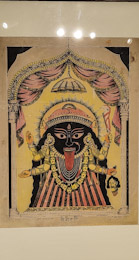
The exhibition, which continues until the 22nd of June 2024, not only contains a good selection of Roy’s works, but also others by Bengali artists working mainly between the late 19th century and the 1950s. Apart from works by Roy’s contemporaries including various members of the Tagore family, Hemendranath Mazumdar, Nandalal Bose, and Qamrul Hassan, there were also paintings by lesser-known or unknown artists who painted in the traditional late 19th century Bengali (Kalighat) style, rather than in experimental styles of the 20th century.

The emergence of modern Indian painting was a consequence of the establishment of The Government College of Art in Calcutta (in 1854). As the website of the Brunei Gallery explained, it was:

“… established by a benevolent government for the purpose of revealing to the Indians the superiority of European art.”

In the late 19th century, Indian artists working in the college began questioning the validity of Indians painting in the alien Western European fashion that was being taught them. The gallery’s website continued:

“Academic art, introduced by the British Raj, was challenged by the nationalist art movement, the Bengal School of painting, led by Abanindranath Tagore (1871-1951) and his disciples who dominated the art scene in the first decades of the twentieth century.”

It is works by these artists, who used their creations as part of their expressions of desire to see India free of British rule, that form the greater part of the show at the Brunei.

Several things particularly interested me whilst viewing the excellently curated and displayed exhibition. One was three paintings by Jamini Roy that illustrate Christian themes (e.g., the Crucifixion, the Last Supper, and the Flight to Egypt). I had not before seen any of Roy’s paintings depicting Christian stories.  Another exciting discovery for me were a selection of paintings by Sunayani Devi (1875-1962), who was the sister of the artists Abanindranath Tagore and Gaganendranath Tagore, some of whose pictures are also hung in the show. These 3 siblings had a famous uncle, Rabindranath Tagore, some of whose paintings were also on show. At the exhibition, there were portraits of Rabindranath Tagore by each of his above-mentioned relatives, and one by Jamini Roy.

Yet another artist on show, whom I had never encountered, is Qamrul Hassan (1921-1988), who was born later than the other artists. Born in Calcutta before independence and the Bangladesh War (1971), he died in what is now Bangladesh. He studied at The Government College of Art in Calcutta in the late 1930s, and afterwards became involved with left wing political activities as well as his art. Later, he was active in the struggle for East Pakistan (now Bangladesh) to become independent of what was then West Pakistan. Beneath one of his creations at the Brunei, there is a quotation by Qamrul about his style of painting:

“… where Jamini Roy ends , I begin …”

And this is so easy to see in the excellent exhibition at the Brunei Gallery

I have told you what stood out for me, but although I have highlighted a few things, the rest of the exhibits are wonderful, and not to be ‘sniffed at’. After seeing the show, I thought that never before had I seen such a fine and large collection of paintings by the liberated artists either here in the UK or in India. The curators of this show deserve hearty congratulations.

Bengali art before it was affected by influences of Europe and the Far East

THE INDUSTRIALIST KASTURBHAI Lalbhai (1894-1980) filled his Ahmedabad home (built 1905) with works of art. One of his relatives had married a member of the famous Tagore family of Calcutta. When the Tagores decided to sell their fabulous collection of Indian art in the 1940s, Lalbhai purchased it and thereby saved it from being sold to buyers who did not live in India. These works are on display in the house, which is now known as the Kasturbhai Lalbhai Museum.

The Museum houses works of Indian art dating from as early as about the 4th century AD to the 1940s. Visitors to the museum are obliged to go on a prebooked informative guided tour through the rooms of the museum. Although a bit of a speedy experience, one leaves having seen an enlightening cross-section of the history of art in India. Photography in the museum is not allowed.

In the special exhibition

In the beautiful grounds of the museum, there is a recently constructed annex, where temporary exhibitions are held. We were treated to a show entitled “The Babu and The Bazaar”. It is a collaboration with the Delhi Art Gallery.

This fascinating exhibition contains a display of images created by Bengali artists, who painted in traditional styles that prevailed before art in Bengal became influenced by British art schools, Western European art, and the art of China and, especially, Japan. These external influences were most famously introduced by figures such as Rabindranath Tagore and his nephews Gagendranath and Abanendranath.

During my visits to India, I have seen plenty of paintings by Bengali artists who incorporated non-Indian artistic styles into their creations, but I cannot remember having seen such a large collection of Bengali paintings and other works in vernacular styles derived more from tradition than from outside influences. Most, but not all, of the artworks depicted Hindu religious subject matter. Many of the paintings were by artists I had never heard of, or were by unidentified painters. The well-labelled exhibits, which were beautifully displayed, were refreshing eye-openers.

One lady with four husbands

ALTHOUGH THERE WERE ALREADY villages on the banks of the River Hooghly where the city of Kolkata (Calcutta) now stands, the Britisher Job Charnock (1630-1693), a man of commerce, is often regarded as the founder of Calcutta. He died there and his remains are interred in a charming mausoleum (1695) of oriental design in the churchyard of Kolkata’s former cathedral, the church of St John.

Job Charnock’s mausoleum

Job does not rest alone in that structure. His companions include the surgeon William Hamilton, who died in 1717. He had cured Ferukseer, the “ King of Indostan”, and beneath his memorial, written in English, there is another written in Persian script. Job’s wife Mary lies next to him. She died in 1700. There is no mention of his other wife, an Indian named Maria. There is also a memorial to Martha Eyles, who died in 1748, having first been married to John Gumley (who died in Dhaka in what is now Bangladesh), and then married Edward Eyles, who was on the council of Calcutta’s Fort William.

Whereas Martha Eyles had had two husbands, Mrs Frances Johnson, whose remains lie in a mausoleum a few feet away from Charnock’s, had a more exciting marital record. Born in 1725, she died in 1812 at the age of 87. Frances had four husbands. First, she married Parry Purple Templer, then after his demise , James Altham. Mr Altham died of smallpox a few days after marrying Frances. Next, she married William Watts, and they produced 4 children. In 1774, after the death of Mr Watts, she married the Reverend William Johnson. He survived until Frances died.

Apart from the above-mentioned graves in the churchyard of St John’s, there are many others that commemorate the deaths of early European inhabitants of Charnock’s Calcutta, and there is also a memorial to those who died in the Black Hole of Calcutta, but more about this at a later date.

A house on the Isle of Wight and a plantation in Sri Lanka: chapter 2

THE PHOTOGRAPHER Julia Margaret Cameron (1815-1879; ‘JMC’) was born in the Garden Reach district of Calcutta (now Kolkata in West Bengal). Her father, James Pattle, was a prosperous English official in the East India Company. JMC and her six sisters, the surviving children of James and Adeline Marie Pattle, had a Bengali ancestor, Thérèse Josephe Blin de Grincourt (1768-1866) She was JMC’s maternal grandmother, a Bengali woman who had married a French man, Ambroise Pierre Antoine de l’Étang (1757-1866, whose presence in Bengal was recorded in “The India Office List 1825” as “De l’Étang, Chevalier Antoine, Knt. St Louis, assist. Stud at Poosa, 1796” (Poosa is in what is now Madhya Pradesh). They married in 1788. At that time, it was not uncommon for European men to have lasting relationships with Indian women. This is well-described in William Dalrymple’s book “White Mughals”. Later, in the 19th century, such interracial liaisons were heavily frowned upon. It was expected that ‘white’ men would only marry ‘white’ women. Incidentally, Thérèse was daughter of a French colonist and his Bengali wife.

As with her sisters, JMC was sent to France to be educated. She remained there from 1818 to 1834, when she returned to India.

Julia Margaret Cameron by James Prinsep

In 1835, suffering from ill-health, JMC travelled to the Cape of Good Hope. This part of what is now South Africa was favoured as a place to convalesce by Europeans based in India. It was in the Cape that JMC met not only the famous astronomer and an inventor of photography Sir John Herschel (1792-1871), but also the man whom JMC would marry in 1838: Charles Hay Cameron (1795-1880). Charles was in the Cape recovering from a malarial illness. A disciple of the philosopher Jeremy Bentham, he was a reformer of law in India and education, who also invested in coffee plantations (in 1848) in Sri Lanka.

Julia and Charles married in Calcutta, where she became a prominent hostess in the city’s British Indian society. During the 1840s, she corresponded regularly with John Herschel about developments in the science and technology of photography. He sent her two dozen calotypes and daguerreotypes, which were the first photographs he had ever set eyes on. The Camerons raised eleven children: five of their own; five orphans (children of relatives); and an Irish girl named Mary Ryan (whom they found begging on Putney Heath).

The entire Cameron family relocated to England in 1845, possibly because their two older children had settled there, and Charles had retired. They settled in Royal Tunbridge Wells in Kent. They became friendly with one of their neighbours, the poet Henry Taylor (1800-1886), who had worked in the Colonial Office under Robert William Hay (1786-1861), who might well have been related to Charles Hay Cameron’s mother. Later, the Camerons moved to East Sheen, which is closer to London than Tunbridge Wells.

It was through Henry Taylor and Julia’s sister Sara (1816-1887), who was married to Henry Thoby Prinsep (1793-1878), an official in the Indian Civil Service, that JMC was introduced to a set of noteworthy Victorian cultural figures. Henry and Sara had returned to England from India in 1835, and were living in (the now demolished) Little Holland House next to the house of the artist Lord Leighton, near Holland Park in west London. Their home became a meeting place for famous artists, as will be described later. It was here that Sara held a salon for pre-Raphaelite artists, poets, and aristocrats with an interest in artistic activities. At Sara’s home, JMC encountered, amongst other worthy cultural figures, the poet Alfred Tennyson (1809-1892).

Tennyson rented Farringford House in Freshwater Bay on the Isle of Wight (‘IOW’) in 1853, and purchased it three years later. In 1860, after a long visit to Tennyson on the IOW, the Camerons bought a property next door to Tennyson’s and named it Dimbola after one of their (then coffee) plantations in Sri Lanka. TO BE CONTINUED

What! Why? Is there no Calcutta on the map?

VINCENZO MARIA CORONELLI (1650-1718) who was most likely born in Venice (Italy) was not only a Franciscan friar but also a cartographer. Recently, I spotted one of his maps hanging in a frame in a friend’s home. It is a beautiful work of art, bearing the title (translated from French): “Maritime route from Brest to Siam and from Siam to Brest”. It was made between 1685 and 1686, based on information provided to Coronelli by six Jesuit priests sent out to the Indies by the King of France. Coronelli, based in The Republic of Venice, drew the map.

I was particularly interested to see what of modern India is represented on the map. On the coast of “Guzararatte ou Cambaje” (i.e. Gujarat or Cambay), the Island of Diu, then a Portuguese settlement, is marked, as are “Surate” (Surat) and “Bombaim” and “Chaul” (also  Portuguese settlements). Further south, Goa is marked, and yet further south along the west coast, we can see Calicut and Cochin. On the east coast of India, we can see “Fort S. Thomé” and “Mahapur”, being old names for a place immediately south of Chennai and Mahabalipuram respectively.

The map becomes more interesting when you look at the “Bouches du Gange” (the mouths of the Ganges). Coronelli draws a complex collection of island’s that depict  the Ganges delta, but where one would expect to find Calcutta (Kolkata) on modern maps, there is only a small inset town plan of a place called “Louvo”. This is not a place in India but in modern Thailand (once known as ‘Siam’): its modern name is Lopburi.

The reason that Calcutta is not marked on Coronelli’s map is simple: the place with that name did not exist when the Jesuit priests reported back to Coronelli. Had they made their survey only a little later, they would have been able to report its existence because in August 1686 Job Charnock (c1630-c1692/3) established a trading post (‘factory’) on the River Hooghly, and that became known as Calcutta.  I have visited his grave and mausoleum in central Kolkata.