THE NEWPORT STREET Gallery near Lambeth Bridge on the south side of the River Thames was founded by the artist Damien Hirst as a place to show items from his extensive collection of contemporary artworks and sometimes his own work to members of the public. Every few months, a different selection of the works in his collection are tastefully exhibited in the gallery. The gallery is housed in converted industrial buildings, described in Newport Street’s website as follows:
“The construction of Newport Street Gallery involved the conversion of three listed buildings, which were purpose-built in 1913 to serve as scenery painting studios for the booming Victorian theatre industry in London’s West End. With the addition of two new buildings, the gallery now spans half the length of the street.”
We visit it regularly, and usually enjoy what is being shown and the way it is displayed.
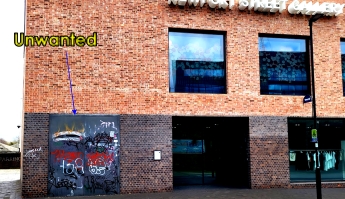
Today (25 March 2026), we visited the gallery again. Before we entered, we noticed two outer doors covered with spray-painted graffiti, and part of the entrance disfigured in the same way. We asked a woman at the reception desk if the graffiti was an artwork sanctioned by the gallery, and were told that it was not. I said that although unwanted, the graffiti was in the spirit of many things that are often exhibited within the gallery. She laughed, clearly understanding what I was getting at.
THE AUCTION HOUSE Christies was founded in London in 1766 by James Christie (1730-1803). Their main premises are on King Street, near St James Palace in the City of Westminster. Usually, the auction house is open to the public, who may enter and view the items waiting to be auctioned, and to watch or participate in an auction. Until 12 March 2026, works from the collection of the Belgian couple Roger and Josette Vanthournout, both now deceased, are up for sale. The sale is being held as a series of auctions over a period that extended from 25 February 2026 until 12 March 2026.
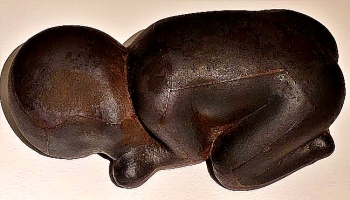
“Iron Baby” by Antony Gormley
The Vanthournout couple have been collecting art for over 60 years. At first, they collected Chinese vases, but soon after that, they began buying modern and contemporary art. Roger trained as an interior designer and ran a furniture store in Izegem, Aurora, which had been founded by his father in 1921. Josette (née T’Kint) was an artist and an art lover. From the 1950s onwards, the couple travelled a great deal, visiting art fairs where they engaged directly with artists, dealers and galleries. They tended to buy much of their art from artists, who had not yet achieved great fame, and by doing so acquired artworks at reasonable prices. And viewing the pieces on display at Christies today (5 March 2026), one can easily see that Roger and Josette both had a ‘good eye’, and bought wisely. After the widowed Josette died in 2025 aged 95, the family decided to sell the collection.
And what a collection it must have been, judging by what we saw on display at Christies. There were fine examples of artworks by, to name BUT A FEW: Josef Albers, Pablo Picasso, Man Ray, Rene Magritte, Henry Moore, Yayoi Kusama, Jean Arp, Lucio Fontana, Jean Dubuffet, Lynn Chadwick, Paul Delvaux, Jacques Lipchitz, Tracey Emin, and James Ensor. I was interested to see a couple of works by Victor Vasarely (1906-1997) because when I lived at home, we had one of his abstract prints hanging on the wall of our living room (I have not seen the print since 1991). There were several sculptures by Antony Gormley. These are quite unlike any of the many works I have seen by this artist. Josette and Roger were lucky to have these examples of his work.
The collection we saw at Christies was well-displayed and filled with an amazing array of art created in the twentieth and twenty-first centuries. Once they have been auctioned, many of the bought by private collectors and galleries far away from London, it will be a very long time, if ever, before they can be seen again by the London public.
Because it is possible to see works of art that are not usually on public display, visiting Christies (and other auction houses) allows ‘the man (or woman) in the street’ to catch a glimpse of artists’ creations that are frequently not usually accessible except by their owners. And even if you have no intention of making a bid, the staff at Christies are most welcoming and willing to answer any questions you might have regarding the items awaiting auction.
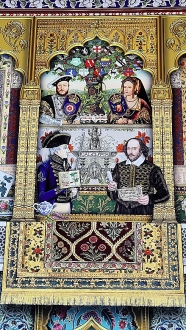
THE SINGH TWINS, Amrit Singh and her sister Rabindra Kaur Sing, were born in Richmond (Surrey), and brought up in Birkenhead (Cheshire). Between the mid-1980s and early ‘90s, they studied art at University College Chester, then at Manchester University. These highly creative women produce works that incorporate features of Indian traditional art, mediaeval illuminated manuscripts, contemporary western culture, and pop art, often all combined in one work.
The exhibition at Kew Gardens, “THE SINGH TWINS: Botanical Tales and Seeds of Empire”, which is showing until 12 April 2026, is filled with great examples of their artwork. Their highly decorative, colourful works are rich in interesting details, rather in the way that Italian renaissance paintings were enriched with symbols and features that would have meant a great deal to those viewing them when they were first paintings, and to art historians many centuries later. The many details in the pictures at Kew evoke many thoughts in the minds of people seeing them today, and remind the audience of events that happened not too long ago when Britain had a vast empire and Britannia ruled the waves, and much of the world’s commercial activity.
Each of the pictures on display at Kew contains plenty of witty and often chilling reminders of what the British (and other Europeans) did to the lands they colonised and exploited. Though filled with imagery relating to Britain’s imperial past and its consequences both abroad and in modern Britain, the pictures are glorious to see. A video, with a commentary written in verse and narrated by the twins, accompanies the exhibition. If the pictures alone do not convey the artists’ messages to all viewers, watching the film is very helpful. In keeping with where they are being exhibited, this collection of the twin’s work focusses not only on colonial histories but also on the plants that helped the colonisers enrich themselves.
The exhibition can only be visited if you have paid for entry to Kew Gardens or if you are a member. After seeing the exhibition you can wander around the gardens and spot some of the many plants that were originally brought from different parts of the empire to grow in the botanical gardens.
WE VISITED BANGALORE’S Chitrakala Parishath, an art school, on the last day of an exhibition called “Hidden Gems of the Western Ghats”. We were alerted to it by a good friend, Ajay Ghatage, who posted something about it on Facebook.
The Western Ghats are a line of hills and mountains that separate the Deccan Plateau from the western coastal strip of India, the shore of the Arabian Sea. The ghats are in the most part forested.
The exhibition included sculptures, many of them beautiful stone carvings, paintings, and a few ‘installations’. Each work expresses its creator’s reaction to the nature and its exploitation (and/or despoliation) by mankind. And the majority of the artworks on display did this well, beautifully, and often highly imaginatively.
Amongst the installations, there was one by Shivanand Shyagoti that particularly attracted my attention. It consisted of a tree trunk into which hatchets had been stuck. On the wooden handles of each of these choppers, there were line drawings of the woodland creatures whose habitat would be disturbed by deforestation.
The other works on display were at least as imaginative as the one described above. What was impressive about the majority of the artworks was that although they often conveyed messages about the fragility of the natural environments of the Western Ghats, they did it subtly, creatively, and, most importantly, beautifully.
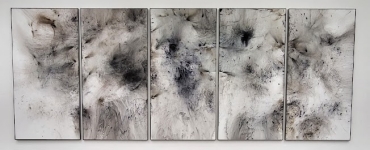
CAI GUO-QIANG IS an artist who was born in Quanzhou, Fujian Province, China, in 1957. Many of his artworks involve the extravagant and clever use of explosive materials, as can be seen in a documentary film being screened at the White Cube Gallery in Bermondsey (south London) until 9 September 2025. The film is accompanied by a collection of the artist’s images created on canvas, glass, and mirrors. Pleasing to the eye, these images have been created by an unusual method.
Guo-Qiang uses gunpowder, and ignites it, to assist him produce his pictures. The gallery’s website outlined his technique:
“… each composition is first mapped by sprinkling the powder, then covered and weighted before ignition, so that the blast disperses, recomposes and fuses matter into image.”
The unpredictability of the explosive material adds an interesting chance element to the finished product, but despite this, the composition was initially planned by the artist. In some of the works on display, not only was gunpowder placed on the base (i.e., paper, glass, etc) but also pigment powders. The explosions caused by igniting the gunpowder cause interesting spreading and scattering of the pigment.
The artist began experimenting with using explosives in his works on materials such as canvas and paper in the early 1980s in Quanzhou. Occasionally, the work in progress would ignite, and the fire had to be smothered to save the artwork. The works on display at White Cube were created after 2015, mainly in the 2020s. By now, he has refined his technique so that wholescale conflagration does not happen. However, as a gallery assistant told us, if you look carefully at some of the works, small burn marks can be found here and there.
Apart from being created in an intriguing way, I found the pictures being displayed in the gallery to be both attractive and beautiful.
ARTSPACE 5-7 IS A small gallery housed in a pre-WW2 Modernist building in Portugal Place, a side street that leads away from Bridge Street in the university town of Cambridge. We visited the gallery in August 2025, and viewed a collection of sculptures and drawings by the London born artist Richard Bray (born 1955). A few years after being awarded a degree in Photographic Arts at the Central London Polytechnic, he was awarded a degree in Fine Art at Norwich School of Art and Design. His exhibition at Cambridge is called “Visible Invisible”.
Whereas kinetic art depends on its movement for effect, Bray’s finely crafted sculptures and prints are static. However, as the viewer moves around his artworks, viewing them from different perspectives, what can be seen changes. Bray’s works seem to acquire internal movement that can only be perceived when the viewer moves past or around them. These effects, which add great beauty to his works, cannot be captured using still photography. Three of the sculptures were on display in the churchyard of St Clements opposite the gallery
Bray spent time in Tanzania during the 1980s. What he must have seen in the way of local design and crafts has clearly influenced the appearance of the works we saw in Cambridge. In fact, when I first entered the exhibition, I saw what I mistakenly thought was a collection of sculptures from Africa.
The gallery because of its Modernist design is worth seeking out when you visit Cambridge. The exhibition of Bray’s works, about which we knew nothing in advance, were refreshingly exciting to see.
THE ARTIST ANSELM Kiefer is said to have remarked:
“I think there is no innocent landscape, that doesn’t exist.”
By Nomoru Minata
For what we see when we regard a landscape is the result of millions of years of geological and meteorological evolution as well many millennia of interventions by biological phenomena including human activities: both constructive and destructive. As the writer and academic Robert Macfarlane wrote:
“We live on a restless crust of earth. Behind the façade of stability, everything is shifting, imperceptibly, but continuously.”
Artists have been creating images of landscape for many centuries. The earliest known depictions of landscape include Minoan frescoes created in about 1500 BC. The genre of European art called ‘landscape painting’ began in Holland in the seventeenth century. The website of the White Cube Gallery in Bermondsey noted in connection with this:
“17th-century Dutch artists of the Golden Age, during which the genre ‘landschap’ was first named, turned away from religious subjects as an expression of Protestant values …”
Until 7 September 2025, the White Cube at Bermondsey is hosting an exhibition called “Alien Shores”. Curated by Susanna Greeves, this show:
“… explores landscape as a place of memory, imagination, yearning and belonging. Through painting, video, photography and sculpture, the artists included offer speculative, symbolic or surreal depictions of emotional terrain and voyages of the imagination, visions of the distant past or possible futures.”
The exhibition includes works by 37 artists, all of whom worked in the twentieth and/or twenty-first centuries. It is a display of modern and contemporary works of art that either depict landscapes or try to evoke thoughts of landscapes. The works are distributed amongst three rooms. In the first two rooms there are videos and kinetic sculptures as well as paintings. A video by Noémie Goudal is particularly fascinating and dramatic. The third and largest room contains a mixed bag of paintings and a sculpture by Noguchi. My enjoyment of the paintings in this room was not 100%. Some of the paintings looked like wall space fillers rather than great works of art. However, it his is not a room to be missed because it contains three outstanding landscapes by Anselm Kiefer. Seeing these in the company of many of the others served to emphasize (to me) what a great contemporary artist he is. Other ‘stars’ in this room were paintings by Minoru Nomata, Georgia O’Keeffe and Marina Rheingantz. A three-dimensional screen depicting a leafless forest by Eva Jospin in the long corridor of the White Cube also impressed me.
Although I wondered why a few of the artworks were included in the show, the Alien Shores exhibition has much to recommend it. It was fascinating to see how in a time frame of well under 100 years, artists have been tackling their various portrayals of landscape, and the interesting varieties of ways they have done it.
THE CHEMOULD ART Gallery was founded in Bombay (Mumbai) in 1963, and ever since then it has been an important player in India’s modern art world. Until 8 June 2025, it is holding a temporary exhibition at London’s Frieze at number 9 Cork Street. The exhibition is of works by Rashid Rana (born 1968).
Rana was born in Lahore (Pakistan), where he is currently the Dean of the School of Visual Arts and Design at BNU (Lahore). Apart from being an artist, he is also a curator and an educator. He is considered to be one of Pakistan’s most innovative artists.
The exhibition in Cork Street includes 4 intriguing images. Each one consists of a mosaic of thousands of tiny photographic images, each one not much larger than a passport photograph. The photographs are not arranged randomly and subjects in neighbouring photographs seem to be unrelated to each other. They are put together in ways that when seen from a distance, form either large objects or abstract patterns. The resulting images are both fascinating and unusual.
Rana has exhibited in many parts of the world. These places are listed on the gallery’s handout and on the artist’s website. However, as far as I can determine, India is not one of these places. I wondered whether this related to the fact that an Indian gallery is displaying his works not in India but in London.
FROM AFAR IT LOOKS like a small red and black oriental rug, but as you approach, it is not what it seemed at first sight. This artwork by Hadi Rahnaward, who was born in Afghanistan in 1986 and now resides in Belgium, is made with matches, glue, and other materials. The matches used are of two sorts. Some are tipped with black material, and the others with red.
The matches have been glued to a base so that each one of them is vertical and standing with its tip pointing upwards. They have been placed close to each other in such a way that their tips form a mosaic resembling a patterned oriental carpet or rug. The artist made this incredibly intricate creation in 2023. It is one of a collection of often intriguing artworks by young artists from south Asia and Afghanistan being exhibited at the SOAS Gallery (formerly known as the ‘Brunei Gallery’) in London’s Bloomsbury until 21 June 2025.
One of the other exhibits that intrigued me is an embroidery by Varunika Saraf (born 1981), who lives and works in Hyderabad (India). Called “The Longest Revolution” and made in 2024, this embroidery depicts many features of Indian women’s struggle for basic rights and parity with men. This busy looking artwork depicts many aspects of women’s political struggles, and in places reminds the viewer of some parts of the Indian Constitution that appear to have been considered less relevant than previously by some in India during the last few years. Even if the political content of this piece is ignored, it is an eye-catching work of art.
THE SHIRLEY SHERWOOD Gallery of Botanical Art is a relatively new addition to the buildings dotted around London’s Kew Gardens. It is an attractive clean lined contemporary edifice containing several interconnected exhibition spaces of varying sizes. Until 23 March 2025, it is housing an exhibition of mostly enormous ceramic objects, which were created by Felicity Aylieef, Professor of ceramics and glass and research at the Royal College of Art, London.
The enormous ceramic objects, which look like grossly magnified jars and vases, were handmade by craftsmen in China, whose names were not prominently displayed (if at all) in the exhibition. Ms Aylieff has painted attractive designs on the vessels using blue paint containing cobalt oxide. The painted ceramic objects are then placed back into enormous kilns, and fired once again to fix the painted designs and to glaze them. Undoubtedly, what she creates is impressive, but maybe pointless. However, the art historian John-Paul clarifies things a bit:
“These are objects to be encountered physically, peered at anear, admired from afar. They may derive from utilitarian vessels, but as objects they are architectural, sculptural even, in their forms. Painterly, we might also say, for the manner in which their surfaces are articulated with glazes”. (Quoted from a label at the show).
I enjoyed seeing these gigantic ceramic objects, but kept wondering whether the great effort (especially physical) to make them was worthwhile.




 yamey
yamey 