Numbered pebbles to remember the dead in Folkestone

ON THE FIRST of July 1916, 19 thousand two hundred and forty British soldiers were killed during the first day of the Battle of the Somme. A memorial on the Leas Cliff promenade in Folkestone, Kent, remembers them, not by name but by number.

In 2008, the artist Mark Wallinger created an artwork called “Folk Stones”, which can be viewed at Leas Cliff. It consists of a square area containing 19,240 pebbles. Each one represents one of the victims killed on that first day of battle in 1916. Just as each of the soldiers had his own service number, the artist has numbered each of the stones in his artwork.

It is a simple creation, but one that is very moving.

Order and chaos portrayed in South London’s Peckham

THE ARTIST LEONARDO Drew was born in 1961 at Tallahassee, Florida (USA), and now works in Brooklyn (New York City). Until 7 September 2025, an entire, large room at the South London Gallery in Peckham is occupied by a work by Drew, which has the name “Ubiquity II”.

At first sight, the viewer is confronted by what looks like the chaotic result of a big explosion. The room is filled with fragments of wood, some of which is piled in heaps leaning against the walls, and the rest scattered on the floor, on which visitors tread. On closer examination, it can be seen that there are fragments of mirrors amongst the debris, and almost every piece of wood has paint or some other modification on it.

Despite looking like disorganised chaos, it is not. The artist carefully selected each of the fragments, modified them (often with paint), and then carefully arranged them to produce what the viewer sees. He has created the depiction of chaos and destruction in a most careful orderly way. As the gallery’s website put it, Drew:

“… creates reflective abstract pieces that play on the tension between order and chaos. Transforming and eroding materials by hand in the studio, he explores the cyclical nature of life and decay.”

And given what is happening in the world today, this powerful depiction of order and chaos is particularly relevant.

A British artist inspired by paintings in Venice

THERE IS SOMETHING SPECIAL about the quality of ambient light in Venice (Italy). It enhances the attractiveness of the many beautiful buildings that the city contains. Maybe the special nature of the light is because it both shines on Venice and then gets reflected back by the water that both surrounds and flows through the city. Whatever the explanation might be, Venice’s natural lighting conditions have attracted, and continue to attract, artists from all over the world. One of these is the British painter David Price (born 1970), who has made many trips to Venice, and is currently exhibiting his paintings influenced by these visits at the Frestonian Gallery (in London W11 4BE) until 17 April 2025.

David has written (quoted from the Frestonian’s website):

“For as long as I can remember I have drawn from paintings. As a child, my only access to art was through the few books that my parent’s kept, some of which had tiny black and white reproductions within them. These books were my first art teachers and I drew from the Rembrandts and Poussins and Titians inside … All of my life I have made drawings in galleries and from books and these sketches have informed and inspired my practice for over 40 years.”

The paintings on display at the gallery were largely inspired by seeing late Renaissance paintings in various locations in Venice including the Scuola Grande di San Rocco, the Accademia Gallery, the Church of Madonna del’Orto, and other churches in the city. At first sight, the connection between David’s exuberantly coloured and beautifully executed paintings and the great works he saw that inspired him are not immediately obvious. Someone well-trained in the art of the late Renaissance might after a while discern something that reminded him or her of the original old masters. However, no knowledge of the history of art is necessary to gain enjoyment from David’s creations. The paintings are neither copies nor parodies of the old originals, but express the artist’s reactions to them.

What struck me as I viewed the paintings is that many of them capture both the quality of the light in Venice as well as well as the city’s rich tradition of carnival and other similar spectacular events. Whether or not this was one of the artist’s intentions. I have no idea, but seeing his works evoked memories of a city that I have visited many times during the last seven decades.

Although the Frestonian is a little way off the main London commercial galleries’ ‘beaten track’, it is well worth visiting. Housed near Shepherds Bush roundabout in what is the only survivor of the short-lived Republic of Frestonia (see: www.linkedin.com/pulse/frestonia-londons-independent-republic-exhibition-adam-yamey/), the gallery hosts a regular series of well-curated temporary exhibitions.

From sewer to seating on the streets of London

THE VICTORIA EMBANKMENT was constructed along the River Thames in the 1860s. It was built to enclose a newly constructed sewer: the Main Low Level Sewer, which was part of the grand sewage system improvement project designed by Sir Joseph William Bazalgette (1819-1891). The wall of the embankment facing the river was constructed from large brick-shaped, carved granite stones, each weighing about 1 tonne. Several of these have had to be removed to construct a new sewage conduit – the Thames Tideway Tunnel.

58 of the granite stones have been repurposed to become a series of open-air public art installations. This series was created by Matthew Barnett Howland, Oliver Wilton, and CSK Architects. Small groups of these have been placed in seven locations: St Peter’s Hill, Carter Lane Gardens, St Paul’s Cathedral, Christchurch Greyfriars Church Garden, King Edward St, Little Britain and Smithfield Rotunda. Today, the 31st of July 2024, we came across the group placed in Little Britain, which is not far from Barbican Underground Station. What we saw were 3 of the huge locks of granite arranged in a straight line. A gentleman was using one of them as a bench while he looked at his mobile telephone. Next to them, a wooden sign explained what is going on. This was useful because if there had been no sign next to them, we might not have given them a moment’s notice.

You might well be wondering why this series of stones were placed at seven places in London. I will leave it to someone else to explain:

“The idea behind the project is to stimulate discussion about reuse, material lifespan and cultural heritage, at a time when we can make a significant contribution to a more sustainable built environment.” (www.cityoflondon.gov.uk/services/streets/from-the-thames-to-eternity-installation)

I wonder what Bazalgette would have thought of this.

Art of heros

GEORGE FREDERIC WATTS (1807-1904) was a prolific, highly acclaimed Victorian artist. Visitors to London’s Kensington Gardens can easily admire one of his works, a sculpture called “Physical Energy”. Standing across the Serpentine from a sculpture by Henry Moore, Watts’s sculpture is a bronze casting of a version of it that was sent to South Africa as part of a memorial to Cecil Rhodes. One of Watts’s less prominent works, and quite a curious one, can be seen in Postman’s Park, which is a few yards north of St Pauls Cathedral in the City of London. It is the Memorial to Heroic Self-Sacrifice.

The memorial consists of a wall covered with rectangular plaques, made with ceramic tiles commemorating heroic deeds carried out by ordinary people. For example, one bears the words:
“Frederick Alfred Croft. Inspector aged 31. Saved a lunatic woman from suicide at Woolwich Arsenal Station but was himself run over by a train. Jan 11, 1878”.
And many other examples of great bravery by civilians are recorded on the wall, which is protected by a canopy with a decorative fringe.

By Susan Hiller

The artist Susan Hiller (1940-2019) was born in Florida (USA) and died in London. Apparently, she was surprised by how few people noticed the memorial in Postman’s Park, let alone read the tragic plaques. I am one of the few, who have done so. So, as soon as I got near to an artwork displayed in a temporary exhibition in the Tate Britain art gallery, I knew it was based on the plaques in Postman’s Park. The piece consists of 41 photographs of plaques on the Memorial, which have been arranged on a wall by Susan Hiller. In the centre of this artistic array that she has called “Monument 1980-1”, she has placed a plaque which consists of a stretch of tiling on which the words “Strive to be your own hero” have been crudely written with black paint.

Susan Hiller’s interesting version of GF Watts’s Memorial is one of several intriguing exhibits in an exhibition called “Material as Message”, which was still being installed when we visited it in March 2023. There is yet one more exhibit to be unveiled. Hiller’s exhibit interested me because I am familiar with Postman’s Park, but the other exhibits were equally fascinating both visually and conceptually.

The World under pressure

DURING A RECENT VISIT to the Wellcome Collection in London’s Euston Road, I saw some artworks that both captured my imagination and were aesthetically pleasing. It was an exhibit by the Moroccan artist Batoul S’Himi (born 1974). Her work in the Wellcome Collection, THE WORLD UNDER PRESSURE, consists of two gas cylinders like those that are used in kitchens around the world, and a commonly used cooking utensil – a pressure cooker. Each of the three objects is empty, and each of them have bits shaped like the map of the continents of the world carefully cut out of them.

According to the label beside the exhibit:
“Common yet dangerous objects in Moroccan kitchens, these gas cylinders and pressure cooker are carved with a map of the world. Here, global anxiety intrudes into the home. The artist’s use of domestic objects hints at the unequal burden of climate breakdown, hitting vulnerable people hardest, including women and children. But perhaps there is also hope, as families start to recognise their global impact.”
This is what the artist is portraying, but I believe that along with its title, the artwork, which uses containers designed to withstand high pressures, is a great visual metaphor for the myriad of pressures the world faces today. Simple though it is, Ms S’Himi’s work is highly effective and beautifully concise in its messaging.

A pavilion for Ramadan

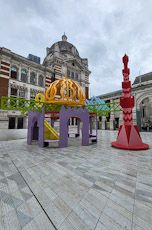
IN 2023 RAMADAN WILL occur between about the 22nd of March and the 21st of April. To celebrate this holy Islamic month, a colourful pavilion has been erected in the courtyard of the Exhibition Road entrance to the Victoria and Albert (‘V&A’) museum. It has been designed by Shahed Saleem and set up by The Ramadan Tent Project and the V&A. According to the museum’s webpage (www.vam.ac.uk/event/ok1kLZm29xJ/ramadan-pavilion-march-may-2023), the pavilion:
“…draws inspiration from the V&A’s Prints and Drawings collection to represent the history of the mosque and Muslims in Britain.”

Another webpage (https://www.vam.ac.uk/blog/museum-life/the-ramadan-pavilion-by-shahed-saleem) contains some interesting information about the history of Islamic edifices in the UK. The first mosque in Britain was built in 1889 in Liverpool by 20 British converts to Islam. It was housed in a Georgian terraced house. Since the arrival of many Muslim migrants in the UK im the 1950s and ‘60s, there is now a sizeable Muslim population in the country, and they worship in Britain’s approximately 1800 mosques. The earliest of these were in converted buildings, but now there are plenty of purpose-built mosques. Of these, one of the most beautiful and original is the mosque in Mill Road, Cambridge.

Shahed Saleem is an architect who specialises in designing mosques. Apparently, his pavilion at the V&A is the result of years spent studying mosques in Britain. With his Ramadan Pavilion, Saleem hopes that it will encourage people, who have never entered mosques, to explore mosque architecture and encourage them to enter these holy places to discover more about them. Well, that is an admirable aim, but from what I have seen of the pavilion, it is unlikely to fulfil that aim.

Undoubtedly, Saleem’s pavilion incorporates elements of mosque architecture and design. Sadly, it looks to me more like a children’s play area than a homage to Islamic architecture. I love Islamic architecture, but feel that the multi-coloured pavilion, which resembles something made with over-sized Lego bricks, does not respect the great beauty, delicacy, and intricateness that can be found in mosques both old and modern.

Faces of India for Queen Victoria

THE CORRIDORS LEADING to the spectacular Durbar Room in Osborne House on the Isle of Wight are lined with portraits of people born in pre-independence India, either painted or photographed during the 19th century. Most of these images depict members of the Indian aristocracy (e.g., rulers of Princely States). A few depict less exalted persons, such as craftsmen and the designer of the Durbar Room.

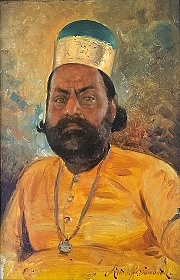
Maharajah Duleep Singh (1838-1893), who surrendered the Koh-i-Noor diamond to Queen Victoria, is portrayed in a few pictures, notably one by the famous German artist Franz Xaver Winterhalter (1805-1873). Many other paintings were created by the Austrian painter Rudolf Swoboda (1859-1914). Queen Victoria liked his painting style and commissioned him to create more than 40 portraits of Indian people. In 1886, the queen paid for him to travel to India, and gave him £300 in travelling expenses. Her instructions to the young artist were:

“The Sketches Her Majesty wishes to have – are of the various types of the different nationalities. They should consist of heads of the same size as those already done for The Queen, and also small full lengths, as well as sketches of landscapes, buildings, and other scenes. Her Majesty does not want any large pictures done at first, but thinks that perhaps you could bring away material for making them should they eventually be wished for.” (www.rct.uk/collection/403755/gulzar).

Many of these can be seen hanging in Osborne House. Amongst his many Indian portraits, there is at least one painted not in India but in England. Queen Victoria had several servants, who were born in British India and the Princely States associated with it. The best known of these ‘imported’ servants was her favourite Mohammed Abdul Karim (1863-1909), her ‘munshi’ (teacher), who helped her study Hindustani, which she learned to write competently in the Urdu script. Amongst Swoboda’s paintings of Indians hanging in Osborne House, there is one of a non-Indian, a lady from Cyprus, and another, a Cape Malay woman from  Cape Town (South Africa). Why they are there, I have not yet found out, but maybe Swoboda spotted them at the Colonial Exhibition held in London in 1886.

Not all the portraits of Indians are painted. Some of them are hand-coloured photographs. A few of these photos are signed by their creators, one of which was the photographic studio of Gobind Ram and Oodey Ram in Jaipur. Along with a studio in Calcutta the Ram brothers were pioneers in photography in 19th century India. One source (www.indiatoday.in/lifestyle/whats-hot/story/tryst-with-colonial-india-205124-2014-08-22) stated:

“Apparently, studio photography was practised by many Maharajas as a means of leisure, mostly using their courtesans as subjects. The Ravi Varma Studios of Calcutta and Gobind Ram-Oodey Ram Studio in Jaipur are just two examples.”

As can be seen at Osborne, these photographers also made portraits of the maharajahs and their families.

Although Queen Victoria loved Osborne House, I cannot see its appeal apart from the wonderful Durbar Room. For me, seeing this lavishly decorated hall and the collection portraits of the Indian people are the main delights of this otherwise rather gloomy residence.

Me Here Now

UNTIL RECENTLY, LONDON Bridge railway station, overshadowed by the glass-clad Shard skyscraper, was not visually appealing. It was a place that you lingered no longer than necessary either whilst waiting for a train or having just disembarked.

Today, the station has been transformed into a place where you might want to linger and explore. It has been cleaned up and tastefully remodelled. The station and the tracks leading from it have always been above ground, supported by innumerable brickwork arches. A few years ago before the improvement works were carried out, many of these archways led to passages beneath the station, most of them dark and unwelcoming.

One of these was the Stainer Street Walkway that links St Thomas Street and Tooley Street and passes through the station’s foyer from which stairways lead up to platforms. This wide passageway lined with ochre coloured brickwork is now well-lit and apart from being a bit chilly, quite pleasant. But look up, and you will see three enormous, reflective, decorative umbrellas suspended from the ceiling. Each umbrella is decorated with geometric symbols and lettering. The lettering forms sets of words that are supposed to be meaningful for those who bother to read them.

Together, these umbrellas comprise an artwork, “.Me. Here. Now” by Mark Titchner , which were put in place in mid-2019. With the decrease in passenger numbers since the start of the covid19 pandemic, this lovely set of artefacts have been seen by far fewer people than were anticipated by the commissioners of this creation, Network Rail.