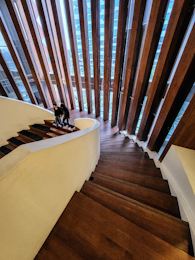
THE KOLKATA CENTRE for Creativity (‘KCC’) was established by the businessman Radhe Shyam Agarwal, executive chairman of the Emami Group. He commissioned architect Pinakin Patel to build the arts centre that stands in Kolkata’s Anandapur district. Inaugurated in late 2018, it has 70,000 square feet of floor space for art, artists, and art lovers. This includes an auditorium, gallery spaces, an elegant café, shops, a dance studio, and a library.
The building is a superb example of contemporary architectural design, both externally and internally. Inside, it is spacious and well-lit. The building, which serves its various purposes well, is in itself a work of art: a functional sculpture, one might say. We attended the inauguration of an exhibition, which was held in the auditorium, which forms part of the gallery space. I will describe the exhibition in another piece, but suffice it to say, the KCC, although distant from central Kolkata, is worth visiting.
BANGALORE IS A CITY which changes rapidly. Sadly, much of the change involves the demolition of buildings of historical interest – so-called ‘heritage’ structures.
So, it is wonderful to come across residences (bungalows) that have been standing for many years. Some of these bungalows appear neglected and will most likely be demolished soon to make way for architecturally indistinguishable office blocks and blocks of flats. Others are still being used as homes and can be seen in varying conditions of repair. And, fortunately, some have been beautifully restored and are either being used as dwellings or for a new purpose.
2 Berlie Street
One of the restored bungalows is number 2 Berlie Street in Langford Town. It is now being used as an art space (for exhibitions) by an organisation called Kaash. We visited it today (22nd November 2024) to view a temporary exhibition about contemporary designs of devotional objects, mainly diyas (oil lamps used on Hindu ceremonies) and also some almost abstract depictions of Devi created by Jayshree Poddar. The artworks were tastefully displayed in some of the rooms in the Bungalow. The other rooms contained folk art from various countries in Africa.
It would be great if most of the remaining heritage bungalows could be preserved, but this is unlikely because the land on which they stand can be sold for enormous sums of money.
All of the photos are of Kaash in Berlie Street unless otherwise labelled.
LIVING NEAR BUSY railway lines can be a noisy experience. The American-born architect Neave Brown (1929-2018), who worked for the London Borough of Camden, understood this when he designed a housing estate that is situated beside a curve of the railway between Kilburn High Road and South Hampstead stations. Six parallel tracks carry trains regulatly past this site. So, living alongside these tracks could be far from peaceful.
Side of the block facing the railway tracks
Neave Brown designed a public housing estate next to this curve. Called the Alexandra and Ainsworth estate, it was designed in the Brutalist style of architecture, but in such a way that the buildings themselves muffle the sounds coming from the railway tracks. How he did this is well explained in a Wikipedia article:
“The higher, eight-story block directly adjacent to the railway line is organised in the form of a ziggurat, and acts as a noise barrier that blocks the noise of the trains from reaching the interior portion of the site, and its foundations rest on rubber pads that eliminate vibration.”
This step-like construction is both impressive and sculptural. Far from being inhuman as many Brutalist constructions can be, the estate, which is rich in vegetation, looks like a pleasant place to live. This contrasts with the pairs of tower blocks that stand on the other side of the tracks. As one of its residents, the architect Lefkos Kyriacou wrote (http://alexandraandainsworth.org/history/):
“… Alexandra Road still retains its cinematic wonder but having suffered the problems that have blighted much of Britain’s post-war social housing it is emerging from the shadows, not only as a valuable part of our national heritage but as a viable example of how mass housing can succeed.”
What is more, and this is a measure of its success, I have read that Neave Brown’s estate has suffered far less from vandalism than almost all of Camden’s other residential estates.
DURING MY TEENAGE years, I had the idea that later I might train to become an architect. I enjoyed drawing, and read books about twentieth century architects such as Frank Lloyd Wright, Mies van der Rohe, Walter Gropius, and Le Corbusier. When the Bauhaus exhibition was held at the Royal Academy in London (September to October 1968), I visited it three times. My enthusiasm for becoming an architect ended after lunch one day when walking from the Highgate School dining hall back to the classrooms. Suddenly, I thought that instead of designing great buildings such as those created by the architects, whom I had read about, I might end up designing extensions and garages for people’s houses. This fleeting thought made me give up the idea of becoming an architect. However, since then, I have continued to enjoy looking at, and reading about, architecture.
One of the 20th century architects who intrigues me much is Le Corbusier. I have seen many of his creations in France and a few in the Indian city of Ahmedabad. But I have never been to Chandigarh in the Punjab. It was to be the new capital of the Indian Punjab. The old capital, Lahore, found itself in Pakistan after 1947. This was a new city that Le Corbusier helped to design in the 1950s – both the layout and many of its buildings. Last year, I acquired a copy of a magazine called “Times of India Annual”. I have the 1955 edition. Although much of Chandigarh was already built by 1955, it was far from completed. The magazine contains an illustrated article by the British Modernist architect Edwin Maxwell Fry (1899-1987).
The article is illustrated with photographs that show both the novel designs employed for residences as well as some of the larger buildings including the Punjab Engineering College, the High Court, and a school. Several of Le Corbusier’s major projects such as the Palace of Assembly and his Open Hand Monument are not illustrated because they had not been completed by 1955. The Secretariat Building designed by Le Corbusier was complete when the article was published, but has not been included amongst its illustrations. The pictures tend to concentrate on the designs for dwellings that were economical without seeming mechanical or inhuman.
Having a great interest in Le Corbusier and Chandigarh, I was excited to find an article written by Fry, one of the city’s planners, at a time when the place was still in its infancy. For three years, he and his wife Jane Drew (1911-1996) worked with Le Corbusier on the planning of Chandigarh. Knowing that, I thought it would be interesting to see what Fry wrote in the magazine. Sadly, Fry’s article’s content is rather anodyne and self-congratulatory. Nevertheless, I am pleased that I have the magazine because apart from Fry’s article, it contains a wealth of other material – both written and illustrative.
UNTIL THE 22nd OF SEPTEMBER 2024, the Victoria and Albert Museum in London’s South Kensington is hosting an exhibition called “Tropical Modernism: Architecture and Independence”. It focuses on two countries: Ghana and India. It was the exhibits relating to India that interested me most, although those connected with Ghana were also intriguing.
The Royal Institute of British Architects describes Modernism as follows:
“Rejecting ornament and embracing minimalism, Modernism became the single most important new style or philosophy of architecture and design of the 20th century. It was associated with an analytical approach to the function of buildings, a strictly rational use of (often new) materials, structural innovation and the elimination of ornament.” (www.architecture.com/explore-architecture/modernism).
Modernism began both in the USA and Europe in the 1920s and 1930s. Its better-known pioneering exponents include Le Corbusier, Mies van der Rohe, Walter Gropius, Maxwell Fry, Louis Kahn, and Eero Saarinen. The Modernist architects, like the abstract painters of the early 20th century, broke with traditional approaches to form and style.
On the 15th of August 1947, India became independent. The country was no longer ruled by foreigners. Jawaharlal Nehru (1889-1964) became India’s first Prime Minister, a position he retained until his death. His vision for India was for it to shake off the shackles of the past (both colonial and traditional) to become a modern state. This extended to architecture in his new India. He invited Modernist architects including Le Corbusier and his cousin Perre Jeanneret to design a new city in the Punjab (following the loss of Lahore to Pakistan): Chandigarh. This is illustrated well in the V&A exhibition. Le Corbusier wanted to create his ideal of a city, which included forbidding street markets and cows to wandering in its streets. His pupil and collaborator, Balkrishna Vithaldas Doshi, who died in 2023, had a more human approach to architecture. Having seen some of his buildings, notably in Ahmedabad and Bangalore, I would say that Doshi developed an architectural opus, which might be loosely described as ‘user-friendly Corbusier’. Incidentally, Doshi was also taught by Louis Kahn, who worked in India, notably in Ahmedabad.
A label in the exhibition noted that in 1959, at a conference about national identity in Indian architecture, Nehru urged Indian architects not to be “imprisoned by tradition”, but to experiment as had been done at Chandigarh (built between 1951 and 1956). Examples of this experimentation can be seen in the exhibition.
Naturally, since Nehru’s death, there have been many changes in India. I notice new changes every time we make our annual trips to the country. Nehru’s vision of a secular India has been replaced by a different vision in the minds of the leaders of the present Indian Government. Modernism’s internationalist aspects, which attracted Nehru and some of his successors, appear to have lost their appeal currently in India.
Immediately after gaining independence, both Ghana and India favoured Modernism in architecture. The exhibition at the V&A shows that even before independence, architects (almost all European) in Ghana had been building in the Modernist style, but specially adapted to cope with intense heat and high humidity. Ghana’s first leader, Kwame Nkrumah, encouraged the continuation of this architectural style. The exhibition includes a fascinating video about this. In India, Modernism seems to have been introduced post-independence. Both leaders wanted to project visions of a emerging modern countries, freed from the constraints of colonialism. Yet both promoted an architectural style developed largely by architects who came from countries that had had colonies in Asia and Africa.
Before ending this piece, I must not forget to mention two exhibits, which caricatured the great British colonial architect, Edwin Lutyens, who was certainly not a Modernist. One of them is a model of Lutyens’s head which has been combined with a model of one of his imperial buildings in New Delhi. The other, which is painted in the style of a Mughal miniature, shows Lutyens offering a model of the (British) Viceroy’s House (in New Delhi) to the Viceroy.
The exhibition was fascinating. Despite its rather obscure title, a good number of viewers were there during the Monday mid-afternoon when we visited it.
AT GROUND LEVEL, London’s Oxford Street is lined with numerous retail outlets, many of which can be seen on shopping streets and in malls all over England. Raise your eyes above ground level, and you will notice that the shops are beneath buildings designed in a bewilderingly wide range of styles. Today (the 22nd of May 2024), I spotted a Modernist style building, number 219 Oxford Street, which is on the corner of Oxford Street and Hill Street. Its ground floor has become part of a Zara shop’s showroom.
The upper floors of the five-storeyed number 219 retain their 20th century Modernist style architectural features, and its Oxford Street facade is adorned with three bas-relief plaques. One of them, at the fourth-floor level bears the date ‘1951’ and a logo. Despite its date, the building has remarkably clean lines and an elegant simplicity. There is much information on the Internet about this edifice, but even though I have walked past it many times, it was only today that it caught my attention.
“… was designed by Ronald Ward and Partners in 1950 for the landlord Jack Salmon, who took the second-floor suite for himself. The scheme was revised in February 1951, but was not built until after August 1951 (explaining the plaques celebrating the Festival of Britain – an event which was held in the summer of that year), and appears not to have been completed until 1952, as evidenced by the dated tile near the door to the upper floors. Despite the delay in its construction the building was among the very earliest post-war commercial buildings to be put up in the capital.”
Another website (https://lookup.london/219-oxford-street-history/) provided some detail about what is depicted on the plaques. The plaque with the date 1951 also contains the (1951) Festival of Britain logo. Above this, the top plaque shows the Royal Festival Hall and next to it the Shot Tower from Lambeth Lead Works, which stood close to the Hall, but was demolished in 1962 to make way for the Queen Elizabeth Hall. The lowest plaque depicts the Skylon, which was also part of the Festival of Britain complex of structures (on the South Bank), but no longer exists.
Number 219 was threatened with demolition in 2004, but luckily for us it escaped this fate, and is now protected as a Grade II Listed Building.
DURING A VISIT TO Basildon Park near Reading, I spotted a display of photographs of “Nabob houses in the Indian Style”. A ‘nabob’ was someone who was conspicuously rich, having made his fortune in India. These were buildings constructed by people who had made their fortunes while working in India. for the British East India Company. Some, but not all of these, buildings incorporate architectural features derived from the architectural styles that the British found when they visited India.
Late 18th century Basildon Park, which was built by a Brit who had made his money in India, is a Nabob’s house, but without any features borrowed from the Indian subcontinent. It is a Palladian-style building. It was one of about 30 houses built in Berkshire for the nouveau-riche British ‘nabobs’, who had enriched themselves in India.
IF YOU HAVE ONLY a short time to look at Bangalore, there is one place that you must try not to miss. I am not referring to Tipu’s summer palace or the Bull Temple or Lalbagh Garden or Cubbon Park or many of the other oft-mentioned places in the city. My first choice of ‘must-see’ places is the Bangalore NGMA (National Gallery of Modern Art), which is located on Palace Road.
Manikvelu Mansion
The NGMA opened its doors to the public in February 2009. It is housed in the elegant former Manikvelu Mansion and the beautiful modern extensions that have been added to it in such a way that the beauty of the old building has not been impaired.
The NGMA stands Inn spacious grounds with a landscaped garden. Within the garden, there are modern sculptures – part of the NGMA’s permanent collection.
The modern extensions contain galleries for displaying artworks, a shop, an auditorium, a library and a very pleasant café under a deep veranda. Even if you have little interest in seeing artworks, the harmonious ensemble of architectural styles is well worth seeing.
The galleries, located both in the old mansion and on the new extensions, are well lit and vary in size. Usually, some of the permanent collection is displayed as well as an often fascinating temporary exhibition. Currently (January 2024), there is a wonderful temporary exhibition of paintings by the Bengali artist Nandalal Bose – I will write about that soon.
Situated not far from bustling Shivajinagar and busy Cunningham Road, the NGMA is a peaceful haven – a place to enjoy some of the best of modern Indian art. In a city where so many modern developments are of dubious aesthetic value, the NGMA on Palace Road is a feast for the eyes.
THE BUSTLING KHWAJA Market in the heart of old Ahmedabad (Gujarat, India) stretches from the Bhadra Fort to the three-arched Teen Darwaja – a magnificent medieval gateway. Between the two, on one side of the marketplace, there is a 20th century edifice that is hard to miss. Built in the Brutalist style, this massive concrete building is the Premabhai Hall.
Premabhai Hall in Ahmedabad
It was completed in 1972. Its architect was Le Corbusier’s disciple and collaborator, the late BV Doshi (1927 – 2023). His building – an auditorium -replaced an earlier meeting hall, which had been built during the British occupation of India.
Looking like a giant piece of moder sculpture Doshi’s building hardly clashes with the mediaeval buildings on either side of it. Sadly, because of concerns about fire hazards, the Hall ceased being used in the 1990s. Luckily, it is still standing, but when looked at closely, it is showing signs of deterioration.
I hope that one day, the Premabhai Hall will be restored to its former glory.
YESTERDAY (THE 4th OF OCTOBER 2023), I gave a short talk to introduce my book about the pioneering Victorian photographer Julia Margaret Cameron (1815-1879). Born in Calcutta (Kolkata), she died in Ceylon (Sri Lanka). Between 1860 and 1875, Julia and her family lived at Freshwater Bay (on the Isle of Wight) in a house called Dimbola. It was named after one of Mr Cameron’s coffee plantations (Dimbula) in Ceylon. The house at Freshwater Bay is now a well-curated museum dedicated to Julia and her photographic works. It was in its large tearoom, once the Cameron’s dining room, that I gave my brief talk.
When the Cameron’s bought Dimbola (at Freshwater), which is close to the house where the poet Alfred Lord Tennyson lived, it was a group of two separate cottages. Builders were employed to join the two buildings to create one large residence. A crenelated tower was constructed to join the two formerly separated edifices. From the outside Dimbola appears to be a typical Victorian construction. However, inside a treat awaits the visitor.
Apart from the interesting exhibits in the museum, some of the house’s internal decorative features deserve attention. There is much timberwork that reminds one of India. The Cameron’s designed parts of their house in what is often known as the ‘Indo-Saracenic’ style. This is an often-successful marriage of gothic and Islamic architectural details. Wikipedia expands on this as follows:
“Indo-Saracenic architecture (also known as Indo-Gothic, Mughal-Gothic, Neo-Mughal, in the 19th century often Hindoo style) was a revivalist architectural style mostly used by British architects in India in the later 19th century, especially in public and government buildings in the British Raj, and the palaces of rulers of the princely states. It drew stylistic and decorative elements from native Indo-Islamic architecture, especially Mughal architecture, which the British regarded as the classic Indian style, and, less often, from Hindu temple architecture.”
Apart from the magnificent example of this decorative style in the Durbar Room at Osborne House (on the Isle of Wight), there are few if any examples of its usage in houses in England that can rival that which can be seen at Dimbola. Fortunately, Dimbola was saved from demolition late in the last century. Had it been demolished to make room for holiday flats, this superb example of the use of Indo-Saracenic style, which harmonises well with some of Dimbola’s Arts and Craft style details, would have been lost. During recent restoration of the house, the walls have been covered with reproductions of the Arts and Craft Style wall papers that used to decorate the place back in the 19th century. Some fragments of the original William Morris wallpapers were discovered during the restoration works. In addition, a wall with Victorian paintwork was found, and has been preserved, albeit a little faded, in its original state.
A visit to Freshwater’s Dimbola is worthwhile, not only to imbibe the atmosphere of the home of the charismatic Victorian photographer but also to enjoy excellent coffee and home-made cakes in its delightful café. And while you are there, you can buy a copy of my book “BETWEEN TWO ISLANDS: JULIA MARGARET CAMERON AND HER CIRCLE” in the museum’s small shop. If you are unable to reach Dimbola, you can get a copy from Amazon sites such as:https://www.amazon.co.uk/dp/B0BZFCVLX9/



 yamey
yamey 