Mud sweeter than honey: Albania under Enver Hoxha

IN MAY 1984, I visited Albania, which was then still under the rule of its Stalinist dictator Enver Hoxha (1908-1985). The year before, I had spent a fortnight in Bulgaria. My impression was that Bulgaria was much less vibrant than Albania. In Albania, which had to be visited in an organised group tour, we were treated well, shown a great deal, and were fed well. I knew that by 1984, Albania was far more sealed off from the rest of the world than North Korea is today. Several things were curious about our visit. First, we were not allowed to converse with any Albanians apart from our three official guides or ‘minders’, and other Albanians were unable to converse with, or even approach, us. Secondly, we were watched carefully, even followed by plainclothes agents. Thirdly, and most strangely, whenever we ate a meal, we were kept out of sight of Albanian onlookers. Either we dined in a private room, or our tables were surrounded by curtains or screens, which separated us from other diners and staff in hotels or restaurants.
Our Albanian hosts successfully showed us some of their country’s beautiful towns, countryside, and other attractions. Their aim was to show us westerners what an ideal country Enver Hoxha and his regime had created. And to some extent, I was fooled by what I saw. Many years later, I visited the country (in 2016), and met people who told me that what I had seen was carefully stage managed – a sort of Potemkin village on a grand scale. One person told me that three days before visitors (foreign or state officials) visited the village to which he had been exiled, the town would be cleaned up, the usually empty shops would be stocked, and other things would be arranged to give the place the appearance of prosperity. And as soon as the visitors had passed through, everything would be returned to its normal depressing condition.

After returning from my second trip to Albania, I read a biography of Enver Hoxha written by Blendi Fevziu, and published in 2016. In it, I discovered something that really shocked me. He wrote that by 1984, when I was being wined and dined royally by our Albanian hosts, most Albanians were starving because of a man-made famine that had begun a couple of years earlier. It was no wonder that whenever we ate, we and our food was kept out of sight of all but the most trusted waiters and staff.  

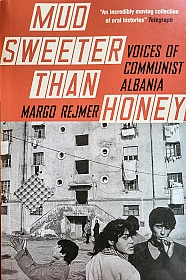
Even when I was in Albania in 1984, I was aware that Hoxha’s regime, like many others run by dictators, was home to prison camps for those who were alleged to have upset the dictator and his paranoid security services. As Margo Rejmer shows in her excellent book “Mud Sweeter Than Honey”, it did not take much to land up in one of Hoxha’s hellish prison camps, and many people suffered this fate.

Rejmer interviewed many people who had lived during Hoxha’s long reign. She successfully demonstrated that every Albanian from the humblest peasant to the highest state official lived in a constant state of fear. Up to one in three people were employed as informers for Hoxha’s secret police – the Sigurimi. It was even dangerous to express one’s thoughts to close members of one’s family. The paranoid dictator ruled, as did Stalin, by endlessly imprisoning or killing anyone that could even slightly be considered a threat to him. Rejmer’s book illustrates this very well and also describes the unbelievable cruelty that prisoners had to suffer in the camps, where they were made to do unpleasant unpaid work, especially in mines.

I am very glad that Rejmer’s book had not yet been written in 1984, because had I read it then, I am certain I would never have set foot in Albania. It is a highly readable, compelling book about the horrific era during which most Albanians had to suffer. My only criticism of it is that she tends to concentrate on people who suffered badly under the regime. However, I suppose it was difficult for her to find anyone who honestly thought that Hoxha had created the paradise, the existence of which our tour guides hoped to persuade us in 1984.

PS My memories of the 1984 visit to Albania are recorded in my book “Albania on My Mind” (https://www.amazon.co.uk/Albania-My-Mind-Adam-Yamey/dp/1291111476/)

Carpaccio and the Albanian community in Venice

THE ITALIAN WORD ‘scuola’ (plural: scuole) does not always mean ‘school’ (i.e., an educational establishment). In Venice, there are several scuole, which were never schools, but confraternities (or guilds). Well-known examples of these include the Scuola Grande di San Rocco, which contains many fine paintings by Tintoretto (1518-1594), and the Scuola Dalmata dei Santi Giorgio e Trifone, which contains a superb set of paintings by Carpaccio (1465-1525). The latter, also known as the Scuola di San Giorgio degli Schiavoni, was founded by Slavs (‘schiavoni’ in Italian) from Dalmatia (now mainly Croatia).

Another group of migrants from the Balkans, Christian (mostly Catholic) Albanians, began arriving in Venice in the early 15th century, both as traders and refugees from the Ottomans. In 1442, the Albanian community in Venice established its own confraternity, the Scuola di Santa Maria degli Albanesi. The building that housed it from the end of the 15th century still stands on a narrow passageway, the Calle dello Spezier, connecting Campo San Stefano and Campo San Maurizio. During our annual family holidays in Venice in the late 1950s and throughout the 1960s, we often passed along the passageway whilst walking from the Academia Bridge to Saint Mark’s Square. After my interest in Albania was first kindled in about 1967, I learnt about the Albanian scuola and always felt excited when we walked past its façade decorated with bas-relief stone carvings.

Three of the sculptures, which are affixed above the ground floor windows, depict two saints (Gallo and Mauritius) with the Mother and Child between them. Above them and located between the two second floor windows there is a larger bas-relief. It portrays a scene with two men in turbans standing on a rock facing a high hill on top of which there is a building with two heraldic crests. One of the men is brandishing a curved sword. This scene is a representation of the great Siege of Shkodër (1478-79). The city was then a Venetian possession. One of the men with a turban is a depiction of Mehmed II. The shields on the building and on the top corners of the sculpture were those of the Loredan and Da Lezze families, who were heroes of the siege.

The Albanian community in Venice was quite important during the period of the Venetian Republic, which ended in 1797. Several years ago, I met the Kosovan scholar and diplomat Bejtullah Destani, who told me that the city’s archives contain many documents charting the activities of the Albanians in Venice, and they have yet to be examined in detail.

Like the Scuola Dalmata, the Scuola degli Albanesi was decorated with a series of paintings by Carpaccio. In 1780, the Albanian scuola was closed. Its building became home to a bakers’ confraternity. 28 years later, when Venice was under Napoleonic rule, the other scuole were all suppressed. The Carpaccio paintings have long since been removed from the Albanian scuola, and can be found in museums in Venice, Milan, and Bergamo.

To get some idea of how splendid the Scuola degli Albanesi must have been in its heyday, a visit to the wonderful Scuola Dalmata should do the trick. Even if you have minimal interest in either Albania or Dalmatia, the paintings by Carpaccio make a good reason to visit Venice.

Two books on Albania by an Albanian and his American wife

I have received news of two books about Albania. One, an intriguing novel, is written by American born Kim Malaj. The other, a collection of Albanian folk tales is written by her husband, Arti Malaj, who was born and brought up in Albania. I look forward to reading them in the future. Why not give them a try, and let me know how you enjoyed them?

THE NOVEL:”CASTLE OF TESKOM” by Kim Malaj

‘Shiny ember rocks are fuel for time; the dull rocks are a fool’s dime.’An old nursery rhyme, or so they think. Itra and Danae stumble across an ancient secret kept hidden behind a reflection in time near their Albanian home. A faded memory and cryptic messages have propelled them to risk an encounter with foes from Greek mythology, altering their perception of Albanian folklore and reality. Itra and Danae grapple with events set in motion centuries ago and must choose toprotect and serve or risk having the secret exposed. Will love, loyalty, and lineage be enough to hold them together, or will they lose their way in auniverse they are only beginning to understand?

Amazon: https://amzn.to/3n5Aetj

eBook: https://books2read.com/u/bpryMl

THE FOLK TALESNORTHERN ALBANIAN FOLKTALES, MYTHS AND LEGENDS

by Arti Malaj

Generations of Northern Albanian are known as great storytellers. They shared many folk tales, myths, and legends with their descendants. The collected short stories include mysterious legends of lost treasures, mystical tales of mountain fairies, superhuman powers, century-old witches, blood feuds, and more written by a twelfth-generation Albanian. The lands described in the stories are still visible today, and locals share a sense of wonder and respect the mysteries that hide beneath. Northern Albania is a true treasure of raw natural beauty and a hidden gem in Southeastern Europe.

Amazon https://amzn.to/2GcDDq2

eBook: https://books2read.com/u/b5ZNOl

One, two, or three heads?

THE HARRAPAN (or Indus Valley) civilisation existed from about 3300 to 1300 BC. Its existence overlapped with that of the ancient civilisation in Mesopotamia (existed approximately 3100 to 539 BC – the fall of Babylon).

Both civilisations used clay to seal closed vessels containing goods. They made identification marks on the clay before it set solid. To do this, they used seals that embossed identifying patterns or marks on the clay. The marks varied greatly.

It is on the ancient Mesopotamian seals that some of the earliest known examples of double-headed birds can be found. Some other Mesopotamian seals depict double-headed horses and other creatures. Whether or not the double-headed eagle of Abania is a descendant of these middle eastern double-headed creatures on sealing rings, I cannot say.

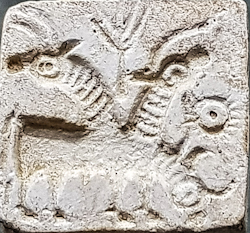
Recently, I visited the Harrapan archaeological site at Dholavira in a remote part of Gujarat close to India’s border with Pakistan. The small museum attached to the site contains several examples of the carved seals used to emboss the wet clay employed to seal close vessels. Knowing about the double-headed birds on the Mesopotamian seals, I was on the look out for similar on the seals excavated at Dholavira.

I was very excited to discove one seal that at first sight looked like a double-headed creature. It was not a bird but a four legged animal. Two heads, each on their own striped necks, faced in opposite directions just as seen in the Albanian double-headed eagle.

I showed the picture of this seal to a friend, who pointed out a third striped neck with its own head. The neck was curved downwards. If the other two heads had not been present, the creature would have resembled, say, a horse or cattle grazing.

Did the craftsman who carved this three headed animal intend it to be three headed or did he/she want to depict movement, just as can be seen on the multi limbed depictions of Hindu gods and goddesses? I cannot say, but it raises the question whether the symbolic Albanian eagle has two heads or one that moves from side to side vigilantly surveying its territory.

An afterthought.
Did Cerberus, the three or more headed dog guarding the underworld, have so many heads, or do the many heads seen in depictions of him really represent one head in frenetic motion?

How China viewed Albania

HAPPY VALENTINES DAY!

Albania is one of the smallest countries in Europe. Between 1944 and late 1990, it was isolated from the rest of the world by a stern dictatorship that held in high regard the Russian dictator Joseph Stalin and his methods of government. In brief, Albania was ruled by a pro-Stalin dictatorship.

The dictatorship, led by Enver Hoxha from 1944 until his death in ’85, had few allies. For a couple of years after 1945, Albania maintained an uneasy friendship with Tito’s Yugoslavia. Then for a longer period, the USSR became its ally and provider of assistance. With Stalin’s death and his replacement by Nikita Krushchev, who denounced Stalin posthumously, Albania rejected the USSR.

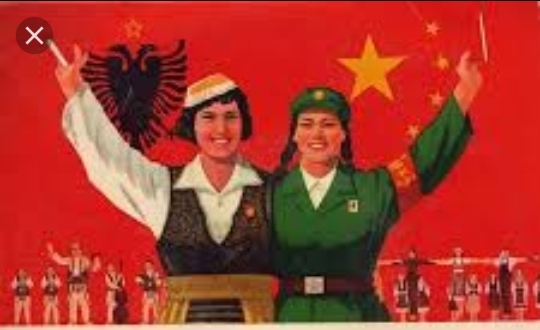
For a period between about 1964 and the mid to late 1970s, tiny Albania became closely allied with the enormous Peoples Republic of China. This period included the ten year Chinese Cultural Revolution. Albanians were subjected to Enver Hoxha’s own version of what the Chinese people had to suffer. Eventually, China’s drift away from Albania’s approach to Marxism- Leninism, caused an end to friendship between the two countries.

I have met several retired diplomats who served in China during the period of Sino-Albanian friendship. Their anecdotes make interesting reading.

When I was last in Tirana, I met a retired Albanian diplomat, who had served in China during the years of Sino-Albanian friendship. He said that in those days the Chinese newspapers were full of pictures and articles about Albania. One day, some Chinese people approached him. They told him that because there was so much about Albania in the news, it must surely be a huge country like China!

A retired Indian diplomat, who had served in China during the Cultural Revolution, collected atlases, something that I also enjoy doing. He found a Chinese world atlas and looked for Albania. In this particular atlad, Albania was hidden away near the spine of the book where two pages met. The country was barely visible except by opening the atlas as widely as possible without cracking the spine. When some young Chinese students asked the diplomat to show them Albania in his atlas, they were surprised at its almost hidden representation in the book. They could not believe that their country’s socialist ally in Europe was so tiny and insignificant. Almost immediately, the students began insulting him with phrases like: “capitalist spy”, “imperialist lackey”, and “enemy of the people”. They refused to believe that the country, which was so important to China, was so tiny.

Another retired Indian diplomat, whom I met in India, came up tomeafter I had given a talk about Albania. He told me that he was serving in China when Enver Hoxha sent the open letter declaring that he was terminating the friendship between his country and China. He told me that he was amazed that such a minute nation like Albania had the nerve to throw mud in the face of a major power and ally such as China was and still is.

These anecdotes help illustrate that tiny Albania had a larger than life history during the 20th century.