An international annual fair of art in a London park and an artist from Uganda

WE WERE FORTUNATE to have been given a couple of entry tickets to the Frieze art fair held every year in London’s Regents Park. The fair consists of the elaborate stalls (or booths) set up by commercial art galleries and dealers from London and all over the world. It is divided into two sections, each housed in enormous temporary structures. Frieze Masters displays artworks and other artefacts (many of them antiques) created before the year 2000 AD. Although many of the pieces on display are fabulously beautiful and for sale, walking around Frieze Masters is rather like exploring a large museum. The stall by Jonckheere was especially wonderful with its display of paintings by Hieronymus Bosch and others of his era.

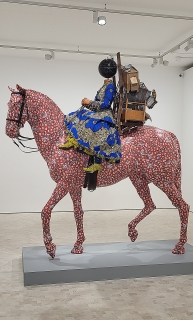
South of the Frieze masters pavilion is the Frieze London pavilion which showcases mainly works created after 2000. I found this to be far more exciting than the Frieze Masters. Many of the exhibitors’ displays had a vibrancy that I found lacking at Frieze Masters. Many of the booths had works by the brilliant, versatile Nigerian British artist Yinka Shonibare, whose works I have seen recently in several other galleries around London. Many other well-known artists such as Grayson Perry had works on display. Three booths, operated by galleries based in India, exhibited works by artists from not only India but also Pakistan and Bangladesh. Amongst the many eye-catching exhibits, there was a collection of works by the artist Patrick Goddard (born 1984). What made this display most interesting was that both the walls of the booth and the artworks were covered by life-like models of snails (see photograph above).

Having seen several exhibitions of contemporary art by African artists during the three days before we visited Frieze, I was attracted to the booth set up by the Stephen Friedman Gallery (London). It contained paintings and sculptures by an artist, Leila Babirye, born in Kampala, Uganda in 1985. She studied art at Makerere University in Kampala, and then participated in the Fire Island Residency (New York State) in 2015. The Residency is a meeting place for visual artists who are (to quote the Residency’s website): “… lesbian, gay, bisexual, transgender, non-binary, intersex and queer …” Ms Babyre is a member of the LGBTQ+ community, which is frowned upon in her native land. Because of this, she received asylum in the USA in 2018, and now both lives and works in Brooklyn, New York City. On display at Frieze, is her collection of colourful portraits, which sre described as “queer identity cards”. A director of the gallery explained that these are a reaction to the formal format of official identity card photographs in which the subject has to remove spectacles, headwear, and tie back their hair. In addition to these, and more interesting visually, there were several sculptures by Ms Babirye. Beautifully crafted, most of them incorporate a variety of different materials – often discarded objects. The point of embellishing her sculptures with what is basically ‘trash’ is to illustrate the word used in the Luganda language to describe homosexuals – ‘ebisiyaga’ meaning ‘sugar cane husk’, in other words ‘it’s rubbish’.

There was plenty more that I found exciting at Frieze London, but the stalls exhibiting artists from the Indian Subcontinent and that showing Leila Babirye wer for me the most interesting. A visit to the Frieze art fair is both exhilarating and exhausting. Luckily, the prices of the artworks were way beyond our budget. Had they not been so costly, I am sure that we would have brought home quite a few of them.

There is something fishy about Hastings

THE HASTINGS CONTEMPORARY art gallery is housed in an elegant modern structure. Some of its large windows and the terrace outside its café look out over the fishing vessels moored on the nearby shingle beach. Other windows give the visitor a view of tall wooden sheds covered with overlapping planks of timber painted black. And yet other windows look towards a couple of long-established purveyors of sea food. The timberwork on the outside of the Hastings Contemporary is  painted black to match its towering neighbours.

The tall wooden structures are ‘net shop’ sheds used for storing fishing nets and other gear when not in use. They are called ‘shops’ not because they sell something, but because ‘shop’ is an old-fashioned word for ‘workshop’. A newspaper article (www.hastingsindependentpress.co.uk/articles/culture/features/the-net-shops-part-one/ ) explained further:

“The Hastings net shops are unique: tall, thin wooden sheds, up to three stories high, painted black, standing side-by-side in clear-cut rows on a part of beach near the sea. Sheds of various shapes and sizes have been on this shingle in front of Hastings Old Town for many centuries, but it was a town planning decision in 1835 that created both the remarkable architectural design and the layout that together make this group of buildings unique. The shops are the traditional storage buildings of the Hastings fishing fleet. They were used in the past to stow gear made from natural materials – cotton nets, hemp ropes, canvas sails, etc – which would rot if left in the open, especially when wet. If possible, the items would be dried on the beach first, and then kept dry inside these weather-proof stores. “

The sheds, the fishing vessels, and the fish shops are all spread along Rock-a-Nore Road, which runs between the cliffs and the seashore, which in this part of Hastings is known as ‘The Stade’. The word ‘stade’ is derived from a Saxon word meaning ‘landing place’.

The two fish shops caught my attention. One of them is called The Net Shop – a jellied eel bar. It is appropriately named because it is right next to a net shop. Established in 1943, this place sells a variety of traditional English seaside seafood delicacies such as: jellied eels, cockles, mussels, oysters, whelks, winkles, dressed crab, prawns, baby octopus, shrimps, crayfish tails, lobster, ocean sticks, and so on. With the exception of the jellied eels, all of the seafood on display looked delicious to me.

The Net Shop jellied eel bar is separated from the Rock-a-Nore Fisheries by the already mentioned timber net shop. The Fisheries shop was started by a member of a family, who had been fishermen since the 19th century. Albert and Lilly set up the shop over 30 years ago. Today, the shop is run by their son Sonny and other members of his family. Sonny’s grandmother:

“… Polly Gannon, used to push a fish cart seven miles from Hastings to Bexhill and back again every day before his parents Albert & Lilly set up Rock-a-Nore Fisheries some 30 years ago.” (https://hastingsflyer.com/hastings-old-town-businesses/).

Sonny’s shop sells wide variety of fish and other seafood. In part of the shop there is an oak-chip fired smokery for smoking seafood. One of their products is smoked salmon. Albert, who worked as a chef in the renowned Brown’s Hotel in Mayfair, enjoyed experimenting with food. He invented a smoked salmon cure, which has been used in the shop for many years – its recipe is a well-guarded secret. Smoked sea salt is also on sale.

Had we been staying for a few days in Hastings in accommodation with cooking facilities, I am certain that we would have been regular customers at both the Net Shop and its near neighbour, Rock-a-Nore Fisheries. However, on our most recent visit, we were only in this charming fishing town for a few hours.

A working men’s club with an unusual name

HASTINGS IN EAST SUSSEX has long had a thriving fishing fleet. It is the largest beach-launched fleet in Europe. Unlike many other fishing ports where the boats are moored in harbours, those at Hastings are moored along the town’s shingle beach when they are at rest. This is part of the beach where in 1066, William the Conqueror famously set foot on English soil.

In 1900, a group of Hastings fishermen met in the (now non-existent) Prince Albert pub – a popular meeting place for these men. The members of the group discussed the idea of raising money to give the poor children of the borough a happy time at Christmas. At that time, regulars of another Hastings pub, the Royal Oak, formed a charitable organisation called the Acorn Club. A website (https://winkleclub.org/early-times/) revealed:

“Apparently at that time in another Hastings pub, the Royal Oak, an Acorn Club had been formed. All members had always to carry acorns, failure to do so involving a fine, all such money being devoted to charity. The fishermen decided to organise an effort on the same lines but one of them … said: `Why an acorn? This is the Old Town; can’t we have something to do with fishing?’ Just then, so the story goes, Providence took a hand. Somebody appeared with a pail of winkles collected from the rocks. Inspiration! Let’s make it the Hastings Winkle Club.”

Thus, the Winkle Club of Hastings was ‘born’.

Members of the Winkle Club must carry a winkle shell at all times. When challenged by a member with the words “Winkle up”, the challenged member must produce his winkle shell and show it to the challenger. For, if they are discovered without their winkle, they are fined. Originally, the fine was one (old) penny, now it is £1. If the person who discovered a member without a winkle did not report him, he would also be fined. All the fines are donated to raise money to achieve the club’s objectives.

In the past, the Winkle Club raised money for poor children as already mentioned. Now, the club raises money for local good causes. Over the years, the Club has included some famous members, who were not fishermen. These include Winston Churchill, the Duke of Windsor, and Lord Montgomery of Alamein.

Close to The Stade, the part of Hastings where the fishing boats are moored, there is a traffic island known as Winkle Island. It is used for various local festivals and is the symbolic meeting place for members of the Winkle Club. A huge sculpture of a winkle shell (see photograph above) stands on Winkle Island. It serves as a public collecting box for the charity. Seeing this marine sculpture is what aroused my interest in this thoroughly worthy charitable organisation.

Wild silk beside the East Sussex sea shore

THERE IS A NIGERIAN woven fabric called ‘sanyan’. Made mostly by the Yoruba people, its principal ingredient is a type of wild silk. The fabric is thick and resembles denim or canvas in texture. Strips of sanyan are sewn together to make garments and other items. During a recent visit to the Hastings Contemporary Art Gallery, which stands close to the seashore, we saw an exhibition of paintings made on sanyan cloths.

The creator of these images is Nigerian born Nengi Omuku who was born in Lagos (Nigeria) in 1987. It is there that this artist, who trained at the Slade School of Fine Art in London, now works. Before becoming an artist, Nengi worked in her mother’s florist shop, eventually coming into contact with art when she began making preparatory drawings for customers’ garden planning.

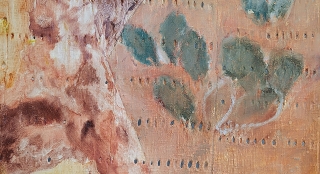
Nengi’s exhibition at Hastings is called “The Dance of People and the Natural World”and is on until the 3rd of March 2024. The artist took large sheets of sanyan fabric, consisting of strips of sanyan sewn tightly together, and then coated them with a gesso ground. When this was ready, she then used oil  paints to create images. Whether it was her painting technique or some property of the material upon which she applied the colours, the resulting images have a uniquely haunting, other-worldly quality that I have not seen in other artists’ works.  

The paintings are well displayed. They have been hung away from the walls so that one can look at their backs. By looking behind the paintings, you can see the stitching that holds the pieces of sanyan together as well as beads of the gesso ground that had oozed between the adjoining strips. By looking closely at the paintings, the joins between the constituent strips of sanyan can easily be detected (see photograph above). These create an interesting surface texture quite unlike the canvas usually used by painters.

I enjoyed the exhibition not only because the artwork was attractive but also because I became aware of an interesting fabric, which is in common use in Nigeria.

Once a real mediaeval castle, but now a garden feature

IN ABOUT 1380, Roger Ashburnam (died 1392) commenced building a castle surrounded by a moat about 6.7 miles southeast of what is now Royal Tunbridge Wells in Kent. During the centuries after the commencement of its construction, this edifice, Scotney Castle, was modified in various ways in different architectural styles.

In 1778, the cricketer and landowner Edward Hussey (1749-1816), who killed himself with a blunderbuss, purchased the estate in which the castle stands. In 1830s, Hussey’s grandson, also called Edward Hussey III, built a new and larger house on a hill overlooking the old castle. It was designed by the architect Anthony Salvin (1799-1881), who was an expert on mediaeval buildings. At the same time, the gardens surrounding the new house were landscaped. As part of the landscaping process, carefully selected parts of the old castle were demolished to create a picturesque ruin – an attractive garden feature.

In the 18th and 19th centuries, it was not uncommon for garden designers to build follies to add interest to gardens. Often, the follies look like classical or mediaeval structures – either constructed to look intact or ruined. At first sight, the old Scotney Castle looks like a grand and elaborate garden folly, but it cannot be so-described – it was not built as a folly. Although its degree of ruination was enhanced in the 19th century, it had been a real castle for several centuries, and had been built to be used as a fortification as well as a residence. Thus, what had once served to counter a possible invasion by the French ended up being an elaborate garden ornament. Maintained by the National Trust, Scotney Castle is well worth a visit. The ruined castle and its surrounding gardens make a magnificent sight. Salvin’s newer edifice, which is open to the public, does not deserve much of a visitor’s attention.

An artistic British Nigerian in Mayfair

WHEN WE ARE IN LONDON, we make regular visits to the commercial art galleries, many of which are to be found in and around Mayfair. Not only can one get to see some of the most recent works of contemporary artists, but also those that will eventually end up in private collections that are usually inaccessible to the general public. Today, the 12th of October 2023, we were walking along Cork Street, heading towards the Waddington Custot Gallery when we passed a gallery, the Stephen Friedman, which we had never entered before. Through its window, we saw works by an artist, whose oeuvre we enjoy, and entered.

Much of the exhibition at Stephen Friedman is dedicated to creations of the British Nigerian artist Yinka Shonibare. He was born in London in 1962. His Nigerian parents took him to Lagos in Nigeria when he was 3 years old, and he lived there until he was 17. A year later, he developed transverse myelitis, which left him paralysed on one side of his body. Despite this, he went on to study fine art at the Byam Shaw art school, and then later at Goldsmith College (part of the University of London). Because of his disability, Yinka directs a team of assistants to create his artworks (sculptures, photographs, fabrics, and much more). He has become a widely exhibited and highly acclaimed artist.

Yinka’s works are visually engaging and highly imaginative. They are also full of meaning. He uses his creations to:

“… question the validity of contemporary cultural and national identities within the context of globalisation. Through examining race, class and the construction of cultural identity, his works comment on the tangled interrelationship between Africa and Europe, and their respective economic and political histories.” (see https://yinkashonibare.com/biography/)

Although one can easily enjoy the aesthetics of his creations without understanding the artist’s messages contained within them, a good knowledge of colonial and post-colonial history will enhance the viewer’s experiences of them.

The exhibition is on until the 11th of November 2023. In addition to Yinka’s works, he has curated a small, but fascinating, collection of artworks by several artists from the African diaspora.

From Lagos in Nigeria to Peckham in London

UNTIL I VISITED THE SOUTH LONDON GALLERY (‘SLG’) yesterday, the 11th of October 2023, I had no idea that Peckham in south London is home to one of the UK’s largest Nigerian diasporic communities. Some even call the district ‘Little Lagos’ after the capital city of Nigeria. Until the 29th of October 2023, the SLG is hosting an exhibition of artworks, called “Lagos Peckham Repeat: Pilgrimage to the Lakes”, by Nigerian and British Nigerian artists. Lagos means ‘lakes’ in Portuguese, and the Nigerian city of Lagos developed on an area with several lakes. Part of the show is housed in the same building as the Camberwell School of Art, and the other in a nearby repurposed, former fire station, which was purchased in 2010 and donated to the SLG by the artist Raqib Shaw (born in Calcutta in 1974). The two venues are a few paces from each other, and both are well worth visiting.

The exhibition consists of photographs, videos (including an excellent one showing a woman in Nigerian clothing riding through Peckham on a black horse), sculptural assemblages, and coloured drawings. Words are inadequate to describe the imaginative exhibits, but if you are unable to visit the show, there is a good verbal summary of the artworks on https://www.southlondongallery.org/exhibitions/lagos-peckham-repeat/ . To give you some idea of the ideas that link the various works on the display, I will quote from the gallery’s guide:

“This exhibition brings together thirteen contemporary Nigerian and British-Nigerian artists to explore links between Lagos, meaning ‘lakes’ in Portuguese, and Peckham as a channel through which to address wider issues of migration. It is framed around ideas of pilgrimage, meaning journeys to a sacred or special place and, in this case, migration motivated by a search for a better life. At the heart of the exhibition is an exploration of the complexities of shifting notions of home and identity as generations of Nigerians settle in London permanently, return to Lagos, or move elsewhere.”

And I feel that this summarises the show very well. All of the exhibits are visually engaging in an exciting way, and if you bother to read the guide carefully, all of them convey the artists’ concepts with great lucidity and originality.

After seeing the show, you can obtain good refreshments in the SLG’s simple but attractive South London Louie café. The SLG also has a bookshop with many intriguing titles on offer.

An unusual title for my latest book about India

SOME PEOPLE MIGHT RAISE THEIR EYEBROWS in surprise when they learn of the title of my new book. Called “The Hitler Lock and Other Tales of India”, it consists of an explanatory prologue and 101 short pieces describing some of my many and varied experiences whilst visiting India frequently during the past 30 years.

My book’s name was inspired by my discovery of a company, Hitler Lock Enterprises, which manufactures padlocks in India. Despite my choice of the book’s title, only three of the vignettes contained in it are related to Germany’s former notoriously monstrous Führer. In these few pieces, I have described how I believe that Adolf Hitler is perceived by many Indians today.

The rest of the book has nothing to do with Hitler. It contains pieces with deal with topics such as: travelling in coracles; problems with monkeys; peculiarities of club life; dress code; encounters with jackals and crocodiles; teamakers and politicians; children called Lenin and Stalin; meeting maharajahs; fabulous booksellers; the City of Joy; Gandhi and his optician; and ‘love marriages’ (including my Indian wedding) – to give but a few examples. The aim of the book is to both inform and entertain, and it is written for those who are familiar with India as well as those who are not.

To be frank, I chose the name of this book to make it both eye-catching and slightly provocative. I hope that by including the word ‘Hitler’ in my title, it will not deter people from reading my text. That despicable genocidal madman is not mentioned much in the book.  And I should emphasise that my text does not glorify him at all.

So, now that you know that my book is about India and its delights, rather than yet another tract about Hitler, you can obtain a copy, and enjoy it.  My text is available as a paperback and a Kindle (e-book) on Amazon’s websites, including (for example):

https://www.amazon.co.uk/HITLER-LOCK-OTHER-TALES-INDIA/dp/B0CFM5JNX5/

Visiting an exhibition of outdoor sculptures in a London park

I ALWAYS ENJOY seeing sculptures displayed in the open-air. Until the 29th of October (2023) the annual outdoor Frieze Sculpture exhibition is being held in the south-east corner of London’s Regents Park. As with all the Frieze Sculpture exhibitions I have seen, this one is no exception – it displays a ‘mixed bag’ of artworks. Although many of this year’s exhibits are colourful, creative, and often playful, few of them are exceptional.

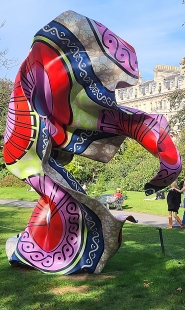
Two works struck me as standing out from the crowd. One of them, created in 2023 by Yinka Shonibare, is a folded work called “Material (SG) IV” (see photograph). This shape of this work resembles a flickering flame frozen in time. Covered in colourful patterns, the artist wanted to depict a piece of printed fabric, such as a sail, blowing in the breeze.  According to the Frieze Sculpture 2023 website, this artist:

“… creates work that explores issues of race and class through the media of sculpture, painting, photography, film, pictorial quilts and public works.”

The website explained that in the work in Regents Park:

“The fabric was originally inspired by Indonesian designs, mass-produced by the Dutch and eventually sold to colonies in West Africa. In the 1960s the material became a signifier of African identity and independence and, in Shonibare’s hands, the ‘perfect metaphor for multi-layered identities’.”

Even though it is interesting to know what was in the artist’s mind when he created the sculpture, it is a visually fascinating and satisfying piece in its own right.

The other work that particularly attracted me was created in 1976 by the artist Louise Nevelson (1899-1988). Born in a city now in Ukraine, she emigrated to the USA in the early 20th century. It was in the States that she studied art, and then created most of her artworks. Painted black, and called “Model for Celebration II”, it is a tall abstract piece, which was:

“… Inspired by the cubist innovations of Pablo Picasso and Henri Matisse, Nevelson reimagines painterly cubism as a sculptural opportunity.” (see https://viewer.mapme.com/frieze-sculpture-2023/location/ca758a4f-1328-48d2-a3cf-6c6b65edf794).

Unlike the other works on display in the park, Nevelson’s work has stood the test of time. So, maybe it was unfair of the curator to include such a work amongst the works of so many newcomers to the ‘art scene’. However, I was pleased to see it, as it is one of the only exhibits that I felt had profundity rather than the immediate and often short-lasting aesthetic appeal of many of the other exhibits.