A CAFE, A PUBLIC TOILET, A CHURCH, AND A MOSQUE IN ISTANBUL

I NEEDED NEW shoes today (20th April 2024). After buying a pair in the superbly stocked Fast Step shoe shop, we felt the need for coffee. Near the shop, we found a café called Gutta. Having enjoyed good coffees – both Turkish style and Italian style, we needed to answer the call of nature.

We asked if the café had a toilet. It did not, but, as has happened frequently in Istanbul, we were directed to the nearest mosque. This mosque, like others in Istanbul, has public toilets, for which in this case a modest charge was levied. As with most WCs in Istanbul, this one was well-maintained.

Kalenderhane Mosque

The mosque in this case is called the Kalenderhane Mosque. Its name derives from the Kalender dervishes, who once used it as a ‘tekke’. From the outside it looks remarkably like a very old Greek Orthodox church. It was converted for the use of the dervishes by Sultan Mehmet (the Conqueror) in 1453. In the 18th century, it was converted into a mosque.

Built in about the 9th to 10th century next to the Aqueduct of Valens , it is now thought to have been dedicated to Theotikos Kyriotissa. Sadly, as it was locked up, we were unable to enter the edifice.

Had it not been for nature’s call, we might not have come across this interesting mosque. As is the case for many old mosques in Istanbul, it is a fine example of Ottoman repurposing existing Christian buildings in the 15th century.

A MOSQUE IN ISTANBUL REMEMBERED, BUT ITS NAME FORGOTTEN

ON OUR LAST visit to Istanbul at least 15 years ago, we visited a small but attractive mosque in Üsküdar (the Asian part of Istanbul). During our present holiday in the city (in April 2024), we hoped to see this mosque again, but we had forgotten its name.

After having waited for the midday Friday prayers to be over at the Atik Valide Mosque, we looked around this edifice that was designed by the famous architect Mimar Sinan in 1583-1584. Incidentally, to reach this building, we climbed a steep staircase with 114 steps – a so-called short cut. Apart from its fine architectural form, the mosque is adorned with several lovely tiled plaques covered with Arabic calligraphy intertwined with the occasional flower.

As we were leaving the mosque’s enclosed compound, a man stopped us, and told us in broken English that we should visit another mosque in the neighbourhood. He said it had beautiful tiling, and it’s name is Çinili. When we heard the name, we remembered that was the mosque, whose name we had forgotten.

Çinili mosque

After climbing another hill, we reached the Çinili mosque. Completed in 1640, it is not as fine architecturally as buildings by Sinan. However, it’s interior is lined with intricately decorated tiling. Unfortunately, the mosque was locked up, but by peering through the windows we got a good impression of the magnificent tiling. The wall of the covered porch in which the main entrance can be found is also covered with beautiful tiling. What we saw was what we remembered from our first visit there at least 15 years ago. We were very grateful that a complete stranger reminded us of the name of the place that we remembered, but whose name we could not recall.

PS both mosques mentioned above were connected with a Valide Sultan – that is with the mother of a reigning Sultan.

MORE ABOUT CATS IN ISTANBUL AND SOMETHING ABOUT CATS IN MY LIFE

I HAVE ALWAYS LIKED cats. Once, when I was about 7 years old, I was in bed suffering from one of my then frequent attacks of tonsillitis. I was recovering in bed when a small black cat wandered into my bedroom.

Knowing my love of cats, my mother had bought one to cheer me up. I christened it “Crumpet”.

There was a big problem. My mother was not keen on cats. As she thought I was too young to be trusted with a tin opener and she was worried that I might cut myself on the opened tins of cat food, she became Crumpet’s feeder.

Because Crumpet knew that Mom was the source of her food, she took a liking to her, often rubbing herself against my mother’s legs. This did not please my mother, and I believe that Crumpet sensed this. After a few months, Crumpet abandoned our house, and moved into another house along our road, where she found a more appreciative host.

Cat shelters in Üsküdar

We are now visiting Istanbul, which is swarming with cats. As I have already written previously, street cats seem to be well treated in this city. People put out food for them, and various organisations, including local municipalities, provide them with cosy shelters.

Today, whilst sitting in a garden outside a mosque in Üsküdar in the Asian part of Istanbul, we saw many cats – as usual. It was a cold, rainy day, and one cat, lacking in shyness, spent time keeping warm by sitting on my wife’s lap, and then mine.

What we have seen of the cats of Istanbul reinforces my affection for these furry creatures.

They came from Spain and worshipped here in Istanbul

IN 1492 THE ANDALUSIAN Arabs were thrown out of Spain. Just like some of the Jewish people who were expelled at the same time, some of the Arabs came to Istanbul, which had been under the rule of the Islamic Ottomans since 1453, when they captured the city from the Byzantine rulers.

In 1475, Fatih Sultan Ahmed converted a church in Beyoglu to a mosque, known as the Galata Mosque. Today, this mosque, whose interior feels (but does not resemble) more like that of church, is now known as the ‘Arap Camii’ (Arab Mosque). This is because the Arabs forced to leave Andalusia settled in the area around the mosque, and used it for worship.

From the outside, the mosque could easily be mistaken for a church. This is because of its shape and what had once been a tall square bell tower. The tower is now topped with a conical feature, such as is found on the tops of most minarets. However at the Arap Camii, the conical object could be mistaken for a church steeple.

We visited this large mosque. The interior is rich in timber features, and looks as if it has been recently restored or renovated. An informative sign outside the mosque stated that when the building was repaired in 1913, Christian gravestones commemorating the deaths of people from Genoa (Italy) were discovered, and placed in a museum of archaeology.

We would have been unlikely to have visited this interesting mosque had we not taken a wrong turning. As the saying goes ‘every cloud has a silver lining ‘.

Istanbul is a city for cats

WE HAVE ALREADY seen many fantastic historical places in Istanbul, and I plan to tell you about some of these. But before proceeding with descriptions of landmarks in the history of Istanbul/Constantinople, let me relate something current.

Istanbul is full of cats. Wherever you look you are bound to see a cat – often looking extremely healthy. They feed both by scavenging and they are also fed by local people. They seem unafraid of humans.

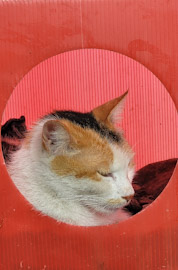
During our first three days in Istanbul, we have noticed something we had not seen before. In several places, we have seen small kennel shaped ‘sheds’ which are large enough to house one big cat or a couple of smaller ones. The floors of some of these shelters are lined with soft material including bits of old bedsheets. Most of the sheds have round holes through which the cats can enter and leave the shelters.

Another feature that makes life more pleasant for felines is that compared with many other cities I have visited, there are few dogs around in the streets.

The cats of Istanbul have much to purr about!

ONCE HE WAS THE GOVERNOR OF BOSNIA

IN THE 1980s, I used to make regular visits to see my friends who lived in the part of Yugoslavia, which is now the independent Republic of Bosnia. The influence of the Turkish occupation of the region for many years was very evident – from Turkish coffee to fine mosques.

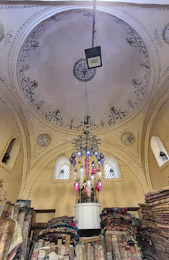
Many years before I began travelling to Bosnia, Üsküplu Gazi Yahya Paşa (died 1506) was appointed Ottoman governor of Bosnia in 1480. He also held other important positions in the empire. He married a daughter of Sultan Beyazit II. He was philanthropic. One of the many things he did for Istanbul was to build a school which stands in Kadirga, a part of Fatih district of the city. This building with two domes still stands and was recently restored by the local municipality.

The former school now houses a shop that sells traditionally designed objects – everything from earrings to large woven carpets. The walls and domes of the interior of the building have been painted so as to recreate the place’s original decor.

This building is one of a huge number wonderful relics of the Ottoman Empire, which can be found whilst strolling around Istanbul. Fortunately, many of these old buildings have informative labels attached, with information both in English and Turkish.

At rest by the waters of the Bosphorus in a beautiful mosque

BY THE LATE SIXTEENTH century, Istanbul had become an extremely important crossroads between Asia and Europe. It was the capital of the Ottoman Empire, which by then extended over large parts of Europe, the Middle East, Egypt, and the north coast of Africa.

Part of the military force that the Sultan of the Ottomans used to maintain the empire was a group of soldiers called janissaries. These were (usually) Christian men who had been captured by the Turks, converted to Islam, and trained in military skills. They were often most effective soldiers.

Today (16th of April 2024), we visited an elegant complex of Islamic buildings close to the waterfront at Üsküdar on the Asian shore of the Bosphorus Straits. Designed by the famous Ottoman architect Mimar Sinan (c1489-1588) in 1580, it houses a former madrasa (now used to house a library), cloisters, a mosque to which is attached the turbe (edifice housing a grave, like a dargah, as can be found in India), and a small mosque.

This complex was commissioned by Ṣemṣi Ahmed Paṣa (1516 – 1580). Amongst his numerous achievements he was, for a time, head of the janissaries. He also served as the beglerbeg (governor) of several provinces including Rumelia (which included much of the Balkans and Romania) and Anatolia.

This lovely architectural ensemble is visited by some of the many tourists who stream past it, and by many pious locals.

A toilet in the airport of Istanbul

I FIRST VISITED Turkey in the early 1960s. It was then that our family first came across squatting toilets. For want of a better name, we called these hole in the floor lavatories ‘Turkish loos’.

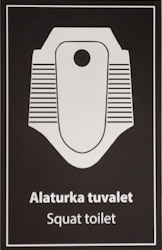
Today, in April 2024, we landed at Istanbul’s vast new airport. As nature was calling, I visited one of the many toilets in the airport building. You can imagine my surprise and satisfaction when I saw on the door to a cubicle containing a squatting toilet a sign that read in Turkish “Alaturka tuvalet”, and beneath it, the English words “Squat toilet”. So, it seems that we were right to christen these types of toilets ‘Turkish loos’.

A COMMANDER OF THE BRITISH EMPIRE AND THE ARTISTIC INTERPRETATION OF COLONISATION

THE ARTIST YINKA SHONIBARE was awarded the prestigious CBE in 2019. In case you do not know what these three letters stand for, it is ‘Commander of the British Empire’ – not that Britain has much of, if any, empire left to boast of. For much of its long existence, places in the British Empire witnessed many injustices and inhumanities. This was especially true before the abolition of the slave trade in the early 19th century. Yinka Shonibare, who was born in London in 1962 and brought up between that city and Lagos in Nigeria, uses his artistic skills to explore Britain’s lengthy history of imperialism imaginatively and creatively. Even without knowing that he does this, his art works are in themselves visually exciting and fascinating to the viewer. The pieces on display until the 1st of September 2024 at the Serpentine South gallery in Kensington Gardens are well worth seeing both for their inherent beauty and for the way that Shonibare expresses his interpretation of Britain’s colonial past and its legacy.

For more information about the exhibition, please visit: www.serpentinegalleries.org/whats-on/yinka-shonibare-cbe-suspended-states/

Paintings by artists in India who escaped from western European artistic traditions – at the Brunei Gallery

WHENEVER I VISITED my in-laws in India, I used to admire the painting by the Bengali artist Jamini Roy (1887-1972), which used to hang in their flat. His style of painting was both modern (20th century) and at the same time almost folkloric. When our friend Bob Annibale posted on Facebook about an exhibition at the Brunei Gallery (in London’s Bloomsbury) that included Roy’s works, we could not resist visiting it, and we were glad we viewed it.

The exhibition, which continues until the 22nd of June 2024, not only contains a good selection of Roy’s works, but also others by Bengali artists working mainly between the late 19th century and the 1950s. Apart from works by Roy’s contemporaries including various members of the Tagore family, Hemendranath Mazumdar, Nandalal Bose, and Qamrul Hassan, there were also paintings by lesser-known or unknown artists who painted in the traditional late 19th century Bengali (Kalighat) style, rather than in experimental styles of the 20th century.

The emergence of modern Indian painting was a consequence of the establishment of The Government College of Art in Calcutta (in 1854). As the website of the Brunei Gallery explained, it was:

“… established by a benevolent government for the purpose of revealing to the Indians the superiority of European art.”

In the late 19th century, Indian artists working in the college began questioning the validity of Indians painting in the alien Western European fashion that was being taught them. The gallery’s website continued:

“Academic art, introduced by the British Raj, was challenged by the nationalist art movement, the Bengal School of painting, led by Abanindranath Tagore (1871-1951) and his disciples who dominated the art scene in the first decades of the twentieth century.”

It is works by these artists, who used their creations as part of their expressions of desire to see India free of British rule, that form the greater part of the show at the Brunei.

Several things particularly interested me whilst viewing the excellently curated and displayed exhibition. One was three paintings by Jamini Roy that illustrate Christian themes (e.g., the Crucifixion, the Last Supper, and the Flight to Egypt). I had not before seen any of Roy’s paintings depicting Christian stories.  Another exciting discovery for me were a selection of paintings by Sunayani Devi (1875-1962), who was the sister of the artists Abanindranath Tagore and Gaganendranath Tagore, some of whose pictures are also hung in the show. These 3 siblings had a famous uncle, Rabindranath Tagore, some of whose paintings were also on show. At the exhibition, there were portraits of Rabindranath Tagore by each of his above-mentioned relatives, and one by Jamini Roy.

Yet another artist on show, whom I had never encountered, is Qamrul Hassan (1921-1988), who was born later than the other artists. Born in Calcutta before independence and the Bangladesh War (1971), he died in what is now Bangladesh. He studied at The Government College of Art in Calcutta in the late 1930s, and afterwards became involved with left wing political activities as well as his art. Later, he was active in the struggle for East Pakistan (now Bangladesh) to become independent of what was then West Pakistan. Beneath one of his creations at the Brunei, there is a quotation by Qamrul about his style of painting:

“… where Jamini Roy ends , I begin …”

And this is so easy to see in the excellent exhibition at the Brunei Gallery

I have told you what stood out for me, but although I have highlighted a few things, the rest of the exhibits are wonderful, and not to be ‘sniffed at’. After seeing the show, I thought that never before had I seen such a fine and large collection of paintings by the liberated artists either here in the UK or in India. The curators of this show deserve hearty congratulations.