A simple cemetery near a tea factory in Munnar

AFTER HAVING EATEN lunch at Munnar’s High Range Club, which I will describe at a future date, we walked along the road that runs along a bank of the Muthirappuzhayar River. As we walked along the road from the club, away from Munnar town, we spotted some graves near to the Chokanad Estate tea factory.


One of the graves, an elaborate enclosure painted blue, is the final resting place of I Krishnan (1932-1980). He was “factory watcher”.


There were a few other substantial, simple funerary monuments, each of which had a small niche in which a diya (oil lamp) can be placed. The other graves in this rustic graveyard are simple mounds, mostly without informative markers. All of them had been sprinkled with a white powder.


None of the graves resemble any Muslim grave that I have seen. And none of them have the crosses one would expect if they were marking burial sites of Christians.


The two names we could read in the cemetery could well be those of Hindus: Krishnan and Shanmugathai. This and the absence of any Muslim or Christian symbols made me guess that this small rural graveyard is where Hindus have been buried.


Now, before some of you tell me that Hindus are cremated,  not buried, let me set you right on this. Many Hindus are cremated, but not all. There are some sects that favour burial. And if you need proof of this, visit the very large Hindu Cemetery which is close to Hosur Road in Bangalore.  The Hindu graves in that cemetery are far more elaborate and colourful than those we spotted surrounded by tea plantations in the hills of Kerala.


I would like to know more about the tiny graveyard by the river. However, it might be a long time before (if ever) I find out.  The place, which is about 400 yards from the nearest houses, is not even marked on maps.

When the letters V and R did not refer to England’s Queen Victoria

THE SETUPARVARTIPURAM DAM, also known as the Kundala Dam, is a popular spot for tourists. This curved dam, built with masonry blocks, lies near the beautiful road that runs between Munnar and Top Station, a high mountain view point.

Kundala Dam

At the entrance to the narrow roadway that runs along the top of the dam, there are two commemorative plaques. Both of them bear the coat of arms if the former Kingdom of Travancore and the letters V and R intertwined.

One of the plaques informs the viewer that the dam was opened during the twenty-fifth year of the reign of “His Highness Sri Chitra Thirumal Sir Balaramvarma … Maharajah of Travancore”. Born in 1912, he died in 1991. He came to the throne in 1924. Therefore, the twenty-fifth year of his reign was 1948/49.

It was in 1949, that the Maharajah agreed to unite Travancore with Cochin (and the rest of India). Between Indian independence in August 1947 and 1949, Travancore resisted unification with the new republic of India. Between 1949 and 1956 Sri Chitra Thirumal served as the first and only Governor of the newly formed Travancore-Cochin Union. In 1956, this territory was incorporated into the state of Kerala.

As for the intertwined R and V, this has nothing to do with Queen Victoria (VR). Instead, it refers to Rama Varma, a set of rulers of Travancore, Cochin, and other parts of Southern India.

Having established the significance of the letters R and V, I must add that a visit to the dam is a delightful experience.

French Onion soup made at a restaurant in the hills of Kerala

I LOVE FRENCH ONION soup. So, whenever I see it on a menu, I order it. In Munnar (Kerala), there is a vegetarian restaurant called Saravana Bhavan. It has French Onion Soup on its menu. So, I ordered a bowl.

What arrived did not have have cheese laden, or even plain, croutons. The soup was dark brown in colour and contained many thin pieces of fried onion. It was delicious but quite unlike the ‘traditional’ French Onion soup. It was spicier and more peppery.

Today, after having enjoyed a second serving of Saravana’s version of the soup, we asked the chef how he made the soup. Its ingredients include salt, pepper, garlic, ginger, onions, and a tiny amount of soya sauce.

When I return to London, I will try to recreate this Munnar version of the soup.

A morning stroll in the town of Munnar in Kerala

JUST OVER FIVE thousand feet above sea level, the small town of Munnar, watered by three streams that meet in the town’s centre, is perched on the slopes of the hills that surround it. Unlike many places we have visited in India that are rich in historical monuments and artistic delights, the joy of Munnar is its situation and the beautiful views of the hills and tea gardens that surround it. Having said that, we did visit a couple of old buildings – old by Munnar’s standards (the town did not exist before the nineteenth century) – during our morning stroll on 14 January 2026.


Walking down the steep road from our hotel to the bazaar area near where three rivers meet, we passed sellers of long sticks of sugar cane topped with green leaves. The canes were stacked vertically creating what resembled a  curtain of bamboo stalks. Facing the canes was a long line of parked Mahindra jeeps, all waiting to be hired. As we passed their drivers, we were asked whether we needed a taxi.


The busy bazaar area of Munnar resembles that found in many small towns in India.  The streets that wound their way through this area have a never-ending stream of traffic: autorickshaws, trucks, cars, minibuses carrying visitors, large buses, and motorised two-wheelers. Bridges cross the river to join two equally bustling shopping areas.


Near the point where the three rivers meet, there is a bank where we got some cash: many businesses, including hotels and some restaurants require cash payments or electronic payments, which we cannot do. After dealing with the bank, we sampled a couple of types of locally grown tea: cardamom and masala milk teas.


After quenching our thirst, we headed away from town along the road that leads to Ernakulam. This leafy thoroughfare is lined on one side with market stalls, selling mainly ‘homemade’ Munnar chocolate and outdoor clothing (anoraks, hats, etc).


After walking up a gradual incline for about 300 yards,  we passed the Government Anglo Tamil Primary School (‘GATP’) and Model Pre-Primary. The GATP was founded in 1918, and its building with corrugated iron roofs and  Tamil style pillars looks quite old.


Christmas Church in Munnar

Not far from the school and high above it is an even older edifice. Completed and consecrated in 1911, this is the Church of South India’s Christ Church.  Built in a gothic style using local granite blocks, it is a grey coloured building, which, to my taste, is not particularly attractive.


Inside, this small church with its timber beamed roof has its own charm. Even though it was long after Twelfth Night  the church was gloriously colourful with its Christmas decorations still in place. A service was in progress. The number of people attending was under twenty. 


The church has a few stained glass windows and several plaques commemorating Brits who were associated with Munnar. One white marble memorial commemorates Archibald William Lunel Vernede who died in Munnar in 1917, aged 67. For many years, he had been:  “Superintendent and District Magistrate of the Cardamom Hills”. These Hills are the part of the Western Ghats that includes Munnar.


Another memorial recalls a more recent death. That of Cecil Philip Gouldsbury, who was a tea planter in the High Range (near Munnar), and died in 1971. I did a little research,  and found that Cecil was born in Calcutta in 1886, and died in Wiltshire (UK).


Although not a great beauty, Christ Church is a functioning Church, one of the oldest surviving buildings in Munnar, and a place that evokes the colonial era in the town.


After our pleasant stroll during which we enjoyed seeing the varying verdant vistas, we rode back to our hotel in an autorickshaw.


[And now a minor gripe. In India, the three-wheeler cabs used to be, and are still often called ‘autorickshaws’. However, their drivers, seeing a European face, will refer to them as ‘tuk tuks’, the name by which they are known further east ( e.g. in Thailand). I prefer to call these vehicles autorickshaws, as I have been doing over more than 30 years of visiting India.]

Recording the terrain before and during its exploration by archaeologists

WHEN ARCHAEOLOGISTS DISCOVER and then remove historical artefacts from the ground, the terrain in which they have lain for centuries or maybe millennia is changed forever, and irreversibly. For once an artefact is removed and/or the site is excavated to reveal its original features, no amount of effort can restore the site to what it was before it was investigated by archaeologists.

Given the permanent changes resulting from the activities of archaeologists, it is important that the appearance of the site is recorded before, during, and after the archaeological dig. To do this, photography is very useful.

Yesterday, 7 January 2025, we viewed an exhibition, “Archeo Logical Camera”. It is being held in a gallery at the Kara Hotel, a luxurious and beautifully designed establishment located on the Maidan (Parade Ground) at Fort Kochi. The exhibits consists of several artefacts dug up by archaeologists as well as photographs taken by Mohamed A, who graduated in Fine Arts at Trivandrum, Kerala.

The photographs, each of which is a work of art, are those he took while documenting archaeological digs in various parts of India. The pictures show, archaeologists at work, the sites where they worked before and during the digs, and artefacts both in their original locations and after excavation.

Not only were the photographs beautifully executed and interesting, but also the exhibition was superbly displayed. The show is a project by Aazhi Archives, and the artistic director is Riyas Komu.

This wonderful exhibition is NOT part of the 2025/26 Kochi Muziris art biennale. However, after having now seen many of the festival’s artistic offerings, I think that the quality and originality of “Archeo Logical Camera”, exceeds most of what is to be seen at the Kochi Muziris Biennale.

Gulam Mohammed Sheikh in Ernakulam (Kerala) and the Kochi Muziris Biennale  2025/26

SOME PEOPLE SAY “save the best till last”. This is what we did accidentally while spending several days exploring the 2025/26 Kochi Muziris art biennale. Much of what we saw at this biennale was far inferior to what we had seen when visiting the four previous biennales. Most of this biennale’s offerings were rich in messaging but insubstantial artistically. The exception to this sad situation is an exhibition held at the Durbar Hall, which is across the sea from Fort Kochi in the city of Ernakulam.


The exhibition at Ernakulam is a large collection of (mostly) paintings by Gulam Mohammed Sheikh,  who was born in 1937 in what is now Gujarat.  His artistic training took place first at the MS University in Vadodara,  then at London’s Royal College of Art.


A Mappa Mundi by Sheikh

The exhibition includes works from the various stages of his career from the 1960s until today. Sheikh’s work provides  imaginative,  creative, original, beautifully executed, refreshing views and interpretations of the world and its inhabitants.


Amongst the many superb creations on display, there is a series of Mappa Mundi paintings, in which, to quote Wikipedia, Sheikh:

“… defines new horizons and ponders over to locate himself in. Sheikh construes these personal universes enthused from the miniature shrines where he urges the audience to exercise the freedom to build up their Mappa Mundi.

These wonderful artworks that were inspired by mediaeval maps of the world provide the viewer with exciting expressions of Sheikh’s interpretations of the world, past and present,  real and imagined. In one room at Durbar Hall, there is a wonderful film that, in a way, brings Sheikh’s Mappa Mundi to life.


Each of Sheikh’s artworks tells a story. However that story is open to each viewer’s own interpretation. The artist’s works are not only vehicles for a story or stories, but they are also aesthetically sophisticated: art at its best.


It was a great pleasure to see Sheikh’s art. Unlike much of the other exhibits in the Biennale,  his work does not rely on gimmickry, sound effects, lighting effects, film clips, ‘objets  trouvés’, and explanatory notes. Sheikh’s works are the products of a technically competent painter who is able to express his imaginative ideas in ways that are both aesthetically pleasing and highly original.


Seeing the exhibition of Sheikh’s works has revived my enthusiasm for art, which had begun to flag while visiting a seemingly never ending series of mediocre artefacts being displayed at the various sites of the 2025/26 Kochi Muziris Biennale.

The oldest existing European building in India was built by the Portuguese

VASCO DA GAMA and his Portuguese crew set foot on Indian soil near Calicut in Kerala in 1498. The Portuguese were not the first Europeans to arrive in India: Romans had traded with India long before the fifteenth century,  but there are no known remains of any structures they might have built. Despite the lack of any structures known to have been built by the Ancient Romans, many Roman coins have been found in India.


In 1503, five years after Vasco arrived, some Portuguese sailors erected a wooden fortress at Pallipuram, about 18 miles north of the present Fort Kochi and 100 miles south of Calicut. Two years later  this fort was replaced by a hexagonal stone structure. This two-storey edifice is believed to be India’s oldest existing building built by  Europeans.


The upper storey of the fort, on which would have been placed canons, no longer exists. Each of the fort’s six walls are about 6 feet thick, 32 feet wide, and 34 feet tall. They contain 18 former embrasures for cannon.


A staircase leads from the ground to the ground floor of the fort. Next to this, there is a circular plaque with the words: “Pallipuram Fort. The most ancient European building in India.  About 1503. Conserved as a historic relic by the Government of Travancore. AD 1909”.


The fort remained in Portuguese hands until 1661, when it was captured by the Dutch. Then the Dutch sold it to the Kingdom of Travancore in 1789. It remained under the control of Travancore until India became independent in 1947.


Today, although little remains to be seen apart from the hexagonal walls, it is fascinatingly evocative to visit a place with such an interesting history. Located within its peaceful grounds there is a square pond (tank) filled with water. I have no idea how long that water feature has been in existence. 


Standing looking it in the hot humid heat on a January afternoon, I wondered how the sixteenth century Portuguese managed to bear the uncomfortable climate and survive in this fort that was once surrounded by steamy jungle.

Two languages in the tea gardens of Kerala

LYING IN THE WESTERN Ghats at 5200 feet above sea level, Munnar, surrounded by tea gardens (plantations), is in the Indian state of Kerala, whose official language is Malayalam. The town’s name is derived from both the Malayalam and the Tamil words meaning ‘three rivers’. Indeed, three rivers meet in the heart of the town.


Top: Malayalam,  bottom: Tamil

Munnar is close to Kerala’s border with its neighbouring state Tamil Nadu. Since tea begun to be grown around Munnar in the 1880s, Tamils came to the district to work on the then British owned plantations. However, even before that there was a substantial number of Tamils living in the area that became Munnar in the early nineteenth century.


So, it is not surprising that there are plenty of Tamil speakers in the Munnar area. 44% of the population were Tamil speakers 2011; the rest were Malayalam speakers. During our first few hours after our arrival in Munnar, I noticed a large number of election posters. Many of these were either only in Tamil or, less frequently,  bilingual: Tamil a day Malayalam.


The man who drove us from Fort Kochi to Munnar, where he resides, told us that he is Tamil, not a Malayali. Also, he mentioned that in the flat coastal parts of Kerala, there are many Christians,  whereas in Munnar, people are mainly Hindu. This might well be the case, but in addition to a large mandir, I have seen several large churches and a large masjid in the town.


Within the state of Kerala,  Tamil speakers account for less than two percent of the population. Most of them live either around Munnar or around Palakkad.


As to whether the Tamils and Malayalis get on with one another in Munnar, I have no idea.

It was barely worth visiting the main venue of the 2025/26 Kochi Muziris Biennale

THERE HAVE BEEN six Kochi Muziris art biennales to date. And we have attended five of them. This year, as is usual, the biennale runs from December to the end of March. Today, we visited the Aspinwall site, the main venue of the 2025/26 biennale and of the previous ones.

For a start, the area dedicated to the Biennale has been halved: an ugly concrete wall separates the area used to display art from a large derelict space that used to be part of the Biennale precinct. This means that not only
has the open space surrounded by galleries been reduced but also some of the lovely buildings that used to house artworks now stand empty and are looking dejected.

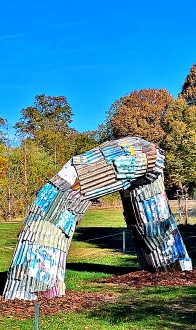
I like this work

As for the artwork on display at the main venue, the less said the better. Of the several hundred exhibits, only two appealed to me. Most of the other ‘artworks’ seemed to be assemblages of diverse objects. Many of these were less artistically arranged than what can be found in many shop window displays.

Naturally, given the way people often think these days, each exhibit was accompanied by an essay that tried to explain the ‘relevance’ of the creation and its relationship to problems that concern ‘woke’-minded people today. I felt that in most cases, the artists’ and curators’ ‘messages’ (written on information panels) were more important than the works’ artistic/aesthetic qualities.

In brief, I was disappointed by the main venue of the Biennale. In previous years, this part of the show contained at least a few outstanding works that appealed aesthetically and did not require reading a contrived explanation to appreciate them.

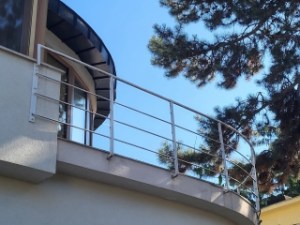
To end on a positive note, I liked the temporary structure that covers the seating area next to a refreshment stall. The shelter was designed by an artist from Pakistan.

[Over the next few days, we will visit some of the other Biennale sites and the many collateral exhibitions, and I hope that I will be able to be more positive about them than what I saw at the Aspinwall venue.]

The first exhibition we visited at the Kochi Muziris biennale in Kerala

OUR FIRST EXHIBITION IN FORT KOCHI (KERALA) 2026

WE HAVE COME to Fort Kochi (Fort Cochin) in the south of India to view art in the town’s Kochi Muziris Biennale. This art show is housed in a wide variety of places in Fort Kochi and its environs. There is a main exhibition area and numerous peripheral venues. The first show we visited in housed in Burgher Street, almost opposite the popular Kashi Art café. At this location, Gallerie Splash from New Delhi was hosting images created by Naina Dalal, who was born at Vadodara, Gujarat, in 1935.

Ms Dalal studied art first at MS University in Vadodara, then at London’s Regent Street Polytechnic, and later at Pratt Graphic Center in New York City. She was one of the first Indian women artists to explore the nude artistically.

The exhibition in Fort Kochi, “An Empathetic Eye”, includes watercolours, oil paintings, and various types of print including collographs. According to Wikipedia:
Collagraphy (sometimes spelled collography) is a printmaking process in which materials are glued or sealed to a rigid substrate (such as paperboard or wood) to create a plate. Once inked, the plate becomes a tool for imprinting the design onto paper or another medium. The resulting print is termed a collagraph.

The works on display in the exhibition were attractive and visually intriguing. Dalal provides fine examples of Indian Modernism that demonstrate her independence from the previously powerful influence of Western European artistic styles on Indian modern art.

Seeing this exhibition made a great start to our exploration of what is on offer during the Biennale that runs until the end of March 2026.