Portraying American women who married British nobility

WHEN A FRIEND invited us to join him at London’s Kenwood House to view an exhibition of portraits by the artist John Singer Sargent (1856-1925), I had some misgivings. In the not-too-distant past I saw an exhibition of his portraits at the Tate Britain, and I left it unimpressed. In that show, the portraits were displayed alongside the dresses that the sitters had worn for their pictures. In contrast, the show, which is on at Kenwood until 5 October 2025, was very satisfying.

Between 1870 and 1914, 102 American women married men in the British peerage, and more than this married into the British upper class. Put bluntly, the men were enriched by their American brides’ money, and the ladies acquired social positions that were highly regarded in British society. Regarding these marriages, Theodore Rooseveldt said:

“I thoroughly dislike … these international marriages … which are not even matches of esteem and liking, but which are based upon the sale of the girl for her money and the purchase of the man for his title.”

Sargent, the artist, made portraits of more than thirty of these brides, and it is a selection of these that are on display at Kenwood in an exhibition appropriately named “Heiress. Sargent’s American Portraits”. Each picture is accompanied by an information panel that gives interesting biographical details about the ladies.

Undoubtedly, Sargent’s grand portraits made with oil paints on canvas are superb. However, even better than these, and there are several on display at Kenwood, are his charcoal sketches. Unlike the paintings that required the subject to attend 6 or more sittings, the charcoal portraits were completed in one sitting. Despite or maybe because of the rapidity of completing the charcoal images, these portraits seem to be even more expressive than the oil paintings upon which he had spent far more time. During a period of 20 years, he completed almost 700 charcoal portraits. Although there might have been one or two of his charcoal portraits at the Tate exhibition, a great proportion of the exhibits at Kenwood were examples of Sargent’s superb charcoal technique. For me, the highlights of this small exhibition were the works executed in charcoal.

I left the show at Kenwood feeling pleased that I had been, and with a greater appreciation of Sargent’s talent than I had before.

Alien Shores in south London’s Bermondsey

THE ARTIST ANSELM Kiefer is said to have remarked:

“I think there is no innocent landscape, that doesn’t exist.”

By Nomoru Minata

For what we see when we regard a landscape is the result of millions of years of geological and meteorological evolution as well many millennia of interventions by biological phenomena including human activities: both constructive and destructive. As the writer and academic Robert Macfarlane wrote:

“We live on a restless crust of earth. Behind the façade of stability, everything is shifting, imperceptibly, but continuously.”

 Artists have been creating images of landscape for many centuries. The earliest known depictions of landscape include Minoan frescoes created in about 1500 BC. The genre of European art called ‘landscape painting’ began in Holland in the seventeenth century. The website of the White Cube Gallery in Bermondsey noted in connection with this:

“17th-century Dutch artists of the Golden Age, during which the genre ‘landschap’ was first named, turned away from religious subjects as an expression of Protestant values …”

Until 7 September 2025, the White Cube at Bermondsey is hosting an exhibition called “Alien Shores”. Curated by Susanna Greeves, this show:

“… explores landscape as a place of memory, imagination, yearning and belonging. Through painting, video, photography and sculpture, the artists included offer speculative, symbolic or surreal depictions of emotional terrain and voyages of the imagination, visions of the distant past or possible futures.”

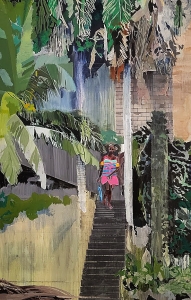
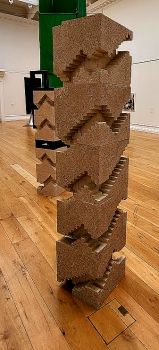
The exhibition includes works by 37 artists, all of whom worked in the twentieth and/or twenty-first centuries. It is a display of modern and contemporary works of art that either depict landscapes or try to evoke thoughts of landscapes. The works are distributed amongst three rooms. In the first two rooms there are videos and kinetic sculptures as well as paintings. A video by Noémie Goudal is particularly fascinating and dramatic. The third and largest room contains a mixed bag of paintings and a sculpture by Noguchi. My enjoyment of the paintings in this room was not 100%. Some of the paintings looked like wall space fillers rather than great works of art. However, it his is not a room to be missed because it contains three outstanding landscapes by Anselm Kiefer. Seeing these in the company of many of the others served to emphasize (to me) what a great contemporary artist he is. Other ‘stars’ in this room were paintings by Minoru Nomata, Georgia O’Keeffe and Marina Rheingantz.  A three-dimensional screen depicting a leafless forest by Eva Jospin in the long corridor of the White Cube also impressed me.

Although I wondered why a few of the artworks were included in the show, the Alien Shores exhibition has much to recommend it. It was fascinating to see how in a time frame of well under 100 years, artists have been tackling their various portrayals of landscape, and the interesting varieties of ways they have done it.

Trekkers beyond the age of 65 should be discouraged

WHILE SORTING SOME old papers, we came across a permit issued to us in Kolkata (Calcutta) in November 2019. It is a document that allowed us to visit Sikkim for five days.

Sikkim, which is a mountainous territory is near to China, in northeast India was an independent kingdom until April 1975 when the king was deposed and its people chose by referendum to become part of India. It is now one of the states of India. Foreigners can visit Sikkim but only after they have obtained a permit. We acquired ours without difficulty in central Kolkata. The wording on the permit lists the places which its foreign holder(s) can visit. The rest of Sikkim is out of bounds.

What I only noticed after finding this permit recently (in August 2025) is that it bears some words of advice:

“Trekker(s) beyond the age of 65 should be discouraged”

From what, it does not say.

Down the slope to an uncertain fate in France and Flanders

A PARABOLIC ARCHWAY made of stainless-steel straddles a pedestrianised roadway on the clifftop near to the harbour in Folkestone (Kent). A few yards east of the archway, the road descends steeply towards the harbour and a pier from which ships used to sail to and from Fance. The impressive metal hoop was inaugurated in 2014 by Prince ‘Harry’, son of King Charles III. It commemorates the one hundredth anniversary of the start of WW1. The roadway that runs along the clifftop and then down to the harbour is now known as Road of Remembrance. On a fence close to the archway, there are thousands of crocheted poppies, lovingly made by women mourning the tragedy of the so-called Great war.

It was along this road and down the slope, formerly known as Slope Road, that during the Great War (1914-1918) millions of soldiers and auxiliary staff marched from nearby Shorncliffe Camp to the harbour, where they embarked on ships that carried them across the English Channel to war-torn France. As a BBC website page (www.bbc.co.uk/news/uk-england-22892729) related in connection with the roadway:

“For many of the millions of servicemen making their way to the trenches of World War I it was the last part of Britain they stepped foot on.”

The archway, which is close to the steep slope is called the Step Short Memorial Arch because as the website explained, “Step Short” was:

“… the order given to the marching men to shorten their stride as they went downhill.”

When we visited Folkestone in July 2025, we were able to walk beneath the arch, see the poppies, and read the various emotional commemorative information panels near it. However, the sloping part of the road leading down to the harbour was closed off for repairs. The banks lining the slope had begun to subside making it hazardous to be on this historic stretch of road.

I was very much moved by the Road of Remembrance, the archway, and the various memorials. For many of those who marched down that steep slope, it would be the last time they would ever see England. For, as is recounted in a British Parliamentary website (www.parliament.uk/business/publications/research/olympic-britain/crime-and-defence/the-fallen/), during WW1:

“… 880,000 British forces died, 6% of the adult male population and 12.5% of those serving.”

That means that about one out of every eight men walking along where the arch now stands and then down the slope would die across the Channel in France or Flanders.

The pointlessness of war.

An Englishman’s home is his castle

IN 1604 THE COURT of the KIng’s Bench made a judgement in the case of Peter Semayne v Richard Gresham. It was a trial during which Peter Semayne was suing his tenant Richard Gresham for an outstanding debt. The Court found against Semayne on several counts, one of which was: “It is not a felony for a man to defend his house to the death.” In 1605, the lawyer and politician Edward Coke (1552-1634) summarised the case in the fifth volume of his “Reports”. Amongst his conclusions about this case, he wrote:

“… the house of every one is to him as his castle and fortress, as well for his defence against injury and violence, as for his repose …”

And by the eighteenth century, the words “An Englishman’s home is his castle” had come to encapsulate what had been decided in law during the trial mentioned above.

Visitors to the British seaside cannot miss seeing rows of single storey beach huts close to the beach. Holidaymakers and local inhabitants hire or purchase these tiny huts to store their deckchairs; bathing equipment; simple cooking equipment; and other items to make spending a day at the beach enjoyable. Each hut is its owner’s or tenant’s small dwelling by the beach. However, as we learned during a visit to Minnis Bay in Kent, nobody can spend the night in a beach hut. They have to be vacated and locked up at the end of the day. Seeing people using these small structures, I felt that they regarded their huts as extensions of their homes, but unlike their actual dwellings, these temporary homes cannot be regarded as their castles.

The Sunken Boat and the sea at the Turner in Margate (Kent)

I HAD NEVER HEARD of the artist Anna Boghiguian (born 1946) until we visited her exhibition at the Turner Contemporary Gallery in Margate (Kent). Anna was born in Cairo (Egypt), where she studied political and social sciences at The American University. She also studied fine arts and music at Concordia University in Montreal (Canada). The works on display at Margate until 26 October 2025 are a superb synthesis of both her interests in world affairs and artistic talents.

Anna’s show at the Turner is called “The Sunken Boat: A glimpse into past histories”. It consists of three installations, one in each of three spacious galleries. One gallery contains an installation comprising a set of sandy beaches littered with the remains of wrecked boats and sails along with other flotsam and jetsam. The walls of the room have frames containing images relating to historical and ecological events. Regarding this fascinating and beautifully composed exhibit, the gallery’s website noted that the installation:

“… the centrality of the sea in shaping histories of labour, trade, ecological collapse, and political conflict. It combines sculpture, painting, cut-out figures and sound, inviting reflection on rising sea levels and geopolitical tensions around undersea communication cables.”

Another room has a cluster of cut-outs depicting famous people of the past including Einstein, Gandhi, Queen Victoria, Napoleon, Pythagoras, and many others. Each of the cut-outs are colourfully painted and are suspended from the ceiling by fine threads, and hang above a large black and white chess board. They rotate gently in reaction to movements of the air caused by motions of the viewers.

The third gallery contained an installation that evoked being under the sea. Figures either swimming or drowning are suspended from the high ceiling. The room is lit with a blueish glow that gives the viewer the feeling of being below the sea’s surface. The floor of the gallery is a representation of the seabed, with undersea cables, marine creatures and plants, assorted debris, and other objects one might expect to find there. The lighting was chosen to evoke the reduced illumination that one can imagine exists deep below the sea’s surface. It reminded me a little of the church at Tudely (Kent) whose stained-glass windows by Chagall create the same impression. In this church, Chagall designed the windows to create the impression of being below the sea because the edifice is dedicated to the memory of someone who died by drowning. Unlike the church at Tudely, the installation at the Turner expresses a less specific, more global concern: that of the sea’s ecology at present and in the future.

Words can hardly do justice to the amazing show at Margate. Without doubt, it must be seen to be fully appreciated. The exhibition illustrates that  Anna Boghiguian is a competent and imaginative artist with a great grasp of past and contemporary political and present ecological challenges facing the waters in our seas and oceans. And she knows how to express these matters in imaginative and compelling ways,

The cock and lion

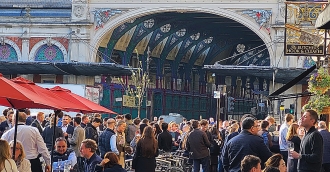
THERE IS A PUB in London’s West End called “The Cock and Lion”. It is located in Wigmore Street and was established in 1786. Its sign is a large golden lion with a tiny golden cock standing on its back. I wonder what this signifies.

Is the lion Great Britain and the cock France? If this is the case, why is the emblem of the once traditional enemy and rival of England perched on the back of an emblem of Britain? Does anyone know the meaning of this combination of bird and beast?

A great exhibition of the works of a British artist

UNTIL I ATTENDED the superb display of the paintings of Edward Burra (1905-1976) at a special exhibition at London’s Tate Britain, I associated him only with depictions of the USA. Despite his Italian sounding surname, Burra’s father came from a long-established British family. Edward trained as an artist at Chelsea School of Art, then at the Royal College of Art. In 1925, he contracted rheumatic fever, and for the rest of his life he suffered ill-health. However, this does not seem to have affected his ability to produce an impressive number of beautiful paintings.

The exhibition at Tate Britain displays Burra’s paintings and drawings chronologically. Throughout his life, he produced works of art that are not only attractive and intriguing but also sensitive portrayals of his views of the times in which he lived. Some paintings exhibit his interest in surrealism, but although many of his paintings have a dreamlike quality, they are in the main not what could be described as Surrealist. His images of France, although highly original and imaginative, capture the ‘atmosphere’ of French life between the two World Wars. Burra was keen on jazz. Many of his paintings include jazz musicians, particularly those he made while visiting the USA, and New York City in particular. The exhibition includes a collection of some of the artist’s collection of jazz music records.

Burra lived through two World Wars and the Spanish Civil War. The Tate’s exhibition includes many of his paintings depicting the horrors of these conflicts. The final room of the show displays Burra’s portrayals of Britain. The artist’s depictions of landscapes is stylistically original, slightly abstracted, but evokes their nature perfectly.

Whether Burra is painting people or objects or machinery or landscapes, the impact of his painting is in each case powerful. This wonderful exhibition will continue until 19 October 2025, and is well worth seeing. I am glad I went because now I realise that although his paintings of New York and jazz are wonderful, they are only a fraction of Burra’s amazingly artistic output.

Numbered pebbles to remember the dead in Folkestone

ON THE FIRST of July 1916, 19 thousand two hundred and forty British soldiers were killed during the first day of the Battle of the Somme. A memorial on the Leas Cliff promenade in Folkestone, Kent, remembers them, not by name but by number.

In 2008, the artist Mark Wallinger created an artwork called “Folk Stones”, which can be viewed at Leas Cliff. It consists of a square area containing 19,240 pebbles. Each one represents one of the victims killed on that first day of battle in 1916. Just as each of the soldiers had his own service number, the artist has numbered each of the stones in his artwork.

It is a simple creation, but one that is very moving.