IN THE LATE 1960s, my mother used to buy taramasalata from the two Greek Cypriot shops that used to be in London’s Goodge Street area: one was in Charlotte Street, the other in Goodge Street. Taramasalata is a pink* paste made with fish roe (‘taramas’ in Greek; ‘tarama’ in Turkish). I still enjoy eating the stuff. Typically, good taramasalata contains about 8 to 10 % cod’s roe by weight and other ingredients. When my mother discovered that most of the bulk of the taramasalata was bread, she felt swindled. She felt that it was unfair to describe taramasalata as a fish paste when most of what was in the container was bread. It was, she felt, an expensive way to purchase soggy bread.
So, one day she decided that she would make her own taramasalata, and hers, unlike that which she had purchased from the Greek Cypriot shops, would be unadulterated with bread. Her version omitted the bread. The result was so incredibly salty that it was inedible. What she had demonstrated was that the traditional way to prepare this fishy dip using bread was not a load of ‘codswallop’.
DURING OUR RECENT visit to east Kent, we spent two nights in a bed and breakfast (‘B&B’) on Spencer Road at Birchington. Despite visibility being restricted by torrential rain when we arrived at the accommodation, I was able to see that there was an attractive sgraffito frieze around the house at the level of the first floor. Even in the poor light, I could make out that frieze was created in the Arts and Crafts Style, which was popular in the last quarter of the nineteenth and first quarter of the twentieth centuries. Our B&B was called The Old Coach House, and I will explain why soon.
Visitors to English coastal towns will have seen the huge numbers of bungalows (single-storey dwellings) that they contain. What many people might not know is that “… England’s first bungalow was built in Westgate in 1867” (www.birchingtonheritage.org.uk/articles/bungalows.htm). Birchington, which is a few miles from Westgate was home to the country’s first bungalow estate. This comprises five bungalows, each with its own watch tower. They are next to Coleman Stairs, which is a steep path leading down from the clifftop to the seashore. The bungalows, close to the cliff edge, were ready for use in 1880 and are accessed via a private lane from Spenser Road.
Each of the bungalows was provided with its own coach house, which accommodated the householder’s servants, carriages, and horses. Our B&B was one of the coach houses. It has been converted into a residence. Our first-floor bedroom would have once been one of the servant’s rooms. A small staircase leads from the ground to the first floor. This was added long after the building ceased to be a coach house. Before this was added, the servants accessed the first floor by an outside staircase, which no longer exists,
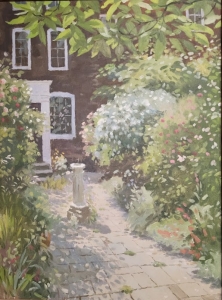
The sgraffito friezes on each of the three former stable blocks that we saw are in good condition. The coach houses were built in about 1882 and designed by John Pollard Seddon (1827-1906), who was closely associated with the Pre-Raphaelite group of artists. The sgraffito work on the coach housed is said to have been created by the sculptor George Frampton (1860-1928), whose other works include the Peter Pan statue in Kensington Gardens and a statue of Queen Victoria in the grounds of the Victoria Memorial in Kolkata. An article published in the Thanet Times in the 1970s revealed:
“Frampton as a youth was a friend of the artist Solomon J. Solomon, a well known artist of his day, who had bought the annex, “The Porch,” in Spencer Road, Birchington, which was the coach house to his main house called “Whitecliff” – one of the famous Tower Bungalows. George Frampton came to live with the Solomon’s when he was a penniless sculptor, fresh from years of apprenticeship to his profession. Solomon wanted to help Frampton and suggested that he might create frescoes round the upper part of his new house. Frampton made this a labour of love. He was 22 years old at the time – 1882 ,,, But the name of his benefactor is almost forgotten – but not Frampton’s frescoes.” (www.birchingtonheritage.org.uk/)
When we booked the B&B, we had no inkling of its historical interest. We had a comfortable stay there, and were well looked after by Tim, our friendly host. His affectionate dog Louie added to our enjoyment of the place.
IN RECENT YEARS, the seaside town of Margate in Kent has become much more of a “trendy” destination than it used to be. From being yet another coastal resort, it has become a magnet for those interested in contemporary art. This is because of the presence of the Turner Contemporary Gallery, Tracey Emins’s gallery, and the Carl Freedman gallery … to mention but a few places. With the influx of tourists with sophisticated tastes, the town has become home to a range of restaurants, which is more varied than in many other seaside towns in north and east Kent.
About 6 years ago, a husband and wife from Cairo (Egypt) set up a tiny restaurant on a corner plot in the old centre of Margate. It is called Alexandria Café. The owners chose the name not because they come from Alexandria, but because like the Egyptian city, Margate is by the sea.
Only open on Fridays, Saturdays, and Sundays at present, this restaurant serves beautifully prepared, tasty Egyptian dishes at very reasonable prices. We tried koshari, falafel, baba ganush, pickled tomato salad, and mint tea. Although these are all without meat, non-veg dishes are also available.
The tiny, comfortable eatery is decorated with photographs of Egyptian film stars. A small television screen was showing old Egyptian films.
A few doors away from the lovely Egyptian cafe, there is an ice cream parlour. What makes it special is that in 1866, Karl Marx stayed in the building.
We did not try the ice cream, but I can safely say that of all the places I have eaten in Margate, having visited the place many times, Alexandria is the best.
THE TRAINS THAT used to run into Folkestone Harbour station have not done so for many years. The station has been restored and repurposed as a pleasant, tasteful leisure amenity.
The signal box that used to regulate rail traffic in and out of the station still stands. It is now used as a café. With fine views of the harbour and Folkestone town, the signal box now contains equipment for making coffees and seats for customers. Apart from being an interesting old building, the old signal box contains the levers that used to operate the points within the station and on the bridge across the small harbour that connects it to the main land.
The café is not only housed in an original building, but also the coffee made there is above average in quality.
This stone cannon ball was fired by the English at the siege of Boulogne in 1544. It was returned to England by the people of Boulogne as a gesture of friendship in 1976.
WHEN MAHATMA GANDHI came to England in 1931, he disembarked at Folkestone in Kent. In those days there boats docked alongside a pier, and then boarded trains at a station on the pier. The pier has long since ceased to be used to service cross channel and other passenger boats, but it and the station have been preserved and converted into a tasteful leisure amenity.
THE MOBILE GULL APPRECIATION UNIT was created by Mark Dion in 2008 for the 2008 Creative Folkestone Triennial. On wheels, this enormous model of a seagull can be towed to different locations. The seagull can be entered and is used by people trying to persuade viewers to understand and appreciate gulls, which are often regarded as pests. Personally, I have nothing against these creatures.
Folkestone in Kent has become a town filled with art works. Every 3 years it hold an art festival, the Folkestone Triennale. This year it began two days ago. This is one of the permanent works.
NEXT TO THE KITCHEN in our family home in Hampstead Garden Suburb, there was a wood framed bell board. It consisted of a set of circular windows, each labelled with the name of a room in the house. There was an old bell button in my bedroom. If you pressed it, a pendulum hanging behind the circular window labelled for my room would begin to swing in the bell board. Had we had domestic servants, a servant would have heard the bell ring, then looked at the bell board to see which room’s pendulum was swinging, and then attend to whomever was in that particular room.
Part of the bell board at Ightam Mote
I was reminded of this antiquated bit of domestic equipment when I saw a similar one at Ightam Mote, a lovely old mansion owned by the National Trust.
Our house was built in 1908. This was during the era when these bell boards were popular. Although we did not have servants at home, earlier occupants most probably did.
When our daughter was much younger, she had an elderly babysitter called Bridie. Before WW2, Bridie worked as a domestic servant at a house in Golders Green. She told us that she had to wear uniforms: one during the daytime, and a different one in the evenings. I never asked her, but I would not have been surprised if that house in Golders Green also had a bell board.
My wife remembered that her family home in Kolkata had a similar bell board. There were servants in the house, but to discourage laziness, her parents had the bell in her bedroom inactivated.
Just as many associate Spain with sunshine, plenty of folk think of rain when they consider England. Yet, ironically, there is currently a shortage of water in the country. This is partly because there has been insufficient rainfall and also because for years, governments have neglected maintaining reservoirs and other water sources and water companies have been prioritising profit over provision of water to their customers.
So when it rained today after many weeks of dry weather, we breathed a sigh of relief. But this will be short-lived, because what fell today was literally a drop in the ocean.
THE CARTWRIGHT HALL Art Gallery in Bradford has a collection of paintings by David Hockney (born 1937), some of which he did when he was as young as 16. These early paintings, though not as adventurous as his later work, show that even as a teenager, he was a skilled artist. He studied art at Bradford College of Art. Then, between 1959 and 1962, he continued his studies at London’s Royal College of Art (‘RCA’). It was after his arrival in London that Hockney began experimenting with new ways of expression in painting. Apparently, he was not an ideal student in the eyes of the RCA. For example, he did not attend lectures and did not do the prescribed coursework. Yet, he created numerous paintings that are evidence of his skilful breaking away from conventional painting. Today, we caught the last day of an exhibition of the paintings he did between 1959 and 1963. It was held at Hazlitt Holland-Hibbert Gallery in Mayfair’s Bury Street.
Detail from the Diploma etching
The gallery’s website explained:
“Exhibited together for the first time, these early paintings embellished with love hearts, graphic text, suggestive shapes and depictions of friends and lovers reveal David Hockney’s precocious talent during the most formative chapter of his career.
In 1959, Hockney moved from Bradford to begin his studies at the Royal College of Art, London, where he was determined to experience the capital’s postwar bohemian culture as well as absorb the modern and contemporary art in its museums and galleries. The exhibition focuses on this period before Hockney relocated to the United States at the end of 1963 and reveals his discovery of an unmistakably personal style of painting that would establish him as the most important artist of his generation.”
It was exciting to view the images he created during this important period of his artistic development. However, for a while the RCA failed to appreciate him, and for a while threatened not to award him his degree. An article in Wikipedia revealed:
“When the RCA said it would not let him graduate if he did not complete an assignment of a life drawing of a live model in 1962, Hockney painted ‘Life Painting for a Diploma’ in protest. He had refused to write an essay required for the final examination and said that he should be assessed solely on his artworks. Recognising his talent and growing reputation, the RCA changed its regulations and awarded him a diploma.”
An etching in the exhibition, “The Diploma”, created in 1962, reflects Hockney’s protestation. Since graduating from the RCA, Hockney has been given awards by many prestigious institutions, and was made a Royal Academician.
Having seen his earliest known works in Bradford, the works done while at the RCA, and later creations, it is easy to understand why Hockney is now regarded as an artist of the highest calibre.