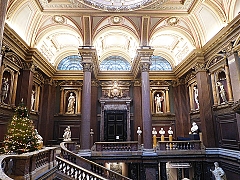
IT IS TEMPTING to concentrate on the wonderful collection of exhibits in Cambridge’s Fitzwilliam Museum, but you should spare some of your attention for the magnificent decoration of some of its galleries. Look up from the paintings and display cases to see superb ceiling decorations above you, and also around you when using the grand staircase. You are sure to be amazed.
The museum is housed in a neo-classical edifice initially designed by George Basevi (1794-1845), architect of London’s Grosvenor Square. After Basevi’s death, the planning of the structure was completed by Charles Robert Cockerell (1788–1863). Built to house the collection bequeathed to the University of Cambridge by Richard FitzWilliam, 7th Viscount FitzWilliam (1745-1816), the present museum was opened to the public in 1848. Over the years since then, the museum has been enlarged by adding newer buildings and now it is home to about 500,000 artefacts.
Years ago, I remember reading (I cannot remember where) a comparison of a museum in the USA designed by Ludwig Mies van der Rohe (1886-1969) with another one, the Guggenheim in Manhattan, designed by Frank Lloyd Wright (1867-1959). Both buildings are elegant but that by Mies Van der Rohe modestly allows the exhibits to grab the viewer’s attention more than the architecture, whereas the unusual design of Wright’s building competes with the artworks for the viewer’s attention. The internal decoration of the older galleries of the Fitzwilliam are sufficiently eye-catching to be able to compete with the exhibits housed in them, but somehow, they hardly do this. That is why I am asking you to take your eyes off the exhibits if only to glance briefly at the décor of the galleries,
THE SCYTHIANS ROAMED around the steppes of Central Asia from about 800 BC to about 300 BC. I write “about” because very little is known for certain about this group of people, also known as the Saka-Scythians or Saka. My interest in the Scythians, who were dependant on horse riding for their not inconsiderable exploits including ruling most of Central Asia, was aroused by discovering that they used the double-headed eagle, a symbol that fascinates me, in their handiwork. So, it was with great excitement that I visited the special exhibition of Scythian gold at the Fitzwilliam Museum in Cambridge. The show, “Gold of the Great Steppe”, is on until the 30th of January 2022.
The exhibition is well worth seeing. The gold and other items found in Scythian grave mounds in Kazakhstan are superb examples of sophisticated technology and fine craftsmanship and they are displayed beautifully. The labelling is clear and easy to read. However, what is very clear from what is written on these labels is that almost nothing concrete is known about the people who created the exhibits. The curators make numerous reasonable-sounding suggestions about the possible ways of life that the items suggest, but these seem to me to be mainly intelligent guesswork. The Scythians left no written records. What we know about them depends mainly on metallurgical and genetic findings, as well as a few linguistic studies. Various Ancient Greek writers have written about them, but their opinions were often biased against them. So, it is not surprising that visitors to the exhibition are left little wiser about the people who created the magnificent artefacts on display. Interspersed amongst the items found in the graves in Kazakhstan there are modern recreations of how the Scythians and their horses might have looked in life. I felt that these mock-ups were rather too speculative for my taste. That said, I was pleased to have seen the show.
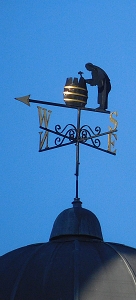
LOOK UP AND if your eyesight is reasonably up to scratch, you might well be lucky enough to see a weathervane on top of a church steeple or some other high point on a building. The ‘vane’ in weathervane is derived from an Old English word, ‘fana’, meaning flag (in German the word ‘Fahn’ means flag). Weathervanes are simple gadgets that indicate the direction of the wind. They usually consist of an arrow attached by a horizontal straight rod to a flat surface that catches the wind. The rod is mounted on a vertical support in such away that it can rotate as the wind catches the flat surface. The horizontal rod with the arrow rotates so that it offers the least resistance to the prevailing wind. Beneath the rotating arrow are often indicators that are labelled with letters denoting the four points of the compass. If, for example, the wind begins to blow from east to west, the horizontal rod will rotate so that the arrow is above the ‘E’ denoting east. Some weathervanes substitute the horizontal rod with a single flat asymmetric object that can catch the wind and rotate. Often the object seen above churches is a cock or other bird, whose beak will indicate the direction of the wind. I suppose that for birds wind direction is quite important.
The weathervane is not a recent invention. It was invented in the 2nd century BC both by the Greeks and the Chinese but separately. Some of the oldest Chinese weathervanes were shaped as birds and later, at least by the end of the 9th century AD, bird shaped vanes became used in Europe. Although avian weathervanes are still very common, a wide variety of other shapes have been used. Sundials, weathervanes, now archaic, only give an approximate indication of time and wind direction respectively. However, unlike sundials, which do not work when the sun is not shining, weathervanes work in all weather conditions and in day and night, although they are somewhat difficult to see at night-time. Despite their relative inaccuracy compared with modern instruments for measurements of wind, weathervanes are attractive adornments to buildings both old and new.
IT IS NOT OFTEN that I feel the need to write about answering the call of nature but after a recent visit to Hampstead’s South End Green, I must satisfy the urge.
There is a yard at South End Green, where buses serving the route number 24 wait before setting off to Victoria station. Long ago, this yard used to have tram tracks as it was the terminus of a tram line. A lovely small café, Matchbox by name, stands beside the yard. Its owner, Mirko, a friendly Slovenian, serves excellent hot beverages and a range of mouth-watering snacks, both sweet and savoury. The nearest public toilets are across the yard, almost opposite to Matchbox.
The toilets are below ground level and accessed by staircases with cast-iron structures above them. It was only on our most recent visit to South End Green, in December 2021, that I had reason to descend into the ‘gents’, and I am pleased that I did, not only for reasons related to my physiology but also to satisfy my curiosity.
The ‘gents’ is magnificent, with its white glazed brick walls decorated with bands of light green bricks, its long narrow, black and white chequered floor, its polished dark wood cubicles, and its row of white urinals all topped with grey (marbled with white streaks) granite separators. Although there is electric lighting, a skylight admits some natural light.
The underground toilet facilities, both the men’s and the ladies’, were constructed in 1897 for the benefit of passengers using the tramway. Stephen Emms, writing in the “Kentish Towner” in October 2013, noted that the gent’s underground facility at South End Green was a pick-up place used by homosexuals. He noted:
“But most memorably South End Green is the only public toilet still in use known to have been visited by iconic 1960s playwright Joe Orton. Apparently it was his “favourite pick-up point” too””
You might be relieved to learn that my recent brief visit was completely uneventful.
A REMARKABLE ENGINEER and furniture entrepreneur Jack Pritchard (1899-1992) and his family lived at 37 Belsize Park Gardens, in London’s Hampstead district. before WW2. Pritchard, who studied engineering and economics at the University of Cambridge, joined Venesta, a company that specialised in plywood goods. It was after this that he began to promote Modernist design. In 1929, he and the Canadian architect Wells Coates (1895-1958) formed the company, Isokon, whose aim was to build Modernist style residential accommodation.
Pritchard and his wife, a psychiatrist, Molly (1900-1985), commissioned Coates to build a block of flats in Lawn Road on a site that they owned. Its design was to be based on the then new ideas for communal housing that had been realised in Germany including the influential Bauhaus in Dessau. The flats are close to Fleet Road and the Mall Studios in Parkhill Road. Completed in 1934, they were, noted the architectural historian Nikolaus Pevsner, “… a milestone in the introduction of the modern idiom to London.” He continued, writing in 1952, clearly critical of the edifice, which:
“…put on a forbidding face towards the street, with large unmitigated concrete surfaces … It is all in the spirit of revolution, unaccommodating and direct to the verge of brutality.”
Well, I quite like the building’s elegant simplicity. In the basement space of the block, there was a refreshment area known as the Isobar. This and its furniture were designed by Marcel Breuer (1902-1981). Regularly, exhibitions were held in the Isobar and, according to an on-line article in The Modern House Journal these were attended by artists including Adrian Stokes, Henry Moore, Barbara Hepworth, Ben Nicholson and Naum Gabo. The article also noted that this refreshment area was frequented by modernist architects such as Erich Mendelsohn, Serge Chermayeff and, Wells Coates, as well as by left-wing politicians. Pritchard occupied the penthouse flat. In 1969, he sold the block, and now it contains accommodation for 25 keyworkers on a shared ownership basis and 11 flats are in private ownership. The block, first known as the Lawn Road Flats, is now called ‘Isokon. Lawn Road Flats’.
T F T Baker, Diane K Bolton and Patricia E C Croot, writing in A History of the County of Middlesex: Volume 9, Hampstead, Paddington, noted that the Lawn Road Flats were built partly to house artistic refugees, who had fled from parts of Europe then oppressed by dictators, notably by Adolf Hitler. Some of them had been associated with the Bauhaus. These included the architect and furniture designer Marcel Breuer, the architect Walter Gropius (1883-1969), and the artist and photographer Laszlo Moholy-Nagy (1895-1946). All three of them are regarded as being masters of 20th century visual arts.
Despite both having come from bourgeois backgrounds, the Pritchards aimed to free themselves from middle-class conventions. The concept and realisation of the Lawn Road Flats, were important landmarks in their quest to achieve a new, alternative way of living. It is accurate to say that the atmosphere that prevailed in the community that either lived in, or frequented, the Lawn Road Flats was predominantly left-wing and extremely welcoming to cultural refugees from Nazi Germany. Probably, it had not been anticipated that the place should become a convenient place for Stalin’s Soviet spies to use as a base. According to a small booklet about the flats Isokon The Story of a New Vision of Urban Living, published in 2016, the flats were home to the following espionage agents, who had been recruited by the NKVD in Central Europe: Arnold Deutsch, Simon Kremer, Jürgen Kuczinski, and Brigitte Kucynski Lewis. Jill Pearlman, one of the book’s several authors, noted that they found the Lawn Road Flats convenient for several reasons:
“Above all, they blended inconspicuously into the sociable community of tenants there. Many tenants too were refugees from Central Europe … Even the Lawn Road Flats building worked well for the spies. One could enter and exit any unit without being seen … no one could see in. At the same time, the cantilevered decks on each floor provided the tenants a perfect vantage point from which to survey the street below.”
Today, there is a small exhibition area in the garage of the flats. This is open on some weekends, but I have yet to visit it.
I DO NOT KNOW why there is a huge Albanian flag hanging outside The Cow pub in Notting Hill’s Westbourne Park Road. The large red flag decorated with a double-headed eagle has been fluttering outside the pub for several weeks, if not longer.
I walked into the colourfully decorated pub, for many years a local favourite both for drinkers and diners, and asked two members of staff if they knew anything about the flag. They did not have any real idea, but suggested that it might be because at least one long-serving member of the pub’s current staff is Albanian. A quick search of the internet revealed nothing.
The flag was put up long before the 28th of November, Albania’s Flag Day commemorating the founding of independent Albania in 1912, and is still flying. Maybe, one of you out there can tell me more about the reason that The Cow has an Albanian flag.
THE ARCHITECT JOHN Soane (1753-1837) was skilled in designing buildings with features to permit natural light to reach parts of them that were far away from their exteriors. Good examples of this were the two homes he designed for himself, one in Lincolns Inn Fields, now the Soane Museum, and the other in Ealing, the recently restored Pitzhanger Manor. Another superb example, which we visited recently (December 2021) is the Dulwich Picture Gallery in south London. Completed and opened in 1817, it became the first picture gallery in England that was open to the public.
Light enters Soane’s galleries at Dulwich from above via overhead sky lights. These were placed in such a way that they illuminate the hanging spaces without allowing direct sunlight to hit the paintings on the walls. This system has since been adopted in many other art galleries. Newer rooms, lit entirely by artificial lighting, are used for temporary exhibitions including that of the woodcuts of the American artist Helen Frankenthaler (1928-2011), which we saw on our latest visit. Compared with Soane’s galleries, these newer ones are far less impressive, and despite the modern lighting they feel claustrophobic and rather gloomy.
The permanent collection of old masters, which is hung in Soane’s original galleries, is fabulous. Some of the paintings were parts of collections made before the 19th century. Others were supplied by the artist Sir Francis Bourgeois (1753–1811) and his business partner, the art dealer and collector, Noël Desenfans (1744–1807). Together they ran an art dealership in London and were commissioned in 1790 to purchase a collection of paintings for the then King of the Commonwealth of Poland and Lithuania, Stanisław August Poniatowski (1732-1798). It took them five years to do this but by 1795, the Commonwealth had been dissolved. The collection remained in England. After Desenfans died, Bourgeois inherited the collection and then commissioned Soane to design a gallery to house it. The superb gallery at Dulwich came into existence. Soane included within it a small circular mausoleum in which the remains of both Desenfans and Bourgeois have been placed. Rather irreverently, I felt, it was being used to screen a video about the artist Helen Frankenthaler.
In 1944, during WW2, the western façade of Soane’s gallery was badly damaged by bombing (a German V1 flying bomb) but it has been well-restored. Later, in 1999, a new café and other facilities in a modern style were built to the designs of the architect Rick Mather (1937-2013).
As for the exhibition of works by Frankenthaler, this was a delightful surprise. It is a collection of colourful abstract woodcuts that are the result of years of the artist’s complex and imaginative experimentation. Many of the works reminded me of, but were not identical to, the subtleties of Japanese ceramic glazes. Despite being displayed in galleries far less satisfactory than those designed by Soane, this as an art show well worth visiting before it ends on the 18th of April 2022.



 yamey
yamey 