
It might sound odd
Something is moving below my bed
Rabbits, it seems

It might sound odd
Something is moving below my bed
Rabbits, it seems
I FIRST MET THE GIRL who is now my wife at University College London (‘UC’). The college was founded in 1826 for Jews, atheists, dissenters, and women. Its principal founder was the philosopher Jeremy Bentham (1748-1832). His mummified body is on display in one the college’s buildings.

Several thousand miles from UC in the city of Kolkata is the now disused Alipore Jail, which was opened in 1864. It was within its walls that many Indian freedom fighters were interred and some executed, by the British when they were ruling India.
Today, the prison has been highly restored and is open to the public as a museum. Here one can see the cells in which, for example, Jawaharlal Nehru, Sri Aurobindo, and Subhas Chandra Bose, were incarcerated. Visitors flock to se the gallows and the autopsy room nearby. Other attractions include the prison hospital and the centrally located ‘watch tower’. As one explores the vast prison, the air is filled with patriotic songs, including “Vande Mataram” blasting out of loudspeakers.
The watch tower is an octagonal building with windows on each of its eight sides. It is an example of a panopticon, a structure invented by Jeremy Bentham in 1787. The panopticon was an institutional structure from which guards (of a prison or a mental asylum) could survey the whole institution. It was to be positioned so that the inmates/prisoners could all see the panopticon. It was designed so that the custodians could look out but the inmates could not see within it. Bentham’s idea was that if the inmates could not see into it, they could not know whether or not they were being watched. Thus, as few as one custodian could keep an eye on the whole institution and the inmates had to behave all the time as they had no idea whether they were under observation. I suppose the system worked because panopticons were constructed in many prisons including that at Alipore.
The panopticon was invented long before cctv and traffic speed cameras were even thought of. Like the panopticon, from which inmates could never be sure that they were not being observed, cctv and speed cameras can employ the ‘panopticon effect’. As you can never tell whether a cctv camera or a speed camera is switched on, when you spot one, it is wise not to do anything wrong, which can be detected by these devices.
When we visited the former prison, now museum, we had no idea that it had a connection with our alma mater, UC. Information panels on the walk of the watch tower include a portrait of Jeremy Bentham alongside some information about his invention. A visit to the jail is worthwhile but do not go on a Saturday afternoon when it is swarming with visitors. It is ironic that the sturdy bolts of the doors of the cells have to be kept locked, not to keep the inmates confined but to prevent the eager visitors from entering them.
THE CHURCH OF ST JOHN in central Kolkata was built by the British East India Company in the 18th century. Its foundation Stone was laid by Warren Hastings in 1784. We had visited it today, the 13th of January 2023, mainly to see the magnificent painting of the Last Supper by Johann Zoffany (1733-1810). We also spent time looking at the memorials that line the walls of the church. Suddenly, my wife pointed at one of them, which is of great interest to me at the moment. It commemorates James Pattle, who died in 1845 aged 68, an his wife Adeline, who died the same year aged 52. Whereas James is buried in London, Adeline was lost at sea.

My interest in this couple is related to a book I am writing about one of their daughters, who became one of the most famous British photographers during the 19th century. You will learn more about her after I publish my book.
James was born in Calcutta, as the city was named in his time. He was educated in England, and returned to Calcutta, where he became a High Court Judge. Adeline was born in French Pondicherry. Her maiden name was De l’Etang. Her father was a French nobleman who has fled from France to French India after the Revolution. He had been in charge of the French Royal stables and became important in the welfare of the East India Company ‘s horses in Calcutta . Her mother Therese had some Indian ancestry. James and Adeline married in 1811 at Bhagulpur in India. They had 10 surviving children.
⁸After James died in his home on Chowringee, he was placed in a barrel of preservative spirits so that, according to his wishes, he coukd be buried in London beside his mother in Marylebone Parish Church. Adeline travelled from Calcutta to London on the same ship as her husband’s corpse. Adeline died at sea according to the memorial in St John’s, but this might be incorrect. In any case, Adeline died a few months after James.
James’s remains did reach England, but they are interred at St Giles Church in London’s Camberwell. It is in this church, not the one in Marylebone, where his mother was buried.
The memorial in St John’s Church must have been placed because his fellow British citizens held him in high regard. The memorial was also a token of love given by their sorrowful childrenAs for his famous daughter, I will leave you in suspense!
THE PRESTIGIOUS TOLLYGUNGE Club, where we are staying in Kolkata, is close to a metro station. The Club’s manager recommended that we used it to reach the city centre quickly rather than taking a much slower taxi into town.

The Kolkata metro, which now has three lines, began operating in 1984.
We travelled from Mahanayak Uttam Kumar Station, which is above ground to Park Street, which is subterranean. At the ticket office each traveller is given a circular plastic counter in exchange for the fare, which depends on the distance to be travelled. At a barrier operated electrically, the counter is placed on a designated panel, and the gate opens to admit the traveller to the platforms.
The clean trains are very efficiently ventilated with an air-conditioning system. There are sections of the carriages for ladies only. Passengers were using their mobile phones in the underground stretches of the journey, which suggests that, unlike in London either broadband or WiFi is available on the train while in a tunnel.
Electronic screens provided information about the journey and the use of the trains in Bangla, English, and Hindi. Announcements made over a loudspeaker system were in Bangla and English.
The train ran smoothly and passengers seemed very calm and polite. The journey was twice as fast as if we had gone by road. Although we travelled at a quiet time of day, the train was quite full. I imagine that during rush hours, we might not have been so comfortable.
All in all, our brief experience of the metro was very satisfactory. After disembarking at Park Street station, we bravely crossed a six lane main road to reach Park Street, which we discovered has now been renamed ‘Mother Teresa Sarani’, but most people still call it by its older name.
WHEN WE LANDED at the huge airport that serves Kolkata (Calcutta), it looked much as it did 3 years ago. Only one of the 6 or 7 baggage retrieval conveyor belts was in use and the vast airport seemed almost empty. The situation was the same when we last used it in December 2019.
We made the long ride from the airport to South Kolkata in a vehicle that was not available 3 years ago: an electric taxi. While being driven in this advanced form of vehicle, I wondered whether much else had changed in the city. Although there is much new construction at the periphery, it seems that delightful old Kolkata simply looks a little older.

A visit to the busy New Market (aka ‘SS Hogg Market’) revealed little obvious change. Our first port of call was at the excellently and tastefully stocked Modern Book Depot, where we chatted with the owner and made a few purchases.
Our search for a small funnel took us around the market buildings. A small store crammed full of kitchenware was able to fulfil our quest. We had been looking for this simple item in three other cities – in vain.
To our great relief, Nizam’s restaurant looked much as it has done for many decades, although an additional dining area has been added. The walls of the two older eating areas are decorated with framed theatre (English and Bengali plays) and cinema posters (mainly films made in India).
Nizam’s was founded in 1932, and has been well-known for its tasty kabab (‘kathi’) rolls ever since. A paratha is fried in oil on a tava, and cooked mutton or chicken is placed on it plus or minus a a beaten egg. When the paratha is ready, it and its contents are rolled up and wrapped tightly in paper. According to the customer’s choice, chillies can be added before the paratha is rolled. The management of Nizam’s states that the paper wrapped rolls were invented so that in the era prior to Independence, British men and their casual, temporary, female companions could eat the rolls without getting grease on their fingers. Whatever their history, these kabab rolls are highly enjoyable.
From where we were sitting, we were able to see the paratha dough being strenuously kneaded by a young man rhythmically thrusting his hands into the stiff paste. I was also able to watch other men threading meat onto metal skewers and others grilling the meat on glowing charcoal. The dough is formed into spheres a little smaller than tennis balls . These spheres are then flattened to make circular discs, which are then fried on the tava as already mentioned.
Walking around New Market and driving between it and south Kolkata revealed that the centre of the city I love has not succumbed to the often tasteless modernisation that has affected many other cities. I enjoy the unchanging appearance of Kolkata, but many people who have lived there bemoan the fact that it is a dying city. This is not say that Kolkata lacks vitality. It is still full of life, but as far as business opportunities are concerned, both the present and the future are not looking particularly optimistic.
The Madras Gymkhana Club library was not devoid of interest. To enter it, one has to climb over a tall step. This is designed to protect the library when rainfall causes flooding of the Club’s grounds which are on low lying land close to the Adyar River estuary.

Another interesting feature was pinned to the shirt of one of the library staff. It was a rectangular plastic badge with a hammer and sickle on both of its sides. One side had words in Tamil, and the other in English. These words explain to the reader that there was a grievance between the staff and their employers, The Club. The problem about which the employees were protesting concerned pay. Seeing these badges of protest reminded me of a visit to Nizam’s restaurant in Kolkata a few years ago. There, the waiters were wearing similar badges, some in Bengali, some in Hindi, and others in English.
As for the library, it seemed well stocked with books and journals. Several old books were being sold, and there were three that I could not resist!
AT ABOUT FIVE in the morning, a taxi dropped us off at the Madras Gymkhana Club in Chennai. It was late February 1994, and we had just disembarked from an overnight train from Bangalore. We were going to rest at the Club before taking a flight to Colombo in Sri Lanka.

Today, the 8th of January 2023, we revisited the Gymkhana Club, and seeing the place reminded me of a strange experience we had there back in February 1994. The Club, which was founded in 1884, has as its main building an edifice gifted by the Rajah of Venkatanagiri in 1886. Compared with the Madras Club, south of it, its architecture is far less refined.
When we got out of our taxi before daybreak in February 1994, we entered the main building, which was unlit at such an early hour. The night watchman at the reception desk asked us to sit in some armchairs near the entrance until the morning receptionist arrived. After sitting for a while in the hot, humid reception area, the sun began to rise and the Club’s interior began to become visible slowly.
I noticed that we were sitting close to a very large room. As the light improved, I saw that the room was filled with tables. The tables were covered with napkins, cutlery, and plates of unfinished food. Alongside the tables, there were bodies lying on the floor. Soon after dawn, these bodies came to life. They belonged to the Club’s staff – waiters and so on. These people then proceeded to clear up the remains of the previous night’s banquet. Maybe, they had finished too late at night to make it worthwhile to return to their homes for a few hours.
Seeing these people lying in the gloomy light of daybreak and then coming back to life was a memorable experience. Visiting the Gymkhana Club today, 29 years later, evoked this memory powerfully.
Our brief visit to the Club today was quite different. The place seemed far from sleepy, and we received a warm welcome.
IT WAS VERY HOT when we decided to travel from Chennai Central Railway Station to the city’s Indo-Saracenic style High Court, which is about a mile away. A policewoman told us that it was too far to walk, so we must take a bus. Following her sensible advice, we boarded a local city bus.

As with all buses in India, there was a conductor on boarf who sold tickets. On enquiring the cost, we were told that the price was 5 rupees. We asked if that was per ticket or for the two of us. The conductor replied that my ticket was 5 rupees and that on his bus women travel free of charge. Then, he gave us two fragile paper tickets. One was marked with a large ‘5’ and the other was covered with Tamil script, but no ‘5’ (except a small one in the ticket’s six digit serial number). A friend, who reads Tamil, explained that the brown ticket without the large 5 reads ‘lady’s ticket’.
After travelling one stop, we disembarked in a busy street market, and walked about a quarter of a mile to the impressive, oriental-looking Court building’s, which were constructed between 1888 and 1892, to the designs of architects JW Brassington, Henry Irwin, and JH Stephens. As we had committed no misdemeanors and had no legal work to do, we could not enter the complex of buildings.
The saying goes ‘there’s no such thing as a free lunch’, but during our visit to central Chennai, we discovered that there is such a thing as a free bus ride!
BE THEY LARGE OR SMALL, I always enjoy railway stations. Today, the 7th of January 2023, we visited the Central Station in Chennai (Madras). This huge edifice is also known as ‘Puratchi Thalaivar Dr. M.G. Ramachandran Central Railway Station’. It is the busiest station in southern India. When we visited it at about 11 am, it seemed rather sleepy even though there were many people waiting for their trains.
The station was designed by a British architect George Harding. Its distinctive exterior has neo-Romanesque decorative features. It was first opened in 1873, but was rebuilt twice: in 1959 and 1998.
We bought coffees to drink in a canteen within the station. After paying at the cash desk we were given two small plastic discs, like counters used in board games. Each disc had the word “coffee” printed on one side of it. We handed these to a lady who prepared excellent South Indian filter coffee.
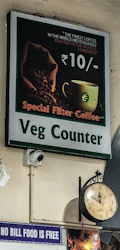
The walls of this small café-cum-restaurant are decorated with murals depicting Chennai and the Central Station. Numerous informative notices were also displayed in the walls. One informed customers that all of the water used had been filtered. Another forbids the eating of “outside food”, which means food not bought in the canteen. Yet another reassured customers that “medium refined” cooking oil was used in the kitchen. And another warned clients that they are under cctv surveillance.
One notice puzzled us. It reads: “NO BILL FOOD IS FREE”. Grammatically, it made no sense to us. We asked another customer, who was standing close to us, if she could explain. She smiled, revealing a set of teeth that would have benefitted from orthodontic treatment, and then, as quick as a flash, she explained that these words mean that without paying, no food will be served.
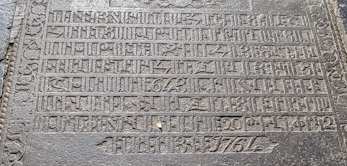
I HAVE VISITED ST THOMAS Mount in Chennai twice so far. The two visits were separated by at least a quarter of a century. Amongst the many interesting things to see and experience on this sacred hill are some examples of Armenian script. This characteristic lettering can be found both on several tombstones and on some framed paintings of saints. Also, there is some Armenian writing inscribed on an ornate pulpit.
The church on the Mount is dedicated to Our Lady of Expectation. There are several sculptures of the pregnant Mary in or near the church, which was constructed close to the spot where St Thomas (the doubter) is supposed to have died. The church was constructed by Portuguese Franciscan missionaries in the 1520s. None of this information provides any clues to the presence of the Armenian lettering.
Armenians began setting in Madras in significant numbers in the mid-17th century. There is an Armenian Street in Chennai, where one can find an Armenian church. This was built in 1712. The two funerary monuments I saw on the Mount are dated after 1712: 1739 and 1764. The paintings with Armenian script are far newer. I am no expert on Armenia, so can say little if anything about their religious practices. Many Armenians are Christians, and a few of them are of the Catholic variety. I can only assume that the graves on the Mount are those of Catholic Armenians, and that some Catholic Armenian donor provided the paintings.
If anyone can give me more information about the presence of Armenian script in this church on the Mount, please share it with me.
 yamey
yamey 