Unknown's avatar

About yamey

Active author and retired dentist. You can discover my books by visiting my website www.adamyamey.co.uk .

Olives in London

I love olives, especially the black Kalamata and Amphissa varieties. These are imported from countries which are members of the EU (European Union), which the UK is destined to leave at the end of October 2019.

It is becoming increasingly likely that the UK will leave the EU without a trade deal. If this happens, supplies of olives may become restricted for some time. Also, the falling value of the Pound Sterling will increase the cost of those olives that make their way into the UK retail market. Gloomy as this seems, there might be light at the end of the tunnel coming from a much feared source.

The UK, like the rest of the world, is affected by climate change, which includes global warming. As I write this, I am sitting in front of a fan, something we would not have considered purchasing, even in summer, 25 to 30 years ago.

A result of global warming struck me today whilst walking in Kensington Gardens. I passed a south facing tree with greyish leaves. It was an olive tree, usually planted in gardens in the UK to provide visual contrasts. However, this particular olive tree was rich in young olives ripening in the sun (see photo above).

Seeing this richly fruited olive tree gives me hope for the future. Maybe, I will be buying British olives as well as those from southern Europe (if import duties and exchange rates do not make them unaffordable).

A surprising place

F48 Folkestone Habour Station


After getting off the train at Folkestone Central station in Kent, you might wonder why you had bothered to travel there. The way from the station to the town centre is far from preposessing.

Until 2001, trains used to run along a branch-line through the centre of Folkestone along its pier to Folkestone Harbour Station, where passengers could embark on one of the many regular cross-Channel ferries shuttling between Britain and France. Between 2001 and 2009, special tour trains like the Simplon-Orient Express  used the station. In 2014, the line was closed. With the opening of the Channel Tunnel and the closure of Folkestone Harbour Station and the line leading to it, Folkestone declined in importance. Knowing this, I expected the town to be very depressing, but a recent visit proved me to be completely wrong.

You might be wondering what prompted us to visit this formerly important  seaport. What caught our eyes was an article about how Folkestone has become a town of art filled with open-air sculptures and other artworks. It has what one of its publicity brochures describes as “The UK’s largest urban contemporary art exhibition“. And, most of the art on display is permanently resident in the town. The works are by a large range of artists including,amongst the better-known: Yoko Ono, Tracy Emin, Cornelia Parker, and Antony Gormley. The artworks are to be found in locations all over the town, but are in their greatest concentrations within the picturesque historic centre and along the attractive sea front.

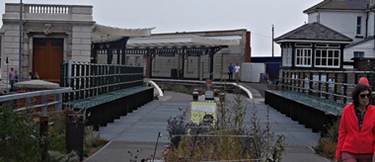
The long pier along which trains used to run and the disused platforms of Folkestone Harbour Station (see illustration) have been beautifully restored and have become a wonderful leisure area with lovely walkways, artworks, and a variety of refreshment stalls. The restoration has been done very sensitively and beautifully. 

The centre of Folkestone is, unlike the area surrounding it, full of life and ‘buzz’. There are many art galleries and eateries as well as a contemporary art centre, the Folkestone Quarterhouse. The Quarterhouse is well worth entering if only to see Ben Allen’s spectacular The Clearing (an architectural installation that has to be seen to be believed) on the building’s first floor.

What we particularly liked about Folkestone is that despite being chock-full of art, it does not feel pretentious. It is a place that people can enjoy the joys of the seaside (nice beaches and fine sea front) as well as, if you feel in the mood, the delights of contemporary art in charming settings. We spent about six hours in Folkestone. Next visit, we will stay there for a couple of nights.

Much more information available here: 

https://www.creativefolkestone.org.uk/folkestoneartworks/

Revolution in north London

65 ca


Between 1965 and 1970, I studied at Highgate School (founded 1565). Its main Victorian gothic building perches on the summit of Highgate Hill. About two fifths of a mile south east of the school, an architecturally unexceptional late Victorian residential building stands on Cromwell Avenue (number 65). Although this brick edifice may not look special, it harbours the ghosts of a lesser-known episode in the history of India’s struggle for independence from the British Empire. The only thing that hints at the interesting history of number 65 is a blue plaque commemorating the fact that the Indian patriot and philosopher Vinayak Damodar Savarkar, a father of Hindu nationalism, lived there once.

In 1905, a wealthy barrister and scholar of Sanskrit, Shyamji Krishnavarma, bought number 65 Cromwell Avenue and named it ‘India House’. He intended it to be a home away from home for Indian students studying in England. However, it became more than that. It became a centre where Indian politics was discussed and acted upon.

Very soon, India House became the nucleus for Indians who wanted India to break free from the British Empire by any means possible. These included: sending propaganda and literature (including bomb-making manuals) regarded as ‘subversive’ and ‘treasonable’ by the British to India; smuggling weapons and ammunition into India; and political assassinations both in England and India. Valentine Chirol, the Foreign Editor of the Times newspaper wrote that India House was “…the most dangerous organisation outside India…”. As such, India House was under the constant vigilance of Scotland Yard, but despite this, its members were able to carry out real-life exploits that rivalled the derring-do of characters in John Buchan’s fiction.

Apart from Krishnavarma, those who congregated or lived at India House included well-known Indian patriots and freedom fighters, such as Madame Bhikaiji Cama, VVS Aiyar, VD Savarkar, Lala Lajpat Rai, Madan Lal Dhingra, and Har Dayal. The place was also visited by MK Gandhi (the future ‘Mahatma’), Charlotte Despard, David Garnett, Dadabhai Naoroji, and VI Lenin.

India House thrived until late 1909. During that year, one of its members carried out an assassination in London. After that deadly deed, activities at India House declined rapidly, and it was closed for ever by the beginning of 1910.

My new book, “Ideas, Bombs, and Bullets”, describes the history of Highgate’s India House and the activities that originated there. In addition, it explores the ideas that led Krishnavarma to ‘create’ India House and the lives led by people who lived in, or congregated, at the place. Also, it contains the background to the replica of 65 Cromwell Road that can now be viewed and entered by visitors to Kutch, an arid part of the western Indian state of Gujarat.

Until I visited Kutch in 2018, forty-eight years after leaving Highgate School, I had not known that my alma-mater is situated so close to the site of such an exciting short episode in the history of anti-colonialism. Boldly, I suggest that this story is also unknown to most pupils, who have attended Highgate School since 1905. Furthermore, Highgate’s India House and Shyamji Krishnavarma are practically unknown amongst many educated Indians, with whom I have spoken. I hope that “Ideas, Bombs, and Bullets” will help to make the exploits and aspirations of the members of India House more widely known.


BUY a paperback version of IDEAS, BOMBS, and BULLETS here:

http://www.lulu.com/shop/adam-yamey/ideas-bombs-and-bullets/paperback/product-24198568.html

BUY an e-book version of IDEAS, BOMBS, and BULLETS here:

https://www.amazon.com/dp/B07W7CYKPG/ 

The Patient Assassin

Assass


I love browsing in second-hand bookshops. Occasionally, I come across really good books that I had not previously known about. The Patient Assassin by Anita Anand (published 2019) was one such discovery.

The Patient Assassin is about the life and exploits of  Udham Singh (1899-1940), a pro-independence, anti-British activist. Some of his friends were killed in the notorious Jallianwalla Bagh massacre  in mid-April 1919. Under the command of General ‘Rex’ Dyer, several hundred innocent men, women, and children, were shot dead within the closed space of Jallianwalla Bagh, a walled public garden in Amritsar. Many others were injured in this cruel attack whose supposed purpose was to subdue the people of the Punjab so that they would not rise against British rule. 

Dyer died of illness in England, having been proclaimed a hero for his malevolent deed. Michael O’ Dwyer, the Lieutenant Governor of the Punjab, who thoroughly approved of what was done at Jallianwalla Bagh and other horrific treatment of Indians, retired to London.

Udham Singh had friends who were killed at Jallianwallah Bagh. He made it his mission to kill O’ Dwyer. The author of Patient Assassin, Anita Anand, traces Udham’s complex and mysterious life from the Punjab to London, where he shot dead O’ Dwyer at a meeting at London’s Caxton Hall in 1940. Ms Anand weaves an exciting tale based on her researches of Udham’s colourful and exciting life. Her book about a real person makes far more engaging reading than most fictional thrillers. 

I was very pleased to stumble across Anand’s book for two reasons. One is that it turned out to be an un-put-downable read. The other is that it chimes with something that I have been working on.

In mid 1909, Madan Lal Dhingra, who like Udham Singh came from the Punjab, shot dead Sir William H Curzon Wyllie, a retired important British administrator in India, at the Imperial Institute in South Kensington. This assassination horrified the British nation and many in India. 

Dhingra had come to England study engineering at University College London several years before shooting Curzon Wyllie. He had become involved in the freedom fighting activities that were centred on India House in Highgate between 1905 and early 1910. It was Dhingra’s fatal shots that hastened the demise of India House, a student hostel and meeting place which was regared by the British as a ‘centre of sedition’.  I have almost completed writing a book about India House and its members, including Dhingra, and it should be available for sale soon. Its title will be “Ideas, Bombs, and Bullets”.

Finding Ms Anand’s book quite by chance was a great delight for me. Unintentionally, it might almost be considered a kind of sequel to what I have just written.

This won’t hurt a bit!

human fist


One of my dental colleagues, a very confident fellow and a competent operator, told me this true story many years ago.

One day, he had a nervous male patient, a well-built strong looking man. However, the patient was extremely anxious, as many dental patients often are. The patient needed to have root canal treatment and was convinced that he would experience much pain during the procedure. 

As my colleague prepared his local anaesthetic syringe, he said, trying to be reassuring:

“Don’t worry, sir, after I have given you this injection, the procedure won’t hurt a bit!”

The patient turned to my colleague brandishing his tightly clenched fist, and said:

“You’d better be right because this will certainly hurt you!”


Photo by Pixabay on Pexels.com

St John’s finger

finger

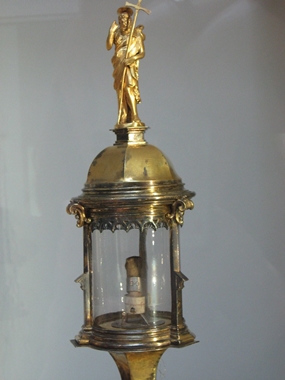
It might have been in the Bargello, or more likely in the Museo dell’Opera del Duomo, both in Florence (Italy), that there was (and probably still is) an exhibit that captured my imagination when I was a young child. Amongst a collection of holy relics housed in elaborately crafted silver and glass containers, there was one holy relic that looked a bit like the stub of a discoloured cigar. It was, so the museum label stated, a bone from the index finger of St John the Baptist. Whether it was or was not, this item fascinated me, and even haunted me.

Many years later when I was looking into the story of St Appolonia, the patron saint of dentists, I read that one of the miraculous properties of the body parts of dead saints is their ability to reproduce themselves – a feature that must have been useful for those who used to sell such things. I am glad that I had not known this when I used to stare fascinated at St John’s finger, which I then believed to be exactly what it claimed. That would have spoilt my amazement, which I always felt when I saw that piece of bone in its ornate container.


Photo from flickr