Yellow and red
Flourishing in sunny Swiss Cottage
Yours to enjoy
ST CLEMENT’S CHURCH in central Cambridge began being constructed in the 13th century. It was modified in later centuries. While many Anglican churches contain one or two Orthodox-style icons, St Clement’s has many of these, including a large one depicting the Mother and Child, flanked by typical Orthodox style, sand-filled candle holders. In addition, there are several large reproductions of frescos of portraits of Orthodox saints including St Clement. Apart from the Orthodox Church features within the building, there are furnishings that one would expect to find in any Anglican church.
The reason that the Orthodox ‘fittings’ fill the church is that St Clemnt’s doubles up as a church for an Anglican congregation and also for a local Russian Orthodox congregation, the members of the Parish of St Ephraim the Syrian, which is an English-speaking Russian Orthodox parish of the Diocese of Sourozh. In the Orthodox church, a screen called the ‘iconostasis’ and usually covered with religious paintings separated the clergy from the congregation. St Clement’s contains an iconostasis, which is retractable. During Orthodox masses, the hinged screen can be unfolded to hide the chancel from the rest of the church. When the Orthodox congregation are not using the church, it is folded away, and can hardly be seen from the nave. I had never seen a retractable iconostasis until I first entered St Clement’s (in August 2025).
One other noteworthy feature in the church is a mural on the east wall above the (Anglican) high altar. It was painted in 1872 by Frederick Richard Leach (1837–1904), who was born in Cambridge and later worked with the designer and social activist William Morris (1834-1896).
I have visited Cambridge numerous times and often passed St Clement’s, but it was only in August 2025 that I first stepped inside. I am glad I did because although it is a fine mediaeval church, its use by two Christian denominations and, in particular, its folding iconostasis makes it especially interesting.
DURING A VISIT to the Victoria and Albert Museum’s recently opened Store at London’s Olympic Park, I spotted an interesting vitrine containing artefacts from India. The small collection was accompanied by an informative label, which tells the viewer that these objects were once housed in a museum that no longer exists – London’s India Museum. This establishment existed from 1801 until 1879.
The India Museum was founded by the British East India Company (‘EIC’). Designed to acquaint visitors with India’s resources and industries, it was housed in the company’s headquarters in Leadenhall Street. After the so-called Indian Mutiny (1857-1858: First War of Independence), the EIC lost its role as the British administrator of India. It was replaced by the government-controlled India Office.
In 1851, the India Museum was a major contributor to the Indian section of Great Exhibition at the Crystal Palace in Hyde Park. Later, the museum continued to participate in international exhibitions that followed. In 1861, the museum moved to Fife House in Whitehall, then to the attics of the newly built India Office in 1869, and from 1875 then to the ‘Eastern Galleries’ on the exhibition site to the west of the present Exhibition Road in South Kensington.
The India Museum was closed in 1879. Then as related in the Victoria and Albert’s website:
“… the collections were dispersed. In broad terms, the natural history specimens were divided between the Royal Botanic Gardens and the nascent British Museum (Natural History) – today the Natural History Museum – according to their nature. Antiquities and some parts of the ethnographic collections went to the British Museum. The bulk of the manufactured objects, however, were transferred to the South Kensington Museum, forerunner of today’s V&A.”
It is a few of those 19,000 objects transferred to the Victoria and Albert Museum that we saw in the vitrine at the V&A’s amazing open access warehouse at the V&A Store at Olympic Park. While we were at the Store, we saw many other objects that must have been brought from India. No doubt, some of those had once been on display in the museum that exists no more.
Between late 2024 and early 2025, we spent 88 days travelling 4000 miles through India. I have published an account of this fascinating odyssey in my book, “88 DAYS IN INDIA: A JOURNEY OF MEMORY AND DISCOVERY”, which is available from Amazon (https://www.amazon.co.uk/dp/B0FKTFBFM2). Here is a very brief excerpt from the book. It describes what happened when we were sitting in a cathedral in the formerly French colony of Pondicherry.
HERE IS THE EXCERPT:
“We sat inside the spacious cathedral’s cool interior within reach of the draught
coming from a fan attached to one of the pillars supporting the long nave’s high,
barrel-vaulted ceiling. As we were relaxing in the cooling breeze, a small group
of Indians entered, and went to the front pews, where they knelt and prayed in
front of the high altar. Amongst them was a young couple dressed in their finest.
Each of them had lavish flower garlands (malas) around their necks. As they
walked away from the front of the church towards where we were seated, we
asked them if they had just married. They told us that that was the case. They
had been married in another church and wanted to pray in the cathedral. These
friendly people invited us to join them in the church’s sunlit entrance while
photographs were being taken of them, of us, and of us with them. They asked
us for our blessing.
Opposite the cathedral on a corner plot, we entered a large bookstore. Tables
covered the floor. They were laden with books, mostly new, but not arranged in
any obvious order. Along one side of this vast hall, there were ...“
END OF EXCERPT
Read my book, and enjoy discovering the wonders of India without leaving home!
IN AUGUST 2003, we spent a day in Aliwal North (now called ‘Maletswai’). This small town on the northern border of South Africa’s Eastern Cape Province is not on many tourists’ itineraries. We went there for a special reason. It was originally named after the Battle of Aliwal (1846), a British victory during the First Anglo-Sikh War.
The town was laid out in 1849. When this happened, the Jewish mercantile firm, Mosenthals, opened a branch in the newly established town. After a few months, they sent a young man, Heinrich (later ‘Henry’) Bergmann (1831-1866), to manage the new store and to help sell land in the embryonic township. Very rapidly, Bergmann became one of the most prosperous people in Aliwal North. He owned much land and managed a bank in the town. Soon, he was so successful that he took over the town’s other two banks. For reasons that are not altogether clear, but they might have had something to do with a financial problem, Bergmann shot himself. Having committed suicide, neither the small Jewish cemetery nor the Christian one was prepared to bury him. In the end, his friends the De Wet family, who farmed in the district, buried him in their private family cemetery, and that is where we saw his gravestone when we visited Aliwal North in 2003.
Henry Bergmann was my mother’s grand uncle.
Arriving in what was then the Cape Colony in 1849, he was the first member of my family to migrate from Germany to southern Africa. He was also amongst the small number of Jewish people who came to that part of the world in the first half of the nineteenth century. The majority of Jewish migrants to what is now South Africa began arriving after the late 1860s, as I have described in my book “Exodus to Africa”.
We visited Aliwal North in 2003 as part of my research into the life of Henry Bergmann. Apart from meeting members of the De Wet family, descendants of those who buried Bergmann, who showed me family histories containing details of my ancestor’s life and fields that were once owned by him, we spent some time with Mrs Joubert, the librarian of Aliwal North’s public library. She was extremely helpful and took a great interest in my research.
Aliwal’s library was selling a few books that were no longer needed. My wife bought a few novels, one of which was “Mr Mirakel” by E Phillips Oppenheim (1866-1946). The book we bought contains the words: “First printed … 1943”. It is a first edition. Inside the book, there are labels inserted by the library. They are printed both in English and Afrikaans. There are also four imprints of an inked rubber stamp. Each one reads: “Aliwal North. Public Library. Cape of Good Hope.”
Just before 1910, when the Unification of South Africa occurred, what had been known as the Cape Colony became known as ‘The Cape of Good Hope Province; (‘often shortened to ‘the Cape Province’). In 1994, this vast territory was divided into the Northern Cape, Western Cape, and Eastern Cape provinces. Given that the book can only have been acquired in or after 1943, the words ‘Cape of Good Hope’ on the stamp intrigued me. Although they do refer to a geographic entity, they have never, as far as I can see, referred to an administrative area, and did not do so on or after 1943 when the book was published.
Had we not been sorting out our books recently, we would not have come across the book from Aliwal North. Seeing it and its library labels and stamps brought back memories of our visit to Aliwal North 22 years ago.
I DERIVE GREAT enjoyment from writing. I enjoy researching the background material that will form the basis of what I will write. Then, I find it satisfying attempting to put my ideas into words because it helps me understand my subject matter and it is challenging to find ways of expressing my thoughts in ways that others will understand what I am ‘getting at’.
When my text is ready, I find it both challenging and interesting formatting the it and any illustrative material so that they ready for printing in book form. Designing the covers for the book and eBook is yet another pleasurable activity. The resulting production might not always be as satisfactory as what is sometimes produced by commercial publishers, but at least it is what I have conceived in my own mind: all my own work!
In the unlikely event of any of my books becoming ‘best sellers’, I would be both flattered and very happy. However, I write and publish for pleasure, not for profit. What matters most to me, and pleases me most, is knowing that at least a few people will read my books, and I hope gain something from them, be it information, enjoyment, or enlightenment.
And, just in case you are interested, my latest book, “88 Days in India: A Journey of Memory and Discovery”, is available in paperback (and Kindle) from Amazon:https://www.amazon.co.uk/dp/B0FKTFBFM2
BRICK LANE HAS become very ‘trendy’ (‘arty’ ?). When walking across the railway bridge along which Brick Lane runs, I noticed that the wall of the bridge had a surprising decorative feature.
The wall was covered with a mosaic-like pattern of electrical socket facings. These had been painted over or sprayed to create patterned graffiti such is found all along the northern half of brick Lane.
I have yet to discover who came up with the idea with using sockets as a wall covering.
THE WHITECHAPEL GALLERY in London’s Aldgate area often hosts exhibitions of adventurous art, and has been doing so for many decades. The current show “Hamad Butt: Apprehensions”, which is on until 7 September 2025, displays works by an artist Hamad Butt. He was born in Lahore (Pakistan) in 1962, and died of AIDS in London, aged only 32. His family brought him to London when he was 2 years old. He studied art at London’s Goldsmith College, Morley College, and Central Saint Martins.
The ground floor of the Whitechapel Gallery contains three enormous sculptures. Together they form an art installation, which the gallery’s website described as follows:
“Familiars 1: Substance Sublimation Unit is a steel ladder made of glass rungs, each filled with an electrical element and crystals of solid iodine. The current ascends the ladder, intermittently heating the rungs, causing the iodine to sublimate into a purple vapour. In Familiars 3: Cradle, named after Newton’s cradle, 18 vacuum-sealed glass spheres are filled with lethal yellow-green chlorine gas. If smashed together, the gas – a respiratory irritant – would be released into the air. In Familiars 2: Hypostasis, three tall, curved metal poles, reminiscent of Islamic arches, contain bromine-filled tubes at the tips.”
Well, they were visually intriguing pieces of conceptual art. What they stand for is almost more important than their physical appearance.
Upstairs, the galleries are hung with paintings, drawings, and prints. There is also another installation that contains a set of lights emitting ultraviolet rays. Visitors are provided with protective goggles when viewing this exhibit called “Transmission”, which is yet another example of conceptual art that you need to read about to make any sense of it.
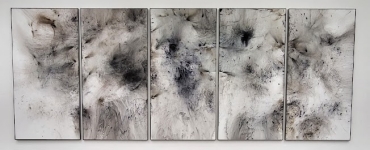
What saved the exhibition for me was the display of Butt’s paintings and prints. Ranging from almost figurative to abstract, they appealed to me immediately. It is a shame the artist lived for such a short time. That which he produced in a few years, I am sure, would have led to him becoming a noteworthy artist with a fascinating output.
MY LATEST BOOK invites you to join me on a fascinating 4000-mile, 88 day journey through parts of India including Karnataka, Rajasthan, West Bengal, Telengana, Tamil Nadu, and Pondicherry. My travelogue relates aspects of each place’s past and present; describes interesting encounters with diverse people – from autorickshaw drivers to artists and academics; and savours local foods. Immerse yourself in the pages of my illustrated account of a modern day Indian odyssey, and discover India without leaving home!
My book, “88 DAYS IN INDIA: A JOURNEY OF MEMORY AND DISCOVER” is available from Amazon websites, such as:
TODAY is the 15th of August, the anniversary of India becoming independent of British rule. What better day to announce the ‘launch’ of my latest book?
My new book invites you to join me on a fascinating 4000-mile, 88-day journey through parts of India including Karnataka, Rajasthan, West Bengal, Telangana, Tamil Nadu, and Pondicherry. My travelogue relates aspects of each place’s past and present; describes interesting encounters with diverse people – from autorickshaw drivers to artists and academics; and savours local foods. Immerse yourself in the pages of my illustrated account of a modern-day Indian odyssey, and discover the wonders of India without leaving home!
My book, “88 DAYS IN INDIA: A JOURNEY OF MEMORY AND DISCOVERY” is available from Amazon websites, such as:
https://www.amazon.co.uk/88-DAYS-INDIA-JOURNEY-DISCOVERY/dp/B0FKTFBFM2/