
Once a stronghold
Built to defy a feared enemy
Wrecked by the waves

Once a stronghold
Built to defy a feared enemy
Wrecked by the waves
THERE IS A GARDEN close to the Wilberforce House Museum and other museums in the old part of Hull (Yorkshire). At one side of this well-tended space, the Mandela Gardens, with his back to the Wilberforce House, there is a bust of the Indian freedom fighter Mahatma Gandhi (1869-1948). The bust was created by an artist from Maharashtra, Jaiprakash Shirgaonkar (born about 1952). When I saw it, I wondered whether Gandhi had ever visited Hull. I do not think he did. On the back of the plinth that supports the bust, there is an inscribed plaque, facing Wilberforce House, with some words spoken (or written) in May 1983 by Sir Sridath (‘Sonny’) Ramphal (1928-2024), who was born in what was British Guiana. They read:
“I invite each and every one of you, citizens of Hull and other friends, to question whether any can take pride in the work and achievements of Wilberforce and the Anti-slavery Movement if, as a nation, as a world community, we fail to take a righteous and uncompromising stand against apartheid. By what quirk of logic, what twist of values can we celebrate emancipation and tolerate apartheid? …”

These words were spoken (or written) in 1983, and apartheid ended in South Africa only in 1994.
The bust of Gandhi was unveiled in October 2018. The following year, Gandhi’s grandson Gopal Gandhi (a former IAS officer and diplomat who was the 23rd Governor of West Bengal, serving from 2004 to 2009) visited Hull to celebrate what would have been the Mahatma’s one hundred and fiftieth birthday. In anticipation of his visit, one of Hull’s then councillors Dave Craker said:
“Hull has a long history of being a city that, like Gandhi, promotes and fights for freedom and civil liberties, so it’s fantastic that we are able to welcome his grandson, Gopal Gandhi, this summer to celebrate his grandfather’s 150th birthday.” (https://news.hull.gov.uk/24/05/2019/gandhis-grandson-coming-to-hull-for-grandfathers-150th-birthday/).
So, even if the Mahatma never visited Hull, at least one member of his close family managed to get there.
Returning to Ramphal, whose words are at the back of Gandhi’s monument, he did have a significant connection with Hull, and visited the city. In 1983, this former Commonwealth Secretary General (from 1975 to 1990) gave a lecture at the University of Hull, which had awarded him an honorary degree.
THE FERENS ART Gallery in the centre of Hull contains a superb collection of well-displayed artworks dating from the fourteenth century until today. While we were visiting it, we viewed a temporary exhibition of works that depict sirens, the mythological females that lure sailors to their deaths. One of the exhibits, on loan from the British Museum, is a fifth century BC Greek vase, which bears one of the earliest known depictions of the Sirens and Ulysses. Magnificent as this is, another exhibit also intrigued me.

It is a painting by Annie Swynnerton (1844-1933), called “Oceanid” and created in 1904. Next to the painting, the museum has installed an information panel that includes the following:
“The first woman to join the Royal Academy since it was founded in 1768, Swynnerton forced open the door of the artworld for many to follow.”
Well, that surprised me because I knew that the female painter Angelica Kauffman (1747-1807) had been involved with London’s Royal Academy of Arts (‘RA’). She and another woman, the artist Mary Moser (1744-1809) were founding Members of the RA. However, despite these two women, the RA remained a strictly male preserve for a long time. So, how could the Ferens Gallery have justified what was written on the label next to Swynnerton’s painting? The explanation can be found on a page of the RA’s website (www.royalacademy.org.uk/article/magazine-ra250-female-invasion-women-at-the-ra):
“Finally, in 1922, the painter Annie Swynnerton became the first woman Associate of the RA (now a defunct category of membership). This historic breakthrough meant little in practice; Swynnerton was 78 years old by this point and never became a full RA. She was followed by Laura Knight who was elected as an Academician in 1936. Knight acknowledged the importance of her predecessor saying, ‘Any woman reaching the heights in the fine arts had been almost unknown until Mrs Swynnerton came and broke down the barriers of prejudice’.”
Although at first sight, the exhibition label seemed to suggest that before Swynnerton, the RA had been closed to women, it is not completely inaccurate, but I felt that its wording could easily be misleading.
KINGSTON UPON HULL (‘Hull’) did not exist as a significant settlement until several centuries after the Romans left Britain. However, the Romans built a road that ran north through Brough, which is west of Hull, to Malton (northwest of Hull), and beyond towards York. Along this road, at Horkstow and Brantingham, and at Rudston and Harpham, along a side road northeast of Hull, remains of buildings constructed by the Romans have been found and excavated by archaeologists. At each of these sites, large areas of Roman mosaics have been found.

The mosaics have been carefully moved to Hull and can be seen at the city’s Hull and East Riding Museum. There, they have been beautifully displayed. I do not think I have ever seen such a large collection of Roman mosaics as can be found in the museum. It is worth visiting Hull to view this remarkable set of mosaics. Although, in my view, the mosaics alone make the museum unmissable, there is much more to be seen in this superbly curated place.
Visitors to the museum, which specialises in archaeology, follow a route that leads from exhibits relating to prehistory to just after the English Civil War. Each room or area along the way is designed to ignite interest in archaeology in the minds of everyone, from small children to adults. Every exhibit is labelled in language that is easy to understand, yet does not ‘dumb down’. Even if you enter the museum with little interest in archaeology and early history, you are bound to leave having become interested in these subjects.
Apart from the Roman mosaics, the museum contains several timber boats, the Ferriby vessels, that were built on the bank of the Humber in the Bronze Age. One of these is preserved in a special tank called the Boatlab, which contains equipment to preserve the ancient timber. It is believed the Ferriby boats are the earliest known form of seacraft made in Europe.
I have highlighted two aspects of this museum in Hull. They are the ‘icing on the cake’, but the rest of the cake is richly interesting. Many people disdain the idea of visiting Hull, but they are mistaken. The museum with its Roman mosaics is just one of many of the city’s relatively unknown but worthwhile attractions.
ESTABLISHED IN 1829, the Minerva is a pub next to the Humber River and close to the recently developed Hull Marina. It has a genial atmosphere, friendly staff, good unpretentious food, and a fine range of alcoholic beverages.

The place consists of several interconnecting rooms where one can eat and drink. One of these rooms is tiny. It can accommodate 4 adults at a squeeze and is, apparently, the smallest pub room in England.
We ate at the Minerva 4 evenings in a row, and were never disappointed. The fish and chips served at this pub were second to none. If you happen to be in Hull, it would be wise to visit the sign of the owl at the Minerva pub to have a good time.
BEVERLEY IN YORKSHIRE is best known for its cathedral-like Minster. Our friend Colin recommended that while in Beverley, we should not miss visiting the church of St Mary. We went there and enjoyed exploring this magnificent medieval gothic parish church. We were shown around by a volunteer who pointed out something we had never seen in any other church.

In WW2, during an air attack on Beverley, a German aeroplane strafed the town. One of the bullets from the ‘plane made a hole in a stained glass window on the south side of the church, and went straight through one of the worshippers, killing him. The volunteer showed us the hole in the wooden pew made by the bullet after it had passed through the unfortunate parishioner. The wooden pew behind the one with a hole has a hollowed out spot caused by the bullet after it had penetrated the pew in which the victim had been seated.
Years later, the volunteer related, a woman from Australia visited St Mary’s, and when she saw the damage caused by the bullet, she burst into tears. The man who had been killed while praying had been her grandfather.
ALMOST OPPOSITE THE modern and magnificent Hepworth Wakefield art gallery, completed in 2011, there is a nine arched bridge, built between 1342 and 1356, crossing the River Calder. Midway across the bridge, there is a small gothic chapel. It is the oldest one of only four surviving bridge chapels in England. Between the mid-14th century, when it was built and the Reformation in the 16th century, the Chantry Chapel of St Mary the Virgin served as a place of worship for travellers crossing the bridge on their way from Wakefield to Leeds.

The purpose of a chantry chapel was:
“…to provide for a priest to say mass for the souls of the dead to reduce their time in purgatory.” (www.wakefieldcathedral.org.uk/visit-us/the-chantry/a-history-of-the-chantry-chapel)
Two acts passed during the reigns of King Henry VIII and his successor the young and fanatically Protestant Edward VI resulted in the closure of the well over 2300 chantry chapels in their kingdom. The chapel on the bridge at Wakefield was one of them. Whereas many chantry chapels were demolished or otherwise rendered unrecognizable, that on the bridge at Wakefield survived because it is an integral part of the structure of the bridge (https://en.wikipedia.org/wiki/Chantry_Chapel_of_St_Mary_the_Virgin,_Wakefield).
The former chapel on the bridge was used for various purposes between 1547, when its religious use was terminated, and 1842, when it was restored. It was used at different times to house a warehouse, a library, an office, and a cheese shop.
In 1842, the formerly Roman Catholic chapel was transferred to the Church of England and it was restored by the Yorkshire Architectural Society, which was influenced in its philosophy by the Oxford Movement, a group of High Church members of the Church of England who wanted to reinstate older Christian traditions, which had been abolished during the Reformation, and incorporate them into Anglican theological practice. The architect George Gilbert Scott (1811-1878) was involved in the restoration of the edifice. By 1848, the bridge on the chapel was once again being used as a place of worship. For a while it became a parish church, and then after a new parish church was built in 1854, it became used for occasional rather than regular services, and peopled prayed whilst water flowed below them.
Currently, the chapel is under the care of the Friends of Wakefield Chantry Chapel, which was founded in 1991. The chapel is usually kept closed but is opened on certain days (see: www.chantrychapelwakefield.org/open-days.html). As luck would have it, we walked across the bridge on a sunny day that the chapel was open. The small chapel is on two floors. The upper chapel is well-lit both by electric lamps and light flooding through its five sets of stained-glass windows. A narrow spiral staircase leads down to a lower, poorly lit, rather dusty chamber, somewhat devoid of interest.
The decorative ancient gothic chapel on the bridge makes an interesting contrast to the elegant but puritanically unadorned exterior of the Hepworth Wakefield gallery almost opposite it. Both buildings are definitely well worth exploring.
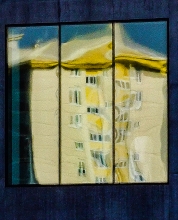
The world distort-ed
Reflect-ed in a window
The eyes are deceiv’d
BRADFORD IN YORKSHIRE is a vibrant multi-ethnic city. Many of its inhabitants have their roots in the Indian subcontinent. We found that many of these people with subcontinental ancestry regard themselves as neither Pakistani nor Indian, but Kashmiri.

When we first visited Bradford a few years ago, we were itching to try the local restaurants serving what is generally called “Indian food”, regardless of whether it has been cooked by an Indian, or a Pakistani, or a Bangladeshi, or even a Kashmiri. As we drove from the station to our hotel in a taxi, we asked the driver, who was of Kashmiri descent, where he thought we would get good Indian food. He recommended ‘X’ in Bradford and ‘Y’ in nearby Shipley. A couple of other people, of whom we asked the same question, both recommended X. With three different recommendations for X, we decided to book it for that evening.
When I phoned the restaurant, a lady answered. I asked to book a table for two. Then, she asked:
“Is it two males or a male and a female?”
Puzzled, I replied:
“A male and a female.”
When we reached the restaurant, we were given a nice table. We had arrived at X with high expectations and good appetites. It was a pleasant restaurant with obliging staff. However, we were served one of the worst meals I have ever eaten in a restaurant serving Indian food. After this experience, we did not try another ‘Indian’ restaurant in Bradford.
During that unsatisfactory meal, the head waiter or manager came up to our table to ask if all was well. Politely, we replied that it was, but my Indian wife, who had seen ladies entering the restaurant but disappearing up a flight of stairs, remarked:
“I have noticed that apart from those little girls with their father, I am the only woman in this room. It does not bother me, but it is a bit strange.”
The head waiter looked perturbed and said:
“Sorry, so very sorry. You should not have been given a table in here. I was not aware of your arrival. Had I greeted you, I would not have seated you in here. It is reserved for men, and sometimes they can get rowdy. Can I move you to another table?”
We said that we were happy where we were. After the man left, we wondered how it was possible that men could get rowdy in a halal restaurant that clearly did not serve alcohol. At the end of the meal, we noticed that there was another section of the restaurant where men and women could dine together, a sort of ‘family room’. We also noticed that groups of women unaccompanied by men were directed to another part of the restaurant on the floor above. While the food at X was memorably poor, the experience was far from dull.
Recently, in September 2021, we revisited Bradford. There, we met our Polish host. Remembering our unfortunate experience at X, we thought it would be fun to try something different, a Polish restaurant perhaps. We asked Pavel if he could recommend one. To which he replied:
“There used to be a Polish restaurant here, but it’s closed. Anyway, I don’t like Polish food. You should eat curry here. Try the International. It’s just around the corner and gets good reviews on Tripadvisor.”
In view of our previous ‘Indian’ meal in Bradford, we entered the bustling International with some trepidation. When the food arrived, our fears evaporated rapidly. We were served some of the best ‘Indian’ food we have ever eaten in the UK. The portions were enormous, and we noticed that at every other table, diners were taking home the remains of their meals in packages. We also noticed that at almost every table, diners had ordered chips (French fries) with their ‘Indian’ dishes. The restaurant’s owner, the son of its founder who opened it 50 years ago, told us that in Bradford:
“These young people eat chips, pizzas, and burgers all the time; sometimes they don’t even eat curry.”
We asked him whether the International was an Indian or a Pakistani restaurant. He told us that it is the latter, but he and most of his staff are Kashmiri.

We enjoyed the International so much that we returned there for dinner on the following day. Once again, we enjoyed first class food served in huge portions. Thinking of the tandoori king prawns and lamb chops makes my mouth water as I write this piece.
On both occasions, we sat at tables on the ground floor. On the second evening, our table was next to a staircase leading to an upper floor, which we were told was used for parties. Both waiters bearing trays loaded with dishes of food and also customers continuously dashed up and down the stairs. At one point in the evening, a group of heavily bearded Asian men dressed in loose fitting robes, Pathan suits or similar, began ascending the stairs. One of them looked down at us, an Asian and European dining together, and we saw him smile and then heard him say:
“Boy meets girl.”
ROMANS TRAVELLING ON the ancient Dere Street, a road constructed by the Romans, between York and Hadrian’s Wall crossed the river Ure near the present Yorkshire village of Aldborough, which archaeological research has revealed stands on the site of a large Roman town called ‘Isurium Brigantum’. Some of the Roman remains can be seen at the beautifully laid out English Heritage site in Aldborough. The parish church in Aldborough is built on the site of the forum of the former Roman town and contains a Roman sculpture, which might well depict the god Mercury. Excavations, which we viewed, being undertaken by archaeologists from Cambridge University are discovering that the Roman town was an important way station for supplying and servicing troops travelling to and from Hadrian’s Wall. The archaeologists, who kindly showed us around their dig, asked us not to reveal what they have discovered because they have yet to be published in the appropriate way.

After crossing the Ure at Aldborough, Dere Street, so named after the Romans had departed from Britain, travelled north to Catterick (Roman: ‘Cataractonium’). A few miles from Aldborough, the old road used by the Romans passed close to the Yorkshire village of Kirby Hill, whose parish church, All Saints, perches on the summit of a hill. It is possible that the church is sited where once there was a Celtic and/or Roman shrine. The church’s informative website (www.allsaintskirbyhill.org.uk/) reveals:
“… there are some large stones in the lower walling; one of these at the South West angle is clearly Roman and has a sunk panel, which once contained a 13 line inscription. Unfortunately, it is now very badly weathered. It was a posthumous dedication to either Antonins Pius or Caracalla, the first such recorded from Roman Britain.”
Unfortunately, when we visited this lovely church recently, we missed seeing this interesting souvenir of the Roman occupation of Britain. However, during our brief look inside the church we did see evidence of some of the invaders who arrived in Britain after the Romans had left.
The church contains some well-preserved carved fragments of Saxon crosses. High up on the south side of the church, we noticed that such a fragment had been incorporated in the stonework of its wall, just as the Roman stonework had been incorporated elsewhere in the structure of the church as already described.
The nave of All Saints was built both during the Saxon and Norman eras. Its structure includes some Saxon slabs as well as those placed after the Norman invasion in 1066. A north aisle was added in about 1160 and is separated from the older part of the church by semi-circular masonry arcades supported by sturdy stone pillars topped with capitals dating back to Norman times.
The church, which we only visited because we followed a roadside direction sign with the words “Ancient Church”, contains many other interesting features, which we did not have time to examine as we were in a bit of a hurry to reach an appointment on time. When we told a lady, who was telling us about the church, that we were rather pressed for time, she said to us, smiling:
“That’s a pity. You’re speaking with the wrong person. You can’t expect someone from Yorkshire to be brief.”
 yamey
yamey 