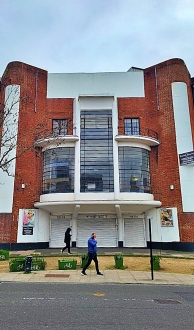
A modern style
It was so several years back
Art Deco it is

A modern style
It was so several years back
Art Deco it is
Here is a short extract from my book “BEYOND MARYLEBONE AND MAYFAIR: EXPLORING WEST LONDON”. The extract concerns an unusual building next to Holland Park:
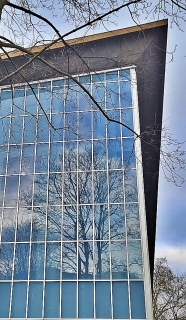
“Set back from the main road, and partly hidden by two hideous cuboid buildings, stands an unusual glass-clad building with an amazing, distorted tent-shaped roof (made of copper). This used to be the Commonwealth Institute. Built in 1962 (architects: Robert Matthew Johnson-Marshall & Partners), I remember, as a schoolboy, visiting the rather gloomy collection of exhibits that it contained shortly after it opened. The Institute closed in late 2002, and the fascinating building stood empty until 2012, when it was restored and re-modelled internally. In 2016, it became the home of the Design Museum. Like the architecturally spectacular Guggenheim Museum in Manhattan, the building competes with the exhibits for the viewer’s attention, and then wins over them easily. The displays in the Design Museum are a poor advert for the skills of British designers, whereas the building’s restored interior is a triumph. This is a place to enjoy the building rather than the exhibits. One notable exception to this comment is the sculpture by Eduardo Paolozzi (1924-2005), which stands outside the front of the museum.
The museum borders Holland Park, which is well-worth exploring. By the park’s High Street entrance, there is a plaque giving the history of the ‘Trafalgar Way’. This was the route taken between Falmouth and London by Lieutenant John Richards Lapenotière (1770-1834), when he carried news of Nelson’s victory at Trafalgar in 1805. It is at this point that I will let you rest on a bench in the park, or to enjoy the delights of its lovely Kyoto and Fukushima Japanese Gardens.“‘
My book is available from Amazon sites by clicking below:

Pentax, Canon, Nikon, Mamiya, Yashica, Olympus, Zenit, Minolta, and Ricoh.
Yes, they are all there, SLR and others, discarded by their owners.
Waiting to be sold to passersby.
Once treasured possessions of photographers, both professional and amateur, now abandoned.
The question I would want answered is: do they work, or are they sold as ornaments?
EVERY FEW WEEKS, we walk along the towpath of the Grand Union Canal (Paddington Arm) between the Meanwhile Garden in North Kensington and Little Venice near Paddington station. About 1/3 of the way along this route, we stop at the pleasant Grand Junction Café. Many canal narrow boats are moored alongside the towpath. Most of them are floating residences. Today, 31 August 2025, we spotted a narrow boat that we had not seen before. Moored between the Meanwhile Garden and the café, it is a floating, mobile art gallery.

Below the words “Canal Boat Contemporary” attached to the starboard side of the boat, there was a large glass-covered frame facing the towpath. This contained about 15 paintings. Next to the frame, there were notices giving information about the gallery’s concept and the works of the artist being displayed. There was also a whiteboard on which viewers could add their reactions to the art, using the marker pen attached to it. Between 27 August and 2 September, works by the artist Henrietta Roeder are on display.
Also attached to the boat and visible to passersby was the ‘manifesto’ of Canal Boat Contemporary, which can be read on a website (www.canalboatcontemporary.com). It refers to the ‘box’, by which they mean the display containing the art. Here are some excerpts from the manifesto to illustrate what the organisation is trying to achieve:
“Opera sings to chandeliers. If art wants to matter, it has to leave the palace … We moor up. We don’t ask for permission.We resist fixed power structures and take art to different places and contexts … We’re all speaking, nodding, showing – but always to each other. The Box is a window turned outward – away from the art world – for new eyes. It’s for someone walking their dog … The Box is modest, but powerful. A single painting on the towpath can shake you to the core … We don’t want your submissions. We want doppelgängers. Copy us. This idea wants to spread like moss. All you need is a frame no one’s using. A window everyone passes.”
Seeing the boat with its artworks, appearing as if from ‘out of the blue’ was a lovely experience. I think it is a wonderful idea to bring contemporary art outside of great institutions and commercial art galleries to make it available for anyone to stumble across unexpectedly.
THREE YEARS AGO, I published a book about west London past and present. In it, I made a brief mention of a pub, the Windsor Castle, which is near to Notting Hill Gate. This is what I wrote in the book:
“At the western end of Peel Street, there is another pub, The Windsor Castle. Unlike the Peel Arms, this is a working establishment, now popular with the locals, most of whom are definitely not poorly paid labourers. The hostelry was originally built in about 1826, and then remodelled in 1933. The pub contains much of its original late Georgian building fabric and is a Grade II listed place.”

Although the pub is a mere 5 minutes’ walk away from our home, where I have been living for more than three decades, I only entered it for the first time today, the 24th of August 2025. On entering, we were given a warm welcome by the pub’s manager before we sat at a table in the shade of a tall tree that overlooks the hostelry’s enclosed garden.
Within the pub, the furnishings look quite old. A notice on the wall draws the attention of visitors to some very low doorways in the wooden screens that divide the interior into separate rooms. The notice relates that in the seventeenth, eighteenth, and nineteenth centuries, families ran pubs. The children of the landlord and landlady used to work in the pubs, delivering food and drinks. They would enter and exit the areas where the customers were enjoying food and drinks through the tiny doors such as still can be seen at the Windsor Castle, closing the doors behind them. The pub’s patrons were not allowed to use these little doors. They had to stay in the sections of the pub that were reserved for their social status: the public bar, the private bar, the sherry bar, and so on.
Just as I had never entered the Windsor Castle before, I had never seen these tiny doorways in any of many pubs I have visited.
My book “BEYOND MARYLEBONE AND MAYFAIR: EXPLORING WEST LONDON” is available from Amazon: https://www.amazon.co.uk/BEYOND-MARYLEBONE-MAYFAIR-EXPLORING-LONDON/dp/B0B7CR679W/
CROWDS OF TOURISTS swarm to west London’s Portobello Road Market, especially on weekends. But how many of these visitors from all over the world know anything about the history of the place?

Here is an excerpt from my book “BEYOND MARYLEBONE AND MAYFAIR: EXPLORING WEST LONDON”. Beginning with Kensington and Paddington, it describes London from west of Park Lane and the Edgware Road to (and including) Heathrow Airport, and from Wembley south to Chelsea.
Here is an extract from the chapter dealing with Portobello Road:
“Before the mid-19thcentury Portobello Lane, as it was then called, was to quote the historians Florence Gladstone and Ashley Barker (writing in1924):“‘… one of the most rural and pleasant walks in the summer in the vicinity of London’, and within living memory it led ‘through fields to Kensal Green… cornfields and meadow land on each side… ‘”
Well, Portobello Road is no longer bucolic. It is lined with buildings along its length. Currently, it begins with a short section that leads off Pembridge Villas. It is here that you can stop for a drink at the Sun in Splendour pub, which was built in the early 1850s.Afterrunning a few yards westwards, Portobello Road heads off in a north-westerly direction, which it maintains with barely any deviation for the rest of its length. Number 22 was the first London home of the writer George Orwell. He lived there as a lodger in the winter of 1927. After crossing Chepstow Villas, the road slopes downwards and soon after this the market area commences. On most weekdays, much of the market is dedicated to daily needs, mostly food. On Fridays and Saturdays, the number of stalls and the variety of goods on offer increases dramatically. In normal times (i.e., when there is no pandemic),Portobello Road is choked with crowds of people from all over the world on Saturdays. In the 1860s, the Metropolitan Line (now the ‘Hammersmith and City Line,) was built. It crosses Portobello Road …”
To discover more about London, from west of Park Lane and the Edgware Road to Heathrow Airport, buy a copy of my book/kindle from Amazon website, e.g..:
SURROUNDED BY SOCIAL housing, the Frestonian Gallery is within a stone’s throw from the Westfield shopping mall in west London’s Shepherds Bush. This small but elegant commercial gallery hosts well-chosen artworks at temporary exhibitions. The artists whose works are displayed there are not as well-known as those shown in some of the larger and longer established galleries in Mayfair, but all of them deserve to be recognised as worthy exponents of their craft and creativity.
The current exhibition, which continues until 13 June 2025, is of paintings by Barry McGlashan, who was born in Aberdeen (Scotland) in 1974. Trained in painting at Gray’s School of Art in Aberdeen, he went on to teach in its painting department between 1998 and 2005. He now lives and works in Edinburgh.

At first glance, many of Barry’s paintings have a hazy or misty appearance. After a few moments, the mist seems to clear, and the viewer can enjoy beautifully painted scenes. The paintings have a dream-like quality, and as the gallery’s handout notes, some of his images are:
“… at once so vivid and yet close to slipping away entirely …”
Barry refers to a concept embraced by the Elizabethan John Dee (1527-1608). Namely, that the world around us is far more unseen than seen. Barry’s pictures do depict such an idea very well.
Rather than wasting time and money in the Westfield shopping mall, feed your eyes on the lovely paintings currently on show at the Frestonian. You will not regret visiting this gallery.
Address: 2 Olaf St, London W11 4BE

THIS SCULPTURE STANDING in the foyer of the ActOne cinema in Acton is labelled “The Urchin” and dated 1968. The sculptor is named Ute Sturch. I have searched the Internet for information about the sculptor, but found nothing. Does anyone have any information about the life and work of this creator?
JUST IN CASE you do not know about it, there is a wonderful independent cinema in West London’s Acton. Called ActOne, it is housed in what was once Acton’s public library. Built between 1898 and 1900, it was one of a series of public libraries financed by the philanthropist Passmore Edwards. Incidentally, the Bush Theatre in Shepherds Bush is also housed in a former Passmore Edwards library.
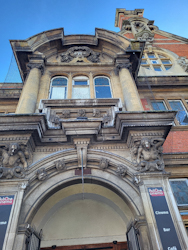
ActOne has two screens, both with comfortable seating and good sound systems. The public spaces in the library include a bar and a large room with shelves filled with books about cinema. All in all, ActOne is a lovely place to enjoy films.
THE RIVERSIDE STUDIOS in west London’s Hammersmith was built on the site of a demolished ironworks in 1933. Many films were made there including “The Seventh Veil”. In 1954, the studios were taken over by the BBC for making television programmes including the well-known “Dr Who”. A dalek such as would have appeared in this series stands in the café/restaurant near the entrance of the present building. The BBC left the Riverside in 1974 and two years later, it became what it is now, a vibrant arts centre with performance spaces, cinema halls, and the above-mentioned refreshments area. Between 2014 and 2019, the Riverside was closed and rebuilt. We often visit the place to see films and plays, as well as to enjoy morning coffees in its café, which has a fine view of Hammersmith Bridge.

Recently, the Indian industrialist Anil Agarwal (born 1954), founder and chairman of Vedanta Group, acquired the Riverside Studios, which have now been renamed ‘The Anil Agarwal Riverside Studios Trust’. Although some have criticised certain of the Vedanta Group’s activities, it is a great thing that Mr Agarwal is helping to finance such a worthy institution as Riverside Studios during a period when there is a great shortage of money available to encourage cultural activities in the UK.
 yamey
yamey 