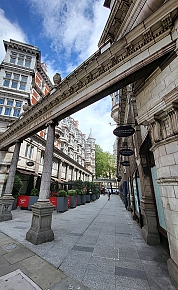
Walking along the path of peace along the Western Front

WHEN I SPOTTED THE book in the shelves of a charity shop in the small town of Bruton (in Somerset), I knew I had to buy it. It is written by Anthony Seldon, the youngest son of my parents’ dearest friends, Marjorie and Arthur Seldon. I have known them and Anthony since I was a very young child. The book I purchased is called “The Path of Peace. Walking the Western Front Way”.

In 2021, when Europe was in the midst of the covid19 pandemic, Anthony decided to walk from the Swiss Border to the North Sea, following the path of the Western Front such as it was during WW1. His aim was to help establish a ‘Path of Peace’, to realise the idea formulated during the war by one of the millions who died during it (in 1915), Douglas Gillespie. His idea was, so he wrote to his parents, to establish:

“… a path along No Mans Land from Switzerland to the English Channel after the war was over.”

Douglas wrote to his old headmaster at Winchester College that when the path was established:

“… I would like to send every man [woman] and child in Western Europe along that Via Sacra, so that they might think and learn what war means from the silent witnesses on either side.”

And Anthony explained that the walk he undertook was to help fulfil this noble ambition of poor Gillespie who perished in the conflict.

The book describes Anthony’s arduous walk along the Western Front. It was arduous physically, as the author explained in graphic detail. His feet suffered greatly, almost as much as those of the soldiers who had to spend long periods in the unhygienic trenches. It was also arduous for Anthony because he had recently lost his first wife, Joanna, who had succumbed to an illness (not covid19). The various governmental restrictions imposed to control the pandemic added to his difficulties. Yet, despite many businesses having shut down in France because of the virus, he managed (occasionally with difficulty) to find food and accommodation along the way.

Anthony describes many interesting aspects of the history of WW1 as he made his way north from Switzerland to the North Sea. He mentions what has become of the many places that were heavily destroyed by the artilleries of the armies fighting each other. Intertwined with these historical facts of an impersonal nature, he relates the poignant histories of his parents’ families during the war. For example, he describes how his father was orphaned when his parents died during the Spanish Flu, the spread of which was facilitated by wartime conditions. He also describes how his mother’s father was badly wounded in France and how his wife, Anthony’s grandmother, defied British officialdom and rescued her wounded husband from war torn France. These aspects of Anthony’s family history were known to me before I found the book, but what her wrote adds greatly to what I already knew.

Throughout the book, Anthony muses on the horrors of warfare and its tragic consequences. Yet, the book is not as gloomy as its subject matter might suggest. As the reader follows his progress along a frequently ill-signposted trail, he or she gets to know Anthony better: his strengths and his self-confessed weaknesses. Anthony’s book is both fascinating and moving. I am glad I bought my copy when I saw it in Bruton.

Sunday morning stroll along the river from Hogarth’s grave to Hammersmith Bridge

EARLY ON SUNDAY mornings, we often drive to the riverside between Chiswick and Hammersmith. Usually, a parking place can be found on Chiswick’s picturesque Church Street close to the church of St Nicholas, in whose graveyard the artist William Hogarth is buried. This narrow lane leads from the Hogarth Roundabout to the riverside. Chiswick Mall follows the riverbank. On one side it is lined with elegant houses, some of which are several hundred years old. Between the Mall and the water’s edge, there is a chain of private gardens, across which you can catch glimpses of the river. All along this road, there are plenty of trees and flowers to be enjoyed.

Heading downstream, Chiswick Mall ends, and leads into the short Hammersmith Terrace, which is lined with houses where some famous printers and typographers once lived. Beyond Hammersmith Terrace, from which the river is hidden by houses, we regain views of the water as we walk along Upper Mall. This riverside promenade heads east and ends at a narrow passageway next to the Dove Pub, but before reaching it, we pass Kelmscott House, once a home of the artist and social reformer William Morris.

After passing the Dove pub, we enter Lower Mall. This riverside thoroughfare runs past Furnivall Gardens and then beneath Hammersmith Bridge, eventually reaching the Riverside Studious, where in addition to seeing one of the Daleks used in the “Dr Who” TV films, you can obtain refreshments in a pleasant café with a good view of the bridge. Sadly, this Victorian strucruer is in such a poor state of repair that only pedestrians and cyclists can cross it.

By walking between Hogarth’s grave and the Riverside Studios, you will have walked almost exactly one mile. We do this pleasant stroll quite often, and are never disappointed. Along the way, there are potential hazards including self-important joggers, who cannot understand that they are not the only people allowed to use the pathways, and cyclists, who seem to have the same arrogant approach as the joggers. That said, walking between St Nicholas and Hammersmith Bridge is a worthwhile and enjoyable experience, and along the way you will pass many places of historic interest, which are described in detail in my book “Beyond Marylebone and Mayfair: Exploring West London”.

Maharajah and a dispute over fees at a tollgate

IN 1872 THE BELLE-VUE zoo in Manchester purchased an elephant from a travelling zoo in Scotland. The elephant was called Maharaja. It was decided to transport the creature by train from Edinburgh. Maharaja was not keen on that plan, and tore the roof off the railway wagon in which he was to travel.

It was decided to travel by road. Maharaja and his human companions walked from Scotland to Manchester. Many tales have been told about this journey. One of them relates that when the party reached a certain tollgate, there was a dispute about the amount that needed to be paid to allow an elephant through the gate. It is said that while the keepers were discussing the matter with the man at the tollgate, Maharaja solved the problem by using his trunk to open the gate.

This tale, which might or might not be true, has been illustrated in a painting that hangs in the Manchester Museum. Entitled “The Disputed Toll”, it was painted in 1875 by Heywood Hardy.

Maharaja lived at Belle-vue zoo for 10 years before succumbing to a fatal illness. He was then about 18 years old. This is a young age – many elephants live for more than 40 years. Maharajah’s skeleton now stands alongside Hardy’s painting in the entrance hall of the museum.

TWO MOSQUES AND A BAZAAR IN ISTANBUL

WHILE WANDERING THROUGH the older part of Istanbul on our way to the Yeni Camii (‘New Mosque’), we came across the Mahmut Paşa Camii. This mosque stands in a remarkably peaceful, large compound, considering how close it is to a route used by crowds of tourists. Despite being in the heart of the most visited part of the city, this mosque seems to be ignored by most tourists.

The Mahmut Paşa was built in about 1463, making it one of Istanbul’s oldest mosques. It was built only 10 years after Istanbul was captured by the Ottomans. The spacious mosque was built in a style typical of some mosques found in Bursa. It has a large central hall flanked on each side by smaller rooms – rather like side chapels. It was the work of Grand Vizier, Mahmut Paşa, who was put to death by Mehmet the Conqueror in 1474. During his life, he was involved with the Siege of Belgrade, chasing Albania’s Skanderbeg, and the conquest of Bosnia. In addition to his military exploits, he was a noted writer, both in Turkish and Persian. It is worth noting that Mahmut Paşa was converted to Islam after he was captured in Serbia by the Ottomans when he was a young boy.

After seeing the mosque, we walked past the crowded Grand Bazaar, and after passing numerous shops selling lingerie and hosiery, we arrived at the Misir Çarşisi (Egyptian Market aka Spice Market). We walked through this covered, fragrantly scented spice market, which was constructed gradually from 1597 to 1664. Where two passageways lined with shops intersect, there is an open space overlooked by a wooden pavilion reached by a spiral staircase. This was used to say prayers to the merchants who gathered to listen to them at the start of each day.

The Yeni Camii is next to the Misr Çarşisi. It is an enormous structure with numerous domes. It was completed in 1603, and overlooks the Golden Horn and the Galata Bridge, which crosses it. Both the interior and the facade facing the courtyard are rich in tiles covered with blue and white motifs and calligraphy. This eye-catching tiling greatly adds to the mosque’s attractiveness. The huge, spacious interior is an oasis of tranquillity compared with the busy roadway and waterfront only a few yards away.

In between the three edifices I have described, the steeply sloping streets connecting them are lined with buildings of all ages – some of them attractive, others less so. Many of these buildings house shops.

Yet again, a stroll in Istanbul has proved to be fascinating. It is not only the historic monuments that I enjoy seeing, but also glimpses of everyday life in the city.

A walk in the sunshine on a Saturday morning in north London

AFTER DAYS OF GREY skies, the sun shone without pauses today (the 30th of March 2024). This was lucky because come rain or shine, we had decided to walk south from Primrose Hill through Regents Park to Marylebone Road. Much of the way we passed places with fond memories for us. The first of these was Chalk Farm Underground station. It was near here that my wife used to live in a flat on Fellowes Road long before we married.

From the station, we walked across a graffiti-covered iron bridge that crosses the mainline railway tracks from Euston. This brought us to the eastern end of Regents Park Road (‘RPR’). Lined with shops and eateries, this curving road is where we met with our friends frequently. One of our favourite places was Lemonia – a Greek restaurant. When it first opened, it was on the south side of the road. Now, it occupies larger premises on the north side of RPR. After having coffee at Roni’s, an Israeli café that did not exist in the 1980s when we often visited the area, we walked towards the base of Primrose Hill. Today, being the Easter weekend, the road was far less busy than it is on other weekends.

Looking down from Primrose Hill

Fortified with coffee and a croissant, we ascended the steep path leading from opposite the house where Friedrich Engels once lived to the summit of Primrose Hill, which had attracted a crowd of people who had come out to enjoy the sun and the magnificent view of London to the south of the hill. While we were descending the hill towards Regents Park, a young lady, who was ascending the hill with her husband and two children, greeted us. I did not recognise her as I had not seen her for 21 years, and (then only briefly) when she was a young teenager. She is the daughter of one of my cousins, and the great-great granddaughter of my ancestor Franz Ginsberg, who was a Senator in the parliament of South Africa between the two world wars.

After reaching the bottom of Primrose Hill, we crossed Prince Albert Road, and then walked over a bridge that traverses the Regents Canal. At the south end of the bridge, we passed some enclosures (containing what looked like large wild boars or warthogs) of the London Zoo.  Then, we walked along a straight path between grassy playing fields – not particularly scenic. In the distance we could see the minaret of the Regents Park Mosque and the domes on the roof of the London Business School, where my wife studied. Eventually we reached a more attractive area close to the eastern edge of the Boating Lake, over which we crossed on a bridge. Soon, we arrived at the circular road, appropriately named the Inner Circle. It seemed to being used as an unofficial racetrack for cyclists on expensive looking bicycles. Having safely crossing the road without being hit by a cyclist, we entered the round heart of Regents Park, which contains the famous Queen Marys Rose Garden.

We took refreshments at the strange-looking Regent’s Bar & Kitchen. In plan, it is a collection of identical adjacent hexagons. The roofs of some of these have sharp conical pinnacles. From there we passed beds of rose plants. All of the roses were without flowers, A small wooden bridge crosses a stretch of water – part of a larger pond – to reach the attractive Japanese Garden Island from which you can see a man-made rocky waterfall designed as it would be in gardens in Japan.

After wandering around the Japanese garden, we headed towards the Inner Circle, which we crossed before walking south along a road called York Bridge because it crosses a body of water by means of of a similarly named Bridge. Before reaching the bridge, we passed the buildings of Regent’s University. These used to house a part of the University of London – Bedford College. Founded in 1849, it was for the higher education of women. From 1878 onwards, women studying there were awarded degrees by the University of London. In 1984, after Bedford College had merged with Royal Holloway College, its premises in Regents Park became the home of Regent’s University, which is not affiliated to the University of London. Interestingly, the wrought iron gates to Regent’s University’s grounds still bear the crests of its predecessor – Bedford College. In the 1920s, my wife’s maternal grandmother, Benabai Bhatia, who had come from India with her husband Haridas, who was studying for an FRCS, studied at Bedford College. On her return to India and after she was widowed at a young age, she became a superintendent of schools in Bombay.

After crossing York Bridge, we soon reached Marylebone Road, having had a thoroughly enjoyable walk.

Golden dogs on a golf course in southern Calcutta

THE TOLLYGUNGE CLUB in southern Calcutta has a beautiful golf course. Between the greens, bunkers, and other golfing features, there is a large variety of trees, many water features, and a profusion of bushes and flowers. It is a joy to stroll through the grounds, taking care not to get in the way of the golfers and their caddies. As you wander through the terrain, you can spot a variety of birds, the occasional dog, and a few pussy cats. However, the greatest treat is to come across the Golden jackals (Canis aureus) that live on the golf course land.

These jackals, usually only seen in the wild, seem quite at home on the golf course. During the day, they lope around or squat, watching the golfers and walkers like myself. Although not tame, they allow humans to approach quite closely before they wander away, but not hurriedly. At night, their howling can be heard if the Club is not holding a noisy social function.

A study by AK Sanyal et Al. (Rec. Zool. Surv. India III, 2010) revealed that when it was published there were 40 to 45 jackals living on the Club grounds. They tend to live some distance away from the Club house and its neighbouring buildings. This is probably because of the tame dogs that hang around close to the Club’s semi-outdoor eating areas. The study discovered that the jackals feed on a wide variety of creatures including insects, birds eggs, rodents, larger animals, and fruits. They are also partial to food produced by humans.

The above-mentioned study revealed that there have been rare attacks on humans, but only by rabid jackals. These incidents have happened in the wild, rather than in the Club’s grounds. And the most common way that the jackals can catch rabies is by being bitten by dogs.

The Tollygunge Club land is about one square kilometre and is home to about 7 families of jackals. In the wild, this number of families would occupy an area of up to three square kilometres. This suggests that the living conditions for jackals in the Club grounds is far better than in the wild.

Every time I have walked on the golf course land, I have seen some of the jackals. When I first saw them, I was wary of them, but now I realise that they have no inclination to interact with me or fellow members of my species. Even though I have seen them plenty of times, I am thrilled whenever I spot one of the Club’s Golden jackals.

Bangalore’s green lung

PARKS ARE SAID to be a city’s lungs. They are places where one can escape from the noises and fumes mainly created by traffic. On New Year’s Day 2023, we took a walk in Bangalore’s Cubbon Park. Almost as soon as we had entered it, the air seemed cleaner, and we experienced an uplifting sense of serenity.

Cubbon Park was laid out in 1870 under the direction of Major General Richard Sankey, British Chief Engineer of Mysore State. Initially named after Sir John Meade, it was later renamed to honour Sir Mark Cubbon (1775 – 1861), the longest serving Commissioner of Mysore State. The name was changed again in 1927 to Sri Chamarajendra Park, in honour of Sri Chamarajendra Wodeyar (1863–1794), ruler of Mysore State when the park was created. There is a statue of this man in the park. Despite that change of name, the place is still popularly known as Cubbon Park. Even the recently built metro station at the northern edge of the park has that name.

The popular park has plenty of trees that provide shade. Many different species grow in the park, several of them flowering trees. Footpaths cris-cross the park, but visitors do not need to be confined to them. A main road winds its way through the verdant landscape, but this is closed to vehicular traffic on Sundays.

Words are inadequate to convey the joys of Cubbon Park. Only by entering this lovely island of nature in Bangalore’s ocean of urban development can one appreciate the beauty and delightfulness of this city’s important green lung.

Cattle in Cornwall and Denmark

THE EARLY MORNING sun was shining over the hills surrounding our holiday cottage near Wadebridge in Cornwall, and we decided to take a stroll along the narrow country lanes nearby. The air was crystal clear, and we could see far-off grassy fields dotted with grazing sheep. Wind turbines with slowly turning blades punctuated the northern horizon. After crossing a small, fast-flowing stream, we ascended a steep hill. Every now and then, gaps in the walls bordering the roadway afforded us with splendid views. We reached the entrance to a field, I was reminded of a holiday I enjoyed in 1962 when I was ten years old.

Cows in Cornwall

Early in 1962, I underwent surgery to have my inflamed appendix removed. A few weeks after this, we set off for Denmark in our family Fiat 1100. It was just before Easter and the weather was cold. After traversing West Germany, we crossed into Denmark and headed for our destination, a farm near Toftlund in Jutland. The farm was owned by Lis, one of our former au-pair girls, and her husband. One thing I remember about Toftlund was something pointed out to me by Lis’s father. He showed me that each house had two different numbers: one was on a red background, and the other on blue. I cannot remember which was which, but one numbering system was that of the Danish authorities, and the other was that of the Germans, who had formerly occupied this part of Denmark.

The most memorable and enjoyable aspect of our weeklong stay on the farm was being able to mingle with the farm animals. The cattle and pigs were housed in sheds because it was too cold for them to graze outside. All day my sister and I enjoyed watching and stroking the animals. I think that the time we spent on the farm was so much fun because it was far more ‘child friendly’ than most of our other family holidays, which were centred around my parents’ fascination with artworks in Italian churches and museums.

Some of the cattle had horns. There is nothing unusual about that. However, my mother, who worried about most things and saw potential danger everywhere, was extremely concerned about these horns. What made her anxious was the possibility that one of the creatures might gore me and thereby cause my appendicectomy scar to burst open. Luckily, I survived to tell this story.

Returning to our walk in Cornwall, you will recall that we had reached an entrance to a field that sparked off my memories of Denmark more than 60 years ago. The gate to the field was the entrance to a small pen, The pen contained several cows waiting to be moved somewhere, or maybe to be milked. Seeing them staring at me staring at them reminded me of my wonderful holiday near Toftlund.

A pretty perambulation

LONDON’S KENSINGTON GARDENS is bounded to the north by Bayswater Road and to the south by Kensington Gore (overlooked by the Royal Albert Hall and the Albert Memorial), which becomes Kensington Road.  Within the park and running almost parallel with its southern boundary is the South Flower Walk (also known as The Flower Walk). The Northern Flower Walk, which runs near and parallel to Bayswater Road was once used by royalty. According to a document published on the Royal Parks website, this was:

“… a delicious and appealing place to stroll for the monarch on the way to … the site of the Bayswater ‘Breakfasting House’…”

The breakfasting house no longer exists. I am not sure whether the South Flower Walk can boast of such an illustrious past. However, when it is in full bloom, it outdoes its northern counterpart in colourfulness and variety of its flora.

Although the whole of Kensington Gardens makes for a pleasant place to stroll, a walk along the South Flower Walk provides and exceedingly pretty perambulation.