
BORN IN MYSORE (Mysuru) in 1969, the Indian artist NS Harsha lives and works in that city. He studied art first at Mysore’s Chamarajendra Academy of Visual Arts, and then at Maharaja Sayajirao University in Baroda (Vadodara). Until 31 July 2026, there is a wonderful exhibition of his large paintings at the Victoria Miro Gallery in London.
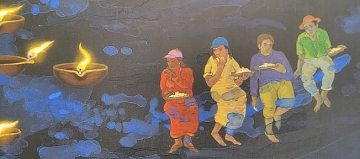
Almost all of Harsha’s beautifully executed paintings in the show contain depictions of lighted oil lamps (diyas), often many in a single work. In some paintings, the oil lamps are arranged to form regular patterns. In others, they are interspersed with images of people, animals, food, and items used in daily life. The numerous people who appear in these works are frequently workers in their overalls and hard hats (helmets), animals, and people planting crops. From a visual point of view, the paintings are very pleasing even if one has no idea what, if any, message the artist is attempting to convey. Although they depict contemporary subjects and far from being miniature, they hark back to the historical traditions of Indian Miniature paintings.
In a web page produced by the Chemould (Prescott Road) Gallery in Bombay, I read that:
“Like a chronicler, often drawing from popular stories and local perceptions of international news events, Harsha depicts in his canvasses small town/city Indian life in our increasingly globalized times. His intricately detailed canvasses juxtapose seemingly disassociated images of scenes of small town and village India with those of more recognizably international ones. Harsha’s multi-layered narratives strongly suggest that the global is always already located within the local imagination.”
Regarding the lamps in the paintings, the Victoria Miro website explained:
“The works, which elaborate on the artist’s celebrated, ongoing ‘lamp grid’ series, feature diyas – lamps traditionally made from clay that are lit during rituals, prayers, ceremonies, celebrations and during power cuts – with flames and trails of smoke together creating patterns that guide the eye around each canvas … In Harsha’s work they represent energy, forces perhaps unseen.”
This interesting interpretation is useful enough, but the paintings alone speak for themselves, and throw an intriguing light on contemporary life in India.
I enjoyed viewing this exhibition, and becoming aware of a fascinating artist, whom I had not come across before.

