
Flowers in the heart
of a leafy plant:
pleasure in a flower pot

Flowers in the heart
of a leafy plant:
pleasure in a flower pot

Fifth November, Guy Fawkes Day
let’s recall:
a Parli-ament saved
[In the UK, the 5th of November is remembered as being the day that many centuries ago the Houses of Parliament were saved from being blown-up by plotters led by Guy Fawkes (1570-1606)]
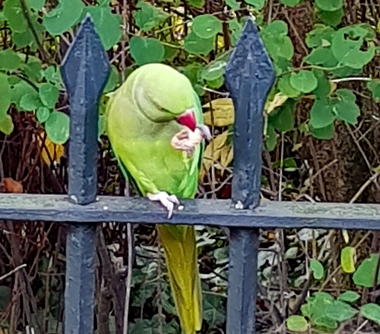
Parrot on a fence
gnawing on a nut:
Once wild, now a bit too tame!
Is fear of the needle
worse than fear of the mask?
Without them, we suffer

Photo by Pixabay on Pexels.com
Many of my adult patients remembered going to the dentist when they were children and having to be put asleep under a black face-mask. This memory instilled in them a life-long fear of visiting dentists.
The day after the 17th of March 1982, when I qualified as a dentist, I was legally allowed to administer general anaesthetics for dental procedures without an anaesthetist being present. General anaesthesia is hazardous enough but without the assistance of an anaesthetist, the risks of problems multiply. I could have accidentally killed a patient on my first day in practice. For the record, I have never ever administered general anaesthetics with or without an anaesthetist.
For a brief while, a few months in the 1990s, I worked in a practice that specialised in treating dental patients while they were under general anaesthesia. The anaesthetics were administered by a visiting hospital anaesthetist, who was assisted by a fully trained anaesthetics technician. The patients, when unconscious, were intubated to maintain their breathing and all the right things were done to ensure their safety. When the patients were ‘under’, I worked on their teeth, as quickly as I could because the anaesthetist wanted to keep the patients ‘under’ for as short a time as possible.
Children were given gaseous anaesthesia through a face mask. Once, I sniffed the gas briefly. It was terrible stuff. It felt as if a knife were shooting up my nose. Most children were, quite naturally, terrified at the prospect of anything that was happening in our clinic. Getting them to accept the black mask with its attached rubber tube was often difficult. The anaesthetist was a friendly man from the Middle East. He would say to the children things like:
“This smells of peppermint.”
The child might reply:
“I don’t like peppermint.”
The doctor would then say:
“I’ve got strawberry flavour.”
“I don’t like strawberry.”
“How about some lovely banana?”
And so, it went on.
One mother impressed me. She said to her child that if he allowed the mask to be put on by the count of three, he could have a treat at McDonalds later. She counted “one”, and the child refused. And, then “two”, but the child still resisted. Then, I wondered how different it would be when she got to “three.”
I was impressed when she said:
“Two and a quarter,” and then “Two and a third”, and so on without ever reaching “three”. Eventually, her child cooperated.
I must to admit that although we got a lot of work done on fully anaesthetised patients, I did not enjoy working under these conditions. However, I enjoyed my weekly encounters with the friendly anaesthetist, ‘Dr A’. He was extremely fond of fiery chillies, which he consumed during our lunch breaks. He was always seeking hotter chillies. This was probably because his taste-buds had become partially damaged by his excessive consumption of these almost corrosive chillies.
One lunchtime, Dr A and I were sitting in the staff room with a male anaesthetic technician from an agency. Wickedly, Dr A passed him a long, thin fresh green chilli, saying:
“Try this.”
The young man put the whole green chilli in his mouth and started chewing it. Soon, his face went bright red, and he rushed to the sink to fill a glass of water. When he recovered, he turned to Dr A, and said:
“I thought it was a bean.”
PS: Nowadays, general anaesthetics for dentistry cannot be administered anywhere in the UK except in a fully-equipped hospital.
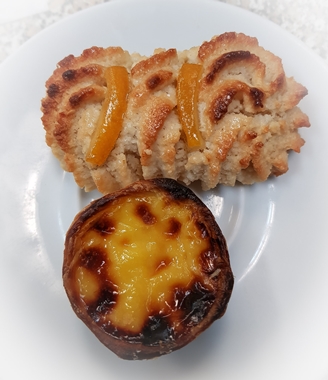
Ev’ry now and then
comes the urge to indulge
in treats sweetly tasting
(Image: Portuguese sweets at Café Lisboa in London, W10)
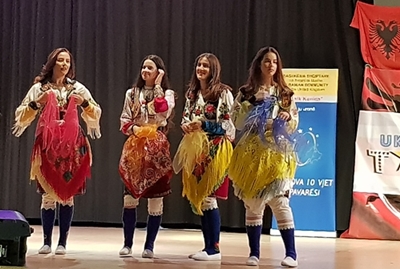
The Albanian community in the UK has been in the country long enough for some of their children to have been born in the country. It would be easy for the first generation born in the UK, who have to attend British schools and mix with non-Albanians, to begin to forget their cultural heritage. However, thanks to various organizations that some of the children of Albanian heritage attend, Albanian language and cultural traditions are being kept alive in the UK. On the 27th of October 2018, I was invited to attend the finals of the, which was held in a school hall in London’s Chalk Farm.
The Albanian Ambassador to the UK, Mr Qirjako Qirko, was one of several well-known personalities who introduced the show in Albanian. He ended his speech with a few words in English. The gist of what he said was as follows. He thanked the Queen and her Government for allowing Albanians to maintain their traditions and language, which is not the case in every other country. The show which followed the speeches certainly demonstrated that despite being far from their traditional homes and many years away from them, the Albanian community is encouraging their children to keep alive the traditions of their forefathers.
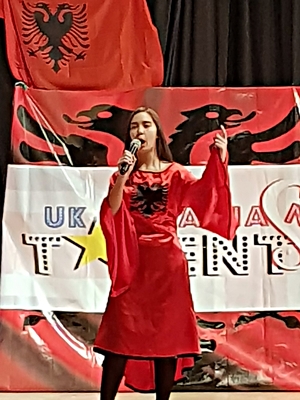
The show consisted of a series of performances by young people whose parents came from Albania or Kosovo. There were songs (traditional and contemporary Albanian as well as renderings of current and not so current popular songs in English). Small troupes of youngsters in traditional Albanian garb performed traditional Albanian dances. Others danced routines that they had choreographed themselves. Several youngsters declaimed poetry in Albanian. Naturally, the quality of performance was not uniform. Some of the young people were dazzlingly competent, the rest were not bad. None of the performers was shy or overtly lacking in confidence. Each of them performed with an enthusiasm that was refreshing to observe. The large audience around me encouraged each of the contestants as they performed on stage, cheering and clapping to the rhythm of the music. The five judges praised and gave friendly encouragement (in Albanian) to each of the performers when their act was over. Three of the judges were for singing, one for poetry recital, and one for dancing. The atmosphere in the hall was joyful and friendly. Everyone who passed my wife and me, greeted us warmly even if they had no idea who we are. It was great to discover that the famed hospitality of the Albanian people has been preserved in its British diaspora.

Many, if not all, of the performers, who sung or recited in Albanian or who dressed up in traditional costumes and performed the dances of their ancestors, use English in their day to day life. They have given up parts of their precious spare time to learn Albanian and to help Albanian cultural traditions remain vital and vibrant. They set an example that many children of British ancestry might profitably follow.
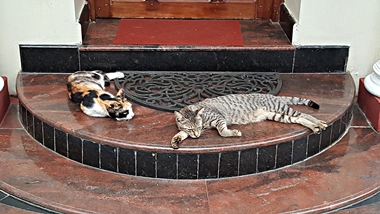
Feel like a feline,
take rest when you can,
life is for lounging: enjoy!

A world in a bottle,
encapsulated
within a thin wall of glass
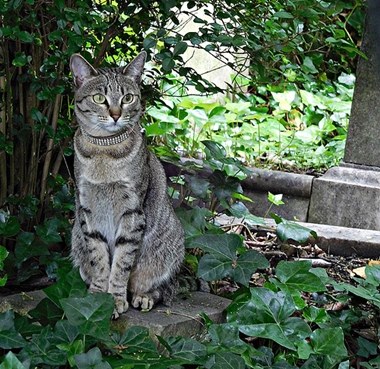
Eve of All Saints Day,
spirits are roaming:
today, it is Halloween

Sun shining on tall spire
At end of day
Autumn evening: inspired
 yamey
yamey 