THERE IS A MEMORIAL that was recently erected in a tiny, picturesque seaport in Cornwall: Mousehole.
It commemorates the 7th anniversary of the disastrous fire that occurred at Grenfell Tower in west London, during which 72 people, including 18 children, perished. Since that tragedy, Cornwall has been hosting survivors of the tragedy as is explained in a newspaper article in The Packet (dated 12 June 2024):
“The plaque was the work of Cornwall Hugs, a Cornish charity that hosted hundreds of Grenfell Tower fire survivors, bereaved family members, and firefighters in the years following the disaster in London … The charity welcomed its 500th Grenfell guest in October 2023. Since then, many families have made their temporary homes in Mousehole. This village also saw Grenfell families unveiling a special street sign featuring a green Grenfell heart in 2019.”
The thoroughfare on which this memorial has been placed is called Grenfell Street. Incidentally, the name Grenfell is associated with several families in Cornwall.
THE MEHRANGARH FORTRESS rests on massive rock overlooking the city of Jodhpur in Rajasthan. At night the walls of the fort are brightly illuminated and can be seen from many places in the city. The older districts of Jodhpur cling to the lower slopes of the rock upon which the fort rests. To take advantage of the splendid views of the fort, many restaurants in the old parts of the city are located high above street level on rooftops. Some of these eateries are as much as five storeys above street level, and none of them have lifts to reach them.
A restaurant is at the TOP
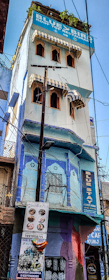
One rooftop restaurant, which we have visited twice, is on the second floor of an old building. Called Indigo, we have eaten excellent Rajasthani meat dishes there, and were looking forward to visiting it a third time today (the 3rd of December 2024).
At about 4 am. on the 3rd of December, I awoke briefly and noticed that there was no electricity in the hotel and the alley next to it. By 7 a.m., the electrical supply had been restored. At breakfast, which is always served on the fourth floor rooftop of our guest house, Mr Manu, the owner of the place, told us that there had been a fire in the kitchen of the Indigo restaurant, which we had begun to enjoy. Burn marks were clearly visible from our guest house’s rooftop.
The reason the power had failed early in the morning was that the Indigo restaurant is located close to an electricity transformer, and the authorities were concerned that the fire might spread ⁷to it. Luckily, it did not.
After breakfast, we decided to walk to Indigo to offer our sympathy to its charming owner. When we arrived, we found his wife and a few other women seated in the restaurant’s ground floor courtyard. Each of them had very sad expressions on their faces. I felt that it was like visiting the bereaved soon after a loved one had passed away. They asked us to sit with them, and soon after that, the owner arrived. We told him how sorry we were about the disaster which had befallen him and his family. I believe that he appreciated our brief visit.
Had the fire not happened, we would have eaten all the rest of our evening meals at Indigo during the remaining few days of our stay in Jodhpur. I hope that Indigo will recover soon and that anyone who happens to read this and is visiting Jodhpur will eat at this excellent restaurant.
WE MADE ANOTHER visit to Beykoz (on the Asian shore of the Bosphorus), hoping to eat paça soup at the place where we had enjoyed it a few days earlier.
The closed restaurant
We were surprised to find it closed, and shocked to discover that the man who ran it had just passed away. A notice to that effect was stuck on the windows of the small restaurant. As my late father often said when faced with disappointment: “these things happen” and “such is life”
Saddened, but hungry, we found another place which served the delicious meat soup. Its tiny dining area overlooked the waterfront. The food was good.
THE KUCUK AYASOFIYA mosque in the European side of Istanbul was once a Byzantine church (construction commenced in 527 AD). It was converted to a mosque after the Ottomans took over Istanbul. In front of the mosque, there is a square garden with a pavilion in its centre. The garden is enclosed on three sides by cloister-like arcades, which contain small shops, a religious institution, craftsmen’s workshops, and a small café.
From the first day we arrived in Istanbul – a Monday, we visited the peaceful garden every evening to relax and enjoy glasses of Turkish tea. The tea was made by a man in his sixties, called Yavuz.
We kept returning to the garden every evening not only because of the tea, but to greet Yavuz. He was the sort of person you have to like. Despite not being able to speak Turkish, we felt the warmth of his personality. After a couple of days, he began greeting us as if we had known him forever. When he walked past our table, he would pat our shoulders in a friendly manner. He was a person, whom you could not help liking. He was warm and genuine.
On the Sunday following our arrival, Yavuz was not at the café. Someone else made our tea. We imagined that it was Yavuz’s day off. On the next day, he was not there. Someone else, whom we had met earlier at the café and spoke good English, was at the café that Monday. We asked him where Yavuz was. He told us quietly: “He is no more. He died of a heart attack at the café late on Saturday night.”
We must have seen him only a few hours before he died. Although we had known him for less than a week, we were heartbroken. We felt as if we had lost a close friend or a much-loved relative.
Sadly, I never took a photograph of dear Yavuz. As we expected to see him during the rest of our trip, I had planned to ask him for his permission to take his picture later on. Even without a photograph, Yavuz will occupy an honoured place in our memories.
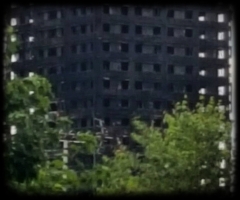
CONSTRUCTED IN 1974, it was 221 feet tall. It overshadowed the homes of many people including many of the wealthier inhabitants of West London’s Kensington. And I imagine that the wealthy inhabitants of the elegant crescents and other thoroughfares near it did not appreciate the views from their windows being spoiled by this Brutalist block of flats containing less well-off people, about whom they would rather not think. Between 2015 and 2016, the block was refurbished and made less of an eyesore by the addition of cladding – ostensibly to improve insulation – to its exterior.
On the afternoon of the 13th of June 2017, I was walking around North Kensington, taking photographs as usual. I stopped to take pictures of the recently built Kensington Leisure Centre and its near neighbour the Kensington Aldridge Academy – both are interesting examples of contemporary architecture. While I was taking these photos, I had my back to the tower block I have just described. Had I looked at it then, I would have thought that it would have been of little interest to me. How wrong I was.
Just after midnight on the following day, a fire broke out in that tall block – Grenfell Tower – that edifice which overlooked the homes of the wealthy residents of Kensington. The fire spread rapidly because of the highly inflammable nature of the cladding used to make the tower more attractive to its neighbours. Seventy-two people died in the conflagration; many were injured; and all the surviving residents were not only badly scarred psychologically, but also lost their homes and possessions.
From wherever you looked in a large area around Grenfell, including from the homes of the prosperous residents of Holland Park and Notting Hill, one could see the horrifically charred tower block – a fear-inspiring eyesore – the result of local government officialdom ignoring repeated warnings about the already known potential fire hazards that the cladding presented and inadequate planning for escape during a fire. I felt – and I am not alone in thinking this – that the local council hardly cared for a few impecunious residents in a tower block. What was more important was to save money so as not to impose high local taxes on people who could have easily afforded to pay them.
Soon after the fire, the charred tower was covered with protective wrapping to assist forensic investigations and to contain debris, which might otherwise have flown away and dropped in the neighbourhood. It also removed from sight the scarred, charred remains of the building – a 24 hour a day reminder of the avoidable, tragic loss of life, which was not altogether disconnected with civic and possibly criminal negligence. The remains of the tower are still covered up. Before the heart-rending remains of the conflagration were covered up, filmmaker Steve McQueen (born 1969 not far from Grenfell Tower) made a short film about the tower. It is currently on show at the Serpentine South Gallery in Hyde Park until the 10th of May.
The film is without words in its soundtrack and without any captions. It looks as if it might have been filmed with a drone or a camera held within a helicopter. It begins with a flight over beautiful countryside far beyond the edge of London. The camera moves above the scenes of rural serenity and slowly the city of London comes into view. We pass over London’s sprawling suburbs, and then the charred Grenfell Tower begins to be seen in the centre of the screen. The camera moves closer and closer to the blackened building, and then slowly circles around it many times. Each time the tower is slowly encircled, and the camera moves closer to it, more and more details of the destruction entered my consciousness, and my understanding of the horror of what had befallen Grenfell and its inhabitants gradually increased. As the camera moved around the wreck, you could catch glimpses of the parts of London surrounding it – the houses and flats of those who must have witnessed the fire, but were not affected by it, at least not physically. As the camera moved, one could see trains moving on nearby tracks and vehicles travelling along roads. I felt that I was witnessing life going on as usual at the same time as witnessing the horrors of a disaster. The absence of commentary added to the powerful impact that seeing these images of a lethal incineration simultaneously with scenes of normality made on me. There was a soundtrack, which consisted of recordings of everyday sounds – both natural and man-made. However, while the camera encircled the tower of death, there was no sound at all. I wondered whether this signified the fact that the victims, who had died, will no longer be able to enjoy the sounds of everyday life.
McQueen’s film is a sophisticated and solemn memorial to an event that could easily have been avoided. Without a soundtrack or explanations, the viewer is left to ponder the tragedy in his or her own way.
PARR HALL IN the heart of Warrington (Cheshire) is a concert hall designed by local architect William Owen (1846-1910). It was built for the townspeople by Joseph Charlton Parr, descendant of the founder of a local bank. The benefactor was a prominent member of his family’s bank, Parr’s, and Warrington’s Mayor between 1901 and 1903. A plaque on the wall of the hall facing Palmyra Square commemorates his generosity. A much larger and newer plaque, actually a frieze, also outside the front of the hall, serves a sadder purpose.
In May 2013, a new rock band was formed in Warrington. Called Viola Beach, it had four members: Kris Leonard, River Reeves, Tomas Lowe, and Jack Dakin. Frankie Coulson and Jonny Gibson were initially members, but they left the group to concentrate on their university studies. Reading of this, I was reminded of one of my father’s students at the London School of Economics: Mick Jagger. Unlike Coulson and Gibson, he could not afford to remain a student as his band was becoming so successful. Incidentally, The Rolling Stones performed at Parr Hall in November 1963.
In June 2016, the band’s debut album, “Viola Beach”, was released. Consisting of 9 tracks, it reached the number 1 position on The UK Albums Chart in August of that year. However, the band were never to learn of their success. In February 2016, the members of the group and their manager were on tour in Sweden. In the early hours of the 13th of February, the car in which they were travelling failed to stop at the closed barriers of a bridge across the Södertälje Canal. The roadway of the bridge was lifting to allow the passage of a vessel in the canal. The car carrying the band plunged into the water 98 feet below. The driver, the band members, and its manager, were all killed. The memorial outside Parr Hall, which portrays the band members and their manager in bas-relief, was sculpted by Tom Murphy. It was unveiled in September 2021.
Had they not met their end so prematurely, I wonder whether Viola Beach formed in a town on the Mersey might have gained some of the success enjoyed by another now much more famous Merseyside band: The Beatles.
PARLIAMENT’S HOME IS OPPOSITE a wall that runs along the northern edge of the grounds of London’s St Thomas’s Hospital. The wall is separated from the River Thames by a walkway, the embankment between Westminster and Lambeth bridges. Almost every square inch of the river facing side of the wall, which is about 440 yards in length, is covered by hand-painted hearts of various sizes and in various shades of red and pink. Many of the hearts have names, dates, and short, sad messages written on them.
Each of the many thousands of hearts painted on the wall (by volunteers) represents one of the huge number of people who died because of being infected with the covid19 virus. The wall is now known as The National Covid Memorial Wall and work on the painting commenced in March 2021. The mural that records the numerous tragic deaths was organised by a group known as Covid-19 Bereaved Families for Justice. The names and other information added to the hearts is being done by people who knew the bereaved person being remembered. When we walked past the wall today, the 27th of October 2021, we saw a young lady carefully writing on one of the hearts. Seeing this and the wall with all its reminders of the pandemic-related deaths was extremely depressing. On our return journey, I insisted that we crossed the river and walked along the opposite embankment on which the Houses of Parliament stands. Even from across the river, the reddish cloud of hearts on the wall is visible. Certainly, this would be the case from the riverside terraces accessible to those who work and govern within the home of Parliament.
It is ironic (and maybe deliberately so) that the wall with its many tragic reminders of deaths due to covid 19 is facing the Houses of Parliament (The Palace of Westminster), where had different decisions been taken, sooner rather than later, many of the names on the wall might not have needed to be written there.
ON SATURDAY THE 17th MAY 2020, an act of cultural barbarism was performed in Tirana, the capital of Albania. The National Theatre of Albania in the heart of the city was demolished. It is unclear who ordered this demolition of a much-loved cultural monument located in a part of the city where property prices are high. The theatre was built in 1939 during the period that the Italians, under Mussolini, were ruling Albania. It was originally a cinema designed by the architect Giulio Berte, but later its screen was replaced by a stage.
In 2016, my wife and I visited Tirana and attended a dramatic performance at the National Theatre. I have described this in my book “Rediscovering Albania”:
“…we visited the National Theatre, a building that dates back to before Communist times. A Pirandello play (Play without a Script) was to be performed in Albanian that evening. The charming ladies clustered around the ticket desk assured us that we would enjoy it because it was going to be full of song and dance. We bought a couple of tickets … The rectangular auditorium of the National Theatre was delightfully old-fashioned, with many drapes and an upper gallery that extended around three sides of it. Everything was red including the plush upholstery of the comfortable seats. Although we did not understand a word of it, the Pirandello play was acted beautifully. The expressive acting was so good that we were able to get a rough idea of what was going on. Some years earlier in London, Lopa and I once attended a performance of Gogol’s Government Inspector acted by a Hungarian troupe entirely in Hungarian, and on another occasion a play from Kosovo in Albanian, during the course of which one of the actors threw a fake chicken at me! On both of those occasions and also in Tirana, great acting compensated for our inability to understand the words. If the actions of actors move me more than their words, I feel this is a sign of truly skilful acting. As the great Constantin Stanislavski said: “The language of the body is the key that can unlock the soul”. This is exactly what the actors in Tirana achieved. The audience was appreciative, and, unlike at the opera, hardly anyone used their mobile ‘phones during the show.”
That has now disappeared. So, has also the unusually attractive appearance of Tirana as it was when I first visited it in 1984 during the dictatorship of the faithful follower of Joseph Stalin, Enver Hoxha. In those repressive times, Tirana was a quiet city with only one high-rise building, the 12-storey Hotel Tirana. Of course, back in 1984, times were tough for the average Albanian citizen. They remained quite difficult during the decade following the ending of Communist rule in 1991. Even now, many Albanians prefer to increase their prosperity by seeking work abroad.
When we visited Tirana in 2016, I found it to be a far busier place than it was in 1984. The traffic was busy – a sign that motoring, an option not available to most Albanians during the dictatorship, had become popular and also affordable. Some of the charm of pre-1991 Tirana remained, but many picturesque old buildings, examples of traditional Turkish and Balkan vernacular architecture, had disappeared (or were about to). In their place, there were many high-rise buildings of little or no architectural merit. I suspect that whoever ordered the demolition of Tirana’s historic, much-loved National Theatre has in mind to construct yet another aesthetically unpleasing edifice.
If as Shakespeare said, “All the world is a stage”, then the demolition of this theatre in Tirana is yet another tragedy enacted on that stage.






 yamey
yamey 