The River Thames is tidal where it flows through the heart of London. At low tide, sandy beaches appear alongside the river’s banks. What is often beneath the water is revealed for a few hours. People, known as ‘mudlarks. wander along the sandy beaches looking for objects and fragments that have been thrown into, or lost in, the water over the many centuries that the city has been in existence. I have never attempted mudlarking, but many people enjoy searching for lost treasures.
EARLY ON SUNDAY mornings, we often drive to the riverside between Chiswick and Hammersmith. Usually, a parking place can be found on Chiswick’s picturesque Church Street close to the church of St Nicholas, in whose graveyard the artist William Hogarth is buried. This narrow lane leads from the Hogarth Roundabout to the riverside. Chiswick Mall follows the riverbank. On one side it is lined with elegant houses, some of which are several hundred years old. Between the Mall and the water’s edge, there is a chain of private gardens, across which you can catch glimpses of the river. All along this road, there are plenty of trees and flowers to be enjoyed.
Heading downstream, Chiswick Mall ends, and leads into the short Hammersmith Terrace, which is lined with houses where some famous printers and typographers once lived. Beyond Hammersmith Terrace, from which the river is hidden by houses, we regain views of the water as we walk along Upper Mall. This riverside promenade heads east and ends at a narrow passageway next to the Dove Pub, but before reaching it, we pass Kelmscott House, once a home of the artist and social reformer William Morris.
After passing the Dove pub, we enter Lower Mall. This riverside thoroughfare runs past Furnivall Gardens and then beneath Hammersmith Bridge, eventually reaching the Riverside Studious, where in addition to seeing one of the Daleks used in the “Dr Who” TV films, you can obtain refreshments in a pleasant café with a good view of the bridge. Sadly, this Victorian strucruer is in such a poor state of repair that only pedestrians and cyclists can cross it.
By walking between Hogarth’s grave and the Riverside Studios, you will have walked almost exactly one mile. We do this pleasant stroll quite often, and are never disappointed. Along the way, there are potential hazards including self-important joggers, who cannot understand that they are not the only people allowed to use the pathways, and cyclists, who seem to have the same arrogant approach as the joggers. That said, walking between St Nicholas and Hammersmith Bridge is a worthwhile and enjoyable experience, and along the way you will pass many places of historic interest, which are described in detail in my book “Beyond Marylebone and Mayfair: Exploring West London”.
IT IS NOT NECESSARY to be able to hold your breath for a long time or to carry a snorkel or even air cylinders to be able to stroll leisurely deep below the surface of London’s River Thames. If you fancy a walk beneath the water, the Greenwich Foot Tunnel is the place to be. It can be entered by stairs or using a wood panel-lined lift from one of its two entrances – the southern one near the Cutty Sark in Greenwich, and the northern one at Island Gardens.
The tunnel, which is circular in cross-section, is 405 yards in length, and 50 feet beneath the river at its deepest point. For most of its length it is 3 yards (9 feet) in diameter, and it slopes downwards at both ends. Its construction began in 1899 and was completed in 1902. Therefore, building the tunnel happened during the entire time that the 2nd Anglo-Boer War was being fought in South Africa. The lifts that are housed beneath domed structures at each end of the tunnel were ready for use in 1904. Judging by the appearance of the wood panelling within the lift carriages, it looks as if these were installed many years ago. Despite their vintage appearance the lifts have been modernised and work without needing an operator.
Although there many notices forbidding cycling in the tunnel, there is no shortage of cyclists disobeying this rule. This makes walking in the tunnel slightly hazardous as the cyclists speed along the narrow walkway in the long, straight tunnel. Using the tunnel is a convenient way of traversing the Thames and gives one the opportunity to walk under water.
IN MY BOOK about west London, “Beyond Marylebone and Mayfair: Exploring West London”, I described a stream that used to flow through Hammersmith. It was located where part of Furnivall Gardens now stands today. I wrote:
“… Furnivall Gardens, a pleasant open space created in 1951, and named after a distinguished scholar of English literature and an important pioneer in the sport of rowing, Dr Frederick James Furnivall (1825-1910) … Before WW2, the area of the park was covered with industrial buildings including the Phoenix Lead Mills, which stood east of The Creek, an inlet of the Thames that was filled-in in 1936.
In earlier times, The Creek, which extended as far inland as today’s King Street, was centre of Hammersmith’s flourishing fishing industry. Writing in 1876, James Thorne described The Creek as follows: ‘… a dirty little inlet of the Thames, which is crossed by a wooden footbridge, built originally by Bishop Sherlock in 1751 … the region of squalid tenements bordering the Creek having acquired the cognomen of Little Wapping, probably from its confined and dirty character.’
The Creek, an outlet of the now largely hidden Stamford Brook, is long gone, but there is a storm outlet in the bank of the Thames close to where The Creek emptied into the river. This can be seen from Dove Pier at the western end of the Gardens.”
Today, the 25th of February 2024, we were walking past Furnivall Gardens along the riverside path. It was low tide. A wide, not too clean, beach lined the river. At one point, the beach was interrupted by what looked like the mouth of a small stream. This was lined on both sides with wooden fencing. The stream, which issued from below the riverside walkway ended abruptly in an archway that was filled by a sturdy door or dam. The position of this sluice gate in relation to the nearby Dove pub, Dove Pier, and Furnivall Gardens is correct for what must have once been the mouth of Hammersmith’s erstwhile Creek. I had noticed the archway with the heavy-looking door many times before, but today, because of the low tide, it was the first time that I could clearly the remnants of the mouth of the Creek. I suppose that there is some leakage from the now covered-up Creek that causes the appearance of the mouth of a small stream when the tide is out.
My illustrated book about West London is available as a paperback and a Kindle from:
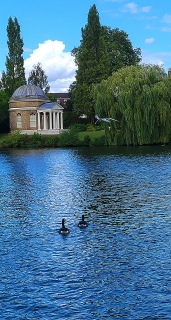
THE GREAT ACTOR David Garrick (1717-1779) was famed for his many performances of plays by Shakespeare and many others. In 1754, he bought Hampton House (now Garrick’s Villa), which overlooks the Thames at Hampton. The following year, he decided to build a garden folly to honour his hero William Shakespeare. This was completed in 1756, and is now known as ‘Garrick’s Temple to Shakespeare.’ Its architect is unknown, but Garrick did employ Robert Adam (1728-1792) to make improvements to Hampton House, and Lancelot ‘Capability’ Brown (1716-1783) to landscape his grounds. Whether either of these two were involved in designing the Temple is not known.
The octagonal Temple is Palladian neo-classical in style and has a portico with columns topped with Ionic capitals. Seen from across the Thames, it looks as if it had been plucked from a romantic painting of a classical Italian landscape by an artist such as Claude Lorrain. The Temple houses a statue of the Bard and a small museum about Garrick. Unfortunately, despite information on the Temple’s website which stated that it would be open, it was locked closed. We were not the only people to have arrived on a Sunday afternoon, expecting it to be open.
I am pleased that I saw the Temple, which I had read about, and plan to attempt to enter it on another occasion.
NORTH LONDON IS riddled with rivers, rivulets, and streams. Some of them have been covered over and built upon, and others are still visible. One of these is Mutton Brook, which rises near East Finchley, flows through Hampstead Garden Suburb, and then merges with another watercourse – Dollis Brook – to become the River Brent. The Brent flows from near Golders Green through northwest and then west London to its mouth at Brentford, where its waters flow into the Thames.Although I did not know it when I played beside the stream as a child, the tiny Mutton Brook helps feed the mighty Thames with water.Minute as it is, as far as watercourses are concerned, it made a large impression on me in my childhood.
For much of its course, Mutton Brook flows through open spaces, such as Lyttleton Playing Fields, Fletcher’s Gardens, Northway Gardens, and a long stretch of parkland flanking the south side of the North Circular Road. Despite being fringed by suburbia and busy roads, the Brook is well separated from them by nicely planted green spaces along which walkers can enjoy the feeling of being in the country despite being in the heart of northwest London.
Until 1907, Mutton Brook would have flowed through what was then rural Middlesex countryside – fields, meadows, and woods. From then onwards, Hampstead Garden Suburb was established, and its neighbour Golders Green grew from being a small hamlet to become a large, mainly residential urban area. My recent book (see: https://www.amazon.co.uk/GOLDERS-GREEN-HAMPSTEAD-GARDEN-SUBURB/dp/B0BHG873FB/) describes Mutton Brook in detail. It also as provides an informative description of life in Golders Green and Hampstead Garden Suburb past and present. These are places I know well because I was brought up in them, and lived there until I was thirty. My book also contains reminiscences of my life there as a child and a young man. I still visit the area frequently because some of my friends and family live there.
THE RIVER BRENT is a major tributary of London’s River Thames. It has two main sources: one, which feeds into Dollis Brook, is west of Barnet; the other, which feeds into Mutton Brook, is near East Finchley. As a child, Mutton Brook figured amongst the places where I used to play with my friends. It flows through Hampstead Garden Suburb (‘HGS’) where I lived during the first three decades of my life. In those far-off days, I had no idea that the then rather malodorous, winding Mutton Brook flowed into the Thames. Mutton and Dollis Brooks merge to become the Brent near Golders Green. The Brent flows through northwest and then west London to reach its junction with the Thames at Brenford, an interesting place, rich in history, described in my book “Beyond Marylebone and Mayfair: Exploring West London”.
The cafe in Pitshanger Park
On its way to the Thames, the Brent skirts another garden suburb, Brentham Garden Suburb (‘BGS’), which, like HGS, was an attempt to create a leafy residential Utopia. They were built at roughly the same time. The northern edge of BGS borders Pitshanger Park, through which the Brent winds its way towards the Thames. The name of the park derives from the Putelshanger or Pitshanger family, who occupied the area in the 13th century. The manor occupied the area between Hanger Hill and the Brent. Until 1908, when it was demolished, the manor house (and its antecedents), known as ‘Pitshanger farmhouse’, occupied a plot on the present Meadvale Road, which runs along the northern edge of BGS. This building was completely different to Pizhanger Manor near Ealing Broadway, which was built by John Soane (and is described in my book).
Pitshanger Park is laid out on what used to be part of the grounds of Pitshanger farmhouse. BGS was built on another part of that same estate. The park is adjacent to Ealing Golf Course. Both were already in existence by 1912. The Brent also runs through the golf course. While we were visiting the park, we watched two men leaning over the bank of the river, rather ineffectually attempting to recover a ball from the weeds growing beside the water.
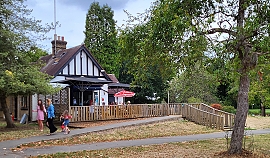
The park consists mainly of spacious grassy meadows that are bordered to the north by dense bushes and trees lining the bank of the Brent. Amenities offered in the park include, tennis courts, outdoor exercising equipment, and an attractive children’s play area. Housed in a small building with fake half-timbering, there is a small café with a terrace on which there are tables and chairs. The ‘caf’ offers hot and cold drinks and a few snacks. Its staff are pleasant, and the washrooms were clean.
While Pitshanger Park cannot be classed as one of London’s more exceptional open spaces, it is a wonderful amenity for residents in the area, just as was (and still is), the public gardens in HGS through which Mutton Brook flows.
THE COMPOSER GUSTAV Holst (1874-1934) is best known for his orchestral suite “The Planets”, which was composed between 1914 and 1916. This work does not include the planet Pluto, which was only discovered in 1930. Son of a professional musician, Holst was born in Cheltenham (Gloucestershire). Between 1886 and 1891, he was a pupil at Cheltenham Grammar School, where at the age of 12 he composed his first piece, “Horatius” for an ensemble of strings, woodwind, brass, and percussion. From 1891, he studied counterpoint for several months with the organist of Merton College in Oxford. Next, Holst studied composition at the Royal College of Music (‘RCM’) in London’s Kensington.
After graduation at the RCM, Holst worked as a professional trombonist in the Carl Rosa Opera Company and the Scottish Orchestra. During this time, he continued composing and also became interested in translations of Sanskrit literature. Several of his compositions reflect his heartfelt interest in the “Rig Veda”, “Ramayana”, and the “Bhagavad Gita”, all of which struck a meaningful chord with him. In 1903, he accepted a teaching role at James Allen’s Girls’ School in Dulwich. Two years later, he left Dulwich to become Director of Music at St Paul’s Girls School in Hammersmith, a position he retained until his death.
Gustav Holst lived here in Barnes
Between 1908 and 1913, Holst lived not too far from the school: at Barnes in a house facing the River Thames on a road called The Terrace. His daughter Imogen Holst (1907-1984), herself a composer, wrote a biography of her father (published 1938). In it she described the house in Barnes:
“… a beautiful bow-fronted brick house overlooking the river. He had a large music room on the top floor, and in the evenings the grey, muddy river would collect all the colours of the sky and shine with a magical light …”
However:
“It was an unhealthy house to live in, for at the spring tides the river overflowed into the streets, and often the floods would come in at the front door. He never felt really well there, and was perpetually suffering from a relaxed throat …”
Before moving to Barnes, Holst began to become interested in socialism, and having read some of the writings of William Morris (1834-1896), who had been living next to the Thames near Hammersmith in Kelmscott House since 1878. Imogen Holst wrote of her father’s interest in socialism:
“… [he] began to hear about Socialism, and after reading several books by William Morris he joined the Hammersmith Socialist Club and listened to Bernard Shaw’s lectures at Kelmscott House. Here he found a new sort of comradeship, and here he became aware of other ways of searching for beauty…. His socialism was never very active, and although he admired William Morris as a man, he found that the glamour of his romantic Mediaevalism soon wore off. But he remained in the club for the sake of good companionship, and in 1897 he accepted an invitation to conduct the Socialist Choir.”
He met his wife, Isobel (née Harrison), when she joined the choir as a new soprano, and they married several years later.
Holst travelled a great deal to places where the climate was better suited to his asthma. While visiting North Africa in 1908, he heard a street musician playing a repetitive tune on a flute in a street in Algeria. This haunted him and led to his composing a lovely orchestral suite “Beni Mora”, which is amongst my favourite pieces by Holst. I first heard this when a musical friend of mine, the late Roger Apps, played a recording of it for me in his home in Rainham (Kent).
A keen walker, Gustav and Isobel went rambling in England. On one of these outings, they visited Thaxted in northern Essex, where they bought one cottage (and then moved to another), in which Gustav spent as much time as possible. I will describe his musical associations with Thaxted in far greater detail in the future. Suffice it to say that some parts of “The Planets” suite were composed there.
In 1913, St Pauls School opened a new music wing, in which Holst was given a large soundproof room for his composing work. That same year, mainly for health-related reasons, he and his family moved from the house in Barnes to a house in Brook Green close to the school.









 yamey
yamey 