DURING THE LONG taxi ride from Kolkata’s airport to the city centre, I noticed an intriguing sign on a building we passed. It read: “Golders Green Complex”. The reason that this interested me was that I was brought up in a northwest London’s suburb called Golders Green.
I have no idea if the proprietors of Kolkata’s Golders Green Complex know of the existence of my childhood haunt in northwest London. The idea that someone might suffer from a malady named the Golders Green complex flashed through my mind. How this would manifest itself, I will leave to your imagination. In my case, the lasting effect of a childhood in Golders Green led me to write a book about the place (https://www.amazon.co.uk/GOLDERS-GREEN-HAMPSTEAD-GARDEN-SUBURB/dp/B0BHG873FB/ )
MUCH HAS CHANGED IN Golders Green since I was a small child in the 1950s. However, a few things have remained more or less the same. My earliest memories of Golders Green Underground station and its neighbouring open-air bus terminus date back to about 1960, when I began travelling by bus to school in Swiss Cottage.
The Underground station used to have two entrances. One, which faces the bus yard, is still in use. The other, which was approached by a long, covered walkway from beneath the bridge crossing Finchley Road, was closed to the public many years ago, but the passageway still exists. It was this entrance that my family used when using the train to travel into central London. There was also a covered staircase situated between these two entrances – this, now disused, was opened during rush hours. It led to the small parking area where the H2 bus, which serves Hampstead Garden Suburb, begins its journey. During my childhood, there was no public transport in the Suburb. Every day, I used to make the 10-minute walk to Golders Green station, passing the crematorium and the Jewish cemetery on my way.
Overlooking the eastern edge of the bus yard, is what was once the Hippodrome Theatre. When I was a lad, this was a flourishing theatre showing plays and pantomimes. Later, it was taken over by the BBC. After they left it, various religious organisations have used it for their meetings. Built in 1913, six years after the Underground was extended from Hampstead to Golders Green, this building’s exterior looks much as it did when I first remember seeing it.
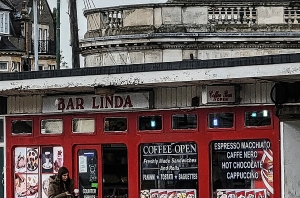
The western edge of the bus yard has always been lined with a row of single storey sheds. Most of these have been used as shops and offices for London Transport. One of them houses a small café called Bar Linda. This was not in existence when I first used to visit the station, but I believe that it opened in the 1960s. Although this friendly little place has been serving customers for many decades, the first time I ventured inside it was in about 2017 when I was about to walk around Golders Green to take photographs for a blog article I was planning to write. I have re-visited it several times since then.
Although Golders Green might not be as aesthetically pleasing as its neighbours, Hampstead and Hampstead Garden Suburb, it is an area full of interest. Much has happened there since 1907 when it began growing from a rural hamlet into a leafy suburb. You can discover much more about Golders Green – its past, my memories of it, and its vibrant present – by reading my book “GOLDERS GREEN & HAMPSTEAD GARDEN SUBURB: VISIONS OF ARCADIA”, which is available (paperback and/or Kindle, from Amazon websites, such as:
HAMPSTEAD GARDEN SUBURB (‘HGS’) in north London, where I spent my childhood and early adulthood, is a conservation area containing residential buildings designed in a wide variety of architectural styles. It first buildings were finished in about 1904/5. Despite this, many of the suburb’s houses and blocks of flats were designed to evoke traditional village architecture. Much of HGS contains buildings that do not reflect the modern trends being developed during the early 20th century, However, there are a few exceptions. These include some houses built in the ‘moderne’ form of the Art Deco style, which had its heyday between the two World Wars.
In Lytton Close
A few Art Deco houses can be found in Kingsley Close near the Market Place (see https://adam-yamey-writes.com/2022/02/07/art-deco-in-a-north-london-suburb/), and there is a larger number of them in the area through which the following roads run: Neville Drive, Spencer Drive, Carlyle Close, Holne Chase, Rowan Walk, and Lytton Close. The part of HGS in which these roads run was developed from about 1927 onwards, mainly between 1935 and 1938. So, it is unsurprising that examples of what was then fashionable in architecture can be found in this part of the suburb. According to an informative document (www.hgstrust.org/documents/area-13-holne-chase-norrice-lea.pdf) about this part of HGS:
“… A relatively restricted group of established architects undertook much development such as M. De Metz, G. B. Drury and F. Reekie, Welch, Cachemaille-Day and Lander, and J. Oliphant. H. Meckhonik was a developer/builder and architects in his office may have designed houses attributed to him.”
Most of the Art Deco houses on Spencer Drive and Carlyle Close leading off from it are unexceptional buildings, whose principal Art Deco features are the metal framed windows (made by the Crittall company) with some curved panes of glass. Fitted with any other design of windows, these houses would lose their Art Deco appearances. Number 1, Neville Drive displays more features of the style than the houses in Spencer Drive and Carlyle Close. There is, however, one house on Spencer Drive that is unmistakably ‘moderne’: it is number 28 built in 1934 without reference to tradition. It is an adventurous design compared with the other buildings in the street.
Numbers 13 and 24 Rowan Walk, a pair of almost identical buildings which stand on either side of the northern end of the street, where it meets Linden Lea, stand out from the crowd. They have flat roofs and ‘moderne’ style Crittall Windows. Built in the 1930s, they are cubic in form: unusual rather than elegant.
I have saved the best for last: Lytton Close. This short cul-de-sac is a wonderful ensemble of Art Deco houses with balconies that resemble the deck railings of oceanic liners, flat roofs that serve as sun decks, curved Crittall windows, and glazed towers housing staircases. Built in 1935, they were designed by CG Winburne. I have to admit that although I lived for almost three decades in HGS, and used to walk around it a great deal, somehow I missed seeing Lytton Close (until August 2022) and what is surely one of London’s finer examples of modern domestic architecture constructed between the two world wars. Although most of the Art Deco buildings in HGS are not as spectacular as edifices made in this style in Lytton Close and further afield in, say, Bombay, the employment of this distinctive style injects a little modernity in an area populated with 20th century buildings that attempt to create a village atmosphere typical of earlier times. The architects, who adopted backward-looking styles, did this to create the illusion that dwellers in the HGS would not be living on the doorstep of a big city but instead far away in a rural arcadia.
ACTON IS NOT usually given high priority on the list of places that visitors to London might compile. However, this district in west London, once a borough in its own right between 1865 and 1965, now part of the Borough of Ealing, is not devoid of interest. After a visit to our dentist, whose surgery is close to Acton’s High Street, we took a look around the area. Churchfield Street, filled with small shops and various eateries, leads east to Acton Central Overground Station.
Opened in 1853 as ‘Acton’ station, it was first a stop on the North and South Western Junction Railway. In 1925, it was renamed ‘Acton Central’. The original 19th century railway building built in about 1876, a rather too grand edifice for such a humble station, has now been converted into a pub/restaurant, whose menu looks appetising. Crossing the tracks, we reach Acton Park, about which I will say more later.
The name ‘Acton’ might derive from Old English words meaning ‘oak town’. At the beginning of the 19th century, the parish of Acton was mostly agricultural land with a small population of about 1400 souls. Between 1861 and 1871, the population increased from about 4000 to about 8300, reflecting the urbanisation of the area. By the mid-1880s, it had reached about 12000. No doubt the accessibility of London via the railway helped increase the area’s attractiveness for people wishing to live in leafy suburbs within easy reach of their workplaces in the centre of the metropolis. Many of the streets near the station are lined with substantial, well built houses.
Acton Park is an attractive, municipal recreation area with lawns, trees, bushes, a café, a putting green, and other facilities including a ‘skate park’ and a children’s nursery. At the northern edge of the park opposite Goldsmiths Buildings, there stands a fine stone obelisk. This was moved to its present position in January 1904 from its original sight in the grounds of the now demolished Derwentwater House on Acton’s Horn Lane. It commemorates James Radcliffe, 3rd Earl of Derwentwater (1679-1816). The date of his death is significant, as I will explain.
James was the son of the 2nd Earl (1655-1705) and Lady Mary Tudor (1673-1726), whose parents were King Charles II and one of his mistresses, the actress Mary ‘Moll’ Davis (c1648-1708). James was brought up in France in the court of the exiled James Francis Edward Stuart (1688-1766), ‘The Old Pretender’, son of the Roman Catholic King James II of England, who was forced to leave England by the Protestant William of Orange. James Stuart, encouraged both by a desire to re-establish the line of James II on the English Throne and by the French monarchy, made various attempts to gain the Throne of England. One of these was in 1715, a year after the Protestant Hanoverian King George I had become crowned King of England. In December 1715, The Old Pretender landed in Scotland, having sailed from France.
In 1709, James Radcliffe, whose memorial stands in Acton Park, sailed to England to visit his recently inherited estates in Cumberland and Northumberland. In 1715, he joined the conspiracy to put his companion since childhood, The Old Pretender, on the Throne of England. A warrant for his arrest was issued, but at first he evaded capture by going into hiding. At the Battle of Preston (9th to 14th November 1715), when the Jacobite forces fighting for The Old Pretender were defeated, Radcliffe was arrested and taken to The Tower of London. After various attempts to reprieve him, he was executed in February 1716. His heart was taken to a convent in Paris, where it remains. The monument was erected by Radcliffe’s widow, Lady Derwentwater, who was living in Acton at the time of his execution. Her home, Derwentwater House, which can be seen marked on a detailed map produced in the early 1890s but not on one published in 1914, stood where Churchfield Road East meets Horn Lane, where today the newish shopping centre, ‘The Oaks’, now stands. Edward Walford, writing in 1883, noted in connection with the house:
“It is said that the iron gates at the end of the garden have never been opened since the day her lord last passed through them on his way to the Tower.”
Acton Park was created in 1888, mostly on land that had been owned by The Worshipful Company of Goldsmiths. Across the road from the park and opposite the obelisk, you will see the elegant Goldsmiths Almshouses. This building was erected in 1811 and enlarged in 1838. They were built on land left to the Goldsmiths Company by John Perryn, in whose memory one of Acton’s residential roads is named.
Tree-lined Goldsmiths Avenue is just 360 yards north of Acton Central Station. Number 78 used to be named ‘Tilak House’ in honour of the Indian freedom fighter Bal Gangadhar Tilak (1856-1920). In early May 1907, Vinayak Damodar Savarkar (1883-1966), a freedom fighter and father of the idea of ‘Hindutva’, an expression of Indian nationalism which underlies the political philosophy of India’s currently ruling BJP party, held a celebration of the fiftieth anniversary of the Indian Rebellion of 1857 at this house. The house was then the home of Nitin Sen Dwarkadas, brother-in-law of another Indian patriot who lived in London, Shyamaji Krishnavarma (1850-1930). Today, there is no memorial to this event.
Other attractions that caught my eye in Acton include St Marys Church (established by 1228, but the current building dates from 1865-67) and its nearby peaceful rectangular cemetery on West Churchfield Road. The Old Town Hall with its accompanying municipal offices was built on the site of the former Berrymede Priory. Designed by the architects Raffles and Gridley, the town hall was built in 1908-10, and extended in 1939. Berrymead Priory, a dwelling, is commemorated by a thoroughfare named Berrymead Avenue, where our dentist practises. It was built on the grounds formerly occupied by William Savile, 2nd Marquess of Halifax (1665-1700), who died here. The priory must have been lovely. Walford noted that it was:
“… a picturesque Gothic edifice of the Strawberry Hill type, and occupied the centre of several acres of ground, which are planted with fine trees and evergreens.”
One of the priory’s better-known inhabitants was the novelist and politician Edward Bulmer (1803-1873), Lord Lytton, who lived there between 1835 and 1836. In 1849, the place was purchased by the wealthy cavalry officer George Drafford Heald, who lived here briefly with his wife, the glamorous Irish born actress and courtesan Lola Montez (1821-1861), one time mistress of King Ludwig I of Bavaria and also of the composer Franz Liszt, whom he had married in 1848. The Healds had to flee to France soon after their marriage, which contravened the terms of her divorce with a previous spouse. Lola and George’s marriage did not last long. However, the building named ‘Berrymead Priory’ lasted longer, until 1982 when it was demolished.
Our Lady of Lourdes, a small Roman Catholic Church built in 1902 in the Romanesque style, was designed by Edward Goldie (1856-1921), who built many other Catholic churches. This church is on the High Street close to another decorative public building, The Passmore Edwards Library, built in 1898-99 and designed by Maurice Bingham Adams (1849-1933) in what Nikolaus Pevsner describes as:
“… his typical rather bulging Baroque paraphrase of the accepted Tudor of the late Victorian decades.”
Adams also designed the Passmore Edwards Library in Shepherds Bush. There is more to Acton than I have described, but maybe what I have written might whet your appetite to explore a part of London that is somewhat off the tourist’s beaten track.




 yamey
yamey 