NOT FAR FROM Henley-on-Thames, lies the village of Bix. Its name might derive from either the Anglo-Saxon word for box, an evergreen shrub, or from a word, ‘behaeson’ meaning ‘to vow’. By 1085, when the Domesday Book was compiled, Bix was divided into two nearby settlements, each of which had its own church. One of these has disappeared, and the other, St James, is now in ruins.
Still consecrated but in a dilapidated state, St James is now known as Bix Old Church. Very little is known about the early history of this ruined church. It was in existence by 1274, when it and the other church were so poor that they had to share a vicar. In the late 1700s, the walls of St James began to collapse. So, brick buttresses were constructed to prevent further damage. These buttresses are still standing, but they failed to halt the collapse of the church. In 1874, the church was deemed unusable, and a new church, the present St James, was built.
We visited the new church, arriving just in time to meet someone who was about to unlock it. Constructed in 1874, it is a Victorian gothic edifice. Inside, the church is built with bricks of differing colours arranged in layers to produce an eye-catching appearance. What makes this church fascinating is that it contains various things that were rescued from Bix Old Church: the font; two fragments of Flemish stained glass dating from 1530; and the carved stone bowl of the piscina. These valuable remains were moved from the old church to the newer one in 1875.
Bix Old Church is reached by a long country lane that is only wide enough for one car. It and the church are in surprisingly a rural environment, considering how close it is to places like Henley, Reading and High Wycombe. We visited the church mainly because when I passed a sign for Bix, which I thought was a strange name, I looked it up on the Internet later while enjoying a picnic, and found out about the existence of the ruined church. Once again, a short visit into the English countryside has resulted in an unexpected, fascinating discovery.
ST NICHOLAS COLE Abbey is a church a few yards southeast of London’s St Paul’s Cathedral. Like the cathedral, St Nick’s (as it is affectionately known) was designed by Sir Christopher Wren and built between 1672 and 1678. The earlier church on this site had been destroyed during the Great Fire of London in 1666. It was the first of the 51 churches lost in the Fire to have been rebuilt. In 1941, it was severely damaged during a German air raid. It remained a shell until it was repaired and reconsecrated in 1962. Sadly, the windows designed by the pre-Raphaelite artist Edward Burne-Jones were destroyed in the air raid. They have been replaced by three attractive windows, which reminded me of the work of Chagall, designed by Keith New (1925-2012).
When we entered the church today (28 April 2025), we found that the floor of its spacious interior was occupied by tables and chairs and along its south side, there was a counter where hot and cold drinks as well as snacks were being served. Most of the tables and chairs were occupied. Some people were enjoying refreshments, others were working with their laptop computers, and yet others were chatting quietly. There are also tables and chairs on the terrace outside the south side of the church. Although the church serves as a café on weekdays, during weekends and on some other days, services are held.
The café has been in existence for about 10 years. Although we have passed the church innumerable times, it was only today that we first ventured inside it. So near to St Pauls and all the eateries catering to tourists visiting it, this church-cum-café seems to be well off the tourists’ beaten track, but well-known to local office workers.
THE MEDIAEVAL CHURCH of St Edmund King and Martyr in the tiny village of East Mersea, on an island close to the coast of Essex, is a joy to visit.
The south wall of the church has some relatively modern windows, which are mostly glazed with clear glass. However, parts of the windows contain small pieces of stained glass, which look quite old. Chris Parkinson at the museum in West Mersea told us that these small fragments of what had once been larger window range from the 15th to the 18th centuries. They were brought to Essex from Devon by the Sunnock family, who came from Topsham and nearby Exeter.
The Sunnocks were a prosperous family. In the 19th century, after the Napoleonic Wars, English gentlemen toured France and the Low Countries, buying up antiques including bits of stained glass from religious establishments. The Sunnocks acquired a large collection of old stained glass this way, and brought it with them when they bought a home on Mersea Island.
During WW2, their Essex home was requisitioned by the military, and the glass was stored in a truk. After the war, some of the glass was restored in Norwich, and then installed in the windows of the church in East Mersea, where it can be seen today.
A TRAGEDY OCCURRED on the 19th of September 1963. Aged 21, Sara Venetia d’Avigdor Goldsmid lost her life in a sailing accident. She was the daughter of Major Sir Henry Joseph d’Avigdor-Goldsmid, (1909-1976) of the Jewish faith and his wife Lady Rosemary d’Avigdor Goldsmid, an Anglican. The family lived at Somerhill, a Jacobean mansion (now a school) near to the church of All Saints at Tudely (just under 2 miles east of Tonbridge). Lady Goldsmid and her daughter Sara used to worship in this small church, which dates to mediaeval times, if not before. Much of the existing structure was constructed in the 13th and 14th centuries, but it was heavily restored in the 18th century.
After Sara’s death, her parents wanted to do something to perpetuate her memory. They and others decided to restore the church. Part of this operation was to replace the existing plain glass east window with a commemorative window, which they asked the artist Marc Chagall (1887-1985) to design for them. This Jewish artist was chosen because Sara and her mother had admired Chagall’s stained-glass at an exhibition they had visited at the Louvre in Paris (France). These included some of the windows that Chagall had created for the synagogue of the Hadassah Medical Centre in Jerusalem (Israel). They were installed in 1962 after having been exhibited not only in Paris but also in New York City.
Chagall created the drawings for the windows, and they were translated into stained-glass by Charles Marq (1923-2006) of Rheims (France). When Chagall visited Tudely, and saw his window after it was installed and dedicated in December 1967, he was so satisfied with it that he offered to create stained-glass images for all the other windows in the church. His offer was accepted. He managed to complete this work, but it was some years before the congregation at Tudely finally agreed to replace the existing Victorian stained-glass windows in the church with those created by Chagall. It was only some time after the church warden, Kenneth Stinton, had seen the Chagall windows on display at the Royal Academy of Arts in Piccadilly in 1985 that the idea of replacing the Victorian windows with Chagall’s became acceptable. They were placed in the church by December 1985.
Many of Chagall’s windows at Tudely are rich in dark blue colouring. Entering the church and finding it suffused with predominantly blue light is like entering an underwater space. This might be intentional as poor Sara d’Avigdor Goldsmid’s life ended beneath the water of the coast near Rye (Sussex). If she saw anything at all as she sunk beneath the sea, it might well have been such a dark blue light. I have visited Tudely’s church several times, and each time the same thought occurs to me. My first visit must have been in the 1980s after December 1985, because I have never seen the church without all the Chagall windows installed.
The church is in a rural setting, surrounded by fields. It has become a tourist attraction, and is occasionally used to hold chamber music concerts, one of which I attended in the early 1990s when I was still practising dentistry in north Kent. Although a little remote, this gem of a church is well worth making an effort to visit it.
NO ONE KNOWS exactly where the Explorer and naval commander Sir Francis Drake (c1540 – 1596) was ‘buried’ at sea. What is known is that his corpse clad in armour was put into a lead coffin, and then dropped into the sea somewhere near Portobelo (now in Panama).
On the 400th anniversary of his death, a stained glass window which is part of a sundial was installed at the Drake family home in Devon: Buckland Abbey. The window depicts a chart of the Atlantic Ocean on which a small cross has been marked in the approximate location of Drake’s burial. The window/sundial was designed by Christopher Daniel.
TWO TEMPLE PLACE was built for the American businessman William Waldorf Astor (1848-1919) in 1895. Located close to Temple Underground Station and Middle Temple, this distinctive edifice is said to be designed in the ‘neo-Gothic’ style, although I would prefer to describe it, and especially its interior, as ‘Tudor Revival’. Every year, between late January and late April, the building, which is now owned and maintained by the Bulldog Trust charity, houses an exhibition, which is always worth viewing. This year’s exhibition, which continues until the 21st of April 2024, is called “The Glass Heart”.
“It will explore the narratives central to glass art and manufacturing, and celebrate the timeless skills, artistry and innovation required to work with this challenging material.”
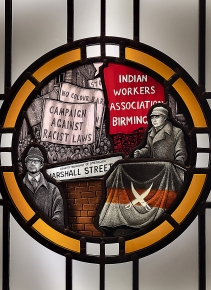
And it does that very successfully by exhibiting a superb collection of glass creations ranging from industrial products, such as Pyrex, through stained glass, to intriguing artistic creations that defy the imagination. I will not attempt to describe all of these exhibits – each one of them both fascinating and beautiful – but I will concentrate on one small collection of items relating to the Red Lion – a pub in West Bromwich (West Midlands).
The Red Lion is a ‘desi’ pub owned by Indians, whose families originated in the Punjab, and came to work in the factories of Britain’s Black Country. Although all are welcome, the pub is mainly a socialising place for local people whose families came from the Subcontinent. It is one of several desi pubs in the former industrial heartland. In 2016, Steven Cartwright, who runs a studio that produces creative and decorative glassworks, was commissioned to create some stained-glass windows to decorate the Red Bull. His mission was to create traditional pub style stained-glass, but with an interesting slant – it was to celebrate the rich culture of the desi pub in the West Midlands. To do this, as Steven explained on his website (www.cartwrightglassdesigns.co.uk/projects/red-lion):
“I designed the window to give the appearance of a traditional pub but with a twist. The window utilises some of the colours and elements of the sub continent and tells the story of the punjabi community who migrated to the area in the 50’s. It also celebrates the establishment of the Indian workers association by Avtar Singh Jouhl and the visit of Malcolm X at their invitation.”
At the exhibition in Two Temple Place, there is a small piece of this pub’s stained-glass and some photographs of the rest of it.
What particularly intrigued me was the mention of The Indian Workers Association (‘IWA’) of Birmingham. The IWA was founded in the 1930s by Indian workers from Coventry to combat racist objections to them both by the British trade unions and the British people in general. The quote mentioned Avtar Singh Jouhl. He was born in the Punjab (British India) in 1937, and after the 1947 Partition, he came to London to study at the London School of Economics, arriving in 1958. Three years later, he moved to Smethwick in the Midlands, where he became an industrial worker. There, he saw and experienced racist anti-Indian conditions that prevailed at the time, He joined the IWA, and soon, along with others, he founded its Birmingham branch.
In February 1965, Jouhi invited the civil rights campaigner Malcolm X to visit Smethwick. A few days before his assassination, Malcolm X said of Smethwick:
“This is worse than America. This is worse than Harlem.”
In Jouhi’s obituary (The Guardian, 4th of November 2022), the following was written:
“The anti-racism campaign that attracted Malcolm X to Smethwick was spearheaded by Avtar Singh Jouhl, who has died aged 84 … Jouhl, as general secretary (1961-64; 1979-2015) and national organiser (1964-79) of the Indian Workers’ Association (IWA), challenged trade union members, factory owners and publicans to end this racism … When it came to breaking the colour bar in the town’s pubs, the IWA’s tactics were similar to those used by the Freedom Riders in the US in the previous decade. White university students were enlisted to order drinks, then hand them to British Indians, such as Jouhl. The landlord would invariably eject them, while the students challenged the eviction. The IWA then used evidence of these actions to successfully oppose the publican’s licence when it came up for renewal … This targeted campaign led to discrimination in pubs being outlawed in the Race Relations Act (1965) and paved the way for Britons of Indian heritage to become publicans themselves and set up what are commonly now known as “desi pubs”.
It was his actions described above and many others that helped to suppress racism in the Midlands and elsewhere in Britain. And it is very pleasing to see that what he achieved is being celebrated in glass in a pub owned and frequented by the people whom he helped. I visited the exhibition at Two Temple Place because I enjoy viewing glass artefacts. Little did I know that I would leave the exhibition having been introduced to an important political movement, about which I had known nothing.
IN 1975 I WENT to the town of Prizren in Kosovo, which was then part of the former Yugoslavia. I visited an old church in the town. Once, its internal walls had been covered with frescos. However, they had been badly defaced up to a certain height above ground level. Above that height and on the ceiling, they were intact. When the Ottoman soldiers arrived in Prizren, they used their spears to destroy the frescos, but only did so as far as they could reach. Being lazy, they did not use ladders to reach the higher parts of the church. So, the frescos beyond their reach survived.
In England, both the Dissolution of the Catholic religious establishments by Henry VIII, and later the defacement of churches by Oliver Cromwell and his followers, resulted in the destruction of many fine works of religious art. During a recent visit to Suffolk, we saw a few fine artefacts, which like the frescos in Prizren, have survived.
Bardwell
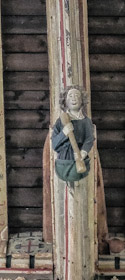
In accordance with Cromwell’s decree, many of the 15th century carved wooden angels that overlooked the nave of the parish church in Bardwell were destroyed. But, a few were left intact. Why was that? Did the workmen lose interest, or were they not paid enough? Who can say? And why was some of the 14th century stained glass left intact? Again, nobody can remember.
Over in the sleepy little town of Eye, the Parish Church contains a wooden rood screen containing beautifully painted panels that should surely have been destroyed by Cromwell’s iconoclastic vandals. Were they covered up with, say, wood panelling before the wreckers arrived, or were they removed and hidden? Luckily for us, these wonderful mediaeval paintings have survived.
Near Eye, there is a tiny church with a thatched roof in the village of Thornham Parva. It contains a rectangular wooden frame containing several mediaeval paintings that were created the 14th century. It was once the retable of an altar. Most likely, it was originally part of an altar in the Dominican Thetford Priory, which was dissolved during the reign of Henry VIII.
It is most probable that when the priory was dissolved, the retable was rescued by a Catholic family who put it in their private chapel. It passed through two other families before it was donated to the church at Thornham Parva in 1927. It is a rare surviving example of 14th century British religious painting. Interestingly, there is another series of painted panels in the Musée Cluny in Paris that resembles the Thornham Parva retable. Comparison of detailed aspects of these two sets of paintings suggests that they were both painted by the same team of artists, and were originally designed for the same location – most probably Thetford Priory.
In the space of three hours, we visited the churches at Bardwell, Eye, and Thornham Parva. All three contain artefacts of great interest and beauty which survived the religious upheavals orchestrated by Henry VIII and later by Cromwell. Once again, touring around in England has opened our eyes to its treasure house of history.
HOLY TRINITY CHURCH in the Suffolk Town of Long Melford is a grand perpendicular gothic affair built in the 15th century when the town was prospering because of the then thriving wool trade. Fortunately for us today, several of the original stained glass windows have survived in reasonably good condition.
On one of these mediaeval windows, which survived the iconoclastic behaviour instigated by Henry VIII, depicts Elizabeth Talbot, the Duchess of Norfolk, who was born in about 1442. Her daughter was married as a child to Richard, one of the two princes murdered in the Tower of London in about 1483.
It has been suggested that John Tenniel, the Victorian illustrator of Lewis Carroll’s “Alice’s Adventures in Wonderland”, might possibly have visited Long Melford, seen the portrait of Elizabeth Talbot, and then modelled his illustration of the Queen of Hearts on that image on the window. Whether this was actually the case or just pure coincidence is up to the viewer to decide. I remain undecided.
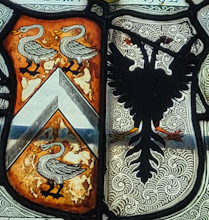
THE GREAT HALL of Lytes Cary Manor House in Somerset has some stained glass windows decorated with crests relating to the Lyte family, who owned the property between the 15th and 18th centuries. One of the crests caught my eye because the crest contains a double-headed eagle. This is a symbol that began to interest me in my teens when I first became fascinated by the Balkans. The double-headed eagle figures on the flags of Albania and some of its neighbours. The earliest known use of this peculiar creature is on seals used to secure goods in Babylon during the 3rd century BC.
The crest at Lytes Cary Manor is a combination of the Lyte family crest and that of the Worth family, which incorporates the two headed bird.
In 1592, Thomas Lyte (c1568-1638) married Frances Worth (1580-1615) who was born in Charlton Mackrell in Somerset. Thus, the double-headed eagle of the Worth family became joined with the three swans of the Lyte family crest. This marriage which was celebrated so long ago, is recorded in glass on a window of the Great Hall at Lytes Cary.
Why the Worths employed the double-headed eagle on their crest is something I would like to know, and will investigate. The double-headed eagle appears on British crests less frequently than other heraldic creatures. Possibly, andI am only guessing, it relates to the fact that a son of King John, Richard, Duke of Cornwall (1209-1272) was appointed King of The Germans, that was a senior position in the Holy Roman Empire. The symbol of that empire was the double-headed eagle.
CHARLES LUTWIDGE DODGSON (1832-1898), better known as Lewis Carroll, author of “Alice’s Adventures in Wonderland”, was born in the village of Daresbury in Cheshire. During his first few years of life, Charles’s father was the curate of the local church of All Saints.
When he was 11, the Dodgson family moved away from Daresbury. Eventually, Charles entered Christ Church College in Oxford. It was here that he met the young child Alice Liddell, daughter of the Dean of Christ Church. It was this young child who inspired Dodgson to create and later publish his famous story. Unlike many other Victorian tales for children it was free from moral instructions.
Dodgson/Carroll died in Guildford, where he was buried. To celebrate the 100th anniversary of his birth, money was raised to create a window in the church in Daresbury to commemorate him. Known as the Lewis Carroll Window, it allows light into a Chapel in the southeast corner of the church. Designed by Geoffrey Webb, it was dedicated in mid 1935.
The stained window incorporates depictions of both Carroll and Alice Liddell, as well as some of the creatures drawn originally by John Tenniel, who illustrated the book about Alice.
A modern addition to the church was built onto its North side. This contains a Lewis Carroll exhibition. One of the exhibits is an old Bell. This used to be attached to a barge that served the religious needs of the people who lived and worked on the canals near Daresbury. This floating chapel was the creation of Lewis Carroll’s father.
We visited Daresbury on a July day when the air temperature was 37 degrees Celsius. Fortunately, it was cooler inside the church. I am grateful to Christine Casson for encouraging us to visit the church with the Wonderland window.





 yamey
yamey 