
Beverages beneath the banyans

ONCE A CITY FILLED with lovely gardens and other verdant open spaces, Bangalore (Bengaluru) is growing alarmingly rapidly. So, public spaces that have been as yet saved from being built on are valuable amenities. One of these areas of greenery is the so-called Tivoli Garden, which is in the grounds of Airlines Hotel in the heart of the city.
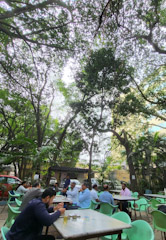
Known popularly as ‘Airlines’, the Tivoli Garden, a name by which it is hardly known, has tables and chairs set out in an open space, a clearing, surrounded by trees, several of them being elderly banyans.

Opened in 1969, the open air café and eatery is still supervised by a man who helped set it up two weeks before it opened all those years ago. Despite its rather untrendy appearance, Airlines is popular with Bangaloreans of all ages. Quite a few of them are students, but many are office workers. Very good South Indian filter coffee is served at Airlines. A wide range of South Indian vegetarian dishes is also served.

The coffee, other drinks, and food are prepared in the kitchen of the hotel. Waiters in white uniforms carry drinks and food across the car park from the kitchen, which is located at the far end of a dingy dining hall, to the garden seating area. Some customers prefer to have their orders served to them whilst sitting in their parked cars.

For my wife and me, Airlines has several attractions. One is the coffee. Another is the pleasant ambience under the trees. And yet another is nostalgia. My wife used to visit Airlines with her family in her late teens. And together with our daughter, my wife and I have been regular visitors to Airlines since when we married in 1994.

For several years, Airlines has been under threat of closure by the people who own the land. Over a decade ago, these people reclaimed half of the area occupied by the café. They built an ugly grey wall (rather like a Berlin Wall) to separate what is left of Airlines from what has now been built on. The supervisor, whom we have known for ages, assured us that as far as he knows the remaining part of the establishment will remain safe from redevelopment.

It would be tragic if Airlines were to disappear, not only because we love it but also it would be yet another example of how what was once a lovely garden city is becoming more and more of an urban jungle
Eating on a train


OHRID BITOLA 77 Train from Medzhitlija


IN THE SUMMER OF 1973, I was on holiday in Greece. Our family and that of ‘K’, a good friend of mine were guests of an extremely wealthy Greek. We had been put up in luxury hotels. We stayed in the George V Hotel in Athens and K’s family were put up by the sea at a luxurious resort at Vouliagmeni. Before leaving England for our Greek holiday, K agreed to accompany me on an excursion north from Greece to a lake in southern Yugoslavia, Lake Ohrid, a body of water now shared by Northern Macedonia and Albania. I was curious to gaze at the then very mysterious Albania across the water from Yugoslavia and K was just being a ‘good sport’ in agreeing to join me.

One day in Athens, K and I left our very comfortable accommodation and arrived at the railway station from which northbound trains departed. The route between Athens and Thessalonika was long and slow, the train having had to wind its way across mountain ranges.

Every twenty minutes, an attendant arrived at our compartment carrying a tray with pork kebabs, lumps of cooked pork on thin wooden skewers. The barely warm meat was delicious. Each skewer seemed better than the previous one. We kept on buying them each time the attendant arrived.

After several hours and many skewers, K said that he had eaten enough of them and he was not feeling too well. My reaction to this was that being an inexperienced traveller compared to me, his stomach was weak compared to mine. I continued munching the delicious kebabs as the journey continued.

At a small place, which was probably Platy, in northern Greece, our train left the main route and headed along a branch line towards Edessa, where we disembarked. Before leaving the station, we had to have our tickets endorsed by a railway official so that we could continue our journey the following day. As soon as we disembarked, K thrust his ticket into my hand and rushed to evacuate his bowels in a field of ripe corn next to the railway.

We booked into a small hotel, the Olympus, in Edessa, where we paid the Drachma equivalent of £1 Sterling for a room with two beds. I gave K some of my anti-diarrhoea tablets, and he ate some plain yoghurt for supper. At this point, I was still thinking how sad it was that my friend’s stomach was so delicate. Surprised to be hungry after having devoured so many pork ‘souvlaki’ on the train, I ate a normal supper.

The beds in the hotel were very short. My feet projected beyond the bed end. I slept well. The next morning, K was feeling much healthier. However, I was not. I had a terrible pain in my stomach which made it difficult for me to stand up straight. I took some of my tablets and tried without much success to enjoy a bowl of plain yoghurt upon which there was a puddle of oil.

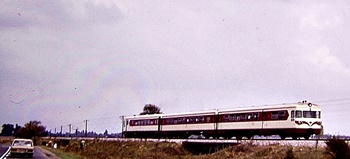
We returned to the railway station and boarded the train which took us westwards to the small town of Florina. We had a short stay, a few hours, in Florina, where I recall buying a roll of toilet paper. The daily train, a single motorised carriage, from Florina to the border with Yugoslavia departed in the early afternoon. K and I were the only passengers. At the border, the Greek carriage drew up next to a Yugoslav motorised train with several carriages on the neighbouring track. A Yugoslav soldier instructed us to move from the Greek to the Yugoslav train and then we set off northwards through southern Yugoslavia, crossing a flat plain with well-tended fields.

We disembarked at Bitola, once known as ‘Monastir’, and transferred to a long-distance bus. As the sun set, this carried us north westward over the mountains towards the historic city of Ohrid on Lake Ohrid.

It was dark by the time we arrived at the campsite on the lakeshore about a mile north of Ohrid city. Both of our stomachs had settled down. For the next few days, I explored the beautiful sights along the lake and enjoyed the local food, much of which was in the form of kebabs. K, having been made wary as a result of our experiences with the Greek railway ‘souvlaki’, avoided this kind of food, preferring to feed himself at our campsite.


Picture taken in 1977 shows the train in Yugoslavia between the Greek border and Bitola