OVER THE YEARS. We have made many visits to Slough, a town in Berkshire, just west of Heathrow Airport. It would usually not figure on tourists’ lists of places that they feel they must see. And there is little in Slough that would entice people to visit the place. Yet, since the early 1970s, we have visited there often.
My PhD supervisor, Robert Harkness, and his wife, Margaret, lived in the countryside not far from Slough. They used to travel between Slough and Paddington stations when they were travelling to and from University College London (‘UCL’). While I was studying with them, they became my close friends. Until they died in the early years of this century, I, and then later my wife and our daughter, often spent weekends in their large Victorian home, Margaret, who played the violin, was involved with the Slough Philharmonic Orchestra (Slough Philharmonic Society). For many years, she not only played in the second violin section but also, she was the orchestra’s honorary accountant. We were often invited to the orchestra’s concerts, many of which were held in concert halls in Slough. A few of the concerts were held in Slough’s ‘posh’ neighbour Eton.
Because Robert and Margaret lived near Slough and we visited them often, we hired a storage unit (‘godown’) in Slough. We could combine visiting our friends with making trips to add things to our storage place. Sadly, Robert and Margaret are now no more than fond memories. However, our storage locker remains in Slough. So, visits to the town continue.
Recently, the company that stores our stuff moved from the edge of Slough to a place closer to the centre. It has a good car park and is close to a wonderful range of food shops. Slough has many inhabitants whose ancestors hail from the Indian Subcontinent and a sizeable Polish population. On the outskirts of Slough, there is at least one large Polish sporting/country club. Near our newly located storage place, there are two well-stocked Polish food supermarkets, which sell many products including things that would not be found at the nearby halal food shops and eateries. In addition to food shops catering for people of Indian and Pakistani origins, there are gift shops where decorated Hindu idols can be bought. There is also a jewellery store whose gold and diamond-studded items are just like what I have seen in India.
Drab as Slough undoubtedly is, the ethnic mix of its inhabitants add a welcome touch of colour and exoticism to the place. Having said that, I am not sure that I would recommend going there unless you have a reason to do so.
TODAY, MY SHOULDER bag broke suddenly whilst on my way to Calcutta’s New Market – one of my favourite shopping districts. Humayun Place, which leads from Chowringhee to one side of New Market, is lined with pavement vendors. We stopped at one selling bags, and asked to see one that I hoped might be a suitable replacement for the bag whose strap had just broken.
Inside New Market in Calcutta
The bag was ‘ok’ but not ideal. We asked the price, and were quoted 950 rupees (about £9.50). We told the seller that seemed too much for such a bag. We told him that we had paid about 500 for the old bag less than a year ago. Hearing that, he said we could have it for 500, and as he spoke those words, he put it into a plastic carrier bag.
I was still not sure that this was the ideal replacement, and we began to walk away. The seller then offered us the bag for 400, saying that if we bought it would be his ‘bohni’ for the day. Hearing that and feeling that the bag was worth 400, we purchased it.
In India (and Pakistan), the custom of bohni is commonly observed. The bohni is the vendor’s first sale of the day (or at the start of some other defined period of time). Many shopkeepers believe that the bohni establishes the success of his or her business during the rest of the day.
So, one of the risks faced by those who shop soon after the stores or stalls open is they will be made to feel that they ought to buy something in order not to jeopardise the vendor’s success during the rest of the day. For, being the first to enter a shop or halt at a stall without purchasing a bohni is a bad omen for sellers.
Although I am sure most vendors who tell you that by making a purchase you are doing the bohni for the day are bona fide, there must be a few who try to achieve a sale by saying it is the bohni when it is not.
JUST BEFORE I VISITED New York City in early 1992, I needed to buy a new coat. I entered Cordings gentleman’s clothing store on London’s Piccadilly and was greeted by a salesman. He listened carefully whilst I explained that what I was seeking had to be warm, windproof, waterproof, lightweight, and furnished with pockets both outside and inside the garment. After a moment’s consideration, he said to me:
“What you need is a Dannimac, Sir.”
I asked him whether I could see one and try it on. He replied:
“There’s only one problem, Sir.”
“What’s that?” I asked.
“They don’t make ‘em anymore.”
So, I set off for New York with an old coat that needed replacing. One day, I entered a clothing store on the lower east side of Manhattan. I explained my requirements to the very talkative salesman. When I explained my pocket requirement. He said abruptly:
“You want pockets on the inside and the outside? What are you? A private detective? A secret agent?”
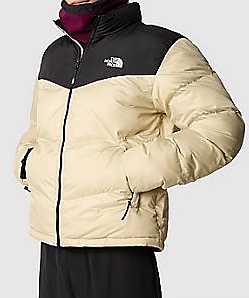
That was the first, and so far, only time, someone has suggested that I did that kind of work. The man showed me some feather-filled puffy jackets made by North Face. They fulfilled all my criteria. I chose a beige one, and happily parted with over 100 US Dollars. I used that North Face for over 25 years until its appearance became too disreputable, and then, sadly, I disposed of it.
Having acquired my fine new coat, I had to get rid of the old one, which I had brought from England. I recall that there were few if any rubbish bins on the streets. As for my friend’s flat, where I was staying, there seemed to be nowhere to dispose of even the smallest bit of rubbish. On my return to the UK, my future wife, who had lived in New York City, explained that there must have been a rubbish disposal shoot in the flat or the building. I did not want to dump the old coat in the street, So, in the end, I handed it to one of the many people begging for money in the city.
DURING THE LATE 1950s and much of the 1960s, my mother created artworks in the sculpture workshops of St Martins School of Art, which was then located on Charing Cross Road near to Foyles bookshop. My mother was a keen follower of the recipes of Elizabeth David (1913-1992), who introduced Mediterranean food to British kitchens. Near to St Martins in Old Compton Street, there were many food shops that supplied the ingredients that were required to follow Ms David’s recipes accurately. There used to be a French greengrocer between Charing Cross Road and Greek Street. This was one of the only places where ‘exotic’ salads such as mâché (lamb’s lettuce) could be purchased. Further west along Old Compton Street, there was a Belgian butcher, Benoit Bulcke, which cut meat in the French style, which my mother preferred. She claimed that English butchers were not ‘up to scratch’. Both these shops have long since disappeared. Another Soho establishment, which we used to visit regularly, was Trattoria da Otello in Dean Street. We went there so often that we were treated like old friends. Now, sadly, that wonderful restaurant is no more.
Three Old Compton Street shops frequented by my mother are still in business. They are the Algerian Coffee Stores, whose appearance has barely changed since the early 1960s when I first remember entering it; and a supplier of Italian foods: I Camisa & Son. Lina Stores, which my mother also used to visit still exists, but its branch on Brewer Street (and other newer branches) seems to have become more like restaurants than Italian delicatessens.
During school holidays, I used to accompany my mother on trips from Golders Green, where we resided, to the West End. On most of these excursions, food shopping in Soho was on our itinerary. So, as a youngster I got to know these various food shops quite well. As an innocent child, I associated Soho with food shopping rather than its other more colourful activities.
Every visit to Soho involved a stop at Bar Italia on Frith Street. There, I would be treated with a cappuccino while my mother drank an espresso. From when I first knew it in the early 1960s (or possibly the late 1950s), the overall appearance of Bar Italia has barely changed. As a friend remarked on a recent visit, the cracked Formica counter opposite the bar is typical of how cafés would have been fitted out back in the 1950s.
Bar Italia is almost three years older than me. It was founded in late 1949 by Lou and Caterina Polledri. Lou was born in the Italian city of Piacenza. According to the Bar’s website, some of the above-mentioned Formica was put in place in 1949, when the establishment was for its time ‘state-of-the-art’. The floor is that which was laid down by members of the Polledri family in 1949.
When it opened, Soho had a large Italian community, which much appreciated the Bar Italia as a home-away-from-home. At the far end of the small establishment, there is a television that broadcasts Italian TV, mostly sporting events. Each time I visit the place, the screen sems to have been replaced by a larger one. However, I cannot recall whether there was a television in place when I visited as a child. What I do remember is that next door to Bar Italia, there used to be a Greek restaurant called Jimmy’s, which, for some reason, my mother never took us there.
Once a local for the Italian community, Bar Italia has become somewhat of a Soho landmark and tourist attraction. In addition to coffee and alcoholic drinks that would be available in any local bar in Italy, Bar Italia now also serves hot meals. It also sells Portuguese ‘natas’, which are not typical fare in bars in Italy. Apart from this change, the prices of its excellent coffee have shot up to levels higher than most London cafés charge. Whereas one can expect to pay from on average £2.80 to “£3.20” for an espresso, Bar Italia is now charging over £4.20. I mention this, but do not begrudge them because by patronising Bar Italia we are helping to preserve a delightful historical London landmark.
NOW watch this lovely little video about the place:
DURING A BRIEF VISIT to Nottingham made especially to view the centrally located Nottingham Contemporary art gallery (opened 2009), we spent a few minutes looking at some of the fine old buildings nearby. One of these is a shopping mall or arcade that reminded me a little of the superb Galleria Vittorio Emanuele II in Milan (Italy). Not as big as the structure in Milan, Nottingham’s Exchange Arcade is surprisingly grand.
Built between 1927 and 1929, it was part of a major civic construction project, which included the nearby Council House. It was opened by the then Prince of Wales, who became King Edward VIII briefly before abdicating to marry Wallace Simpson.
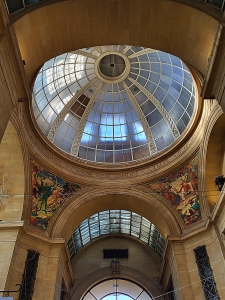
Shops in the Exchange are arranged along a long central corridor and two shorter side corridors. Together, these wide walkways make a ‘T’ shape. Where the long corridor meets the two shorter ones is beneath a glazed dome. The dome is supported by four sloping walls, upon each of which there is a colourful fresco. One of these depicts a local hero, Robin Hood, firing his bow and arrow.
When it first opened, the Exchange housed Joseph Burton’s emporium, Nottingham’s version of London’s Fortnum & Mason. By the early 1980s, the arcade had become shabby, and was renovated. Now, it contains 17 retail stores. Although I am pleased that we saw the Nottingham Contemporary, I am glad we also managed to visit the magnificent Exchange arcade.
“In the early 1960s, my parents installed a Permutit water softening unit in our family home. I have no idea why they did this. Maybe it was to save soap and the furring up of pipework. I am not sure that they would have done it had they known of the research that shows that heart disease is reduced as the hardness of drinking water increases.
The apparatus consisted of two cream-coloured cylinders, each about five feet high, which stood next to each other in our garage by the side of the house. One of the cylinders was sealed shut and surmounted by a circular metal control wheel. Its neighbour could be opened by lifting a lid. Once a week, my father had to refresh the ion-exchange resin in the sealed container. This was done by adding salt in large quantities to the other cylinder …
… A special salt, called dendritic salt, was required for the weekly process … There was only one store that would both supply sacks of dendritic salt and, also, deliver it to our home. That store was the world-renowned Harrod’s in Knightsbridge, which brought us the salt in their silent, electrically powered delivery vehicles. In order to get these regular deliveries, my parents had to open a Harrod’s account...”
Today, at the end of May 2023, I paid a visit to Harrod’s – a department store, which I last entered about 15 years ago. Since then, its interior has been modified considerably. The Ancient Egyptian themed central escalator hall is as it was when I last saw it, as is the superb, tiled food hall. Otherwise, it seemed unrecognisable to me.
Rather than being what I have always believed a a department store should be – a large shop in which its various sections display different kinds of goods (for example, men’s clothing, kitchen appliances, toys, etc), todays Harrod’s is a collection of departments, each one dedicated to a brand rather than a type of product. Wandering through the store, trying to find our way out, it occurred to me that Harrod’s has become more like a shopping area in a large international airport than an ‘old-fashioned’ department store. Is this, I wonder, because today’s customers are more interested in brand names than the products to which they are attached? Also, I am curious to know whether Harrod’s still deliver sacks of dendritic salt to addresses in the Hampstead Garden Suburb, where we used to live.
SOUTHALL LIES NOT far from Heathrow Airport. Despite its architecture being mostly typical of dull London suburbs that developed between the two World Wars, it is far from being a run-of-the mill west London suburb. Recently, in March 2022, we visited Southall after several years since we last went there.
The centre of what was once the tiny village of Southall is about 1.7 miles north of Osterley Park house. The manor of Southall was owned by the Archbishop of Canterbury in the 14th century. Separated by countryside from its neighbours, it lay on the road from London to Uxbridge and Oxford. It was only in the 1870s that the village began expanding southwards to the Great Western Railway line. Today, the place has been fully incorporated into London and retains little or nothing of its former rustic nature.
Detail of the roof of the Himalaya Palace in Southall
On arriving by train at Southall station, the observant traveller will notice that the station name signs are bilingual; they are in both Latin and Punjabi scripts. Southall is sometimes aptly referred to as ‘Chota Punjab’ (Little Punjab). The three Punjabi brothers, Charan Singh Bilga, Jagar Singh Bilga, and Lave Singh Bilga, began living in Southall in 1938. They were followed by Pritam Singh Sangha, who opened a shop in Southall in 1954, having arrived in the area in 1951. His shop was then the only shop in west London, if not in the whole of the metropolis, purveying Indian provisions. Pritam Singh Sangha in partnership with his friend and business associate, Jarnail Singh Hura (also known as “Ghura”), established the first known business in Southall and Fakir Singh purchased numerous houses which he rented out to his countrymen.”
Vivek Chaudhary, writing in the Guardian in April 2018, recorded:
“By the time my own father arrived in 1960, local authority records show that there were approximately 1,000 Punjabis living in Southall, nearly all men. He would joke that one of the reasons why they settled here was because of its proximity to Heathrow airport, only three miles away, and “if the gooras [whites] ever kicked us out, it would be easy to get on a plane and return home”. It was a light-hearted reference to the uncertainty that was generated by the chronic racism of the time. It was the R Woolf rubber factory in neighbouring Hayes that attracted Punjabis to Southall – the general manager had served with Sikh soldiers during the second world war and was only too happy to recruit them…”
He added:
“Punjab was partitioned by the British in 1947; part of it fell within Pakistan with the remainder in India. Punjabis can be Sikh, Hindu or Muslim, and while all three demographics settled in this outpost of west London, it was the Sikhs who came in the largest numbers and gave Southall its distinct identity.”
Chaudhary mentioned that at the time he wrote his article, although at one stage Southall’s population was 70% Punjabi, this has decreased to about 50% and the descendants of many of the original settlers:
“…have prospered and moved to wealthier pastures, replaced by new communities from Afghanistan, Sri Lanka and Somalia. At its heart, though, this corner of west London remains an indelibly Punjabi town.”
And so, it is. Southall is like the Punjab and other places in India or Pakistan, but with the often-dull English weather and rather pedestrian suburban architecture. The main streets, South Road and the Broadway (Uxbridge Road), are lined with shops, small bazaars consisting of several tiny shops, and eateries. Judging by the profusion of colourful, often glittering, Indian (and Pakistani) style party clothing on sale, one might be excused for thinking that the people of Southall do nothing apart from attending ‘glitzy’ weddings. If you wish to sample shopping as it is in India without leaving the country, then Southall is the place to do it in London. It seemed to my wife and me that the quality of the clothing on sale was high, better than much that is available in India. A Sikh salesman explained that what is on sale in Southall is made in India but unlike what is on sale over there, this is export quality.
One building is worthy of special mention in Southall, apart from the area’s gold-coloured domed Sikh gurdwaras. This is the former Himalaya Palace cinema. Built in 1929, it is unique in Britain in that its façade is in the form of a Chinese Temple. It has a pagoda roof which is flanked by dragons. It used to screen films from India’s Bollywood studios until it closed in 2010. It has now become an indoor market called Palace Shopping Centre. Fortunately, the building is protected by a preservation order and the façade is likely to remain a wonderful landmark in the foreseeable future. Not far away in a less distinguished building is another mall, the Himalaya Shopping Centre. Entering these malls, and the others in Southall, is like stepping into a typical indoor shopping bazaar anywhere in India. The air in these Southall shopping centres has the special fragrantly perfumed odour I associate with India.
Near the former cinema, stands the former Southall Town Hall, which was constructed in 1898. On its wall, there are commemorative three plaques placed by an anti-racism group called Southall Resists 40. They are dedicated to Gurdip Singh Chaggar, who was killed in 1976; Blair Peach who was killed in 1979; and ‘Misty in Roots & People Unite Musicians Cooperative’. Each of the three bears the words “Unity against Racism”.
THE BATTLE OF Portobello was fought between the British Navy and the Spanish in November 1739. It was an event during the War of the Austrian Succession. The battle’s aim was to capture the port of Portobello in Panama from the Spanish. The British were victorious.
I have been walking along Portobello Road frequently for over a quarter a century. Each time, I have passed a series of neighbouring shops collectively known as Admiral Vernon Antique Market. I thought it was an odd name until today when I noticed that it is close to an alley called Vernon Yard. Then, the penny dropped, and I began thinking about the choice of the shop’s name – an admiral on Portobello Road.
Admiral Edward Vernon (1684-1757) was born in London. He joined the Royal Navy in 1700, aged 12, and rose through the ranks. One of his many achievements was the creation of the name ‘grog’ for the commonly consumed drink consisting of rum diluted with water. Also, he made improvements to the methods of naval manoeuvres and the welfare of sailors. Another of his claims to fame was that along with Lieutenant-General Thomas Wentworth (c1693–1747) he led the British forces that captured Portobello.
Knowing this makes sense of the name of the antique shop and the name Vernon Yard. The shop and the dreary little alley are not the most magnificent of memorials to Edward Vernon. There is a more elegant one in Westminster Abbey. The most impressive item commemorating the admiral is the estate of Mount Vernon in Virginia (USA), which was once owned by George Washington’s family. It was named after Edward Vernon because one of Washington’s brothers, Lawrence (died 1752), had been under Vernon’s command during the capture of Portobello.
FROM THE LATE 19th century until a few years ago, High Street Kensington was a healthily flourishing retail centre. In its heyday, it boasted of three large department stores, Pontings, Barkers, and Derry & Toms. The impressive buildings that housed the latter two still stand and are fine examples of art deco architecture located close to the Underground station, which has been in service since the late 1860s. In recent years, the advent of on-line shopping, high rents, and the proximity of the Westfield Mall at Shepherds Bush (opened 2008), which has good parking, have conspired together to make High Street Kensington less appealing to shoppers. Consequently, at any one time a large proportion of shops remain empty awaiting new tenants. Sadly, what was once (especially in the 1960s and ‘70s) a bustling high street with trendy shops like Biba and the ‘funky’ Kensington Market, both gone, has become slightly dreary.
Barkers building
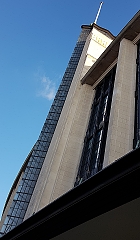
Barker’s former shop, a lovely art deco edifice, which opened in 1933, was designed by Bernard George (1894-1964). Between 1928 and 1962, he was the chief architect for Barker’s of Kensington in-house design group. It is worth examining this building closely to enjoy is many attractive details.






 yamey
yamey 