Victoria slept here once

LOVINGTON BAKERY AND CAFÉ in Wincanton (Somerset) provides a superb range of breakfast items, all prepared beautifully. No effort was spared to ensure that we had a most enjoyable breakfast. The café, which is housed on the Market Place close to the Town Hall, is almost opposite a former coaching inn, once called ‘The Greyhound’.

The elegant three-storey building that used to be the Greyhound has a centrally located archway that has a cobbled driveway passing beneath it. There is a bas-relief depicting a royal coat of arms above the archway. A cast-iron inn sign showing a greyhound with its broad neck collar remains suspended over the pavement above the archway. An oval panel above the archway but at the level of the roof has a faded painting of a greyhound.

The Greyhound was built in the 18th century, probably by the local builder Nathaniel Ireson (1685-1769), whose impressive funerary monument, which includes a handsome statue and carvings of builder’s tools, can be seen in the graveyard that surrounds the town’s large church of St Peter and St Paul.  The building was first mentioned in parish records in 1743 and advertised as being “new” in 1760 (https://historicengland.org.uk/listing/the-list/list-entry/1238740). The greyhound is the armorial symbol of the Churchey Family of Tout Hill.

In 1825, when the future Queen Victoria was a child aged about six years, she visited Wincanton and stayed for one night at The Greyhound. This visit is recorded on a plaque attached to the building. Where she was going, I have not yet been able to ascertain, but she was not the only royal visitor to be associated with Wincanton. In 1688, William of Orange (reigned 1698-1702) not only visited the town but also his Dutch troops fought and won a battle against troops loyal to the deposed King James II in the town. After his victory, he spent a night in Wincanton A plaque attached to a picturesque old building not far from the former Greyhound inn commemorates the Battle of Wincanton (20th of November 1688).

The Greyhound is one of many pubs (former and still working) that line the main road through Wincanton. In the olden days before motor transport superseded horse-drawn transport, these inns served as staging posts for travellers, places for being fed and for resting overnight. The Greyhound no longer serves the traveller but houses a gallery and has also become part of a housing unit. We spent the night in a modern hotel not far from the modern highway (the A303), which takes traffic past Wincanton rather than through its winding hilly streets. From our bedroom window, we can see a concrete factory and a tall sign advertising a KFC food outlet. Had Victoria been staying here, I am certain that she might have said or thought “We are not amused”.

Diana and the deer

LIKE AN ORIENTAL PASHA with his harem, a large stag with huge branching antlers sat in the shade of a big tree on a warm September afternoon in Bushy Park. Five female deer sat close by, all of them looking at him attentively.

Bushy Park abuts the grounds of Hampton Court Palace, which was built in 1515 for Henry VIII’s former favourite, Cardinal Wolsely, who died in disgrace in 1530 after losing the king’s favour. The area where the Park stands has known human usage since the Bronze Age, maybe as long ago as 4000 years. In mediaeval times, the area was used for agricultural activities.

In 1529, when Henry VIII took over Hampton Court from Cardinal Wolsely, Bushy Park became used for deer hunting. Later, in the 17th century, King Charles I (reigned 1625-1649) ordered the building of a canal, the Longford River, which carries water for 12 miles from the River Colne (a tributary of the Thames) to the grounds of Hampton Court Palace. The man-made waterway, designed by Nicholas Lane (1585-1644) and dug by hand in only 9 months in 1638-39, flows through Bushy Park, supplying water to its numerous water features. The water was drawn from the river Colne at a point (Longford near Slough) whose altitude (72 feet above sea level) was great enough to ensure a fast flow to Hampton Court Palace, which is only about 13 feet above sea level. Today, the water still flows rapidly through the Park’s numerous streams.  Later, the architect of the current St Pauls Cathedral, Sir Christopher Wren (1632-1723), designed the mile-long avenue (Chestnut Avenue), which runs through the Park, and its water feature as a grand approach to Hampton Court Palace.

During the two World Wars, large parts of Bushy Park were used temporarily to grow much-needed food for the British public. Before it became a royal hunting ground, much of the park was common land, accessible to all and sundry. The general public had to wait to have access to this lovely area until the reign of William IV (reigned 1830-1837), who requested that there should be free admission of the public to ‘his’ park. In 1838, when Queen Victoria opened the grounds of Hampton Court to the people, visits to Bushy Park increased. The park’s popularity grew significantly when the railway reached Hampton Court from London in 1849. Today, judging by how difficult it was to find a space in the car park, Bushy Park’s popularity continues to be great.

We entered the park, driving along the Chestnut Avenue. With its tidily arranged rows of trees, it reminded me of an entrance driveway to a French chateau or one of the opening scenes in the film “Last Year in Marienbad”.  Each tree is protected from the park’s deer by its own fence. We drove off the avenue into the car park near the Pheasantry, café with pleasant outdoor tables and chairs, housed in a pleasing contemporarily designed building (built 2014, designed by Mizzi architects, who have been responsible for many attractive kiosks in Kensington Gardens and Hyde Park and other Royal Parks).

After drinking coffee, we took a walk in the park. There are patches of woodland fenced off from the rest of the park, doubtless to prevent deer from entering. The Woodland Gardens have many trees and bushes. The shady area is dotted with ponds, some of them almost covered with waterlilies, and fast flowing, shallow streams. Small bridges cross the streams in this delightful part of the park and many ducks swim in the water.

We left the woodland area to enter the rest of the park. This consists of wide expanses of grassy terrain with isolated, and, also, clumps of trees. These areas allow the visitor to enjoy wide vistas and huge expanses of sky. It does not take long before you spot deer grazing, some of them quite close to visitors enjoying the park. What at first sight looks like a distant leafless tree branch will suddenly begin moving, proving that what you had spotted was not a piece from a tree but the antlers of a stag. Seeing the deer running wild is a joy that adds to the loveliness of the park. We also saw horseriders and cyclists, but these are not as visually interesting as the deer.

After taking a somewhat circuitous but very picturesque route through the park, we arrived at a circular pond, which is near the Hampton Court end of Wren’s Chestnut Avenue. Part of the original design, the avenue skirts the circumference of the pond. As we approached the pond, a solitary heron sitting on its edge, noticed us and then flew elegantly across the pond, less than 3 feet above the water’s surface.  The middle of the pond is occupied by a fountain surmounted by a gold-coloured statue. The stone plinth on which the statue stands has several more metal statues, which are not gilded. These are most probably, but not definitely, works of the Italian Francesco Fanelli (c1590-1653). The tall stone plinth was designed by, amongst others, Nicholas Stone (c1586-1647).

The gilded figure on the top of the fountain depicts Diana, the Roman goddess associated with hunting. This seems like an appropriate statue to stand in what were royal hunting grounds until the 19th century. However, when the French sculptor Hubert Le Sueur (1580-1658) was commissioned by King Charles I to make this statue to adorn the garden of his wife, Queen Henrietta Maria, it stood at London’s Somerset House. There, it stood on a lower pedestal than it does today. Incidentally, Le Sueur’s bronze equestrian statue of King Charles I stands in Trafalgar Square close to the point from which all distances from London are measured. Both Hubert Le Sueur and Francesco Fanelli had had experience working in the Florentine studios established by the Flemish born sculptor Giambologna (1529-1608), who was famous for his bronze statuary.

The Diana statue and the rest of its associated artworks were moved to Hampton Court Palace by Oliver Cromwell during the English Commonwealth (1649-1660). The fountain topped by Diana was moved to its present position during the works carried out to the designs of Sir Christopher Wren. The current plinth was completed in 1713 during the reign of Queen Anne. So, it was not until the 18th century that the goddess of hunting stood amongst the hunters’ prey. Although it is commonly held that the gilded statue represents Diana, some believe that it might depict Arethusa, Proserpina, or Venus. The one person that she does not depict is the late Diana, Princess of Wales.

After the heron had taken flight, we noticed about four black-coloured birds perching on the sculptures on the fountain’s plinth. One of them was on top of Diana’s head. The birds had largeish bodies and long necks that were often in sinuous poses. They resembled cormorants, but none of them had their wings unfolded, which is what these creatures do to dry them.

It was my first visit to Bushy Park, and I hope that many more will follow. I have learnt much about the park whilst researching this essay. Future visits will be enhanced by the knowledge I have acquired. I am grateful that our friends in Richmond have introduced us to yet another part of London that was until recently quite new to me.

Finally, it is useful not to confuse Bushy near Hampton Court with Bushey in Hertfordshire.

A bridge and a king


KINGSBRIDGE IS A SMALL town in South Devon. It lies at the head of an inlet of a ria (a completely submerged river valley) upon which the better-known and more popular resort of Salcombe is also located.

BLOG KING 3

 Many histories of Kingsbridge relate that the town resulted from the union of two neighbouring settlements, the neighbouring royal estates of Alvington and Chillington. Kingsbridge was formed around a bridge (possibly, a draw-bridge) that connected the two at the head of the inlet of the ria. The bridge was built by the 10th century. So far, so good, but today there is no bridge in the town of Kingsbridge.

If you drive from Kingsbridge towards Dartmouth via the A379 road, you will soon arrive at the New Bridge west of the town. This not so new bridge with five arches was built in 1845 and restored several times since then. It crosses Bowcombe Creek, another branch of the ria. This bridge is not, and has never, ben inside the town of Kingsbridge; it is well outside it. It is not, as has been suggested to me by several locals, the bridge that gave the town its name. So, where was the bridge?

By chance, I found a book about the history of Kingsbridge on-line. It is “Kingsbridge and its Surroundings” by SP Fox, published in 1874. This is the only source that I have found so far that mentions the site of the bridge in Kingsbridge. On page 10, the author noted:

“Nearly at the lower end, Fore Street is crossed at angles by Mill Street and Duc’c [now called Duke] Street, the former on the west side, leading to West Alvington and Salcombe; the latter on the east, in the direction of Totnes and Dartmouth, and uniting the towns of Kingsbridge and Dodbrooke by a very small bridge.”

The old bridge mentioned by Fox no longer exists, but the two streets mentioned do. Duke Street, which used to run through from Fore Street to Church Street near to the present Duke of Prussia pub (according to a late 19th century map), is now a cul-de-sac on which you can now find the main entrance to a popular fish and chips shop called ‘The Cod Father’. Mill Street is still a road leading towards West Alvington and Salcombe.

Where Fox describes the bridge, there is no sign of a ditch or stream today. Maybe, long ago there might have been a ditch or stream across which the bridge straddled. At the head of the inlet of the ria in Kingsbridge, there is a small arch, which might be the outlet to a formerly visible stream, which has long since been covered.

To add some complexity to the story, a modern source (https://kingsbridge.gov.uk/wp-content/uploads/2020/01/B13-Kingsbridge_Devon-Historic-Market-and-Coastal-Towns-Survey-Report.pdf) suggested that the bridge after which the town was named was not within the town itself but some way outside it:

“The exact site and function of the bridge is of great interest, as clear documentary evidence for an  Anglo-Saxon bridge in Devon is rare (Henderson and Jervoise 1938, 29; Hoskins 1954, 147), and, in the present context, because the development and character of the town, like its name, can be expected to have been fundamentally linked with that of the bridge and its highway. The attraction and shaping of urban growth to main roads and river crossings is a strong pattern across medieval Devon (Slater 1999). The detailed map analysis for the urban survey indicates that the early bridge may have crossed   the River – between routes later altered to become Love or Boon’s Lane on the west side, and Quay Street on the east – downstream from a tidal ford on the Mill Street-Duke Street route and below the extent of the medieval town…”

So, we cannot be certain of the location of the old bridge.

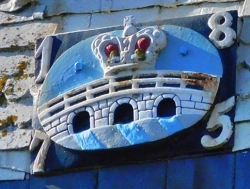
The coat of arms of Kingsbridge consists of a three-arched bridge surmounted by a royal crown. Whether or not the bridge had three arches is not at all certain, but the fact that it linked two royal estates justifies the presence of the crown. If the bridge was located where Fox believed, there was hardly enough width for a bridge with three arches.

But who was the king? It might well have been King Edgar, ‘The Peaceful’, who reigned from 959 to 975 AD. For, it was during his reign that a charter relating to boundaries dated 962 AD mentions the existence of a ‘king’s bridge’. That could also mean that the bridge was in existence before that king’s reign.

So, regardless of the actual position of the bridge after which Kingsbridge is named, we can be certain that the name is justified as there was a bridge somewhere in or near the town and it had royal connections. Whatever the origin of the name, the town of Kingsbridge is well worth a visit.

The highest point

LAST BUT NOT LEAST on our visit to Mount Abu was a visit to Guru Shikhar, the highest peak of the Mount Abu district. Being a Sunday, the winding road leading to it had heavy traffic. Many of the private cars had Gujarati registration plates, and judging by the general lack of driving skill and courtesy I guessed that many of the drivers had little if any experience of negotiating mountain roads. There is an observatory perched on the very top of the mountain. It is part of the Indian Space Research Organisation. The views from the summit were spectacular especially because the air was uncharacteristically free of mists and heat haze. We were surrounded by lower peaks and in one direction there was a good view of the plain far below us. Mount Abu is the highest point in Rajasthan and neighbouring Gujarat. We left this peak to visit other sights dotted around on the far from flat Mount Abu plateau.

A short visit to Shankar Math will suffice all but the most devout of Hindus. A modern structure surmonted by an enormous lingam houses a much older and slightly older lingam carved in white stone with bluish grey striations.

Achal Garh has several attractions. There is a large attractive Jain Temple, which looked quite old. It was surrounded by newly carved sculptural fragments which were being used to replace worn out stone elements of the temple. Old parts were being exchanged for newly made replicas.

Close to the Jain temple at Achal Ghar, there is a market place catering mostly to tourists. Beyond the market a well made road winds upwards to Kapoor Tank, a peaceful water body where we saw women washing laundry in its calm water. Little children, including a tiny three year old girl, offered to guide us around the area.

The road continues to ascend above Kapoor Tank until it reaches the gates of an old fortress. It was built in 1452 by a local Rajput ruler, Maharana Khumbar of Mewar, on the site of an older fort. Not much remains to be seen. The area within the fort contains various Jain temples, which I hope to look at on a future visit.

The Jain temples at Adhar Devi, high up on a mountain slope, can only be reached by climbing more than 350 stone steps. I did not feel like doing that, so there is little I can tell you about them except that one of them is called Arbuda Devi Temple, Arbuda being the pre-British name of Abu, as in Mount Abu.

The highlight of our excursion was not the highest peak but an incredibly beautiful lake surrounded by rocks in the middle of a wildlife nature reserve. A badly surfaced road leads from the main road between Mount Abu and Guru Shikhar to Trevor’s Tank. This water body was created in 1897 by Colonel GH Trevor to breed crocodiles. A fading notice on of the huge rocks surrounding the pool advises visitors not to enter the water because of the very real risk of meeting these creatures. Some German hikers, whom we met, pointed at some crocs resting on a rock across the Tank, but I could not see them. The land for the wildlife sanctuary had been gifted to Trevor by the Maharaja of Sirohi, in whose kingdom Mount Abu is located.

The Tank has to be seen to believed. Its smooth water reflects the finest details of the rocks and vegetation surrounding it. Our new friend Dr Sharma told us that one of the joys of Trevor’s Tank is listening to the sounds of nature. During our visit, these had to compete with the sounds made by the excited groups of mainly young trippers. If there is limited time available when you visit Mount Abu, then Trevor’s Tank and the Dilwara Jain Temples should be seen before anything else. But, it would be foolish not to allot at least several days to savour Mount Abu.

We ate lunch in the restaurant of the Jaipur House hotel, the highest of the former Rajputana palaces in Mount Abu . Its windows provide superb views over the Nakki Lake, the Polo Ground and the rest of Mount Abu town. The former palace, now a hotel, is elegant without being flamboyant.

We strolled down from the palace through the town to our hotel feeling sad that on the following morning we would be leaving Mount Abu, which has captured our hearts.

Temples and a palace

THE DELWARA JAIN TEMPLE COMPLEX close to Mount Abu opens to tourists at noon. We arrived at about 11 am and our driver, Zakir, suggested we visit the local museum, which turned out to be a handicraft shop.

We were directed upstairs to the fabric department and invited to sit down whilst a salesman told us about the products, which had been made locally, thereby providing employment to about 4500 locals. No obligation to buy, of course! However, we wanted a razzai, a bed quilt like an eiderdown, and after having been shown numerous examples we settled on one. Its price was greater than we were prepared to pay. We were told that the prices were not negotiable. Both the salesman and his manager told us that they could offer us cups of tea or coffee but not reductions in price. We pointed out that as kind as that was, it would only save us about 20 to 40 Rupees.

We had been in the shop, I mean ‘museum’, for almost an hour and I was becoming restless. I think that when the manager noticed this, he felt that there was a real risk that he would lose a sale. He sold us the razzai, having reduced the price by a third.

The Delwara Jain temple complex contains several temples, two of which are well over 600 years old: one dates back to the 11th century AD. Sadly photography is not permitted within the temples. Words cannot do justice to the beautiful intricate stone carvings that adorn these places of worship. Even photographs, if they had been allowed, would only hint at the perfection of the carving and their fine artistry. The precision and sharp definition of this ancient carving done by hand rivals what can be done with the most hi-tech computerised cutting devices. I have never visited the Taj Mahal, but I believe that these temples are even more breathtakingly beautiful than the famous monument at Agra. You will have to see it yourself, and then you will know what I mean.

Mount Abu was the summer resort for the rulers of the princely states of Rajputana, now Rajasthan. Many of them built lavish summer palaces, some of which are now used as ‘heritage’ hotels. Zakir drove us to the Kishangarh House hotel. Kishangarh was a tiny state near Ajmer in Rajasthan. Its population was 91000 in 1901. Its Maharaja built his palace at Mount Abu on sloping ground, which was transformed into terracing and surrounded by terraced gardens. We ate snacks there and were shown the rooms available for hire. Of all the former royal palaces I have seen in India, this looks to be the most comfortable. Even the lowest priced rooms are huge and extremely well appointed.

Zakir dropped us back in town in the town bazaar, as opposed to the touristic market area. There are numerous shops in picturesque winding streets.

Before returning to our hotel for a much needed rest, we bought some socks from a wayside stall. As is expected of customers, we bargained a little. When we agreed on a slightly lower price than the salesman asked initially, he said (in Hindi), maybe hoping to shame us into paying a little more:
“Will you feel better if you buy the socks at the lower price?”
We replied: “much better.”

A royal palace

IT IS COSTLY PAYING A VISIT to the Faluknuma Palace in Hyderabad, but is it worth the expense?

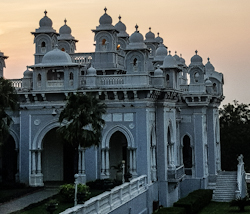
The Faluknuma Palace, which is located on a hill, is high above the rest of Hyderabad. It was built in a neo Palladian style to the designs of an Italian architect between 1884 and 1890 as a residence for Sir Viqar al Umra, a Prime Minister of Hyderabad. To settle a debt, in 1897 Viqar handed his palace to his creditor, the 6th Nizam of Hyderabad.

The palace is now used as a luxury hotel. One night at this place will set you back by at least £440 excluding taxes. The most economical way to see the palace is by booking afternoon tea, which is not at all cheap. However, such a booking includes a guided tour around the palace. After much difficulty and numerous telephone calls to the hotel, we managed to book a couple of places for the afternoon tea experience.

The guided tour was fairly uninformative but gave us a chance to see several rooms that were used by the former Nizams and their guests.
Unfortunately, the guide was uninspired and his English was poor. It would have been better if the guide had been better informed as well as more interested in history and culture.

One thing the guide told us impressed me. He said that the palace was wired up for telephony and was supplied with electricity in the 1890s whilst the Nizam’s subjects lived without electricity until the late 1930s.

Each of the rooms and hallways of the palace look spectacular at first sight. However, after closer examination they are not so impressive. The rooms which were designed to amaze are actually rather dowdy and unrefined. The interior has a Victorian heaviness. In contrast, the Marble Palace in Calcutta, also built to mimic European tastes, is spectacular both macroscopically and in minute detail. Unlike the Faluknuma, the Marble Palace is an example of exquisite taste.

I find it sad that Indians such as the builders of the Faluknuma (and the Marble Palace) found it necessary to mimic, not always successfully, the styles favoured by their imperialist rulers rather than building in styles that have evolved from the rich legacy of pre-colonial architecture. One palace that I have visited, that at Bhavnagar, The Neelambagh, was designed by a European architect who paid tribute to India’s rich cultural heritage by successfully incorporating elements of India’s historical architectural styles. The so-called Indo-Saracenic style sometimes melds European and Indian elements successfully.

The afternoon tea was elegantly presented. The serving staff outnumbered the guests. There was a great deal of bustling about, but our requests were eventually fulfilled. Every member of staff we encountered at the palace was kind and caring. I felt that everyone wanted us to enjoy our visit, which we did.

Was our visit worth what we paid? I would say ‘yes’ cautiously, but I would have preferred to have been charged a little less. It would have been really good value at two thirds of the price. Is the palace worth seeing? I would recommend it not because it is either an aesthetic gem or an architectural marvel, but it is a great example of how the wealthy and powerful spent their money to impress their subjects and the British Colonial Officials, who guaranteed the continuing existence of their vassals, the rulers of the Princely States, of which Hyderabad was the largest, richest, and most powerful.

While we were sitting waiting for our taxi to take us away from the palace, we watched horse drawn cartiages passing by. They carry guests up the long winding drive to the hotel. We also saw staff feeding some of the more than one hundred peacocks which live in the extensive grounds of the palace, which provide a peaceful refuge from the city that sprawls all around the Faluknuma.

A tingle down my spine


I enjoy exploring historical places. Well, I know that everywhere has a history, but what I mean is places which contain tangible remnants of their history like the Regency buildings designed by John Nash, built at the beginning of the 19th century around Regents Park in London. They were built when the future George IV was Regent.

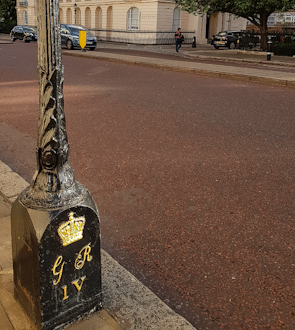
Well, there is nothing surprising about these beautiful buildings. That is what I thought until my wife spotted the street lamp posts next to some of the buildings. Each of their bases has a symbol for King George IV. Seeing such mundane objects that must have been in daily use since so long ago sent a tingle down my spine.

The same thing happened to me once when I was driving along a ring road around Munich and I passed a direction sign pointing to Dachau.