RELIGIOUS DIVERSITY AT A SUFI SHRINE IN RAJASTHAN


IN MY BOOK “Coracles and Crocodiles: 101 Tales of India”, I have described how practices associated with Hinduism can sometimes be seen in Indian mosques. This is particularly true in the Sufi dargah (shrine) in Ajmer, where Khawaja Gharib Nawaz (1143 – 1236), also known as ‘Muʿīn al-Dīn Chishtī’, buried. According to Wikipedia, he was:

“… one of the first major Islamic mystics to formally allow his followers to incorporate the “use of music” in their devotions, liturgies, and hymns to God, which he did in order to make the ‘foreign’ Arab faith more relatable to the indigenous peoples who had recently entered the religion.”


The shrine is in a large compound containing a mosque and other shrines in the heart of Ajmer.

 The dargah compound is much visited, not only by Muslims but also by adherents of other religions: Hindus, Sikhs, etc. Visiting the dargah is considered to be a very special auspicious event. Visitors of all religions buy baskets of red petals to place on the various shrines in the complex. In many places, there are Muslim clerics who bless you by tapping your head with what looks like a large peacock feather duster. In exchange for this benediction, the recipient is expected to leave a financial donation. If the donation is large enough, it and your name will be recorded in a ledger, and you will receive a receipt. If it is insufficient,  the cleric appears to pocket it.


Apart from the groups of musicians playing and singing qawwalis (قوّالی). surrounded by appreciative pilgrims seated around them, there were several other things that interested me. All of these can be found in Hindu places of worship. They include burning incense sticks (agarbatti); lighting diyas (oil lamps) and placing them in holders such as can be found in Hindu temples; and tying threads to parts of the shrines.  Another activity that I found unusual in a Muslim place of worship was blessing of pieces of cloth that were then tied around the pilgrim’s head.


The atmosphere in the dargah compound was lively and festive. People seemed happy to be there. And surprisingly for someone like me, who is not particularly religious, I  felt that the place seemed very holy. This might be because those around me were at the dargah not as an obligatory ritual but because they believed strongly in its holiness.

[ MY book is available from https://www.amazon.co.uk/CORACLES-CROCODILES-101-TALES-INDIA/dp/B0DJZ6DMYB

Built as a Jain temple, then repurposed as a mosque

AT THE TOP OF a short but hazardous flight of stairs, one reaches the compound of an extremely interesting mosque in Ajmer (Rajasthan, India). It is the Adhai Din Ka Jhonpra mosque, whose name means ‘Two and a half day hut’. To what the two and a half day refers is not certain.

The building was originally constructed as a Jain temple in 660 AD. In about 1190, the temple was destroyed by the Afghan leader Muhammad of Ghor. He built the mosque on the site of the former temple using carved stonework plundered from Hindu and Jain temples. The resulting edifice, although shaped like a mosque, contains many architectural features and decorative motifs that you would expect to find in 12th century (and earlier) Hindu and Jain temples.

The mosque and its ccompound is very popular with visitors. I noticed that I was the only European amongst several hundred visitors. The site is a much desired place to be photographed. There are many photographers carrying Nikon SLR cameras, all touting for business. And there is no shortage of people wanting to pose for photos. The photographers seemed to have plenty of customers despite the fact that most people carry mobile phones.

Although the nearby dargah (a Sufi shrine) attracts most tourists, the Adhai Din Ka Jhonpra is well worth visiting.

A first peek at the Pink City of Rajasthan

FOR VARIOUS REASONS, we hired an autorickshaw to give us a first glimpse of Rajasthan’s Pink City: Jaipur. Although the Pink City is the oldest part of Jaipur, its main thoroughfares were laid out centuries ago in a grid pattern typical of modern cities. A complex warren of narrow streets and courtyards lead off from the main roads. We have yet to explore these byways.

The city is so-named because its buildings are all painted with various shades of pink paint. Apparently, this has been done since the structures were first built in order to hide the inferior quality of the stones used in their construction.

After our elderly Bihari driver, Ganesh, had driven us along the straight main roads of the Pink City as well as some of the twisty, narrow lanes leading off them, he took us to see two factories. At one, we were shown men at work making the silver settings for precious stones. At the other, we were shown the way block printing on fabrics is carried out by hand.

At both factories, after we had been shown how the goods were prepared, we were (not surprisingly) invited to make purchases. We bought a few small objects. After leaving each factory, Ganesh asked us how much we had spent. This was not idle curiosity. He told us that he received 1% of whatever his passengers had spent. He told us that the factories, which sell their goods at wholesale prices, give him a much smaller commission than retail outlets.

I am glad that Ganesh took us to the factories rather than the retailers because it was interesting to watch the manufacturers at work.

Tomato soup in the tandoori oven by the roadside in Rajasthan

WHEREVER I HAVE BEEN in India, both in big cities and in small rural places, tomato soup is often available at eateries be they humble or grand. What is more, everywhere I have consumed this soup in India, it always been flavoured differently. It always tastes of tomato, but the detailing of the taste is never the same. This is because the soups are prepared in the kitchens of the restaurants, and not in a factory.

Makrana Raj restaurant

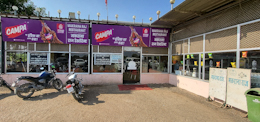
Today (29th November 2024), we were travelling along the six lane highway between Jaipur and Ajmer when we stopped for a light lunch at the roadside Makrana Raj restaurant. This unpretentious, well-run place is not far from Ajmer. We ordered a light lunch including a paratha stuffed with cauliflower, a garlic naan, and a bowl of tomato soup. The excellent paratha was served with a garlic chutney and butter churned in the restaurant.

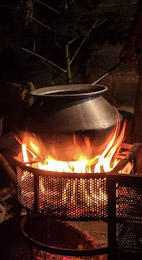
As usual, the tomato soup had a unique flavour. It tasted slightly smoky and was delicious. We asked the waiter how it was prepared because we had never before come across smoky tomato soup. He told us that the soup is cooked in the wood fired tandoori oven, which is why its taste reminded me of the flavour of charcoal-grilled meats and fishes.

While I would not recommend making a special detour to visit the Makrana Raj, if you happen to be travelling by road between Ajmer and Jaipur, then look out for the place, and have something to eat there.

Red coloured meat dish from Rajasthan

LAL MAS IS a traditional meat dish that originated in Rajasthan. Its name means ‘red meat’ and its colour comes from the use of mild, fragrant, fresh red chillies. The best sort to use are those grown at Mathania in Rajasthan, but if these are not available, Kashmiri chillies can be used but they are less satisfactory. Originally, lal mas used to be prepared to feed hunters after a day of hunting. The meat being game.

We have been staying at the Sharad Baug Palace homestay in Bhuj (Kutch, Gujarat), which is owned and run by members of the Royal family of Kutch. Several members of the family are great cooks. The food they have been preparing for our evening meals has been superbly tasty.

Last night, one of the family gave us a very special treat. While we watched, he prepared lal mas on a pot heated on a wood fired brazier in the garden. The smoke from the burning wood enhances the flavour of the dish.

Even if I knew the exact recipe for lal mas, it would be pointless giving it to you. This is because to achieve a good result, the person cooking it must be constantly tasting the sauce and adding ingredients as required, as well as checking the degree of tenderness of the meat. This is something that cannot be described in writing.

That said, this is, roughly speaking, how he prepared the lal mas. First, good quality cold-pressed mustard oil was heated to a high temperature. Then, he added whole spices including the Mathania chillies. Next, chopped onions, followed by pureed onions and pureed Mathania chillies. Following this, the goat meat was added. Later, chopped tomatoes followed by ginger and fresh green chillies – both minced. After a while at various stages, other ingredients including ground cumin, turmeric, coriander powder, fenugreek leaves (added at the end), hot red chilli powder, salt, and water were added to the stew. Throughout the cooking process, which took almost two hours, the stew has to be stirred often, and water added as required so as to maintain the sauce’s thick consistency and to prevent the spice mixture from burning.

I can say, without exaggeration, that the resulting dish was one of, if not, the very best Indian meat dishes I have ever eaten. It was fragrant, tasty, and not too piquant. It was without fault.

We are very grateful that our host took the time and care to produce this miracle of culinary art for us.

India to St Ives

ST IVES IN CORNWALL is chock full of art galleries apart from the better-known Tate St Ives (highly overrated), the Penwith, and the splendid Barbara Hepworth house. Many of these galleries are best bypassed because they contain artworks of pedestrian workmanship and often poor aesthetic qualities. Last year, we visited a mediocre exhibition in the Crypt Gallery below the St Ives Society of Artists, which is housed in a deconsecrated church. So, when we passed the gallery today, I was reluctant to enter until I spotted that the exhibition was entitled ‘Cornwall and India’. The artist whose works were on display is called Paul Wadsworth.

Born in East Anglia in 1964, Paul studied at the art school in Falmouth (Cornwall). He told us that he has made three lengthy visits to India. One trip was to Rajasthan, another to Goa, and a third to Kerala. While in India, he commissions lovely leather-bound books to be made in Pushkar (Rajasthan). He fills these with line drawings and painted sketches. These visual records become the basis for his paintings inspired by his observations of India. Some of his Indian paintings are completed in India and others in his studios in Cornwall. To my eye, Paul captures the essence of India well: its colours and vibrancy.

Some of the paintings on display were those inspired by India. Others that involve skilful application of paints with a palate knife depict the spirit of the landscape of Cornwall. These paintings, Paul explained, are not done from photographs or preliminary sketches, but straight from true life. Given how the sky often changes so quickly in Cornwall, the artist has done a great job of seizing the moment and recording it on canvas.

Circus is another subject that attracts Paul. Some of his vivid depictions of life in the circus arena were on display. Complementing these, his sketch books have many lovely images created whilst he spent time with Kathakali dancers in India. Some of these sketches have been translated into paintings.

Paul spent time with us, patiently answering our numerous questions as well as showing us his works. He has the gallery for three weeks, starting 20th September 2020 and has filled it not only with his artworks but also the materials that he uses to create his works of art. He has created an exhibition within what he will use as his temporary studio.

I am truly glad that I entered the Crypt Gallery despite initial misgivings. If I had not, I would have missed out a highly enjoyable collection of good quality, well-executed art and meeting Paul, its affable creator.

The highest point

LAST BUT NOT LEAST on our visit to Mount Abu was a visit to Guru Shikhar, the highest peak of the Mount Abu district. Being a Sunday, the winding road leading to it had heavy traffic. Many of the private cars had Gujarati registration plates, and judging by the general lack of driving skill and courtesy I guessed that many of the drivers had little if any experience of negotiating mountain roads. There is an observatory perched on the very top of the mountain. It is part of the Indian Space Research Organisation. The views from the summit were spectacular especially because the air was uncharacteristically free of mists and heat haze. We were surrounded by lower peaks and in one direction there was a good view of the plain far below us. Mount Abu is the highest point in Rajasthan and neighbouring Gujarat. We left this peak to visit other sights dotted around on the far from flat Mount Abu plateau.

A short visit to Shankar Math will suffice all but the most devout of Hindus. A modern structure surmonted by an enormous lingam houses a much older and slightly older lingam carved in white stone with bluish grey striations.

Achal Garh has several attractions. There is a large attractive Jain Temple, which looked quite old. It was surrounded by newly carved sculptural fragments which were being used to replace worn out stone elements of the temple. Old parts were being exchanged for newly made replicas.

Close to the Jain temple at Achal Ghar, there is a market place catering mostly to tourists. Beyond the market a well made road winds upwards to Kapoor Tank, a peaceful water body where we saw women washing laundry in its calm water. Little children, including a tiny three year old girl, offered to guide us around the area.

The road continues to ascend above Kapoor Tank until it reaches the gates of an old fortress. It was built in 1452 by a local Rajput ruler, Maharana Khumbar of Mewar, on the site of an older fort. Not much remains to be seen. The area within the fort contains various Jain temples, which I hope to look at on a future visit.

The Jain temples at Adhar Devi, high up on a mountain slope, can only be reached by climbing more than 350 stone steps. I did not feel like doing that, so there is little I can tell you about them except that one of them is called Arbuda Devi Temple, Arbuda being the pre-British name of Abu, as in Mount Abu.

The highlight of our excursion was not the highest peak but an incredibly beautiful lake surrounded by rocks in the middle of a wildlife nature reserve. A badly surfaced road leads from the main road between Mount Abu and Guru Shikhar to Trevor’s Tank. This water body was created in 1897 by Colonel GH Trevor to breed crocodiles. A fading notice on of the huge rocks surrounding the pool advises visitors not to enter the water because of the very real risk of meeting these creatures. Some German hikers, whom we met, pointed at some crocs resting on a rock across the Tank, but I could not see them. The land for the wildlife sanctuary had been gifted to Trevor by the Maharaja of Sirohi, in whose kingdom Mount Abu is located.

The Tank has to be seen to believed. Its smooth water reflects the finest details of the rocks and vegetation surrounding it. Our new friend Dr Sharma told us that one of the joys of Trevor’s Tank is listening to the sounds of nature. During our visit, these had to compete with the sounds made by the excited groups of mainly young trippers. If there is limited time available when you visit Mount Abu, then Trevor’s Tank and the Dilwara Jain Temples should be seen before anything else. But, it would be foolish not to allot at least several days to savour Mount Abu.

We ate lunch in the restaurant of the Jaipur House hotel, the highest of the former Rajputana palaces in Mount Abu . Its windows provide superb views over the Nakki Lake, the Polo Ground and the rest of Mount Abu town. The former palace, now a hotel, is elegant without being flamboyant.

We strolled down from the palace through the town to our hotel feeling sad that on the following morning we would be leaving Mount Abu, which has captured our hearts.

Moore than meets the eye

“HOW COULD YOU SPEND FIVE DAYS IN MOUNT ABU?”, someone asked me, adding that “one day is more than enough – you see the Jain temple, and that’s it”. How wrong this is. Even a fortnight would not be long enough to absorb all that Mount Abu (in Rajasthan) and its surroundings have to offer. I write this not because I was lucky enough to meet the amazing Dr Arun Sharma, but because even before we met him I had that idea.

Dr Sharma, a local medical practitioner, is an artist who expresses his ideas by composing music, painting canvases, as well as writing poetry and dramas. He is also a mine of information about the history of Mount Abu.

Major General Arthur Thomas Moore (1830 – 1913 or 1923) was a British officer in India. At the age of 26, and serving in the 3rd Bombay Light Cavalry, he was awarded a Victoria Cross for bravery at the Battle of Khushab in Persia.

Dr Sharma told us that for many years Moore’s whereabouts in India during a period of 3 or 4 years were completely unknown. After he resurfaced and returned to Europe, he died in his native land Ireland, where he is buried.

The regiment that Moore served has been renamed The Pune Horse, but nowadays it uses tanks instead of horses. Since 1947, it has been involved in over 60 skirmishes and battles and never been defeated. The members of the regiment believe that the spirit of the incredibly brave Moore is their guardian angel.

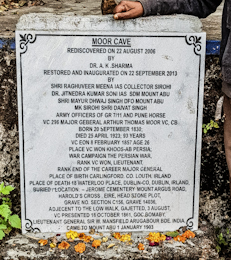
The regiment was delighted when in 2006, Dr Sharma accidentally stumbled on a cave near Sunset Point in Mount Abu. This cave had inscriptions carved in beautiful handwriting by Arthur Thomas Moore. These inscriptions include the date 1901, which was during the period that Moore had gone missing. What Moore was doing in this cave that Dr Sharma discovered we may never know, but at least we now know that Mount Abu was one of the places he visited during his period of disappearance.

Dr Sharma took us to see the cave, whose restoration he instigated, and proudly showed us the informative memorial plaque he created.

This cave and many more natural and man made historical sights and sites have convinced me that Mount Abu has more to see than most people realise.

I wish to thank Dr Sharma for opening my eyes to the exciting history of Mount Abu and its surroundings.

Around the mountain

LAST NIGHT WE MET DR ARUN SHARMA. He was introduced to us by Mr Kashyap Jani, the owner of Hotel Saraswati, where we stayed in Mount Abu. Not only is Sharma a medical doctor in Mount Abu but he is also an accomplished writer, a prolific poet, a composer of music, a keen and well informed local historian, and also a skilful painter. In addition to singing an excerpt from one of his many operas, he told us a bit about the history and mythology of Mount Abu, which he believes is the oldest place on earth. Partly at his suggestion and partly because we had seen some information displayed at our hotel, we decided to take a driver to visit historic places around the base of Mount Abu and its associated peaks.

Our driver, Zakir, picked us up early in the morning and drove us to a food stall next to the Madina Masjid, the only mosque in Mount Abu. We joined some men who were keeping warm around a bonfire and had tea and omelettes. Throughout Mount Abu, locals make bonfires to keep warm, especially after sunset.

We drive downhill from Mount Abu along the winding mountain road, Abu’s only road link to the ‘outside world ‘. The picturesqueness of the landscape was enhanced by patches of morning mist.

Our first stop was at the Badrakali Hindu temple, which is extremely old. We were told it is 8000 years old, but this seems unlikely. We entered the inner sanctum to see the idol depicting the principal deity.

We were followed by a man, who walked over to an enormous speaker and turned it on. We were blasted with incredibly loud music: mostly rhythmic drumming with frequent blasts on conch shells. The volume was as high as, or even greater than most discotheques.

The priest within the chamber with the main idol waved around a smoking censer before lighting several lamps on a metal holder, creating what looked like a fiery comb. While ring a bell with his left hand, he waved the flaming comb around the inner sanctum, up and down the principal idol and other lesser ones. All the time, the loud music thudded deafeningly. Suddenly, he put down the comb of flames, picked up a conch shell and used it to throw water at all of us facing him. As suddenly as it had begun, the music ended. The priest continued chanting while all those attending this ‘aarti’ left the temple. We were lucky to have witnessed this dramatic yet very moving ceremony because it is only performed twice a day.

A short drive, during which we saw wild peacocks and plenty of greyish monkeys with black faces, brought us to another ancient temple, the Hrishikesh, a very peaceful spot. After walking past cattle and a large number of monkeys, we entered thetemple compound. A young boy was cleaning an idol of the ‘guru’ which faced the main idol of the temple located in the innermost sanctum. This chamber was covered by a cloth curtain. The priest llowed us to peer inside, where he was carefully cleaning the idol. He told us that only when the goddess had been cleaned and dressed, could she be revealed to worshippers. The temple and its compound contains numerous finely carved religious stone artworks.

After a lovely drive through very rustic landscape, Zakir drove us along a rough track to the isoated Toda Paladi, a very small Hindu temple. We chatted to the priest, who, after inviting us to sit with him, asked us if we were at peace and content. Then, we looked at the old stepwell (‘vav’) near the temple. It was almost overflowing with water covered with a thin layer of green algae. The priest had told us that the well always received a good supply of water that flowed down from nearby Mount Abu. We left the customary donation to the temple. The priest explained that when enough money had been collected, he hoped that it would be spent on improving the road leading to his temple.

The Sun Temple at Varman was built in the 10th century AD. Somewhat ruined, but maintained by the Archaeological Survey of India, it contains carved stone features such as some of those that we saw at the great Jain temples at Mount Abu. The Sun Temple is, even though now incomplete, a gem.

Not far from the Sun Temple, we drove along a very sandy road until Zakir said the car could go no further safely. I disembarked and walked with some difficulty through vey soft fine sand towards a pair of huge banyan trees. Near these are the unguarded remains of Krishna Vat. A passing local with flamboyant facial hair typical of that seen on many Rajasthani men made me understand that the temple had been destroyed long ago by invaders. Despite the temple being a disorganised pile of exquisitely carved stones, people still worship there. For that reason my ‘guide’ asked me to remove my sandals while I prowled around the ruins, taking photos. My companion explained to me in Hindi what I was looking at, but I barely understood what he was saying. However, he did make it clear that a small rectangular patch of earth surrounded on three sides by stones was all that remains of the innermost sanctum of the temple.

After a relatively long drive, we reached the Behra Tarak Jain temple, which was built about 20 years ago. Although recently constructed, this temple, like most other contemporary Jain temples, is designed in the same way as those which were built over 1000 years ago. Thus, this new temple gives the visitor a good idea of how the historic temples must have looked when they were just completed. In all of the modern Jain temples we have visited both in Gujarat and Rajasthan no expense has been spared to create or recreate the perfection seen in the earliest temples.

Another drive along country lanes brought us close to the Karodi Dhwaj Hindu temple. I had to climb about 150 metres up a track too rough for our taxi to reach this small old temple compound clinging to the rocky slopes of Mount Abu. A staircase cut into a huge rock led down to a pool of water deep in a rocky cleft. The temple buildings overlooked this. Although of great beauty, they had been heavily painted with silver and other coloured paints. Some of the finer details of the carved stone idols were also hidden under deep layers of garish coloured paint. This temple almost hidden away in the rocks reminded me of some monasteries I have visited in Serbia. They were located next to the sources of streams at the heads of valleys to make them less accessible to foreign invaders, in their case the Ottoman soldiers.

The Mirpur Jain temple is definitely not concealed. It overlooks the plain surrounding Mount Abu. The mountainside makes an impressive backdrop to this beautiful temple constructed in a rare stone with light blue streaks. Constructed before the better known Dilwara temples, this could well have been the model which inspired the builders at Dilwara. Many of the finely carved features seen at Dilwara, where photography is firbidden, are in evidence at Mirpur. Almost as breathtaking as Dilwara, seeing Mirpur is a ‘must’.

The last stop on our tour was a Hindu temple within a natural rock cave, the Vastanji Shiva temple. This is located above a slope that was covered with litter. We were welcomed by several friendly temple assistants to the cave temple with its low painted rock ceiling. After we had admired the deity, we were invited into a neighbouring building, where men and women were keeping warm around a wood fire in a hearth on the floor. We were given a warm welcome and cups of tea. Pur new acquaintances invited to stay for a night of prayer at the temple. They told us that we would be offered food and bedding. Many people make the pilgrimage to this place and avail the hospitality offered. The sleeping quarters are flattish surfaces below the temple under colourful cloth shamianas. I guessed that much of the litter lying around was the result of the previous night’s pilgrims. All around we saw monkeys busy eating discarded vegetables and flower garlands.

We drive back up to Mount Abu after sunset, and disembarked at the grandiose former summer palace of the rulers of Bikaner, an erstwhile princely state in Rajasthan. It is now a ‘heritage’ hotel. We ate an indifferent meal in one of the dining rooms. The place was so cold that all of the diners were wearing inelegant padded jackets for outdoor use rather than dinner jackets and other fine garments that would have been worn when the hotel was a royal palace.

Thus, ended a fine day that was inspired by the historical research which Dr Sharma has been doing for years and by the publicity given to it at our hotel by its owner.

Temples and a palace

THE DELWARA JAIN TEMPLE COMPLEX close to Mount Abu opens to tourists at noon. We arrived at about 11 am and our driver, Zakir, suggested we visit the local museum, which turned out to be a handicraft shop.

We were directed upstairs to the fabric department and invited to sit down whilst a salesman told us about the products, which had been made locally, thereby providing employment to about 4500 locals. No obligation to buy, of course! However, we wanted a razzai, a bed quilt like an eiderdown, and after having been shown numerous examples we settled on one. Its price was greater than we were prepared to pay. We were told that the prices were not negotiable. Both the salesman and his manager told us that they could offer us cups of tea or coffee but not reductions in price. We pointed out that as kind as that was, it would only save us about 20 to 40 Rupees.

We had been in the shop, I mean ‘museum’, for almost an hour and I was becoming restless. I think that when the manager noticed this, he felt that there was a real risk that he would lose a sale. He sold us the razzai, having reduced the price by a third.

The Delwara Jain temple complex contains several temples, two of which are well over 600 years old: one dates back to the 11th century AD. Sadly photography is not permitted within the temples. Words cannot do justice to the beautiful intricate stone carvings that adorn these places of worship. Even photographs, if they had been allowed, would only hint at the perfection of the carving and their fine artistry. The precision and sharp definition of this ancient carving done by hand rivals what can be done with the most hi-tech computerised cutting devices. I have never visited the Taj Mahal, but I believe that these temples are even more breathtakingly beautiful than the famous monument at Agra. You will have to see it yourself, and then you will know what I mean.

Mount Abu was the summer resort for the rulers of the princely states of Rajputana, now Rajasthan. Many of them built lavish summer palaces, some of which are now used as ‘heritage’ hotels. Zakir drove us to the Kishangarh House hotel. Kishangarh was a tiny state near Ajmer in Rajasthan. Its population was 91000 in 1901. Its Maharaja built his palace at Mount Abu on sloping ground, which was transformed into terracing and surrounded by terraced gardens. We ate snacks there and were shown the rooms available for hire. Of all the former royal palaces I have seen in India, this looks to be the most comfortable. Even the lowest priced rooms are huge and extremely well appointed.

Zakir dropped us back in town in the town bazaar, as opposed to the touristic market area. There are numerous shops in picturesque winding streets.

Before returning to our hotel for a much needed rest, we bought some socks from a wayside stall. As is expected of customers, we bargained a little. When we agreed on a slightly lower price than the salesman asked initially, he said (in Hindi), maybe hoping to shame us into paying a little more:
“Will you feel better if you buy the socks at the lower price?”
We replied: “much better.”