
LAST NIGHT WE MET DR ARUN SHARMA. He was introduced to us by Mr Kashyap Jani, the owner of Hotel Saraswati, where we stayed in Mount Abu. Not only is Sharma a medical doctor in Mount Abu but he is also an accomplished writer, a prolific poet, a composer of music, a keen and well informed local historian, and also a skilful painter. In addition to singing an excerpt from one of his many operas, he told us a bit about the history and mythology of Mount Abu, which he believes is the oldest place on earth. Partly at his suggestion and partly because we had seen some information displayed at our hotel, we decided to take a driver to visit historic places around the base of Mount Abu and its associated peaks.
Our driver, Zakir, picked us up early in the morning and drove us to a food stall next to the Madina Masjid, the only mosque in Mount Abu. We joined some men who were keeping warm around a bonfire and had tea and omelettes. Throughout Mount Abu, locals make bonfires to keep warm, especially after sunset.
We drive downhill from Mount Abu along the winding mountain road, Abu’s only road link to the ‘outside world ‘. The picturesqueness of the landscape was enhanced by patches of morning mist.
Our first stop was at the Badrakali Hindu temple, which is extremely old. We were told it is 8000 years old, but this seems unlikely. We entered the inner sanctum to see the idol depicting the principal deity.
We were followed by a man, who walked over to an enormous speaker and turned it on. We were blasted with incredibly loud music: mostly rhythmic drumming with frequent blasts on conch shells. The volume was as high as, or even greater than most discotheques.
The priest within the chamber with the main idol waved around a smoking censer before lighting several lamps on a metal holder, creating what looked like a fiery comb. While ring a bell with his left hand, he waved the flaming comb around the inner sanctum, up and down the principal idol and other lesser ones. All the time, the loud music thudded deafeningly. Suddenly, he put down the comb of flames, picked up a conch shell and used it to throw water at all of us facing him. As suddenly as it had begun, the music ended. The priest continued chanting while all those attending this ‘aarti’ left the temple. We were lucky to have witnessed this dramatic yet very moving ceremony because it is only performed twice a day.
A short drive, during which we saw wild peacocks and plenty of greyish monkeys with black faces, brought us to another ancient temple, the Hrishikesh, a very peaceful spot. After walking past cattle and a large number of monkeys, we entered thetemple compound. A young boy was cleaning an idol of the ‘guru’ which faced the main idol of the temple located in the innermost sanctum. This chamber was covered by a cloth curtain. The priest llowed us to peer inside, where he was carefully cleaning the idol. He told us that only when the goddess had been cleaned and dressed, could she be revealed to worshippers. The temple and its compound contains numerous finely carved religious stone artworks.
After a lovely drive through very rustic landscape, Zakir drove us along a rough track to the isoated Toda Paladi, a very small Hindu temple. We chatted to the priest, who, after inviting us to sit with him, asked us if we were at peace and content. Then, we looked at the old stepwell (‘vav’) near the temple. It was almost overflowing with water covered with a thin layer of green algae. The priest had told us that the well always received a good supply of water that flowed down from nearby Mount Abu. We left the customary donation to the temple. The priest explained that when enough money had been collected, he hoped that it would be spent on improving the road leading to his temple.
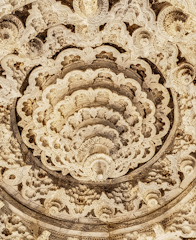
The Sun Temple at Varman was built in the 10th century AD. Somewhat ruined, but maintained by the Archaeological Survey of India, it contains carved stone features such as some of those that we saw at the great Jain temples at Mount Abu. The Sun Temple is, even though now incomplete, a gem.
Not far from the Sun Temple, we drove along a very sandy road until Zakir said the car could go no further safely. I disembarked and walked with some difficulty through vey soft fine sand towards a pair of huge banyan trees. Near these are the unguarded remains of Krishna Vat. A passing local with flamboyant facial hair typical of that seen on many Rajasthani men made me understand that the temple had been destroyed long ago by invaders. Despite the temple being a disorganised pile of exquisitely carved stones, people still worship there. For that reason my ‘guide’ asked me to remove my sandals while I prowled around the ruins, taking photos. My companion explained to me in Hindi what I was looking at, but I barely understood what he was saying. However, he did make it clear that a small rectangular patch of earth surrounded on three sides by stones was all that remains of the innermost sanctum of the temple.
After a relatively long drive, we reached the Behra Tarak Jain temple, which was built about 20 years ago. Although recently constructed, this temple, like most other contemporary Jain temples, is designed in the same way as those which were built over 1000 years ago. Thus, this new temple gives the visitor a good idea of how the historic temples must have looked when they were just completed. In all of the modern Jain temples we have visited both in Gujarat and Rajasthan no expense has been spared to create or recreate the perfection seen in the earliest temples.
Another drive along country lanes brought us close to the Karodi Dhwaj Hindu temple. I had to climb about 150 metres up a track too rough for our taxi to reach this small old temple compound clinging to the rocky slopes of Mount Abu. A staircase cut into a huge rock led down to a pool of water deep in a rocky cleft. The temple buildings overlooked this. Although of great beauty, they had been heavily painted with silver and other coloured paints. Some of the finer details of the carved stone idols were also hidden under deep layers of garish coloured paint. This temple almost hidden away in the rocks reminded me of some monasteries I have visited in Serbia. They were located next to the sources of streams at the heads of valleys to make them less accessible to foreign invaders, in their case the Ottoman soldiers.
The Mirpur Jain temple is definitely not concealed. It overlooks the plain surrounding Mount Abu. The mountainside makes an impressive backdrop to this beautiful temple constructed in a rare stone with light blue streaks. Constructed before the better known Dilwara temples, this could well have been the model which inspired the builders at Dilwara. Many of the finely carved features seen at Dilwara, where photography is firbidden, are in evidence at Mirpur. Almost as breathtaking as Dilwara, seeing Mirpur is a ‘must’.
The last stop on our tour was a Hindu temple within a natural rock cave, the Vastanji Shiva temple. This is located above a slope that was covered with litter. We were welcomed by several friendly temple assistants to the cave temple with its low painted rock ceiling. After we had admired the deity, we were invited into a neighbouring building, where men and women were keeping warm around a wood fire in a hearth on the floor. We were given a warm welcome and cups of tea. Pur new acquaintances invited to stay for a night of prayer at the temple. They told us that we would be offered food and bedding. Many people make the pilgrimage to this place and avail the hospitality offered. The sleeping quarters are flattish surfaces below the temple under colourful cloth shamianas. I guessed that much of the litter lying around was the result of the previous night’s pilgrims. All around we saw monkeys busy eating discarded vegetables and flower garlands.
We drive back up to Mount Abu after sunset, and disembarked at the grandiose former summer palace of the rulers of Bikaner, an erstwhile princely state in Rajasthan. It is now a ‘heritage’ hotel. We ate an indifferent meal in one of the dining rooms. The place was so cold that all of the diners were wearing inelegant padded jackets for outdoor use rather than dinner jackets and other fine garments that would have been worn when the hotel was a royal palace.
Thus, ended a fine day that was inspired by the historical research which Dr Sharma has been doing for years and by the publicity given to it at our hotel by its owner.


