Tagore and the oppression of women in traditional families in Bengal

THE BENGALI POLYMATH Rabindranath Tagore (1861-1941) is modern India’s most important cultural figure. In 1913, he was awarded the Nobel Prize for literature, and in 1915 he was honoured with a knighthood by King George V. Following the massacre at Jallianwala Bagh in 1919, which was instigated by a British military commander, he renounced the knighthood. Five years before this, Tagore, who did not tolerate injustice, wrote “Streer Patra” (‘A Wife’s Letter’), a short story that highlighted and questioned the domination of women by men in 19th and early 20th century families. Kolkata’s leading English language actress and two colleagues have created a play “I am Mrinal”, which is based on Tagore’s short story.

Piali Ray on stage

On the 9th of September 2025, I watched a performance of this play at London’s Nehru Centre. Piali Ray skilfully and convincingly acted all the roles in the play. These were: Mrinal, the wife of the second eldest son in the family; Bindu, an orphaned child, related to one of Mrinal’s in-laws; Mrinal’s brother-in-law’s wife; and Mrinal’s husband. Against everyone except Mrinal’s wishes, Bindu was accepted into the household.  Mrinal’s husband disapproves of Bindu’s presence in the joint family home, but childless Mrinal treasures this young girl’s presence. Mrinal’s husband is keen to evict Bindu, and eventually decides to marry her off to an insane man. In desperation, Bindu sets herself alight, and she dies. Then, Mrinal flees from Kolkata to Puri, where, at the end of the play, she writes a letter to her husband, explaining that she will never return to the domestic bondage that she had to endure for 15 years as his wife. Tagore’s story vividly illustrates the oppression of women in conventional Bengali families, and his feeling that this injustice needed to be combatted. It was written in 1914, the year the First World War commenced. It might not have been “the war to end all wars”, but after it was over, women in many parts of the world began to question their roles in society, and to improve their status.

During Piali’s performance, she switched roles effortlessly, and one was never in doubt as to whom she was portraying at any given moment. Even when she was playing the role of the husband, one forgot that she was not actually a man playing this part. She used a different tone of voice and set of gestures for each of the characters. Throughout the performance, there was music playing in the background. It impressed me that Piali’s movements on stage seemed to harmonize with the music. Her performance was not simply dramatic but also balletic.

It was fascinating watching this play not only because it gave an insight into the oppressive conditions experienced by women in traditional bourgeois Bengali joint families in the early 20th century, but also because it gave me a chance to watch a skilled actress conveying the story so beautifully.

Adam Yamey is the author of “88 Days in India: A Journey of Memory and Discovery” [https://www.amazon.co.uk/dp/B0FKTFBFM2],  and several other books about Indian topics.

A stone with Chinese characters in a garden in Cambridge

WHEN RABINDRANATH TAGORE (1861-1941) visited China in 1924, he gave a series of lectures in English, which were translated for the Chinese audiences by the talented young poet Xu Zhimo (1897-1931).  During a visit to Cambridge (UK) in August 2024, in several shop windows I noticed a book called “Xu Zhimo Cambridge & China” by Zilan Wang. Even though Cambridge has many students and tourists from China, I wondered about it.

Xu Zhimo was born in Haining (China). He studied law in Beijing, then in 1918 travelled to the USA, where he studied for, and was awarded a degree at Clark University in Worcester, Massachusetts. After starting a degree at Columbia University in New York City, he left the USA because he could no longer stand the place. He then travelled to the UK, where he first studied at the London School of Economics, and then at Kings College, Cambridge. It was in Cambridge that he became deeply attracted to poetry, and began writing it. In 1922, he returned to China, where he became an important figure in China’s modern poetry movement. He was a believer in ‘art for art’s sake’ rather than the (Chinese) Communists’ belief that art should serve politics.

When Tagore came to China, the country was in turmoil: there was fighting between rival warlords and the risk of an invasion by the Japanese was great. Xu Zhimo served as one of his oral interpreters, translating Rabindranath’s romantic (English) language into vernacular Chinese.  Tagore did not rate his visit to China a great success. He was met with some hostility as Huan Zhao explained in the introduction to an article entitled “Interpreting for Tagore in 1920s China: a study from the perspective of Said’s traveling theory” (Perspectives, Volume 29, 2021 – Issue 4):

“During Tagore’s visit, his initial perceptions of welcome were transformed dramatically into a feeling of rejection, resulting in an unpleasant sojourn. After forty-odd days, Tagore left China, disconsolate, with his mission unaccomplished. Exactly what happened remains unclear. The introductory flyleaf of Talks in China claims his poor reception had much to do with ‘organized hostility from the members of the Communist Party and was labeled as a reactionary and ideologically dangerous.’ Others maintain that Xu, as Tagore’s interpreter, should shoulder much of the responsibility for the visit’s outcome – that Xu’s efforts to enhance his own fame while welcoming Tagore effaced Tagore’s purposes and ideas”

And in the author’s conclusion, the following was written:

“In 1920s China, Tagore’s lectures and Xu’s interpretations faced strong resistance from Chinese intellectuals who sought radical social reform. This resistance interrupted Tagore’s visit and inflicted lasting anguish on his interpreter Xu Zhimo. Although challenged by critics, Tagore’s lectures continued to influence Chinese philosophers, thanks in large part to Xu’s unyielding efforts to expand and explain Tagore’s lectures.”

Xu Zhimo was killed in an air crash in November 1931.

On our recent visit to Kings College in Cambridge, we stopped to look at a large stone on which Chinese writing characters are inscribed. We had passed it on previous visits to the city, but had not investigated it. This time, we noticed a short path leading from the stone into a circular enclosure surrounded bushes and trees. The path is lined with rectangular paving stones on which some lines of a poem by Xu Zhimo is carved. Alternate stones are in Chinese, the others are in English. The words are from Xu’s poem “再别康桥” (Zài Bié Kāngqiáo, which means ‘Taking Leave of Cambridge once more”), which he wrote in 1928.  The enclosed area has a small bench upon which we sat, watching a continuous stream of Chinese people visiting the memorial, stopping to look at it respectfully.

Paintings by artists in India who escaped from western European artistic traditions – at the Brunei Gallery

WHENEVER I VISITED my in-laws in India, I used to admire the painting by the Bengali artist Jamini Roy (1887-1972), which used to hang in their flat. His style of painting was both modern (20th century) and at the same time almost folkloric. When our friend Bob Annibale posted on Facebook about an exhibition at the Brunei Gallery (in London’s Bloomsbury) that included Roy’s works, we could not resist visiting it, and we were glad we viewed it.

The exhibition, which continues until the 22nd of June 2024, not only contains a good selection of Roy’s works, but also others by Bengali artists working mainly between the late 19th century and the 1950s. Apart from works by Roy’s contemporaries including various members of the Tagore family, Hemendranath Mazumdar, Nandalal Bose, and Qamrul Hassan, there were also paintings by lesser-known or unknown artists who painted in the traditional late 19th century Bengali (Kalighat) style, rather than in experimental styles of the 20th century.

The emergence of modern Indian painting was a consequence of the establishment of The Government College of Art in Calcutta (in 1854). As the website of the Brunei Gallery explained, it was:

“… established by a benevolent government for the purpose of revealing to the Indians the superiority of European art.”

In the late 19th century, Indian artists working in the college began questioning the validity of Indians painting in the alien Western European fashion that was being taught them. The gallery’s website continued:

“Academic art, introduced by the British Raj, was challenged by the nationalist art movement, the Bengal School of painting, led by Abanindranath Tagore (1871-1951) and his disciples who dominated the art scene in the first decades of the twentieth century.”

It is works by these artists, who used their creations as part of their expressions of desire to see India free of British rule, that form the greater part of the show at the Brunei.

Several things particularly interested me whilst viewing the excellently curated and displayed exhibition. One was three paintings by Jamini Roy that illustrate Christian themes (e.g., the Crucifixion, the Last Supper, and the Flight to Egypt). I had not before seen any of Roy’s paintings depicting Christian stories.  Another exciting discovery for me were a selection of paintings by Sunayani Devi (1875-1962), who was the sister of the artists Abanindranath Tagore and Gaganendranath Tagore, some of whose pictures are also hung in the show. These 3 siblings had a famous uncle, Rabindranath Tagore, some of whose paintings were also on show. At the exhibition, there were portraits of Rabindranath Tagore by each of his above-mentioned relatives, and one by Jamini Roy.

Yet another artist on show, whom I had never encountered, is Qamrul Hassan (1921-1988), who was born later than the other artists. Born in Calcutta before independence and the Bangladesh War (1971), he died in what is now Bangladesh. He studied at The Government College of Art in Calcutta in the late 1930s, and afterwards became involved with left wing political activities as well as his art. Later, he was active in the struggle for East Pakistan (now Bangladesh) to become independent of what was then West Pakistan. Beneath one of his creations at the Brunei, there is a quotation by Qamrul about his style of painting:

“… where Jamini Roy ends , I begin …”

And this is so easy to see in the excellent exhibition at the Brunei Gallery

I have told you what stood out for me, but although I have highlighted a few things, the rest of the exhibits are wonderful, and not to be ‘sniffed at’. After seeing the show, I thought that never before had I seen such a fine and large collection of paintings by the liberated artists either here in the UK or in India. The curators of this show deserve hearty congratulations.

Rabindranath Tagore, blood, and coffee in Calcutta

THERE IS A BRANCH of the India Coffee House chain in College Street, Calcutta. Housed on the first and second floors of Albert Hall (built 1876 in memory of Victoria’s Prince Consort), it is located in the midst of a vast bazaar specialising in bookselling – mainly textbooks and technical manuals. Soon after it was opened, the coffee house within Albert Hall became a centre of anti-British agitation.

The first floor serving area – many chairs and tables – is overlooked by two huge portraits. One photograph depicts Rabindranath Tagore as a young man and next to this, there is another of the poet and writer Kazi Nazrul Islam. Other smaller painted portraits line the walls of the café. Waiters wearing pugrees busily wandered around taking orders and delivering food and drinks – mostly coffee.

This ninth of January (2024) was a special day when an annual blood donation camp was held in memory of the Bengali footballer Sailendra Nath Manna (1924-2012). It was, as we discovered today, being carried out on the second floor gallery overlooking the serving area of the College Street India Coffee House.

Loudspeakers within the coffee house and in the streets surrounding it were exhorting people to come and donate some blood. A steady stream of volunteers climbed the staircase to the second floor. One of the officials, who was having coffee at a table near us, suggested we took a look upstairs.

The gallery was full of people. Chairs lined the walls. Donors were sitting in these with catheters in their veins. Several medics were wandering about with stethoscopes around their necks. Those who had donated blood were given packages contains bottled water and snacks. There were a few folding beds ready for anyone who fainted or collapsed during or after they had given blood, but these were unoccupied. Despite the seriousness of the purpose of the occasion, the blood donation camp seemed more like a joyous fair or party than a clinical situation.

We had come to College Street to enjoy the historic ambience of the old coffee house. Little had we expected to come acros a blood donation festival within it.

White and nutritious – milk and racism

UNTIL I WAS ABOUT 18, I drank a pint of chilled milk in the morning and another when I came home from school. I did not drink all the varieties of milk that were supplied by the milkmen who worked for the Express Dairy Company, but chose the ‘homogenised’ variety, which did not have cream at the top of the bottle. Never once whilst drinking this refreshing slightly watery liquid did I ever imagine that I would one day visit an exhibition about milk. Today, the 29th of July 2023, I viewed an exhibition called “Milk”, which is being shown at the Wellcome Collection in London’s Euston Road until the 10th of September 2023. Amongst the numerous exhibits displayed in this beautifully curated show, the following particularly interest me.

  1. There was a collection of decorated porcelain cream jugs.  Each one was shaped like a cow. Cream used to be poured into the hollow cow via a hole in its back. Then, a lid was placed to cover that orifice. To use the cream jugs, the cows were tilted so that the cream could flow out of another hole through creatures’ mouths.
  2. There was a terracotta model of a mule carrying two trays laden with cheeses. This Ancient Roman artefact dating back to the 3rd or 2nd century BC was found by archaeologists in Southern Italy. In times long before refrigeration, making cheese was one way of preserving milk for future use.
  3. I saw a metal lactometer, which was used to determine the amount of water in milk. My wife said that when she was a child in India, milk used to be delivered to the door. To check whether the milkman had watered it down, her mother used a lactometer just like the one on display at the exhibition.
  4. Our daughter spotted an 18th century etching depicting St Bernard of Clairvaux kneeling before the Virgin holding the Christ Child. As the saint knelt before the Virgin, he received a squirt of her milk from her breast. This was supposed to grant him wisdom and eloquence. When she was studying History of Art, our daughter wrote a thesis about this curious episode – The Lactation of St Bernard’.
  5. A rather uninteresting looking exhibit proved to be most fascinating. It consisted of two milk testing forms, which had to be completed after a farmer’s batch of milk had been tested for diseases, bacteria, fat content, and protein content. The forms on display related to milk produced by cattle on the Dartington Hall Estate in Devon. The Estate was founded to research the merits of various scientific farming methods. One of the founders of the Estate was the agronomist Leonard Elmhirst (1893-1974). What made him special in my mind was that after meeting the great Rabindrath Tagore (1861-1941) in the USA in 1913, he later (in 1922) set up for Tagore an Institute of Rural Reconstruction near Tagore’s university at Shantiniketan (now in West Bengal). After marrying Dorothy Straight, Elmhirst and his wife established the Estate at Dartington in 1925. It was modelled on what he had founded near Shantiniketan.

There were plenty of other exhibits that were both visually interesting and thought provoking. A theme that I felt pervaded the exhibition is related to the colour of milk – white. Because milk is often perceived as being healthy, pure, and virtuous, it may also nourish the malevolent ideas of white racists. One of the exhibits showed a video of Trump supporters cavorting around, each one of them waving large bottles of white milk whilst shouting racist and anti-Semitic slogans. Yet, the ancestors of racists like these were perfectly happy to snatch the newborn babies of black slaves away from their mothers, so that these unfortunate women could be forced to breast-feed the babies of the white women of the families who owned them. Their milk was white, but not their skin colour. To compensate for these and other harsh reminders that all is still not well in the racial tolerance scene, the exhibition includes a satirical film from You Tube ( https://youtu.be/cevXg_SlT-Q ), which makes fun of people with racist tendencies.  

Well, it never occurred to me that milk and racism might be considered in the same brackets until I visited the splendid show at the Wellcome Collection. It is well worth seeing not only because of its historical and scientific aspects, but also for its artistic and sociological content.

Three Indian men in London’s Bloomsbury

MAHATMA GANDHI IS commemorated by a statue in Tavistock Square in London’s Bloomsbury. He is probably the most famous of three Indians with statues in Bloomsbury. Crafted by the sculptor Fredda Brilliant and presented by the Indian High Commission, it was unveiled by Prime Minister Harold Wilson in 1967.

The next most famous Indian represented by a sculpture in Bloomsbury is a Nobel Prize winner, the celebrated writer and polymath from Kolkata (Calcutta), Rabimdranath Tagore (1861-1941). The memorial depicts Tagore’s head. It was created by the sculptor Shenda Armery, and unveiled by the Prince of Wales, now King Charles III, on Tagore’s 150th birth anniversary year in July 2011. The bust stands in Gordon Square, close to University College London, where Tagore studied law briefly. His face looks away from the college towards the southeast. – towards India, his homeland. On one side of the plinth, there are some words written in Bengali script. On another side, there is a translation of this brief text (by Tagore) in English:
“Thou hast made me endless, such is thy pleasure. This frail vessel thou emptiest again and again, and fillest it ever with fresher life. This little flute of a reed thou hast carried over hills and dales and hast breathed through it melodies eternally new. At the immortal touch of thy hands my little heart loses its limits in a great joy and gives birth to utterance ineffable. Thy infinite gifts come to me only on these very small hands of mine. Ages pass and still thou pourest and still there is room to fill.”
This is from Tagore’s collection of poems – “Gitanjali”, translated into English from Bengali by the author in 1913. It was this collection that led to Tagore being awarded the Nobel Prize for Literature in 1913. In 1915, King George V awarded him a knighthood, but following the Jallianwala Bagh massacre of 1919, he renounced his knighthood to express his horror at the murders that had been perpetrated on innocent Indians by British troops in the Punjab.

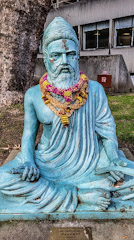
Thiruvalluvar

Call me ignorant but I had never heard of Thiruvalluvar, whose bust stands in a garden next to the School of Oriental and African Studies in Bloomsbury. According to a plaque next to the bust, this man was author of “Thirukkural”, which was a classic of Tamil philosophy and ethics. The bust was donated by the Governent of Tamil Nadu in 1996, and unveiled by the then Indian High Commissioner Dr ML Singhvi. Celebrated as he is in Tamil Nadu, little is known about his life. It is possible that he was born or lived in Mylapore (now a district of Chennai) in the south of India. According to Wikipedia:
“His work Tirukkuṟaḷ has been dated variously from 300 BCE to about the sixth century CE.”
As for his great work “Thirukkural”, the online version of Encyclopaedia Britannica remarked:
“…Tirukkural (“Sacred Couplets”), considered a masterpiece of human thought, compared in India and abroad to the Bible, John Milton’s Paradise Lost, and the works of Plato.”

I have described monuments to three notable men from India, but omitted one woman, whose memorial is close to those already described. The WW2 heroine Noor Inayat Khan (1914-1944) is commemorated by a bust, which, surprisingly, I have never noticed, in Gordon Square. Sculpted by Karen Newman, it was placed in the square in 2012. This artist also sculpted a bust of Violette Szabo (1921-1945), which is on the embankment of the Thames near Lambeth Palace. Both Noor and Violette worked for the British SOE, and perished in Nazi concentration camps.
Once the epicentre of the British Empire, it is not at all surprising that one comes across memorials to notable Indians whilst wandering about in London and other places in the UK.

Rabindranath Tagore in Hove and Hampstead

FROM HOVE TO HAMPSTEAD

THE NOBEL PRIZE winning Rabindranath Tagore (1861-1941) was born in Calcutta (Kolkata). Raised in a culturally rich, wealthy household, he began writing poetry when he was eight years old. His family wanted him to join many of his compatriots, who travelled to England to become barristers. By becoming barristers, many Indian men were able to begin on the pathway to wealth and/or political influence both within the British colonial system, or against it.

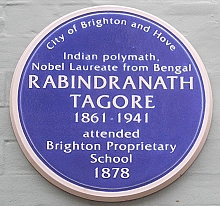
Tagore was enrolled in a school in Brighton in 1878. Whilst there, he resided in Medina Villas in Hove. His biographers, Krishna Dutta and Andrew Robinson, wrote in their book (published 1996) that one of Rabindranath’s (‘Rabi’s’) nieces:

“…retained fresh memories of Rabi Kaka (Uncle Rabi) in the family house at Medina Villas, between Brighton and Hove, where he settled for several months.”

Tagore wrote:

“Our house at Hove is near the sea. 20/25 houses stand in rows and the name of the complex is Medina Villas. When I first heard that we would be living in Medina Villas, I imagined a lot, such as there are gardens, big big trees, flowers, fruits, open space and lakes etc. After coming to my place I found houses, roads, cars, horses and no sign of Villas” (http://rabitalent.blogspot.com/2017/06/rabindranath-in-england.html).

The school that Tagore attended briefly, for about two months, was in Brighton’s Ship Street, close to the town’s famous ‘Lanes’ and a few feet from the seafront. Recently, a commemorative plaque was attached to the building which housed the school and is now part of a hotel, which used to be its neighbour. The plaque named the educational establishment “Brighton Proprietary School”.

I attended a preparatory school before moving on to a high school, but until I saw the plaque in Brighton I had never heard of proprietary schools. It seems as if they were private schools that were run as businesses, rather than not-for-profit organisations. A note on the National Archives website (https://discovery.nationalarchives.gov.uk/details/r/b1c290ea-4580-4c52-962b-10c0d281ac2a) revealed:

“The school was opened on 18 July 1859 under the title of the Brighton Proprietary Grammar and Commercial School for the Sons of Tradesmen. The proprietors … each had a share in the school and were entitled to take up places there. The education given had a Protestant bias and the first headmaster was the Rev John Griffiths, formerly of Brighton College.”

Brighton Proprietary School later became the Brighton, Hove and Sussex Grammar School (www.britishmuseum.org/collection/term/BIOG250324). Dutta and Robinson wrote:

“After spending a short time in a school in Brighton and Christmas with his family, he was taken away to London by a friend of his elder brother, who felt he was making little progress towards becoming a barrister. There he would stay during most of 1879, with a break to visit Devon, where his sister-in-law had taken a house, and, most probably, time spent with some cousins…”

Fast-forwarding to 1912, Tagore, by then a world-famous cultural figure, visited London. During his stay, he resided in Hampstead’s Vale of Health, as I recount in my book “Beneath a Wide Sky: Hampstead and its Environs” (available from  https://www.amazon.co.uk/dp/B09R2WRK92). Here is a brief extract from what I wrote:

“The only vehicular access to the Vale is a winding road leading downhill from East Heath Road. This lane is bordered by dense woodland and by luxuriant banks of stinging nettles in spring and summer. At the bottom of this thoroughfare, there are houses. Most of the expensive cars parked outside them suggest that the Vale is no longer a home for the impoverished. At the bottom end of the road, there two large Victorian buildings whose front doors are framed by gothic-style archways. They have the name ‘Villas on the Heath’. One of them bears a circular blue commemorative plaque, which has leafy creepers growing over it. It states:

“Rabindranath Tagore 1861-1941 Indian poet stayed here in 1912.”

I have visited the palatial Jorasanko where Tagore was brought up in Calcutta. The large (by London standards) ‘villa’ in the Vale is tiny in comparison. An article published in a Calcutta newspaper, The Telegraph, on the 13th of September 2009 reported with some accuracy:

‘In Hampstead, north London, regarded as a cultural “village” today for left-wing but arty champagne socialists, there is a plaque to Rabindranath Tagore at 3 Villas on Vale of Heath.’”

I have known about Tagore’s stay in Hampstead for a long time, but it was only during a recent visit to my wife’s relatives in Hove, that we first learned of the plaque commemorating Tagore’s brief educational experience in Brighton.

Around London’s Euston Station

AFTER EATING DELICIOUS KEBABS and a wonderful mutton biryani at Raavi Kebab, a Pakistani restaurant in Drummond Street close to Euston Station, we took a short post-prandial stroll around the area, a part of London that is home to University College London (‘UCL’), where my wife and I did our first degrees and we first met.

BLOG TAGORE

The west part of Drummond Street has become a desolate building site because of the works being undertaken to construct the HS2 railway. A building covered in tiles the colour of clotted blood stands in the midst of the building works. It looks like some of the entrances to older London Underground stations. It is located on the corner of Drummond and Melton Streets. It was the original entrance (opened between 1907 and 1914) to Euston station of the Charing Cross, Euston and Hampstead Railway, now part of the Northern Line, which is now accessed from within Euston railway station. The latter was built in the 1960s on the site of the demolished Euston Station (with its impressive Doric arch) built in the 19th century.

When the old Euston Station existed, Drummond Street stretched further east than it does today. It ran past the southern façade of the 19th century station and across the present Eversholt Street, ending at Churchway (not far from the current British Library).

All that remains of what must have been a splendid old station is a statue of the railway engineer Robert Stephenson (1803-1859) and two pavilions on Euston Road. These formed part of the entrance to the old station’s forecourt. Built of Portland stone in about 1870, they were designed by JB Stansby. The corners of these two buildings bear the names of the stations that were served by trains from Euston Station. Interestingly, these include cities such as Cork and Dublin, which are no longer within the United Kingdom. When the pavilions were constructed, the whole of Ireland was under British rule.

Strolling along Gordon Street, we passed the Ingold Chemistry building, part of UCL, where my wife and I spent many happy hours trying to synthesize various organic compounds, often ending up with tiny granules of non-descript materials, which might have been bits of broken glass rather than the desired product. Across the street, where there had once been an open-air entrance to the main campus of UCL there is a new building, glass-fronted at street level. Through the glass, we could see the mummified, clothed remains of the philosopher Jeremy Bentham (1748-1832) in a glass container, instead of the old wooden one in which he used to be housed. Bentham was strongly associated with the foundation of UCL in 1826.

As I stared at Bentham, an opponent of slavery, through the windows of the new building, I wondered what his views were, if any, on colonialism in India. Some of Bentham’s followers, such as John Stuart Mill, had been employees of the East India Company. Mill and Bentham, were not opponents of British colonialism, but did criticise it.

It was almost dark when we walked into the garden of Gordon Square, a place overlooked by the homes of some members of the famous Bloomsbury Group, a set of British intellectuals and artists, which thrived during the first half of the 20th century. We discovered something that had not been present when we last visited the square some years ago. This is a bust of the Bengali genius Rabindranath Tagore (1861-1941). Created by Shenda Amery, it was unveiled by the Prince of Wales in July 2011, seventy years after Tagore’s death and one hundred and fifty years after his birth.

Tagore coined the name ‘Mahatma’ for the Indian Nationalist and freedom fighter MK Gandhi and also composed (in 1911) both the words and music of the Indian national anthem, “Jana Gana Mana”. The eminent historian Ramchandra Guha explains in his “Makers of Modern India” that:

“Tagore was a patriot without quite being a nationalist. He was no apologist for colonial rule… he was dismayed by the xenophobic tendencies of the populist edge of the Indian nationalist movement. He thought that India had much to learn from other cultures, including (but not restricted to) the West.”

Following the horrendous massacre of innocent Indians by soldiers under the command of the British at Jallianwala Bagh in 1919, he returned his knighthood to King George V.

Tagore was sceptical about ‘non-cooperation’ as advocated, for example by Gandhi. He was also worried about the concept of nationalism as applied to India. In his book “Nationalism”, published in 1917, he wrote:

“When our nationalists talk about ideals they forget that the basis of nationalism is wanting. The very people who are upholding these ideals are themselves the most conservative in their social practice. Nationalists say, for example, look at Switzerland where, in spite of race differences, the peoples have solidified into a nation. Yet, remember that in Switzerland the races can mingle, they can intermarry, because they are of the same blood. In India there is no common birthright. And when we talk of Western Nationality we forget that the nations there do not have that physical repulsion, one for the other, that we have between different castes. Have we an instance in the whole world where a people who are not allowed to mingle their blood shed their blood for one another except by coercion or for mercenary purposes? And can we ever hope that these moral barriers against our race amalgamation will not stand in the way of our political unity?”

Tagore’s views on Indian independence were not as clear cut as many of the other advocates of freeing India from British rule, such as Gandhi, Jawaharlal Nehru, Subhas Chandra Bose, and Vinayak Savarkar. He was essentially in favour of it but as Radha Chakravarty wrote in “The Essential Tagore”:

“For Tagore, the view of nationalism and patriotism that the movement was taking on was too narrow. He disengaged with the movement but remained expressive on the issue of independence through his art and writings … Fundamental to his belief was that nationalism could not rise above humanity…”

We left Tagore as his bust began to become less visible in the deepening gloaming and walked along Torrington Place past Waterstones bookshop that is housed in the pinnacle-rich building that once housed Dillons, the university bookshop. Almost opposite the north eastern corner of the bookshop, a private roadway leads into the UCL campus and under a circular archway. This was a familiar landmark for us when we were undergraduate students because it allows the roadway to pass beneath the building that housed ‘our’ Department of Physiology. Being August and in the midst of both the university holidays and the coronavirus pandemic, this normally busy roadway was empty.

We walked north along the east side of Gower Street passing a door marked ‘Anatomy’. This used to be an entrance to the Physiology Department, where I spent six years studying. During the last three of these, I used to have a key to the door so that I could let myself in whenever I wanted to do laboratory work on my PhD project. In those far-off days, security was far laxer than it is nowadays.

After passing the main entrance to UCL, we reached the corner of Gower Street and Gower Place. This building, now a part of UCL, used to house the medical bookshop, HK Lewis & Co Ltd. This, according to a plaque on the wall, was founded in 1844 in Gower Street, soon after UCL’s medical school was established in 1834. HK Lewis had a useful second-hand department, where I bought a few of my textbooks at prices not much lower than they would have been if they had been new.

We returned to our car parked in Drummond Street. Our favourite Asian grocery and Ambala’s sweet shop were already closed for the day. Raavi Kebab, a haven for carnivores, and its neighbour, the long-established Diwana Bhel Poori House, a haven for vegetarians, were still serving diners. These restaurants and several others in the street serving foods from the Indian subcontinent are run by folk whose ancestors were subjects of the British Empire prior to 1947. The street is a fine example of the idea suggested by the French colonial writer Frantz Fanon (1925-1961), namely, that eventually the colonial chickens come home to roost. And, thank goodness they have because they help to give London the vibrancy that makes it such a great city.