Photographs of Chandigarh in an old Indian magazine

DURING MY TEENAGE years, I had the idea that later I might train to become an architect. I enjoyed drawing, and read books about twentieth century architects such as Frank Lloyd Wright, Mies van der Rohe, Walter Gropius, and Le Corbusier. When the Bauhaus exhibition was held at the Royal Academy in London (September to October 1968), I visited it three times. My enthusiasm for becoming an architect ended after lunch one day when walking from the Highgate School dining hall back to the classrooms. Suddenly, I thought that instead of designing great buildings such as those created by the architects, whom I had read about, I might end up designing extensions and garages for people’s houses. This fleeting thought made me give up the idea of becoming an architect. However, since then, I have continued to enjoy looking at, and reading about, architecture.

One of the 20th century architects who intrigues me much is Le Corbusier. I have seen many of his creations in France and a few in the Indian city of Ahmedabad. But I have never been to Chandigarh in the Punjab. It was to be the new capital of the Indian Punjab. The old capital, Lahore, found itself in Pakistan after 1947.  This was a new city that Le Corbusier helped to design in the 1950s – both the layout and many of its buildings. Last year, I acquired a copy of a magazine called “Times of India Annual”. I have the 1955 edition. Although much of Chandigarh was already built by 1955, it was far from completed. The magazine contains an illustrated article by the British Modernist architect Edwin Maxwell Fry (1899-1987).

The article is illustrated with photographs that show both the novel designs employed for residences as well as some of the larger buildings including the Punjab Engineering College, the High Court, and a school. Several of Le Corbusier’s major projects such as the Palace of Assembly and his Open Hand Monument are not illustrated because they had not been completed by 1955. The Secretariat Building designed by Le Corbusier was complete when the article was published, but has not been included amongst its illustrations. The pictures tend to concentrate on the designs for dwellings that were economical without seeming mechanical or inhuman.

Having a great interest in Le Corbusier and Chandigarh, I was excited to find an article written by Fry, one of the city’s planners, at a time when the place was still in its infancy. For three years, he and his wife Jane Drew (1911-1996) worked with Le Corbusier on the planning of Chandigarh. Knowing that, I thought it would be interesting to see what Fry wrote in the magazine. Sadly, Fry’s article’s content is rather anodyne and self-congratulatory. Nevertheless, I am pleased that I have the magazine because apart from Fry’s article, it contains a wealth of other material – both written and illustrative.

From India’s Punjab to London’s Primrose Hill

WHEN THE PUNJAB WAS divided (by the British) between Pakistan and India in 1947, its former capital, Lahore, became a Pakistani city and the Indian part of the region was left without a capital. Jawaharlal Nehru, the first Prime Minister of India, decided that instead of assigning an existing city to become the capital of India’s Punjab a new city should be created. It was to symbolise the birth of modern India. A team of architects led by the Swiss born Le Corbusier began designing the new city, Chandigarh, in the early 1950s. In late 1953, it became the capital of India’s Punjab, which was later further divided into Punjab and Haryana states.

Amongst those who were on the team designing Chandigarh was Le Corbusier’s cousin, the architect Pierre Jeanneret (1896-1967). He designed much of the furniture installed in the buildings created in Chandigarh. According to one source (www.worldofinteriors.com/story/pierre-jeanneret-and-le-corbusier-chandigarh-furniture):

“Pierre Jeanneret, was strongly influenced by local materials and craftsmanship, with a Modernist twist. Due to the vast scale of what needed to be created for an uninhabited city – from Palace of Assembly chairs to university cafeteria tables and and linen baskets – Jeanneret experimented with what was on hand. Iron Sikh Sarbloh bowls became lampshades; mango tree trunks became tables. Readily available materials such as bamboo, teak, rope and wicker were woven into the designs.”

Recently, I saw a couple of examples of this furniture on display at a special exhibition at the Victoria and Albert Museum. Today, the 29th of October 2024, we visited an exhibition, “Syncretic Voices:Art & Design in the South Asian Diaspora”, in a private house near London’s Primrose Hill. What made it special for me is that there were many examples of Jeanneret’s Chandigarh furniture on display. The exhibition ends on the 1st of November 2024.

The house near Primrose Hill is owned by Rajan Bijlani, whose parents came from India to the UK in 1975. Rajan has been collecting Jeanneret’s Indian furniture for some time, and he showed it to us. Of particular interest was a table with a zinc table-top, which was once used in the Punjab University cafeteria in Chandigarh. Many of the other pieces on display were chairs and stools. There was also a shelving unit designed to hold files. Most of the furniture came from various government buildings in Chandigarh. Some of the pieces still have their original inventory numbers painted on them.

The furniture is in several rooms of the house. The walls of these rooms are decorated with attractive  modern artworks by several artists of Indian origin including Vipeksha Gupta, Rana Begum, Soumya Netrabile, Tanya Ling, Harminder Judge, and Lubna Chowdhary. Rajan told us that they were all for sale and he was holding them as consignments from various galleries. He is also selling some of his Jeanneret furniture. Rajan showed us around and was a perfect guide. It was a great pleasure and privilege to have been able to see his beautifully designed home and the fascinating furniture and other artworks displayed within it. If you wish to see this exhibition before it closes, visit: https://www.rajanbijlani.com/about

CREATIONS IN GLASS FROM INDUSTRY AND ARTISTS AND A PUNJABI PUB

TWO TEMPLE PLACE was built for the American businessman William Waldorf Astor (1848-1919) in 1895. Located close to Temple Underground Station and Middle Temple, this distinctive edifice is said to be designed in the ‘neo-Gothic’ style, although I would prefer to describe it, and especially its interior, as ‘Tudor Revival’. Every year, between late January and late April, the building, which is now owned and maintained by the Bulldog Trust charity, houses an exhibition, which is always worth viewing. This year’s exhibition, which continues until the 21st of April 2024, is called “The Glass Heart”.

The exhibition is described on the Two Temple Place website (https://twotempleplace.org/) as follows:

“It will explore the narratives central to glass art and manufacturing, and celebrate the timeless skills, artistry and innovation required to work with this challenging material.”

And it does that very successfully by exhibiting a superb collection of glass creations ranging from industrial products, such as Pyrex, through stained glass, to intriguing artistic creations that defy the imagination. I will not attempt to describe all of these exhibits – each one of them both fascinating and beautiful – but I will concentrate on one small collection of items relating to the Red Lion – a pub in West Bromwich (West Midlands).

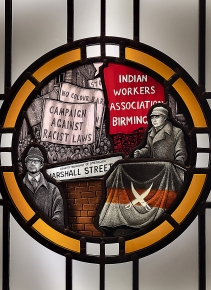
The Red Lion is a ‘desi’ pub owned by Indians, whose families originated in the Punjab, and came to work in the factories of Britain’s Black Country. Although all are welcome, the pub is mainly a socialising place for local people whose families came from the Subcontinent. It is one of several desi pubs in the former industrial heartland. In 2016, Steven Cartwright, who runs a studio that produces creative and decorative glassworks, was commissioned to create some stained-glass windows to decorate the Red Bull. His mission was to create traditional pub style stained-glass, but with an interesting slant – it was to celebrate the rich culture of the desi pub in the West Midlands. To do this, as Steven explained on his website (www.cartwrightglassdesigns.co.uk/projects/red-lion):

“I designed the window to give the appearance of a traditional pub but with a twist. The window utilises some of the colours and elements of the sub continent and tells the story of the punjabi community who migrated to the area in the 50’s. It also celebrates the establishment of the Indian workers association by Avtar Singh Jouhl and the visit of Malcolm X at their invitation.”

At the exhibition in Two Temple Place, there is a small piece of this pub’s stained-glass and some photographs of the rest of it.

What particularly intrigued me was the mention of The Indian Workers Association (‘IWA’) of Birmingham. The IWA was founded in the 1930s by Indian workers from Coventry to combat racist objections to them both by the British trade unions and the British people in general. The quote mentioned Avtar Singh Jouhl. He was born in the Punjab (British India) in 1937, and after the 1947 Partition, he came to London to study at the London School of Economics, arriving in 1958. Three years later, he moved to Smethwick in the Midlands, where he became an industrial worker. There, he saw and experienced racist anti-Indian conditions that prevailed at the time, He joined the IWA, and soon, along with others, he founded its Birmingham branch.

In February 1965, Jouhi invited the civil rights campaigner Malcolm X to visit Smethwick. A few days before his assassination, Malcolm X said of Smethwick:

“This is worse than America. This is worse than Harlem.”

In Jouhi’s obituary (The Guardian, 4th of November 2022), the following was written:

“The anti-racism campaign that attracted Malcolm X to Smethwick was spearheaded by Avtar Singh Jouhl, who has died aged 84 … Jouhl, as general secretary (1961-64; 1979-2015) and national organiser (1964-79) of the Indian Workers’ Association (IWA), challenged trade union members, factory owners and publicans to end this racism … When it came to breaking the colour bar in the town’s pubs, the IWA’s tactics were similar to those used by the Freedom Riders in the US in the previous decade. White university students were enlisted to order drinks, then hand them to British Indians, such as Jouhl. The landlord would invariably eject them, while the students challenged the eviction. The IWA then used evidence of these actions to successfully oppose the publican’s licence when it came up for renewal … This targeted campaign led to discrimination in pubs being outlawed in the Race Relations Act (1965) and paved the way for Britons of Indian heritage to become publicans themselves and set up what are commonly now known as “desi pubs”.

It was his actions described above and many others that helped to suppress racism in the Midlands and elsewhere in Britain. And it is very pleasing to see that what he achieved is being celebrated in glass in a pub owned and frequented by the people whom he helped. I visited the exhibition at Two Temple Place because I enjoy viewing glass artefacts. Little did I know that I would leave the exhibition having been introduced to an important political movement, about which I had known nothing.

Return to the Himalayas

SOUTHALL LIES NOT far from Heathrow Airport. Despite its architecture being mostly typical of dull London suburbs that developed between the two World Wars, it is far from being a run-of-the mill west London suburb. Recently, in March 2022, we visited Southall after several years since we last went there.

The centre of what was once the tiny village of Southall is about 1.7 miles north of Osterley Park house. The manor of Southall was owned by the Archbishop of Canterbury in the 14th century. Separated by countryside from its neighbours, it lay on the road from London to Uxbridge and Oxford. It was only in the 1870s that the village began expanding southwards to the Great Western Railway line. Today, the place has been fully incorporated into London and retains little or nothing of its former rustic nature.

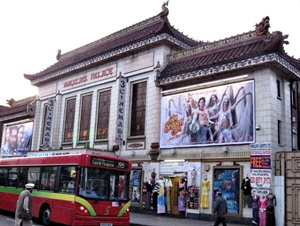
Detail of the roof of the Himalaya Palace in Southall

On arriving by train at Southall station, the observant traveller will notice that the station name signs are bilingual; they are in both Latin and Punjabi scripts. Southall is sometimes aptly referred to as ‘Chota Punjab’ (Little Punjab). The three Punjabi brothers, Charan Singh Bilga, Jagar Singh Bilga, and Lave Singh Bilga, began living in Southall in 1938. They were followed by Pritam Singh Sangha, who opened a shop in Southall in 1954, having arrived in the area in 1951. His shop was then the only shop in west London, if not in the whole of the metropolis, purveying Indian provisions.  Pritam Singh Sangha in partnership with his friend and business associate, Jarnail Singh Hura (also known as “Ghura”), established the first known business in Southall and Fakir Singh purchased numerous houses which he rented out to his countrymen.”

Vivek Chaudhary, writing in the Guardian in April 2018, recorded:

“By the time my own father arrived in 1960, local authority records show that there were approximately 1,000 Punjabis living in Southall, nearly all men. He would joke that one of the reasons why they settled here was because of its proximity to Heathrow airport, only three miles away, and “if the gooras [whites] ever kicked us out, it would be easy to get on a plane and return home”. It was a light-hearted reference to the uncertainty that was generated by the chronic racism of the time. It was the R Woolf rubber factory in neighbouring Hayes that attracted Punjabis to Southall – the general manager had served with Sikh soldiers during the second world war and was only too happy to recruit them…”

He added:

“Punjab was partitioned by the British in 1947; part of it fell within Pakistan with the remainder in India. Punjabis can be Sikh, Hindu or Muslim, and while all three demographics settled in this outpost of west London, it was the Sikhs who came in the largest numbers and gave Southall its distinct identity.”

Chaudhary mentioned that at the time he wrote his article, although at one stage Southall’s population was 70% Punjabi, this has decreased to about 50% and the descendants of many of the original settlers:

“…have prospered and moved to wealthier pastures, replaced by new communities from Afghanistan, Sri Lanka and Somalia. At its heart, though, this corner of west London remains an indelibly Punjabi town.”

And so, it is. Southall is like the Punjab and other places in India or Pakistan, but with the often-dull English weather and rather pedestrian suburban architecture. The main streets, South Road and the Broadway (Uxbridge Road), are lined with shops, small bazaars consisting of several tiny shops, and eateries. Judging by the profusion of colourful, often glittering, Indian (and Pakistani) style party clothing on sale, one might be excused for thinking that the people of Southall do nothing apart from attending ‘glitzy’ weddings.   If you wish to sample shopping as it is in India without leaving the country, then Southall is the place to do it in London. It seemed to my wife and me that the quality of the clothing on sale was high, better than much that is available in India. A Sikh salesman explained that what is on sale in Southall is made in India but unlike what is on sale over there, this is export quality.

One building is worthy of special mention in Southall, apart from the area’s gold-coloured domed Sikh gurdwaras. This is the former Himalaya Palace cinema. Built in 1929, it is unique in Britain in that its façade is in the form of a Chinese Temple. It has a pagoda roof which is flanked by dragons. It used to screen films from India’s Bollywood studios until it closed in 2010. It has now become an indoor market called Palace Shopping Centre. Fortunately, the building is protected by a preservation order and the façade is likely to remain a wonderful landmark in the foreseeable future. Not far away in a less distinguished building is another mall, the Himalaya Shopping Centre. Entering these malls, and the others in Southall, is like stepping into a typical indoor shopping bazaar anywhere in India. The air in these Southall shopping centres has the special fragrantly perfumed odour I associate with India.

Near the former cinema, stands the former Southall Town Hall, which was constructed in 1898. On its wall, there are commemorative three plaques placed by an anti-racism group called Southall Resists 40. They are dedicated to Gurdip Singh Chaggar, who was killed in 1976; Blair Peach who was killed in 1979; and ‘Misty in Roots & People Unite Musicians Cooperative’. Each of the three bears the words “Unity against Racism”.

Ely to India and back

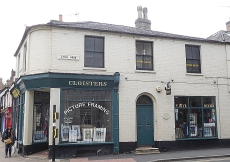
AT THE CORNER OF Lynn Road and St Marys Street in the cathedral city of Ely in Cambridgeshire, there is a shop selling used books and an assortment of ‘objets’, all in delightful disorder. This shop, with a fine view of the cathedral, ‘Cloisters’ by name, is across the road from The Lamb pub. Apart from being a lovely shop with an informative, genial owner, Barry Lonsdale, it was once home to an interesting but lesser-known military personality. His story is detailed by a blog writer named Michael Taylor (https://www.blogger.com/profile/12276420943738372719) and I have summarised it below.  

 Billett Genn (1827-1917) was a son of Billett Genn (senior), who died in 1872, and Margaret (née Austin (http://ginn-hertfordshire.blogspot.com/2014/06/). It is probable that they lived in the house that now contains the Cloisters shop. In 1841, young Billett became an indentured apprentice seaman, a seven-year contract. For reasons unknown, Billett returned to England before his seven-year term was completed. In 1846, he signed up as a trooper in the 3rd Kings Own Light Dragoons, another seven-year contract. The Dragoons had been stationed in India for several years, arriving there in 1837 (https://amp.blog.shops-net.com/10388944/1/3rd-the-kings-own-hussars.html) for the First Anglo-Afghan War (1839-1842). Billett arrived in India in time to become actively involved in fighting against the Sikhs in the Punjab Campaign of 1848/49. Billett took part in various engagements including the Battle of Chillianwala in January 1849. This battle was one of the bloodiest during the 2nd Anglo-Sikh War (https://en.wikipedia.org/wiki/Battle_of_Chillianwala), and one in which both the Sikhs and the East India Company claimed victory.

Genn was discharged and sent back to London in 1853, having been awarded the Punjab Campaign Medal. He returned to Ely where he became a schoolteacher in the city’s Needham School for poor boys. In 1867, he married Victoria Haylock. They produced seven children. Billett and Margaret lived at number 1 Lynn Road, which now contains the Cloisters shop. Margaret died in 1913 and Billett four years later. He was the last member of a family that had lived in Ely continuously for over 300 years. He was given a full military funeral.

Billett Genn was, at the time of his death, the last survivor of the Punjab Campaign (www.cambstimes.co.uk/news/the-story-of-remarkable-ely-man-billett-genn-is-retold-4887142). An unobtrusive plaque affixed to the wall of the shop commemorates this fact. We had come to Ely mainly to see its truly remarkable cathedral, which surpassed all expectation, but I was pleasantly surprised to discover this city’s far from well-known connection with distant Punjab.

PS: The Genn family also owned The Lamb pub at some time

Himalaya Palace

HIM 1 BLOG


THE HIMALAYA PALACE cinema in the London suburb of Southall, an area where many people of Punjabi descent live, showed only Bollywood films from India, usually the latest releases. Being keen on these films, we often made the long trip from our home to Southall to watch them. During our regular visits to India, always including Bangalore, we take time to see Bollywood films in the country where they are created.

We were in Bangalore in December 2001 when the blockbuster film “Kabhi Khushi Kabhie Gham” (ie ‘sometimes happy, sometimes sad’) was released all over India. We were staying with my in-laws,  and everyone decided that we had to see it.

We chose a cinema near the famous Mavalli Tiffin Rooms (MTR), a long established popular eatery in Bangalore. It was decided that we should have breakfast there before seeing a morning screening of the film. So popular is MTR, that queuing is always required before getting a table. It was my first visit to this highly esteemed place and I hope my last. Everything we were served was almost dripping with ghee, which is part of its attraction for its many fans.

The cinema was a few steps from MTR. After buying tickets, we had to wait in another queue. This one was to await one’s turn to have bags searched by security personnel. I thought this was to prevent weapons and bombs from entering the auditorium, but it was not. The security people were searching for food and drinks. So-called ‘outside food’ could not be brought into the cinema because it risked reducing the sales of overpriced snacks and drinks sold by the cinema.

When we reached our seats, my sister-in-law showed me her basket, lifted a shawl within it, and revealed the sandwiches and other snacks beneath.  So inefficient were the security people that they had not delved into the bag with any seriousness of purpose.

Before the film started, my sister-in-law offered me and the rest of the family rolls of compacted cotton wool rather like those that dentists stuff into patients’ cheeks to dry the mouth. She said we might need them because the volume of the soundtrack would be very high. I declined them, and enjoyed the full impact of the sound.

At the Himalaya in Southall before the start of any film, a sign would be projected. It said something like:

“Please do not talk during the performance.”

This was a pointless exhortation because at the Himalaya the soundtrack was played so loud that even if you screamed at your neighbour, they would not have heard you.

Sadly, the Himalaya Palace (built 1929) is no longer a cinema. It closed in 2010. When we last visited Southall a few years ago, the Chinese style front of the Himalaya, complete with dragons, still existed, but its interior had become a covered market.

Nowadays, well at least before the pandemic arrived,  we watch Bollywood films that are shown regularly (at least one per week) at a Vue cinema in London’s Shepherd Bush.

Providing you miss the Friday and Saturday screenings of the latest releases, the audiences are usually minute, often less than ten people in an auditorium that can seat well over 150 people. Even before the pandemic, social distancing  was the norm during the screenings because empty seats usually greatly outnumbered occupied ones.

Most Bollywood films are long, usually over two and a half hours. So, there is an interval during their screening. The point at which the interval occurs is chosen by the film maker to leave the audience at a point of high suspense in the story.

Once during an interval at a Bollywood screening at the Vue, we sat in the almost empty cinema and heard two ladies, sitting several rows in front of us, chatting in Italian. Out of curiosity,  we asked them in Italian why they had chosen to see a Bollywood film. Their reply surprised us.

The two women were members of an Akshay Kumar fan club in Calabria in the far south of Italy. They had only ever before seen films starring Akshay on video screens.  They were staying far away from Shepherds Bush in Dulwich when, to their delight, they discovered that the film we were watching, starring Akshay, was being screened in Shepherds Bush. They had come to see one of Akshay’s films on the ‘big screen’ for the first time.

Bollywood’s films have captured the hearts of people all over the world. They were even  popular in the former USSR. When we visited Albania in 2016, we discovered that they, as well as Indian TV soap operas, had captured a significantly large audience of Albanians. These films would not have been shown in Albania prior to the downfall of its Stalinist style regime in 1991.

Until it is safe to do so again, my wife and I will have to enjoy armchair screening of our Bollywood DVDs. Enjoyable as these are, they are an incomplete substitute for ‘in your face’ full blast performances in a cinema auditorium.

The Patient Assassin

Assass


I love browsing in second-hand bookshops. Occasionally, I come across really good books that I had not previously known about. The Patient Assassin by Anita Anand (published 2019) was one such discovery.

The Patient Assassin is about the life and exploits of  Udham Singh (1899-1940), a pro-independence, anti-British activist. Some of his friends were killed in the notorious Jallianwalla Bagh massacre  in mid-April 1919. Under the command of General ‘Rex’ Dyer, several hundred innocent men, women, and children, were shot dead within the closed space of Jallianwalla Bagh, a walled public garden in Amritsar. Many others were injured in this cruel attack whose supposed purpose was to subdue the people of the Punjab so that they would not rise against British rule. 

Dyer died of illness in England, having been proclaimed a hero for his malevolent deed. Michael O’ Dwyer, the Lieutenant Governor of the Punjab, who thoroughly approved of what was done at Jallianwalla Bagh and other horrific treatment of Indians, retired to London.

Udham Singh had friends who were killed at Jallianwallah Bagh. He made it his mission to kill O’ Dwyer. The author of Patient Assassin, Anita Anand, traces Udham’s complex and mysterious life from the Punjab to London, where he shot dead O’ Dwyer at a meeting at London’s Caxton Hall in 1940. Ms Anand weaves an exciting tale based on her researches of Udham’s colourful and exciting life. Her book about a real person makes far more engaging reading than most fictional thrillers. 

I was very pleased to stumble across Anand’s book for two reasons. One is that it turned out to be an un-put-downable read. The other is that it chimes with something that I have been working on.

In mid 1909, Madan Lal Dhingra, who like Udham Singh came from the Punjab, shot dead Sir William H Curzon Wyllie, a retired important British administrator in India, at the Imperial Institute in South Kensington. This assassination horrified the British nation and many in India. 

Dhingra had come to England study engineering at University College London several years before shooting Curzon Wyllie. He had become involved in the freedom fighting activities that were centred on India House in Highgate between 1905 and early 1910. It was Dhingra’s fatal shots that hastened the demise of India House, a student hostel and meeting place which was regared by the British as a ‘centre of sedition’.  I have almost completed writing a book about India House and its members, including Dhingra, and it should be available for sale soon. Its title will be “Ideas, Bombs, and Bullets”.

Finding Ms Anand’s book quite by chance was a great delight for me. Unintentionally, it might almost be considered a kind of sequel to what I have just written.