
Post a letter
In this very small red mail box
Make someone happy

Post a letter
In this very small red mail box
Make someone happy

It has been sent
Carefully wrapped I believe
Oh, when will it arrive?
I VISITED INDIA at least 50 times over the last 29 years. It was not until this trip (2022-2023) that I began noticing letter boxes of historic interest. I spotted three of interest in Bangalore, and now I have found one outside the post office in Fort Kochi in Kerala.

Painted green with some gold coloured details it is hexagonal with a decorative top. Between the words “Post” and “Office”, there is a British royal cipher with the lion and unicorn. Beneath this is a V and a R entwined, a logo I have seen on Victorian letter boxes in the UK.
The old letter box, now sealed up so that nothing can be put in it, stands close to the verandah at the front of the post office. Within the verandah, there is a panel giving some information about postal services in the former Kingdoms of Cochin and Travancore
Postal services began in the Kingdom of Cochin in about 1864. It was known as the Anchal Service. The letter box described above might have been an Anchal post box originally, although it is unlikely.
According to an article (https://englisharchives.mathrubhumi.com/news/offbeat/last-anchal-runner-of-kerala-passes-away-1.3462681#:~:text=Anchal%20Post%20was%20the%20postal,on%20which%20bells%20were%20attached):
“Anchal Post was the postal service system started and existed during the Kingdom of Travancore to transfer official letters and documents. The post man of this system was called anchal pillai. He used to run carrying the dispatches in a bag with a stick on his other hand on which bells were attached.”
He used to run eight miles a day. People were required to make way for this important courier, and not to impede his progress. The last surviving anchal pillai, Kannan Chapli, died aged 90 in 2019.
The post office outside which stands the historic letter box is on Ridsdale Road opposite the east end of the church of St Francis (Church of South India), and was constructed in May 1928. At that time, Fort Kochi was in the Kingdom of Cochin. In 1949, it and its neighbour, The Kingdom of Travancore, were integrated into India and merged to form the State of Thiru-Kochi. In 1956, this state was renamed Kerala and its postal service became incorporated into the Indian Post system.
Interestingly, the post box outside the Fort Kochi post office bears the intertwined V and R. The information panel has a drawing of an anchal letter box. Similar in shape to the Victorian post box, the one in the drawing bears a different logo and the words “Travancore Anchal” and something in Malayalam script. If I am not mistaken, Cochin, unlike Travancore, became a British Protectorate. In which case it might well have become part of the British Indian postal system. This could explain why the historic letter box in Fort Kochi has a British logo instead of that used in the Anchal system. There might also have been Anchal boxes in the Kingdom of Cochin, but I am uncertain about that.
Today, letters are posted in a simple red cylindrical letter box not far from the historic one. The Victorian letter box is one of a huge number of interesting historic survivals that can be seen whilst wandering around Fort Kochi.
WHEN MRS BRONSON OPENED her 10 bed boarding house in Bangalore in 1887, it became the city’s first hotel. Her establishment became The West End Hotel. It was, and is still, the best hotel in Bangalore. Set in beautiful grounds, the West End is home to Bangalore’s supposedly oldest letter box.

The cast-iron cylindrical pillar box is surmounted by a royal crown, below which are the words “post office”. The word “letter” is below the crown and above the slot for inserting mail. Below this slot, there is a large plate with mail collection times engraved on it. The plate seems to be newer than the rest of the pillar box.
Beneath the plate, there is a circular cartouche with lettering that has become difficult to read because it has been painted over so many times. However, I could make out the word “Greenock” and other wwords including “suttie”, “tho”, “street”, and “??thga??”. These indistinct words allowed me to direct my search of the Internet.
I discovered that Thomas Suttie of Greenock manufactured pillar boxes identical to the one at The West End in 1858. Only one of these has survived in the UK, but 7 or 8 of them can still be found in India. They are at The West End, in Vire, in Darjeeling, in Shimla, and two in Kasauli. There are also a few in Pakistan. One example, dated 1856, stands in the National Museum of Scotland in Edinburgh.
The year 1858 is of interest. It was when the Indian Uprising, which commenced in 1857, was coming to an end. It was also when the British Government decided to take over the governig of India from the East India Company.
The Suttie pillar box at The West End is still in use. Mail is collected from it three times a day. Given its date of manufacture, it is much older than The West End Hotel. Why it stands there is a mystery to me. Maybe the hotel acquired it as an antique curio. This is the third functioning historic post box I have seen in Bangalore. The other two are at the Bangalore Club and its near neighbour, The Bowring Institute.
Happy New Year!
NEXT TO THE POST OFFICE on the corner of Bangalore’s Museum and State Bank of India Roads, there is a recently opened Museum of Communication. Housed in an old-fashioned Bangalorean bungalow, it is effectively a museum of the Indian postal services. This well laid out museum contains a variety of exhibits ranging from postage stamps to large pieces of mechanised equipment. I will describe a few of the many exhibits that interested me.
There is a photograph of the world’s highest post office (somewhere in the Himalayas). There is an enormous piece of equipment, which occupies the whole of a room. It was used for transmission of money orders. Several panels described the history of the Indian freedom struggle and that of the Indian Post.

Outside on the museum’s shady verandah, there is a collection of old letter boxes. They include boxes of various shapes, sizes, and colours. One of them bears the Portuguese words “CAIXA POSTAL”. Once upon a time, it must have been used in one of Portugal’s Indian colonies, but there was no information about its original location.
Outside the museum, and still in use, there is a hexagonal pillar box, very similar to one placed at the Bowring Institute in the late 1880s. Unlike the one at Bowring, which bears the British Indian postal insignia, the box near the museum has been modified to make it look like a post-Independence Indian Post pillar box.
Next to the entrance to the museum, also on the verandah, there is aalifesize model of an Indian postman of yesteryear. Wearing a green and white uniform (including a turban) with some red trim, he has a sack slung over his left shoulder. His right hand is stretche out in front of him. In it he holds a wooden shaft tipped with a sharp metal spear tip. Four small bells are attached to the base of this tip. A lantern hangs from his right wrist.
In the past, the postman mafe his way from village to village along paths through the jungle. The spear tip and its staff were used to ward off wild animals. The lantern was used to light his way, and the bells were rung to alert villagers to his arrival.
Visiting the museum was an interesting experience. Seeing the hardships that postmen used to face should make us pleased that we can now communicate using fax, email, and other modern inventions.
A FRIEND IN BANGALORE, Mr Aggarwal, alerted me to the existence of an historic pillar box (letter box) in the city’s Bowring Institute. This private club has been located in its current position on St Marks Road since 1888, when it’s elegant clubhouse was constructed.
In front of the main entrance to the clubhouse, there is a hexagonal pillar box, which is still in use. This six-sided box is topped with six sloping triangular panels which meet at the highest point of the letter box.

The box bears a crest or emblem on the side where the slot for posting letters is located. This consists of a lion and a unicorn facing each other. Their forecast rest on a circle contains a cross. The circle is surmounted by a crown with two crosses. There is also a small crown with a cros on the lion’s head.
Below the crest, there is a diamond shaped lozenge containing the letters R, N, C, I (or possibly O). What these letters signified (or whether this was the manufacturer’s name) has not yet been revealed by an Internet search.
It had been suggested to me that the pillar box was a British East India Company (‘EIC’) letter box. This is unlikely to be the case because, from what I have managed to ascertain, the EIC crests included two lions facing each other, but no unicorns. Furthermore, by 1888 India was governed by the British Government rather than the EIC (which was in charge of governing India prior to 1857).
The letter box is believed to be contemporary with the construction of the Bowring clubhouse. In 1888, Queen Victoria was the Empress of India. The post box is therefore likely to have some connection with the British Indian postal service. I have yet to discover whether I am right about this. A quick search of the Internet did not reveal any examples of historic pillar boxes bearing the crest on the box at the Bowring Institute. If anyone knows more about this particular crest, please do inform me.
HAPPY CHRISTMAS
IT IS ODD how seeing a mundane object can stimulate less than mundane thoughts. Embedded into a wall in Salcombe (Devon), I saw an official post box for depositing mail. At first, I took little notice of it. Then, when I saw it a second time, I noticed that its red-painted front bears the letters “GR”. This refers to a King George. Because the first letter boxes were installed in the reign of Queen Victoria, the GR on the letter box in Salcombe must refer either to George V (reigned 1910-1936) or George VI (reigned 1936-1952) because the other King Georges all preceded Victoria.

Possibly the GR on the box in Salcombe refers to George V because he was the first George to follow Victoria, in whose reign the boxes bore the letters “VR” (Victoria Regina). Even though Edward VII was the first monarch to follow Victoria, boxes installed in his reign include the Roman numeral VII. Likewise, in the case of other monarchs who followed Victoria, their initials on post boxes include numerals identifying which king or queen they denoted (i.e., E VII R, G VI R and E II R). Not having ever looked out for it before, I am not sure whether any post boxes installed during the reign of George V bear the logo G V R or, as I saw in Salcombe, simply GR. A rapid search of the Internet revealed that most George V post boxes illustrated on websites dealing with post boxes bear the letters GR, as was the case with the example I noticed in Salcombe.
I suppose that when Charles or his son William come to the throne, letter boxes, if they still exist in the age of electronic mail, will bear the logos “C III R” and “W V R” respectively, rather than “CR” and “WR”. Why the V (meaning ‘5’) was not included on the post boxes issued during the reign of George V but the VII (meaning ‘7’) appears on those installed during his predecessor’s reign is not clear to me.
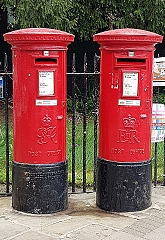
WHILE WALKING IN CAMBRIDGE, I spotted a pair of pillar boxes. At first sight they looked identical but soon I realised that they were not. One had a wider orifice for inserting letters than the other. The wider one bears the ‘logo’ of Queen Elizabeth II and its neighbour with the narrower slit bears the logo of the Queen’s father, King George VI. Apart from these differences, there were much the same.
The two pillar boxes I saw in Cambridge are not particularly old. The first post box on the British mainland was placed in Carlisle in 1853. The idea of using such receptacles for collecting mail is connected with the author Anthony Trollope (1815-1882). An informative website (https://www.postalmuseum.org/collections/highlights/letter-boxes/#) related:
“Anthony Trollope, now more famed as a novelist, was, in the 1850s working as a Surveyor’s Clerk for the Post Office. Part of his duties involved him travelling to Europe where it is probable that he saw road-side letter boxes in use in France and Belgium.He proposed the introduction of such boxes to Britain and a trial on the Channel Islands was approved. Four cast-iron pillar boxes were installed on the island of Jersey and came into use on 23 November 1852. In 1853 the trial was extended to neighbouring Guernsey. None of the first boxes used on Jersey survive. It is possible that one still in use on Guernsey together with another in our collection, originally sited in Guernsey, date from the 1853 extension to the trial.”
Before the introduction of pillar boxes:
“… there was [sic] principally two ways of posting a letter. Senders would either have to take the letter in person to a Receiving House (effectively an early Post Office) or would have to await the Bellman. The Bellman wore a uniform and walked the streets collecting letters from the public, ringing a bell to attract attention.”
Well, all that history is news to me and I might not have bothered to find out about it had I not seen the father and daughter pillar boxes standing side=by-side in Cambridge’s Market Square.
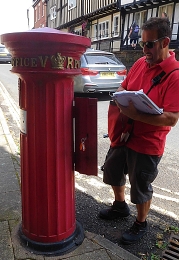
In Britain, posting boxes for letters and small packages are sometimes referred to as ‘pillar boxes’
While visiting the town of Warwick, famous for its castle, we spotted a letter box that is truly a pillar box.
This post-box (pillar box) is shaped like a classical pillar. It was made in cast-ron in 1856 and is one of two of this design in the town of Warwick. They are still in use.
WEST HAMPSTEAD, FORMERLY known as ‘West End’ in the time, before the 20th century, that Hampstead was a small town separated from London. Now, yet another of London’s numerous suburbs, West Hampstead has several churches as well as a synagogue. One of these places of worship, St James Church, is worth entering because it is not what it seems from its external appearance.
The large Parish Church of St James, built mainly with red bricks, was erected in about 1887 (www.lwmfhs.org.uk/parishes/6-middlesex/28-hampstead). It was designed by Sir Arthur William Blomfield (1829-1899), the fourth son of CJ Blomfield, Anglican Bishop of London between 1828 and 1856, who encouraged much new church building during the 19th century. This large church could seat 1000 people (www.british-history.ac.uk/vch/middx/vol9/pp145-152#h3-0007) and has some fine 19th century stained-glass windows.
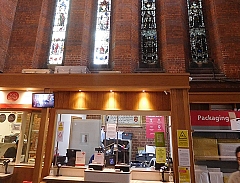
On entering the church through its electrically operated glass sliding doors, you will be surprised by what you find beneath its fine hammer beam timber ceiling. The west end of the nave is occupied by a post office, the first main-branch of a UK post office ever to be housed within a church. The north aisle of the church contains a children’s ‘soft play’ area, appropriately named ‘Hullabaloo’. The floor of the nave is filled with tables and chairs occupied by people of all ages, some enjoying refreshments from the church’s Sanctuary Café. All these things that you would not normally expect to find inside a church are part of The Sherriff Centre, a community organisation that began operating in 2014 (https://thesherriffcentre.co.uk/). The Centre’s activities also include a stationery store, a free food bank, live music as well as other events, free wi-fi, debt advice, and more.
Jesus is said to have thrown the moneychangers and others involved in commercial activity from the Temple in Jerusalem (“The Holy Bible”, John, Ch 2, v 13-16). However, he might have approved of the commercial activities within St James because profits from the sales outlets in the Centre are used to help finance charitable work. In addition to everything that I have already described about what goes on within St James, there is one more thing to mention. Despite the activities that you might not expect to find inside a church, regular religious Church of England services are held there. It is wonderful that St James, instead of becoming yet one more barely used Victorian church in London, has become a vibrant and beneficial part of a local community, catering to more than only just its by now small congregation.
 yamey
yamey 