CROWDS OF TOURISTS swarm to west London’s Portobello Road Market, especially on weekends. But how many of these visitors from all over the world know anything about the history of the place?
Here is an excerpt from my book “BEYOND MARYLEBONE AND MAYFAIR: EXPLORING WEST LONDON”. Beginning with Kensington and Paddington, it describes London from west of Park Lane and the Edgware Road to (and including) Heathrow Airport, and from Wembley south to Chelsea.
Here is an extract from the chapter dealing with Portobello Road:
“Before the mid-19thcentury Portobello Lane, as it was then called, was to quote the historians Florence Gladstone and Ashley Barker (writing in1924):“‘… one of the most rural and pleasant walks in the summer in the vicinity of London’, and within living memory it led ‘through fields to Kensal Green… cornfields and meadow land on each side… ‘”
Well, Portobello Road is no longer bucolic. It is lined with buildings along its length. Currently, it begins with a short section that leads off Pembridge Villas. It is here that you can stop for a drink at the Sun in Splendour pub, which was built in the early 1850s.Afterrunning a few yards westwards, Portobello Road heads off in a north-westerly direction, which it maintains with barely any deviation for the rest of its length. Number 22 was the first London home of the writer George Orwell. He lived there as a lodger in the winter of 1927. After crossing Chepstow Villas, the road slopes downwards and soon after this the market area commences. On most weekdays, much of the market is dedicated to daily needs, mostly food. On Fridays and Saturdays, the number of stalls and the variety of goods on offer increases dramatically. In normal times (i.e., when there is no pandemic),Portobello Road is choked with crowds of people from all over the world on Saturdays. In the 1860s, the Metropolitan Line (now the ‘Hammersmith and City Line,) was built. It crosses Portobello Road …”
To discover more about London, from west of Park Lane and the Edgware Road to Heathrow Airport, buy a copy of my book/kindle from Amazon website, e.g..:
MORLEY COLLEGE WAS founded in 1889 by Emma Cons (1838-1912), who was an artist, social reformer, and suffragette. The college was established to provide education to diverse groups of people living in London. It was named after the wool manufacturer and Liberal MP Samuel Morley (1809-1886), who endowed much money to Emma for the creation of her college. It is one of the oldest of Britain’s providers of education for adults. Its first branch was, and still is, in Lambeth. There are now other branches including one at Wornington Road in North Kensington.
In North Kensington, the stretch of Portobello Road between Golborne Road and Raddington Road is lined by a wall along most of its east side. Students from Morley College have created a series of pictures that are supposed to capture the vibrant atmosphere of Portobello Road and North Kensington, and do so successfully. These images have been attached at intervals along the wall. The collection has been given the name “Street Art Market -Portobello Wall (2024-2025)”. It is one of a series of annual public art commissions, the first of which appeared in 2009. The idea behind this ongoing project is to liven the rather dull stretch of Portobello Road that connects the two popular street markets, one on Portobello Road, and the other on Golborne Road. The result is usually very pleasing, and, surprisingly, does not attract the activities of graffiti ‘artists’, who often deface public surfaces with their spray paints.
THE FIRST PLACE I practised dentistry was in Rainham, Kent. Every Thursday, we climbed into my then boss’s open-topped TR 7 sports car, and drove down the High Street to a pub called The Cricketers. There, we used to enjoy a hearty meat and two veg lunch. One of the waitresses, a middle-aged woman, was a patient at the practice and always made sure that we were given large portions. On other days, I used to eat either in the practice or in one of the other local eateries. Sometimes, I would go into the local branch of Tesco’s supermarket to buy myself a few items for lunch. These always included either a Mars bar or a chocolate covered honeycomb caramel called a Crunchie. All the cashiers in the supermarket knew where I worked, and often, whilst I was paying, they would raise the Mars or Crunchie in the air, and shout:
“Look what the dentist is eating!”
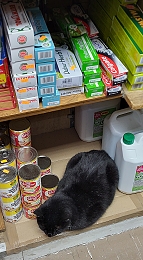
Recently, I entered a grocery shop near Portobello Road. I noticed a black cat resting on a shelf surrounded by tins, bottles, and boxes containing tubes of toothpaste. Seeing this creature reminded me of my days long ago in Rainham. There was a small ‘corner shop’ across the road from our surgery. The lady who owned it made very acceptable, generously filled sandwiches. Every now and then I used to buy one of her sandwiches for lunch. I used to accompany this with a packet of potato crisps. These packs were kept in an open topped cardboard box in no particular order. I used to rummage through its contents and select the pack that I fancied.
One day, I entered the shop to buy my lunch. When I turned to look at the box containing the packs of crisps, I saw a very plump cat comfortably curled up on top of the packets of crisps. Despite the fact that the crisps were sealed in their packets, I did not feel like choosing one. As I left the shop, I wondered where else that cat chose to rest during the day. Thinking about that put me off ever entering that little shop again.
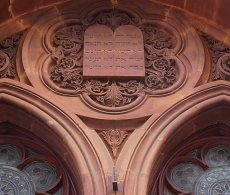
THERE IS SOMETHING curious about a small building on Kensington Park Road (near to London’s Portobello Road). Above its centrally located, west-facing front door, there are three tall windows topped with semi-circular arches. In each of these windows, there is a circular pane of glass painted white.
If you look at the circular panes carefully, you will notice that, almost obscured by the paint, there is a six-pointed star, the Jewish Magen David. Inside the building, there is a large hall flanked by galleries at the first-floor level. The galleries are supported by metal columns topped with decorative capitals. High up on the east wall of the building, there is a circular stained-glass window. The glass depicts a Magen David: it has not been concealed by paint.
In the former synagogue on Kensington Park Road
Did you know that this building, now much modified, was one of two synagogues in the Bayswater/Notting Hill area of west London? The other, still functioning, is on St Petersburgh Place near Bayswater Road.
I will not tell you any more about these two synagogues, one defunct and the other working, and west London Jewish communities, because you can read about them ( and much more) in my book “Beyond Marylebone and Mayfair: Exploring West London”. You can buy the book from Amazon (https://www.amazon.co.uk/BEYOND-MARYLEBONE-MAYFAIR-EXPLORING-LONDON/dp/B0B7CR679W/), or if you prefer to support independent bookshops, you can order a copy from a lovely bookshop near the former synagogue on Kensington Park Road: Lutyens & Rubinstein (21 Kensington Park Rd, London W11 2EU).
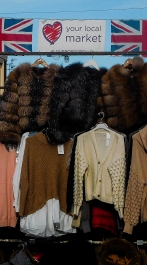
IT WAS EASTER Saturday (2022), the sun was shining, the air was warm, and we paid a visit to the world famous, popular Portobello Road Market. For the first time after over two years of pandemic-induced suppression of London’s ‘joie-de-vivre’, the market was buzzing with activity, crowded with foreign tourists and local visitors. As it was before Covid19, the market was bustling and business at the stalls, which offer everything from artichokes to antiques and pancakes to paella, seemed to be brisk.
Portobello Road
A friend, who lives in rural France, said to me a few days ago when we were walking near Leicester Square:
“It’s hard to believe that there was ever a deadly pandemic in this city.”
And as we walked along a short street in the area, he added:
“There are more people out in this street than there are living in my hometown.”
Yet, Covid infection rates are high in the UK. Friends in India have been telling us that they are thinking twice before visiting the UK because the risk of becoming infected here is so great at the moment. Recently, I have heard that approximately between 1 in 12 and 1 and 15 people in the UK are likely to be infected with a Covid19 virus, and therefore capable of spreading it to others.
Apart from personal hygiene and wearing face coverings, good ventilation is considered to be useful for reducing the risk of spreading the viruses. So, when I boarded a bus in South Kensington recently, I opened the window closest to me – each window on London buses has a label saying “Open this window”. Immediately after following this instruction, which has been given for reasons of prevention of infection, the lady sitting behind me, who was not wearing a face covering, stood up and slammed it shut. I stood up, opened it, and told her not to touch it. She said, speaking angrily with an Eastern European accent:
“You don’t need to open it. You are wearing mask and have three vaccinations.”
How she knew my vaccination status, I do not know. My wife said to her:
THE BATTLE OF Portobello was fought between the British Navy and the Spanish in November 1739. It was an event during the War of the Austrian Succession. The battle’s aim was to capture the port of Portobello in Panama from the Spanish. The British were victorious.
I have been walking along Portobello Road frequently for over a quarter a century. Each time, I have passed a series of neighbouring shops collectively known as Admiral Vernon Antique Market. I thought it was an odd name until today when I noticed that it is close to an alley called Vernon Yard. Then, the penny dropped, and I began thinking about the choice of the shop’s name – an admiral on Portobello Road.
Admiral Edward Vernon (1684-1757) was born in London. He joined the Royal Navy in 1700, aged 12, and rose through the ranks. One of his many achievements was the creation of the name ‘grog’ for the commonly consumed drink consisting of rum diluted with water. Also, he made improvements to the methods of naval manoeuvres and the welfare of sailors. Another of his claims to fame was that along with Lieutenant-General Thomas Wentworth (c1693–1747) he led the British forces that captured Portobello.
Knowing this makes sense of the name of the antique shop and the name Vernon Yard. The shop and the dreary little alley are not the most magnificent of memorials to Edward Vernon. There is a more elegant one in Westminster Abbey. The most impressive item commemorating the admiral is the estate of Mount Vernon in Virginia (USA), which was once owned by George Washington’s family. It was named after Edward Vernon because one of Washington’s brothers, Lawrence (died 1752), had been under Vernon’s command during the capture of Portobello.
THIS IS AN EXTRACT from my latest book, “Walking West London”, which can be downloaded in its entirety (as a pdf file), free of charge and with no strings attached, from: https://adamyamey.co.uk/walking-west-london/ (just click on the green button, labelled “Download”). The sample below relates to the street market on Portobello Road:
NO LONGER A COUNTRY LANE (PORTOBELLO)
Lovers of street markets, whether they be searching for antiques, bric-abrac, jewellery, telephone covers, clothing, snacks, cafés, flowers, fruit, or vegetables, will enjoy browsing the diverse stalls and small shops that line Portobello Road. This street, which used to be called ‘Portobello Lane’ runs from Notting Hill Gate to just south of the main railway line that begins at Paddington Station. In days gone by, it ran from the gravel pits at Notting Hill Gate to the now long-since demolished Portobello Farm,which stood roughly between Orchard Close and Blagrove Road in NorthKensington.
Before the mid-19th century Portobello Lane, as it was then called, was to quote the historians Florence Gladstone and Ashley Barker (writing in1924):
“‘… one of the most rural and pleasant walks in the summer in the vicinity of London’, and within living memory it led ‘through fields to Kensal Green … cornfields and meadow land on each side … ‘”
Well, Portobello Road is no longer bucolic. It is lined with buildings along its entire length. Currently, it begins with a short section that leads off Pembridge Villas. It is here that you can stop for a drink at the Sun inSplendour pub, which was built in the early 1850s. After running a few yards westwards, Portobello Road heads off in a north-westerly direction, which it maintains with barely any deviation for the rest of its length. Number 22 was the first London home of the writer George Orwell. He lived there as a lodger in the winter of 1927.
After crossing Chepstow Villas, the road slopes downwards and soon after this the market area commences. On most weekdays, much of the market is dedicated to daily domestic needs, mostly food. On Fridays and Saturdays, the number of stalls and the variety of goods on offer increases dramatically. In normal times (i.e., when there is no pandemic), Portobello Road is choked with crowds of people from all over the world, especially on Saturdays.
In the 1860s, the Metropolitan Line (now the ‘Hammersmith and City Line’) was built. It crosses Portobello Road close to the Ladbroke Road station, which was originally known as ‘Notting Hill’ station. Rail access probably accounted for the urban development of what was once ‘Portobello Lane’. The market in Portobello Road probably began operating in the second half of the 19th century. Until the 1940s, it served people’s daily needs. Then, in the 1940s, traders selling anything from junk to antiques began trading along the road, alongside the purveyors of daily requirements, and that has how it has remained.
The architecture of Portobello Road is far from distinguished. Much of it is ‘bog standard’ Victorian suburban sprawl, but this is hardy disturbing as the eye has plenty of other things to distract it along the multicultural, bustling, colourful, sometimes quirky market street.
Next, I will point out several things worth noticing if you can take your eyes off the shops, the buskers, and the stalls in the market. The Electric Cinema on Portobello Road was first opened in 1910, making it one of the oldest still working cinemas in the UK. It was one of the first buildings in the area to receive a supply of electricity. It has an Edwardian façade. Despite having been closed for several short periods during its lifetime, it still shows films. Since its extensive repairs in 2000, it has become a luxurious space in which to watch films. It is near to Talbot Road that leads to the church of All Saints.
The Victorian church was built between 1852 and 1861 …
END OF SAMPLE. If you have enjoyed it, please download a copy of my book to learn more about London west of Park Lane.
SOME ‘POSHER’ JEWISH people in west London tended to live around Bayswater. These prosperous members of the Jewish community arrived in Bayswater in the 19th century as the district began to be urbanised. Many of them had drifted westwards from Bloomsbury and the City (www.british-history.ac.uk/vch/middx/vol9/pp264-265). This migration placed them at an inconvenient distance from the synagogues they had been used to attending. So, in 1863, Bayswater Synagogue (at corner of Chichester Place and Harrow Road) was consecrated. This new place of worship was a branch of both the of the Great Synagogue (in the City north of Aldgate) and the New Synagogue (originally near Leadenhall Street, and then later in Great St Helens Street). Like so many Jewish buildings in mainland Europe, this synagogue was destroyed by the forces of Nazi Germany, during WW2.
New West London Synagogue
In 1879, an offshoot of the now demolished Bayswater Synagogue was consecrated in St Petersburg Place, a short distance from the main road known as Bayswater. This, The New West End Synagogue, is now one of the oldest surviving functioning synagogues in Great Britain. At first sight, you might easily be mistaken for thinking that the huge red brick building with Victorian gothic architectural features, a rose window, and twin bell towers, is a church. And maybe that was the intention of the community that commissioned the building. Upwardly mobile Jewish people in Victorian England might well have preferred not to advertise their religious beliefs too much in a society that then had many prejudices against Judaism and other non-Christian religions. The synagogue in St Petersburg Place looks no more exotic or out of place than the Church of St Matthew a few yards north on the same street. In fact, it is another building to the north of these two and within sight of them that is unashamedly exotic in appearance, Aghia Sofia, the Greek Orthodox cathedral on Moscow Road, which was consecrated only three years after the synagogue.
The desire of some Jewish people to ‘meld’ seamlessly with British ‘high society’ was not confined to England. Amos Elon writes about this in his inciteful book about the ‘emancipation’ of Jews in Germany, “The Pity of it All”, and what a dreadful fate it led to. It is my impression that amongst the few Jewish people, mostly of British and German origin, living in Victorian South Africa, there was the belief that economic and social advancement was not hindered by being somewhat discreet about their religious beliefs. This changed during the final few decades of the 19th century when many Jewish people began arriving from parts of the former Russian Empire, many from what is now Lithuania. Often much poorer than their co-religionists, who were already well-established in South Africa, they were far less reticent about expressing their religious beliefs and critical of the ‘established’ Anglo-German Jewish community, who had, in their eyes, become rather too lax about Jewish religious observance.
Returning to Bayswater and its mainly prosperous Jewish families, we can now travel less than a mile northwest to reach the northern end of Kensington Park Road, close to Portobello Road, in nearby Notting Hill, to reach the site of another, now disused, synagogue. This building, still standing but now repurposed, was not designed to mislead the onlooker into believing it was a church. As was the case in South Africa during the last few decades of the Victorian era, large numbers of Jewish people began arriving in London from Eastern Europe, and many of them settled in the crowded East End. In 1902, A Jewish Dispersion Committee, set up by the (Jewish) banker and philanthropist Sir Samuel Montagu (1832-1911), tried to attract some of these new arrivals to settle in areas away from the East End, like Notting Hill (www.british-history.ac.uk/vch/middx/vol1/pp149-151).
The former Notting Hill Synagogue at numbers 206/208 Kensington Park Road was opened in 1900 (www.jewishgen.org/jcr-uk/london/notting_fed/Index.htm), a little ahead of the formation of the above-mentioned committee. Presumably, it was worth opening because there must have been sufficient Jewish presence in the neighbourhood. By 1905, it had 281 members and ten years later, there were 250. Its ritual was Ashkenazi Orthodox, the same as that at the New West End Synagogue, but the congregants were less wealthy than those who attended the latter. Many of them were market stallholders or artisans, such as tailors and shoemakers (http://www.ladbrokeassociation.info/Churchesandotherreligiousbuildings.htm#Synagogue). They lived in what were at the beginning of the 20th century far less salubrious dwellings than many of those, who worshipped in St Peterburg Place. Although I do not know for certain, I doubt there was much socialising between the Jewish communities of Bayswater and Notting Hill.
The Notting Hill Synagogue was housed in a former church hall. Its memorial stone dated the 27th of January 1900 was laid by Sir Samuel Montagu. Although it was a discreet building externally, its interior with galleries for the women and girls was elaborate and attractive as can be seen in old photographs (www.jewishgen.org/jcr-uk/london/notting_fed/Photographs.htm). We have walked past it many times without realising it was once a place of worship until a friend told us recently about its former incarnation.
During WW2, the synagogue was severely damaged by a German bomb. It was restored and reconstructed. During the Notting Hill race riots in the late 1950’s, during the time that the fascist Oswald Mosely (1896-1980) was campaigning as a candidate in the election for the parliamentary seat of the local constituency, Kensington North, he set up his office close to the synagogue. On the 31st of January 1959, one of his supporters daubed the synagogue with the words used by the Nazis: “Juden raus”. Despite these traumatic events, the synagogue continued to thrive until the 1990s, when the size of the local Jewish population had declined. Rabbi Pini Dunner (born 1970), who had been invited to help in performing the ritual in 1992, when the synagogue, under the leadership of its charismatic Stuart Schama, was falling into decline, wrote:
“Notting Hill Synagogue was nothing like any shul I had ever seen. The congregants consisted of a motley group of mainly octogenarian men, characters out of some East End Jewish sit-com, each with his own catchphrase, many of them not quite sure why they were there week after week.”
The synagogue then closed, and amalgamated with the Shepherd’s Bush, Fulham & District Synagogue. Since its closure, the synagogue has been used as a ‘health club’. Currently (March 2021), the building bears the name ‘Teresa Tarmey’, a company that supplies various treatments (www.teresatarmey.com/).
The transformation of the former synagogue into a trendy beauty salon reflects that of Notting Hill from a relatively impoverished area into a prosperous area with high property prices, which is beginning to make Bayswater seem less attractive in comparison. The synagogue in St Petersburg Place continues to thrive. One of my cousins, who lives many miles from it, told me that it was well worth travelling to because its congregation is vibrant and life-enhancing, which is good to know because the mainly residential area surrounding the synagogue is usually rather sleepy.







 yamey
yamey 