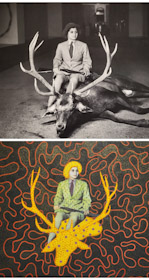
THE MUSEUM OF ART and Photography (‘MAP’) on Kasturba Road is a relatively new addition to Bangalore’s cultural scene. When it opened in February 2023, we were amongst its first visitors. Privately financed by the Poddar family, it is housed in a recently constructed edifice. I prefer the appearance of its interior to that of its exterior.
MAP describes itself as a museum of art and photography. The institution is home to a large collection of photographs created over the many years since the technique was invented. Much photography is in my opinion also art. However, the present exhibition at MAP, which is on until the 24th of March 2024, combines a traditional art form – painting – with photography. The show is called “What the camera didn’t see”.
The British born artist Alexander Gorlizki (born 1967) , who holds a higher degree from the Slade School of Art (at University College London) and now works in NYC, has teamed up with Pink City Studio – a group of miniaturist painters in Jaipur – to present historic photographs in a new light.
The exhibition at MAP consists of several old photographs from the museum’s collection and new reproductions or prints of these vintage images. Gorlizki and his colleagues have taken the reproductions and painted over them in the traditional Mughal miniature style, but leaving faces in the photographs uncovered by paint.
The resulting ‘doctored’ photographs are mostly quite whimsical and witty. The highly imaginative ideas of the artists are skilfully and beautifully superimposed on the reproductions of the old photographs. Thus, the art of the original photographers has been metamorphosed by contemporary painters in Jaipur in collaboration with their curator, Alexander Gorlizki. The results, which are on display at MAP, are both amusing and most pleasing aesthetically . This is an exhibition well worth seeing.
THERE IS A PHOTOGRAPH in the “Times of India” (Mumbai edition: 19th of December 2023). It is a good image showing a group of women wearing saris, and seated on a wall next to the sea close to the Gateway of India. The picture on its own is a pleasure to see, but what enhanced my enjoyment of it was its wonderfully witty title: “SAREE SOIREE AT THE GATEWAY”
YESTERDAY (THE 4th OF OCTOBER 2023), I gave a short talk to introduce my book about the pioneering Victorian photographer Julia Margaret Cameron (1815-1879). Born in Calcutta (Kolkata), she died in Ceylon (Sri Lanka). Between 1860 and 1875, Julia and her family lived at Freshwater Bay (on the Isle of Wight) in a house called Dimbola. It was named after one of Mr Cameron’s coffee plantations (Dimbula) in Ceylon. The house at Freshwater Bay is now a well-curated museum dedicated to Julia and her photographic works. It was in its large tearoom, once the Cameron’s dining room, that I gave my brief talk.
When the Cameron’s bought Dimbola (at Freshwater), which is close to the house where the poet Alfred Lord Tennyson lived, it was a group of two separate cottages. Builders were employed to join the two buildings to create one large residence. A crenelated tower was constructed to join the two formerly separated edifices. From the outside Dimbola appears to be a typical Victorian construction. However, inside a treat awaits the visitor.
Apart from the interesting exhibits in the museum, some of the house’s internal decorative features deserve attention. There is much timberwork that reminds one of India. The Cameron’s designed parts of their house in what is often known as the ‘Indo-Saracenic’ style. This is an often-successful marriage of gothic and Islamic architectural details. Wikipedia expands on this as follows:
“Indo-Saracenic architecture (also known as Indo-Gothic, Mughal-Gothic, Neo-Mughal, in the 19th century often Hindoo style) was a revivalist architectural style mostly used by British architects in India in the later 19th century, especially in public and government buildings in the British Raj, and the palaces of rulers of the princely states. It drew stylistic and decorative elements from native Indo-Islamic architecture, especially Mughal architecture, which the British regarded as the classic Indian style, and, less often, from Hindu temple architecture.”
Apart from the magnificent example of this decorative style in the Durbar Room at Osborne House (on the Isle of Wight), there are few if any examples of its usage in houses in England that can rival that which can be seen at Dimbola. Fortunately, Dimbola was saved from demolition late in the last century. Had it been demolished to make room for holiday flats, this superb example of the use of Indo-Saracenic style, which harmonises well with some of Dimbola’s Arts and Craft style details, would have been lost. During recent restoration of the house, the walls have been covered with reproductions of the Arts and Craft Style wall papers that used to decorate the place back in the 19th century. Some fragments of the original William Morris wallpapers were discovered during the restoration works. In addition, a wall with Victorian paintwork was found, and has been preserved, albeit a little faded, in its original state.
A visit to Freshwater’s Dimbola is worthwhile, not only to imbibe the atmosphere of the home of the charismatic Victorian photographer but also to enjoy excellent coffee and home-made cakes in its delightful café. And while you are there, you can buy a copy of my book “BETWEEN TWO ISLANDS: JULIA MARGARET CAMERON AND HER CIRCLE” in the museum’s small shop. If you are unable to reach Dimbola, you can get a copy from Amazon sites such as:https://www.amazon.co.uk/dp/B0BZFCVLX9/
I HAVE NUMEROUS albums full of photographs that I have taken in India and many places in Europe over the years since about 1993. Before that date, for about 10 years, I used to take pictures on slide film, and have them processed into slides for projecting. I still have most of these, and each one is labelled. For some mysterious reason, when I began putting my photographic prints in albums, I hardly ever labelled them. Consequently, I have a vast collection of – dare I say it – interesting photographic prints taken at locations I can either not remember or can only vaguely recall.
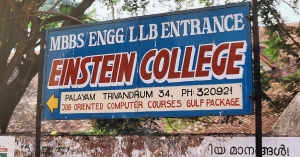
Yesterday (5th August 2023), I chose to look at one of my albums randomly chosen from a box containing several of them. As I flicked through the pictures, I came across one showing an advertisement for an institution called Einstein College, somewhere in India. The location was easy to identify because the college’s address was in the city of Trivandrum (Thiruvananthapuram) in Kerala. Having looked on the Internet, I see that the college still exists.
Two other prints were stored close to the college photograph in the album. So, I guessed they might also have been taken in Trivandrum. One of them shows a building with geometrically decorated walls and numerous small roofs. At first, I thought it might be a temple, but then I wondered whether it was the palace-like museum in Trivandrum, which houses a fine collection of paintings by the Keralan artist Ravi Varma. I checked on the Internet, and discovered my picture shows apart of the museum’s exterior. The third print shows what looks like an enormous terracotta coloured ‘multi-storey’ pigeon coop. It is a cylindrical structure with some helical decorative features. The edifice bears a sign that reads “India Coffee House”. Using that clue, I found that is one of the three branches of the India Coffee House chain in Trivandrum.
Had I labelled these photographs, I would not have needed to do any detective work to identify them and their locations. Sadly, many of my unlabelled prints do not have obvious clues that can help me identify them, and most likely they will remain a mystery. The moral of this story is that it pays to be methodical and systematic occasionally.
THE PHOTOGRAPHER BALDWIN Lee, a Chinese American, was born in Brooklyn (New York) in 1951. He studied photography at MIT and then at Yale. In 1982, he was appointed Professor of Photography at the University of Tennessee, where he established the university’s photography course. As a New Yorker born and bred, he was amazed at the contrast between living conditions in the southern states and where he had come from. He began making tours of the south, photographing members of various African Americans at home, at work, and at play. Over the years he took more than 10000 photos. All of them are in the black and white format. Apart from being fascinating glimpses of the everyday lives of low income ‘black’ Southerners, they are beautifully composed, superbly detailed images – well worth seeing, as we did recently at the David Hill Gallery in London’s Ladbroke Grove.
At his gallery, David Hill discussed Lee’s work with us. What particularly interested me was that Lee used (still uses) an old-fashioned field camera with a lens made before WW1. He chose this old lens because unlike modern lenses its glass has no coating. Also, and this is something I learned long ago, many of these older lenses were hand ground, rather than machine made. This resulted in the lens having a far better resolution than many of the best quality lenses that were available in the 1980s. The type of camera that Lee used to make his splendid photographs was not dissimilar to the kind of camera that early photographers such as Julia Margaret Cameron (1815-1879) used to create images. The lens on the simple camera that Lee used projects an image onto a ground glass screen at the back of the camera. In Victorian times, a prepared glass photographic plate used to be attached to the rear of the camera to capture the image. Lee, working more that 100 years later, captured his images on sheets of 5×4 inch high quality, fast negative monochrome film. Using these, Lee was able to create high resolution photographic images, and his subjects did not have to hold their poses for nearly as long as was the case when Cameron was creating her photographs. Because Lee’s subjects did not have to maintain their poses for more than a few seconds, his images are far clearer than Cameron’s whose subjects often had to try to remain still for many minutes. This meant that in addition to the deliberate artistic manipulations that Cameron made in her dark room, the inevitable slight movements that her subjects made added to the interestingly other-worldly images she created.
The advantage of using an old-fashioned camera and lens, such as Lee employed, was that it was a high-quality pin-hole camera. Unlike modern cameras, these present hardly anything that might alter the light entering the camera and affect the images. I found it fascinating that apart from taking advantage of the improvements in film quality this superb photographer prefers to use a camera that would have been familiar to Julia Margaret Cameron rather than a modern one that made the light entering it take a complicated path from the outside world to the film surface.
You can read more about Cameron in my book, which is available here:
RECENTLY I PUBLISHED a book about the highly innovative Victorian photographer Julia Margaret Cameron (‘JMC’; 1815-1879). She married a British colonial administrator and lived during the heyday of the British Empire. In my book, I tried to portray her sympathetically, but I do hint briefly that she was a ‘child of her times’ as far as he attitudes towards the colonised was concerned. Today, the 11th of July 2023, I paid a visit to London’s National Portrait Gallery (‘NPG’) to see how JMC and her works are currently presented.
JMC was a friend of the painter George Frederic Watts. His portrait of her hangs in the NPG. Another portrait by Watts hanging in the gallery depicts the historian and social commentator Thomas Carlyle (1795-1881). Nearby in another room, you can see Carlyle as portrayed in a photograph taken by JMC. This photograph is close to JMC’s photograph (see photo above) of Edward John Eyre (1815-1901). As British Governor of Jamaica, this gentleman was responsible for the brutal suppression of a revolt against British rule on the island. Under his command, 1000 homes were burned and 439 people were killed. Although this outraged many in Britain, it was defended by people such as Carlyle. Eyre’s portrait, made whilst he was awaiting trial, was, according to the NPG’s label, crafted by JMC to make him seem as if he was vulnerable and not:
“… a ruthless murderer but a sensitive man of duty.”
Another caption, next to a photograph of JMC by an unknown photographer suggests that her:
“… photographs are admired for their beauty and artistry. They also reflect the values of the Victorian era. Her portrait of Governor Eyre indicates her support for him following his violent suppression of the Morant Bay uprising.”
From what I have just written, you might get the impression that someone who composes the labels in the NPG is disapproving of JMC. Much as I feel that JMC’s apparent support for Eyre (and Carlyle) is not to my 21st century taste, one must remember that Cameron was living in a time when any uprising in the colonies would have been regarded as a dangerous – even apocalyptic – threat to the privileged life that she and her contemporaries enjoyed.
In all fairness to the NPG, they also have on public display one of JMC’s photographs of a less controversial sitter – the scientist Sir John Herschel (1792-1871). JMC met him in South Africa whilst she was convalescing from an illness she caught in India where she was living in 1837. It was Herschel who sparked off JMC’s enduring fascination with photography, which really ‘took off’ when she received her first camera in late 1863. She was then living on the Isle of Wight next door to her friend the poet Alfred Lord Tennyson.
JMC did not confine herself to taking photographs of defenders of colonialism. She made wonderful photographs of anyone she could find – both famous and completely unknown. What distinguished her work from that of her contemporaries is that, by experimenting with techniques in the studio and also in the darkroom, she created photographs that were works of art rather than slavish attempts to record real life accurately. Like great portrait painters, her photographic portraits give the viewer a sense of the sitter’s inner personality as well as his or her physical appearance.
It is always satisfying to produce a well-focussed photograph of an insect at work. This bee was busy visiting flowers in Queen Mary’s Rose Garden in London’s Regents Park. This picture was taken with my Samsung S21 mobile telephone.
SOME OF MY REGULAR readers will know that recently I published a short book about the Victorian photographer Julia Margaret Cameron (1815-1879). Her photographic creations, which she produced mainly between 1863 and 1875, differed significantly from those of her contemporaries. At the time that she was taking pictures, most other photographers concentrated on using their cameras to produce slavishly accurate renderings of their subject matter – often portraiture. In contrast, Julia experimented with her focussing, film processing, and other aspects of creating photographic images, to create imaginative artworks, often achieving effects that had been hitherto impossible for painters to produce. She used the camera not to reproduce nature but to produce often expressionistic or impressionistic renderings of her subject matter. For her, the camera was not merely a method of mirroring reality, but a pathway to creating works of art.
Today, the 23rd of May 2023, I visited the Waddington Custot gallery on London’s Cork Street. My wife and I enjoyed viewing an exhibition, “Picture This: Photorealism 1966-1985” – Photorealism was a term created by Louis K Meisel in 1969. The show continues until the 24th of June 2023. At first sight the pictures on display seem to be enlarged, well-focussed photographs. Soon, you will notice that these fabulous pictures of scenes in the USA are not photographs, but paintings created using oil and acrylic paints. One of the gallery staff explained that some of them are not images of actual places, but scenes imagined by the artists. Furthermore, he made an interesting point about them. He remarked that the artists have not painted the scenes as they would have appeared to the naked eye, but instead they have painted them how they would have looked if the images of them had been created using photographic techniques. In addition, by making their paintings of often imagined scenes in this way, the viewer is forced into questioning the assumption that photographs capture the truth.
After seeing the exhibition, it occurred to me that whereas Julia Margaret Cameron was using her camera to create art, the Photorealists were doing quite a different thing – creating artworks that imitate what can be achieved by accurate photography.
ALMOST WITHOUT REALISING IT, it seems that I have developed an interest in 19th century photographers. A visit to the Isle of Wight in 2022 led to me becoming interested in the life and work of the pioneer of artistic photography – Julia Margaret Cameron (1815-1879). She lived at Dimbola Lodge in Freshwater on the Isle of Wight between 1860 and 1875. It was here that she produced most of her highly creative photographs. I have written a book about her: “Between Two Islands: Julia Margaret Cameron and Her Circle”.
Five years after Julia left the Isle of Wight, my great-grandfather Franz Ginsberg travelled from the German Empire to King Williams Town (‘KWT’) in the eastern part of what was then the southern African Cape Colony. Aged 18, he arrived there with his future brother-in-law Jakob Rindl. The two men set up what became a successful commercial photographic studio in the town, which they might have chosen because many of its European inhabitants were German speakers. Although Jakob continued the studio after 1885, Franz diversified his activities by founding soap, match, and candle factories in the town.
I believe that despite becoming a successful industrialist and politician, Franz continued taking photographs as a hobby. Because of his success in KWT, other members of his family came out from Germany to work in the town. Amongst these were Franz’s nieces, Anna and Else Ginsberg. These two intrepid ladies founded a photographic studio in KWT. They were the first ladies to have opened a commercial photography studio in what was to become South Africa. Of interest, amongst each of the generations of Franz and Jakob’s descendants, there have been keen photographers including myself,
In May 2023, when we visited the city of Funchal on the Portuguese island of Madeira, we came across a museum that helped to bring 19th century photography back to life for me. It is the Museu de Fotografia da Madeira in Rua de Carriera. The museum is housed in what had been the premises of the commercial studio founded by Vicente Gomes da Silva (1827-1906) in 1863. The studio remained in business until 1978. In 1982, the Regional Government of Madeira purchased the building – Atelier Vicente – and used it for a museum of photography.
Vicente Gomes da Silva became interested in photography in 1856, and by 1859 he was recorded as an amateur photographer in a local newspaper published in the June of that year. By 1863, he had made photography his business venture, and moved into the Atelier on Rua Carriera in 1865. A year later, he was appointed photographer to the Empress of Austria. His son, also called Vicente, continued the business, and was appointed photographer to the Portuguese royal family in 1903.
The museum is interesting not only because it exhibits the sorts of cameras that must have been used by my ancestors in South Africa and by Julia Margaret Cameron, but also because features that were characteristic of early photographic studios have been maintained and explained. The Atelier was opened before there was electricity on Madeira. The main studio area was arranged so that it was lit by northern light that filtered through skylights and curtains designed to make it a homogenous light source. Part of the studio’s laboratories had skylights that allowed ingress of sunlight that was required at various stages of preparing the photographic plates. At the back of the studio, there are a set of sliding panels, each painted with a different scene that could be used as a background to the people being photographed. The desired scene could be slid out behind the area where the subjects posed for their pictures. In other rooms, there are exhibits illustrating the history of cameras and photographic processes, as well as a fine collection of reproductions of images captured by some of the many photographers – both Portuguese and others – who worked in Madeira. Some of the foreigners who took photographs on the island included British photographers such as Russell Manners Gordon (1829-1906) and Alexander Lamont Henderson (1837-1907).
Although I have no information about the appearances of the photographic studios used by my relatives in 19th century KWT, seeing the museum helped to give me an inkling of how their workplaces must have been. In the case of Julia Margaret Cameron, the places where she created images in her home, Dimbola, were far more makeshift from what I can gather.
Except for Julia Margaret Cameron, all the photographers I have mentioned, and many others working in the nineteenth century, aimed to create visually accurate images of their subjects. Often crystal clear, these pictures are fascinating but usually lifeless. What made Julia Cameron’s photography both unusual and full of life was her experimentation with focussing and processing. She used the camera not as equipment for capturing real life accurately on film but as a tool for creating works of art, in the same way as a painter uses the brush and the sculptor uses chisels. By doing this, she was far in advance of her time; experimentation with photography as a creative art form really only took off in the 20th century. The portraits and other composition that she created on film successfully captured not only their external appearance but also her astute interpretations of her subjects’ personalities.