NOT FAR FROM the Bhadra Fort in Ahmedabad (India), on Bhadra Road, there are two shops that sell tasty, crystallised fruits (my favourites are orange slices with their rinds and pineapple) and a large selection of imported: sweets, biscuits, dates, nuts, and other mainly edible items suitable for gifts. In one of the shops, I noticed that there was a wide range of spice mixes made by a company called Shan. As we have used this excellent brand often at home, I looked at them.
Now, Shan is a Pakistani company (founded in Karachi in 1981), and at present Pakistan and India are not on the best of terms. So, I was interested to note that a Pakistani brand was on sale in a shop in India. When I looked at the packaging, I noticed that they were not labelled ‘Product of Pakistan’, but instead ‘Product of the UAE’. After looking at several boxes, I notice that one or two of the many that were on the shelf had the words ‘Product of Pakistan’. I wondered whether the shop owners had noticed this.
PS: The company has factories in UK, Pakistan, Saudi Arabia, and UAE
IT IS WORTH climbing the steep staircase that leads to the Larkin Durey gallery in Mason’s Yard, near London’s Piccadilly, to view the paintings of Naira Mushtaq, which are on display until 20 March 2026. Ms Mushtaq was born in Lahore, Pakistan. She studied art at Kinnaird College For Women, Pakistan, and then at National College of Arts, also in Pakistan. Then, between 2017 and 2019, she studied at University of the Arts London: Central Saint Martins. Currently, she lives and works in London.
“ … is focused on history, memory and social commentary stemming from a desire to understand grief and memory and how memories are formed as affect … My practice examines these questions by looking at the socio political and cultural context, while in most instances the backdrop of this comparison is my home country of Pakistan – the concerns under question are broader. Which memory is being remembered, who is it being remembered by, and the context of remembrance. How one memory merges with another, multiplicity and singularity of memory, what narratives we tell, what we choose to remember and what is the value of the narratives that we choose to remember if at all, drawing from these areas of interest and I examine memory as a form of impalpable archive while the tangible photograph or sourced materials aid to its inaccuracy, a palimpsest of truths and half-truths.”
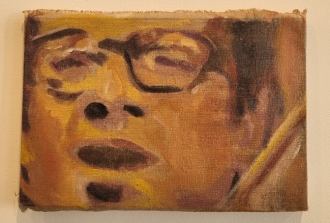
Each of the 20 paintings on display depict faces or parts of faces. In each painting, the artist has used subdued colouring, which maybe suggests a sadness about her subjects, and concern about her often troubled native land. Some pictures depict faces and people in such a way that they look as if they are adapted from stills taken from a film (movie), being watched through darkly tinted spectacles. One portrait shows a distorted face, which reminded me of the way that Francis Bacon used to paint. And another evoked memories of Edvard Munch’s “The Scream”. Otherwise, her style is her own. Despite their melancholic, sometimes menacing subject matter, and dark colours, the paintings are both highly original and pleasing visually.
I am very glad I climbed the steep staircase to view this talented artist’s paintings.
THERE HAVE BEEN events that have caused people to flee from one part of the Indian subcontinent to another, traversing national boundaries. The best known of these events was the Partition of India in 1947. Another event was the Bangladesh War of 1971, which resulted in Bangladesh (formerly East Pakistan) becoming independent, no longer united with West Pakistan.
Until I visited an exhibition, “Shifting Identities”, at Arthshila, an art institution in Ahmedabad, I was unaware of India’s temporary occupation of a part of West Pakistan in 1971. In order to deflect some of West Pakistan’s army from their activities in East Pakistan, India staged an attack on Sindh, a province in West Pakistan. As a result of this, India temporarily annexed a part of Sindh close to Kacchch (Kutch). This annexation was reversed by treaty in 1972. However, this resulted in a flow of refugees from Pakistan into border areas of Gujarat and Rajasthan. Likewise, during the liberation struggle in what was East Pakistan, refugees flowed from what was to become Bangladesh into Indian West Bengal.
Amongst the migrants who sought refuge in India, there were many who were skilled in traditional crafts, notably textile manufacturing.
The splendid exhibition at Arthshila contains beautiful examples of textiles made by refugees both from Sindh and the former East Pakistan. The exhibition also includes documents and photograph albums that belonged to these people who felt it necessary to flee their former homes. The photographs in the albums were those sent to the migrants by family and friends they had left behind.
The show at Arthshila is both attractive and very moving. The exhibits are well labelled with much information. It showcases the skills that were the only riches that the refugees were able to carry with them when forces beyond their control made them feel it was necessary to leave the land that had been their home for innumerable generations.
KRISHEN KHANNA CELEBRATED his one hundredth birthday in July 2025. The NGMA (National Gallery of Modern Art) in Bombay is currently holding a superb exhibition showcasing his paintings. The show is beautifully displayed and the artworks are skilfully illuminated.
Khanna was born in Lyallpur, now in Pakistan. After the Partition of India in 1947, he worked as an official in Grindlays Bank in Bombay. However, before Partition, he had already begun painting. The bank job was just to help keep him and his family going after they had left/fled what became the Pakistani part of Punjab.
Soon after arriving in India, Khanna began associating with members of Bombay’s Progressive Art Group that included notable creators such as FN Souza and MF Hussain. Thereafter, his painting career took off, and his reputation soared.
The exhibition at the NGMA surveys Khanna’s extraordinary range of paintings. Their subject matter ranges from political to historical to religious … and much more. The show, which demonstrates the artist’s amazing versatility and great artistic skill, continues until 12 December 2025, and should not be missed if you are in Bombay.
THE WHITECHAPEL GALLERY in London’s Aldgate area often hosts exhibitions of adventurous art, and has been doing so for many decades. The current show “Hamad Butt: Apprehensions”, which is on until 7 September 2025, displays works by an artist Hamad Butt. He was born in Lahore (Pakistan) in 1962, and died of AIDS in London, aged only 32. His family brought him to London when he was 2 years old. He studied art at London’s Goldsmith College, Morley College, and Central Saint Martins.
Familiars 3
The ground floor of the Whitechapel Gallery contains three enormous sculptures. Together they form an art installation, which the gallery’s website described as follows:
“Familiars 1: Substance Sublimation Unit is a steel ladder made of glass rungs, each filled with an electrical element and crystals of solid iodine. The current ascends the ladder, intermittently heating the rungs, causing the iodine to sublimate into a purple vapour. In Familiars 3: Cradle, named after Newton’s cradle, 18 vacuum-sealed glass spheres are filled with lethal yellow-green chlorine gas. If smashed together, the gas – a respiratory irritant – would be released into the air. In Familiars 2: Hypostasis, three tall, curved metal poles, reminiscent of Islamic arches, contain bromine-filled tubes at the tips.”
Well, they were visually intriguing pieces of conceptual art. What they stand for is almost more important than their physical appearance.
Upstairs, the galleries are hung with paintings, drawings, and prints. There is also another installation that contains a set of lights emitting ultraviolet rays. Visitors are provided with protective goggles when viewing this exhibit called “Transmission”, which is yet another example of conceptual art that you need to read about to make any sense of it.
What saved the exhibition for me was the display of Butt’s paintings and prints. Ranging from almost figurative to abstract, they appealed to me immediately. It is a shame the artist lived for such a short time. That which he produced in a few years, I am sure, would have led to him becoming a noteworthy artist with a fascinating output.
THE CHEMOULD ART Gallery was founded in Bombay (Mumbai) in 1963, and ever since then it has been an important player in India’s modern art world. Until 8 June 2025, it is holding a temporary exhibition at London’s Frieze at number 9 Cork Street. The exhibition is of works by Rashid Rana (born 1968).
Rana was born in Lahore (Pakistan), where he is currently the Dean of the School of Visual Arts and Design at BNU (Lahore). Apart from being an artist, he is also a curator and an educator. He is considered to be one of Pakistan’s most innovative artists.
The exhibition in Cork Street includes 4 intriguing images. Each one consists of a mosaic of thousands of tiny photographic images, each one not much larger than a passport photograph. The photographs are not arranged randomly and subjects in neighbouring photographs seem to be unrelated to each other. They are put together in ways that when seen from a distance, form either large objects or abstract patterns. The resulting images are both fascinating and unusual.
Rana has exhibited in many parts of the world. These places are listed on the gallery’s handout and on the artist’s website. However, as far as I can determine, India is not one of these places. I wondered whether this related to the fact that an Indian gallery is displaying his works not in India but in London.
IN 1904 THE WASIF Manzil, a palace in Murshidabad (West Bengal, India) was restored after an earthquake had badly damaged it in 1897. The palace was built for Sir Sayyid Wasif Ali Mirza Khan Bahadur (1875-1959), who became Nawab of Murshidabad in 1906. It was designed by a Britisher, Mr Vivian, and a Bengali engineer, Surendra Barat. This pleasant building is a mixture of architectural styles and includes some turrets with crenellations.
Visitors can explore the interior of Wasif Manzil, which now contains a museum. The exhibits include several wooden framed mirrors, which were imported from Belgium. There are also some glass topped display cases containing dust covered documents, several of which have obsequious addresses to Queen Victoria and some of her royal successors. By the time that Wasif Ali Mirza was living, Indian royalty was very much at the beck and call of the British rulers of India. It was in their interest to appear to be loyal supporters of the Imperial rulers of India.
On the fifteenth of August 1947, when land was divided between the newly formed Pakistan and independent India (by Cyril Radcliffe who only visited India for the first tine in 1947), Murshidabad was allotted to Pakistan: it became part of East Pakistan (https://en.m.wikipedia.org/wiki/Murshidabad_district).
Thus, the Wasif Manzil stood on Pakistani territory. However, less than two days later, there was a territorial land swap: Murshidabad, then in Pakistan, was exchanged for Khulna, then in India. Thus Murshidabad became part of India and Khulna became part of East Pakistan (now Bangladesh).
Because of a brief period in the second half of August 1947, the Wasif Manzil was in Pakistan for less than two days.
IN AUGUST 1947, India and Pakistan became independent sovereign nations. Following this, vast numbers of Sikhs and Hindus fled from Pakistan to India, and many Muslims fled in the opposite direction. This mass migration of people was accompanied by unbelievably horrific incidents of violence; many lost their lives on both sides of the frontier. Meanwhile, in much of India, daily life for many went on without incident. A yearly publication was published in Bombay from 1919 until 1979. It was called “Times of India Annual”, but between 1942 and 1948, it was called “Indian Annual”. The 1948 issue of “Indian Annual” was published by the Times of India soon after Independence was achieved in 1947. I have a copy of this beautifully illustrated issue. In common with many magazines, it is amply supplied with advertisements. Studying these was interesting because although some of them seem to have recognised that India was independent of both the British Empire and separate from Pakistan, others have not taken this into account.
I imagine that many of the readers of the 1948 Indian Annual were Indians. The magazine includes advertisements for many products used by Indians. Many of these commercials depict faces or people. Some of them show people with faces that look Indian. These include the adverts for Firestone tyres, the India Tea Marketing Expansion Board, Cyclax (beauty products), Tata Steel, Saba Radio Company, and Himanlal Manchand (jewellers). Others feature people with faces that are unmistakably (white) European, for example: Ovaltine, Terra Trading Corporation (modern Czechoslovak glassware), Argoflex (cameras), Rogers (soft drinks), Yardley (beauty products), Rendells products (feminine hygiene), and Virol (a health product). Either these companies that used European faces were recycling pre-existing company advertising material or not sensitive to the fact that India was then independent, or both. Another possibility is that these companies were appealing to the spending abilities of the many European people who were to continue living in India until well into the 1970s. For even after Independence, there were institutions (e.g., some clubs and schools) in India that for many years were only for Europeans, but excluded Indians.
Several of the advertisements in the 1948 publication listed the cities where they had branches. Some of these listings ignored the fact that India and Pakistan were no longer parts of one country. Ovaltine was distributed by a company that had branches in Bombay, Calcutta, Karachi (Pakistan), and Madras. The mechanical and construction engineers Garlic &Co had branches in Indian cities and also in Lahore. And Modern Trading Company listed offices in Bombay, New Delhi, Karachi (Pakistan), Calcutta, and Lahore (Pakistan). Another advertisement, that for the Chicago Telephone & Radio Co. Ltd, includes listings of offices both in India and Pakistan. The Rootes Group, which manufactured cars like the Humber, the Hillman, and the Sunbeam Talbot, list their (I quote) “Distributors in India” as being in towns such as Karachi, Lahore, Peshawar, and Rawalpindi. Had the advertiser not realised that these towns were now no longer in India, but in Pakistan? In all the cases I have mentioned in this paragraph, the advertising agencies seemed to have ignored the fact that what had once been (greater) India was now India and Pakistan. Given what was happening in the way of the misery caused by the partition of India at the time the Annual was published, it seems odd or even insensitive that the advertisements display no sign that the Subcontinent had been divided.
After Independence, Jawaharlal Nehru wanted to move India into what he perceived as the ‘modern era’. Some of the advertisements reflect this both in their design and the products they were promoting. The advert for Godrej shows some tubular household furniture of a design that many would have considered avant-garde in 1948. An advertisement for Indian-made Panama cigarettes is reminiscent of the Italian Futurist style. Likewise, for the Tata steel advertisement. This has futurist features but also veers towards the Soviet Socialist Realism style.
Finally, we come to a very interesting advert, that for the Bombay based Himanlal Manchand jewellers. It depicts Indian warriors on horses and is covered with crests of various rulers of Princely States and that of the Governor of Bombay, which is accompanied by the words:
“By appointment to H.E. Rt. Hon’ble Sir John Colville, Governor of Bombay”
Sir John Colville (1894-1954) was appointed Governor of Bombay in March 1943. He held this post even after India became independent, and was replaced by Raja Maharaj Singh in early January 1948. The jewellers were also by appointment to the princely rulers of Baroda, Jodhpur, Cooch-Behar, Jubbal, Jaipur, Indore, Palanpur, and Dewas. These maharajahs had been the rulers of ‘semi-autonomous’ (vassal) states within the British Empire. All of those listed became incorporated into the India which came into existence in August 1947. Their rulers were recognised officially by the Indian government until 1971. Between 1947 and 1971, these and other rulers of princely states received a privy purse from the Indian government. In 1971, Prime Minister Indira Gandhi put an end to the majority of these payments and de-recognised their titles and put an end to all of their royal privileges. So, in 1948 when Himanlal Manchand placed their full page coloured advertisement in 1948, they were entitled to show off their appointments to Indian royalty. The advertisements alone make the 1948 Indian Annual an interesting curiosity. The articles in the magazine along with many of its fine illustrations make it into a real treasure of great historical interest. While writing this piece, I discovered that the 1949 issue can be read online (https://archive.org/details/dli.venugopal.824/page/n91/mode/2up) . Skimming through this, I noticed that some companies still depicted European faces in their adverts and others included cities in Pakistan in the lists of their branches. This was despite the fact that since October 1947 Pakistan had been fighting a war over Kashmir. This only ended on the 1st of January 1949.
ADEELA SULEMAN IS an artist based in Karachi (Pakistan). She was born in 1970 and educated at the University of Karachi. In an exhibition at London’s Grosvenor Gallery, a collection of her works relating to the life of Tipu Sultan (the ‘Tiger of Mysore’: 1751-1799) is on display until the 25th of October 2024.
For those who are unaware of his fame, Tipu Sultan (son of Hyder Ali) ruled the independent kingdom of Mysore, and defended it against the attacks of the British. However, in the end, he was killed while defending his fortress at Srirangapatna. Before his demise, he was forced to deliver two of his sons to be held by the British as hostages. This happened in 1792. His death 7 years later was due to treachery within his court.
Adeela Suleyman has painted exquisite scenes depicting stages in Tipu’s life. The paintings have been created on vintage ceramic plates (platters). Each plate is surrounded by an elaborately carved timber picture frame. The paintings are rich in detail, and reminded me of Persian or Mughal miniatures. They portray episodes of Tipu’s story colourfully and vividly. Each of the images is a delight to see. What the artist has created is an attractive and respectful memorial to a great man. According to the gallery’s catalogue, the images can be sold separately, but it would be a shame to have this collection dispersed; it would be better to keep it intact.
In addition to the painted plates, there are some sculptural items (relating to Tipu) created by the artist. although they are eye-catching, it is the painted plates that appealed to me much more.
ONE GREY SEPTEMBER afternoon, we stepped into the Almine Rech gallery in London’s Mayfair a few days before its wonderful exhibition of paintings, “Summer of Dragons”, by Hiba Shahbaz was due to end (on the 28th of September 2024). Each of the works on display depict dragons, and some of them also include human figures, often scantily dressed.
Hiba was born in Karachi, Pakistan. She studied Indo-Persian miniature painting in Lahore’s National College of Art. Then, she studied in the USA at the Pratt Institute in Brooklyn (New York City), where she was awarded her Master of Fine Arts degree. She now lives and works in the USA.
The skills she gained while training to paint Indo-Persian miniatures can be seen in the much larger paintings, which are on display at Almine Rech. Some of the paintings evoked memories of Chinese or Japanese art. Others depict dragons in the company of naked women. All the paintings, including some wooden boxes decorated with paintings, were completed in 2024. I suspect that had she remained in Pakistan and produced the same images, those containing the nudes might have been severely frowned upon.
We left the gallery, feeling very satisfied with what we had seen. Although the clouds above us had become more threatening, the visual experience of the exhibition brightened our moods.





 yamey
yamey 