
Why do some birds
Stand on only one leg instead of two?
Please tell me

Why do some birds
Stand on only one leg instead of two?
Please tell me

LONDON’S HOLLAND PARK contains a lovely area – the Kyoto Garden. It is a well-maintained Japanese-style garden. I visit it frequently. Each time, I see something different there.
The garden is planted around a small pond in which there are several rocks, which look like miniature islands. Today, I saw a heron perched on the summit of one of these rocks. It stood still, moving its head slowly every now and then. It showed little interest in the many fish that swim in the pond. My wife noticed that there was a nest containing eggs just below the bird’s feet. The creature stood like a sentinel, guarding its future offspring.
I could see four eggs in the nest – there might have been more. In general, so I learned from Wikipedia, the various species of heron are monogamous and lay between three and five eggs. I have no idea what species I saw in the Kyoto Garden, but it is the first time I have seen a heron’s nest with eggs anywhere in Holland Park.
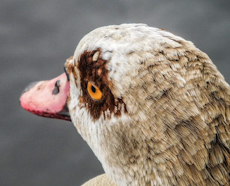
It gives me great pleasure and sense of wellbeing watching the ducks, moorhens, geese, swans, seagulls, and other fowl, swimming in or sitting close to the water bodies on London’s parks.
Sometimes, I have spotted rarer birds such as herons, cormorants, and pelicans (in St James Park). Golders Hill Park in northwest London used to have flamingos. I do not know if they are still there.
I often wonder what the birds think about the humans, who come to visit them, that is if they think at all. Are we good company for them or simply an occasional source of welcome food waste?
It does not matter to me whether or not they think, so long as they are there to give us all a pleasurable experience and that they are enjoying life in an avian kind of way.
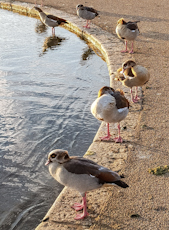
Waiting at waters edge
Watching for tasty snacks
At the park’s Round Pond

Most are white, some black
Flexible necks, but not giraffes
They are swans, of course

WHEN I WAS A SMALL CHILD, I used to be taken to see the small menagerie at Golders Hill Park in Northwest London. In addition to wallabies and deer, there used to be, and it is probably still in existence, an enclosure containing a few flamingos. Until a recent visit to Mandvi in Kutch (Gujarat, India), these were the only flamingos I can recall seeing.
Every year, flamingos migrate to Kutch during the winter months to escape from the cold that affects their summer habitats during winter. They might fly in from central Asia, or from parts of India that get particularly cold in winter.
We were keen to see these flamingos in Kutch. A keen bird watcher, who lives in Baroda, told us that flamingos had been sighted at Modhva beach, a few miles east of Kutch Mandvi.
We drove to Modhva beach, arriving there about twenty minutes before sunset. At first, the only birds we could see were seagulls. There were no flamingos to be seen. We asked some local fishermen about them. They pointed at the sea.
Our driver, who must have keen eyesight, pointed at some specks on the surface of sea, maybe more than one hundred yards from the water’s edge. Using the twenty times optical zoom on my digital camera, I could see quite clearly that the specks were flamingos with pink and white plumage.
I managed to take a few photographs before the sun sunk rapidly below the horizon. I had seen flamingos in the wild for the first time in my life. It was an exciting experience.
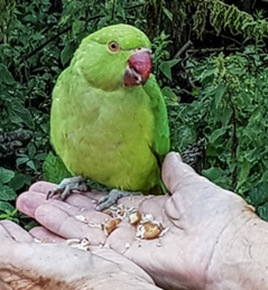
A bird in the hand
Is worth two in a bush
So wise folks say sometimes
Kensington Gardens, London
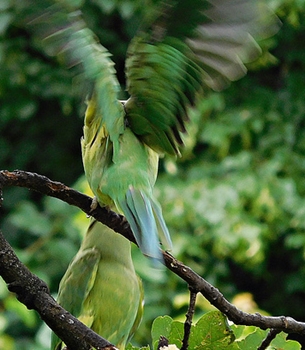
Feathers fluttering.
Our heads below:
Welcome to Kensington Gardens!

Parrot on a fence
gnawing on a nut:
Once wild, now a bit too tame!
 yamey
yamey 