ALTHOUGH WE HAVE visited Ahmedabad (in Gujarat) at least 4 times, we had never been to the hectically busy Manek Chowk area in daylight, which is why we had never noticed a fine building until today, when we went to the area in the morning. After dark, the area is so busy that one needs to be wary of the numerous autorickshaws and motorised two-wheelers whizzing around to notice the architecture of the buildings overlooking the frenetic bazaar.
The building we noticed this morning (1 December 2025) has a facade with some neo-classical detailing and jharokhas (projecting windows). Overall, this edifice, which is far more elegant than its neighbours, has a European appearance. Above its main entrance, you can see the following words (in English): “The Ahmedabad Share and Stock Brokers Association”.
“… Ahmedabad Stock Exchange functioned in a building constructed in 1919 when the Bombay Share and Stock Brokers association collaborated with the Ahmedabad Share and Stock Brokers association. And that heritage style building served as ASE’s home before it was shifted to Kamdhenu complex in 1996.”
The Kamdhenu Complex is in the outskirts of Ahmedabad.
Following the establishment of the Bombay Stock Exchange in 1875, the Ahmedabad Stock Exchange (‘ASE’) was set up in 1894. At that time and until well after Independence, Gujarat was part of the former Bombay Presidency. According to an article in Wikipedia, at first:
“… stock exchange functioned under the framework of the Bombay Securities Contracts Act, 1925. Following the passage of The Securities Contract Regulations Act, 1956 the Gujarat Share & Stock Exchange, Indian Share and General Exchange Association and Bombay Share and Stock Exchange, Share and Stock Brokers Association merged with the Ahmedabad Share and Stock Brokers Association and gave rise to ASE.”
The ASE was India’s second oldest stock exchange, the oldest being in Bombay. As already noted, the ASE functioned in the elegant, now disused edifice we saw at Manek Chowk today.
I BECAME AWARE of William Thomas Beckford (1760-1844) in the late 1960s when my late friend Michael Jacobs and I were fascinated by the gothic revival that began sometime in the 18th century and continued with great vigour into the following century. Although I never read it, the ‘Gothic’ novel “Vathek” was written by Beckford, who also built the (now demolished) gothic revival style Fonthill Abbey. My interest in Beckford gradually drifted into the back of my mind and remained there until we made a visit to Bath (Somerset) in July 2024. Our hosts suggested that we visit the recently restored Beckford’s Tower, which is located on a hill just north of the Lansdown district of Bath. Kindly, they drove us there, and what we saw was interesting.
Beckford had a house in Bath’s Lansdown Crescent. It was set in extensive grounds that spread from his house to where the tower is located. The Italianate neo-classical tower was designed by the Bath-based architect Henry Goodridge (1797-1864), and completed for Beckford in 1827. It is 154 feet high and contains rooms that Beckford used as a library and living rooms. The grounds between Beckford’s house and his tower were landscaped to become Beckford’s Ride. Along the way, there is a manmade grotto, which has been recently restored.
After Beckford’s death, the tower and the land associated with it were donated to Walcot Parish, which used the area to create a burial ground. In 1931, the tower and the rooms at its base were badly damaged by fire. The cemetery was closed in 1992, and the following year, the site – tower and graveyard – were purchased by the Bath Preservation Trust, who have restored it. Between 1997 and 2000, extensive repair work was carried out on the tower. Further work was undertaken between 2022 and early 2024. This rendered the tower structurally sound and safe for it to be opened to the public. Before ascending the elegant spiral (helical, actually) staircase in the tower, the visitor can view exhibits relating to the life of Beckford in the rooms at the base of the tower. Amongst these, I spotted an early edition of “Vathek”, written it the language in which it was first published: French.
The author of “Vathek” was extraordinarily wealthy. His father, Sir William Beckford (1709-1770), was born in Jamaica, and later became Lord Mayor of London (1762-1769). His wealth, and therefore that of his son, was derived from his sugar plantations he owned in Jamaica. These were worked by the hundreds of slaves he owned. Thus, the tower was financed by the labour of these unfortunate unpaid labourers. Unlike several colonial apologists I have met and heard, the website of the restored tower, and many exhibits and notices within the edifice, emphasise the way in which the author of “Vathek” was able to pay for the tower and his extravagant lifestyle. The website (https://beckfordstower.org.uk/about/history/) includes the following:
“Through marriage and ruthless ambition over four generations, the Beckford family became one of the most powerful on the island of Jamaica. Their vast fortune was built on the profits of sugar plantations, directly created through the stolen labour of thousands of enslaved Africans.
William Beckford’s father, Alderman William Beckford, used the family’s wealth to rise through British politics, and was twice Lord Mayor of London. He presented himself as a hero of liberty for British citizens, whilst people on his plantations in Jamaica were trafficked and forced into slavery, stripped of their dignity, traditions, familial ties and African names, and given the surname Beckford.”
The Lord Mayor is commemorated by a statue in London’s Guildhall.
“William Beckford inherited 3,000 enslaved Africans in Jamaica, whom he mercilessly exploited to accumulate great wealth in Britain. His enslaved Africans were victims of routine sexual violence, torture, bodily mutilation and mass murder. Today, we recognise slavery as a crime against humanity and an unresolved stain on the national consciousness. We display this statue not because we wish to honour Beckford, but as a reminder of how we as a nation have sanitised, obscured and neglected racial capitalism and racial terror as foundational narratives of our modern history.”
In 1835, after the British Parliament had abolished slavery, former slave owners were compensated financially as the tower’s website explained:
“In 1835 following the abolition of slavery Beckford [author of ‘Vathek’] received a compensation payment of £12,803 (nearly £1.3 million today), the ‘value’ of the lives of 1,860 enslaved people. He immediately acquired the neighbouring property at 19 Lansdown Crescent and embarked upon a further period of commissioning new furniture and interiors for his home and the Tower.”
Despite its association with slavery, the unusual Beckford’s Tower, is, like the Egyptian pyramids also built with slave labour, interesting both historically and architecturally. It has been beautifully restored. During the latest round of restorative work, care was taken to adapt the tower “… for sustainable energy use …” by installing some solar energy panels on the flat roof of the building that forms the lower part of the tower.
If you are visiting (or living in) Bath, a trip to see and enter Beckford’s Tower is well worth making. And when you are there, do not miss climbing the tower’s dramatic staircase to obtain a superb view of the city of Bath and the countryside beyond it.
WHEN I WAS a teenager, I made excursions – day trips – to places outside London with a small group of friends. Being too young to have driving licences, we had to rely on public transport. One place that we always wanted to get to is on the border between Somerset and Wiltshire: the gardens at Stourhead. Sadly, despite much research we could never find a way to reach it by public transport. It was only many years later (in the second half of the 1990s) that using a car, my wife and I were able to visit this place that my friends and I yearned to reach in the 1960s. We have visited Stourhead several times, both before and after the covid19 pandemic. Our latest trip there was on the 8th of July 2024. Despite it having rained extraordinarily heavily the previous day, the paths in the garden were not waterlogged.
The gardens were laid out between 1741 and 1780. They were designed to resemble the arcadian scenes as portrayed in paintings by Claude Lorraine, Nicolas Poussin, and Gaspar Dughet. The designer and source of inspiration for the gardens was the banker Henry Hoare II (1705–1785), also known as ‘Henry the Magnificent’. The resulting horticultural creation is a remarkably successful realisation of what had inspired him. A central water feature – a lake – is fed by streams and rivulets. Around the lake, are a series of picturesquely positioned neo-classical pavilions, a bridge, a Tudor cottage (which existed before the garden was created), and a man-made grotto.
One of the neo-classical structures, The Pantheon (designed by Henry Flitcroft; 1697-1769 – he died in London’s Hampstead), contains a set of 18th century sculptures of Ancient Greek gods and heroes. It also contains a well-preserved Ancient Roman statue, which one of the Hoares bought while travelling in Rome. It was interesting to enter this building because on all our previous visits, it had been locked closed. Another pavilion, smaller than The Pantheon, contains a huge white vase made from Coade Stone (made from clay, quartz, and flint), which was regarded as a ‘wonder’ material by architects and designers in the 18th century. In those days, it was cheaper than most stones and timber. It is named after the businesswoman Eleanor Coade (1733-1821), who was very successful at marketing this material invented by Daniel Pincot. The reason I write about this is that currently there is a small exhibition about Eleanor Coade in the small neo-Classical pavilion that faces The Pantheon across the lake.
Even if you are unable to enter any of the pavilions surrounding the lake, a visit to Stourhead Gardens is a magical experience. Here, nature has been guided into creating the 18th century ideal of a classical landscape. It brings to life the Latin expression ‘Et in Arcadia Ego’, which means something like ‘even in Arcadia, there am I’.
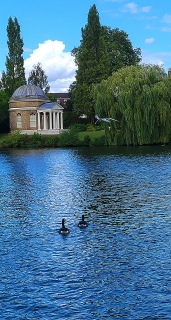
THE GREAT ACTOR David Garrick (1717-1779) was famed for his many performances of plays by Shakespeare and many others. In 1754, he bought Hampton House (now Garrick’s Villa), which overlooks the Thames at Hampton. The following year, he decided to build a garden folly to honour his hero William Shakespeare. This was completed in 1756, and is now known as ‘Garrick’s Temple to Shakespeare.’ Its architect is unknown, but Garrick did employ Robert Adam (1728-1792) to make improvements to Hampton House, and Lancelot ‘Capability’ Brown (1716-1783) to landscape his grounds. Whether either of these two were involved in designing the Temple is not known.
The octagonal Temple is Palladian neo-classical in style and has a portico with columns topped with Ionic capitals. Seen from across the Thames, it looks as if it had been plucked from a romantic painting of a classical Italian landscape by an artist such as Claude Lorrain. The Temple houses a statue of the Bard and a small museum about Garrick. Unfortunately, despite information on the Temple’s website which stated that it would be open, it was locked closed. We were not the only people to have arrived on a Sunday afternoon, expecting it to be open.
I am pleased that I saw the Temple, which I had read about, and plan to attempt to enter it on another occasion.
I HAVE PASSED IT OFTEN while travelling along London’s busy Marylebone Road and admired its elegant neoclassical portico supported by six columns with Corinthian capitals, but never entered it until today (the 7th of September 2022). I am referring to the Church of St Marylebone, consecrated in 1817. One of its predecessors, dedicated to the Blessed Virgin Mary was erected nearby in about 1400. It stood near the River Tyburn. The name Marylebone seems to be derived from a conjunction of the words Mary and ‘burn’ (from Tyburn, which began to have a bad reputation because of the much-used gallows close to its banks). This early church was replaced by another, constructed in 1740. It survived until it was demolished in 1949. Nearby, the present larger church, which we see today, was constructed in 1817 on what was then the New Road, a by-pass on the northern edge London, and is now Marylebone Road. Its grand portico faces north, and the high altar and the colourfully decorated apse are in the south end of the building. The church, a typical example of a Regency interior with first-floor galleries, is tall and spacious.
Charles Dicken’s son was baptised in the church. The poet Robert Browning (1812-1889) married a fellow poet Elizabeth Barrett (1806-1861) in the church in 1846. And the composer John Stainer (1840-1901) composed his oratorio “The Crucifixion” specially for this church in 1887 when he was already a fellow of the Royal Academy of Music, which is across the main road facing the church.
The Methodist Charles Wesley (1707-1788), who lived nearby, asked to be buried in what was the churchyard of the older (1740) church. Where this edifice stood is now a peaceful open space, the Garden of Rest, next to Marylebone Lane (a few feet south of Marylebone Gardens). In this small space, there is a stone obelisk mounted on a pedestal. This commemorates the life of Charles Wesley and several members of his family.
Close to Madame Tussauds and the Royal Academy of Music and neighbouring one of London’s more enjoyable shopping areas – Marylebone High Street, stands the lovely church of St Marylebone, which as I discovered today, merits a visit.
AL SAQI BOOKSHOP in London’s busy Westbourne Grove occupies a shop with a façade that would not look out of place on a palazzo on the Grand Canal in Venice. I have already described the interesting history of this building elsewhere (https://adam-yamey-writes.com/2020/10/18/the-story-of-a-bookshop/).
62-64 Westbourne Grove, London
Further west along the Grove, well past the Planet Organic ‘wholefood’ store and Alounak, one of the Grove’s several Persian restaurants, we reach number 62-64, whose façade is almost as grand as that of Al Saqi. Unlike the latter, this building’s history is harder to ascertain. Currently, it is the premises of Aveda, a beauty salon also called Gina Conway Salon Spa. The ground floor façade of this edifice includes neoclassical columns with Doric capitals, and decorative mouldings, which include the letters ‘C’, ‘L’, and ‘M’. These are intertwined to form a logo. The first floor is fronted by three large arches separated by decorative mouldings and the top storey has three sets of windows set back behind lintels supported by short columns with Doric capitals. The salon, although modernised to suit its current purpose, has its original elaborately decorated moulded plaster ceiling and wall mouldings, some of which depict the heads of angels or putti. Nobody in the salon had any ideas about the history of this attractive building.
A photograph in the London Metropolitan Archives describes number 62 as having an Edwardian façade. When this image was created in 1974, the building was a branch of the Midland Bank, which occupied its western two thirds. The eastern third of the place was the premises of The French Kitchen and Tableware Supply Company. The bank was already in existence at this address in 1940. What was there before the bank occupied the edifice and when exactly it was built, I have not yet discovered. The building is marked as a bank on a detailed map surveyed in 1914, but not on one surveyed in 1893. However, Allan & Mortons Street Directory of 1867 revealed that number 62 was then the address of Dr Barry, who practised homeopathic medicine. Both the 1893 and the 1914 maps mark the building west of number 62-64 on the corner of the Grove and the western arm of Newton Road as being a bank at those times. This building currently houses Farmacy, a vegan eatery.
The logo ‘LCM’ on the old bank stands for ‘London, City, and Midland’, a bank founded in 1898, which was renamed the London Joint City and Midland Bank in 1918 and then the Midland Bank in 1923 (www.gracesguide.co.uk/London_City_and_Midland_Bank). In the absence of any more information and in view of the fact that the architectural historian Pevsner regarded it as “Edwardian”, it might be safe to conclude that the present building at 62-64 Westbourne Grove was originally constructed to house a bank sometime during the reign of Edward VII, i.e., between 1901 and 1910, and certainly before 1918.
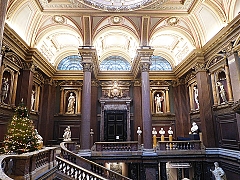
IT IS TEMPTING to concentrate on the wonderful collection of exhibits in Cambridge’s Fitzwilliam Museum, but you should spare some of your attention for the magnificent decoration of some of its galleries. Look up from the paintings and display cases to see superb ceiling decorations above you, and also around you when using the grand staircase. You are sure to be amazed.
The museum is housed in a neo-classical edifice initially designed by George Basevi (1794-1845), architect of London’s Grosvenor Square. After Basevi’s death, the planning of the structure was completed by Charles Robert Cockerell (1788–1863). Built to house the collection bequeathed to the University of Cambridge by Richard FitzWilliam, 7th Viscount FitzWilliam (1745-1816), the present museum was opened to the public in 1848. Over the years since then, the museum has been enlarged by adding newer buildings and now it is home to about 500,000 artefacts.
Years ago, I remember reading (I cannot remember where) a comparison of a museum in the USA designed by Ludwig Mies van der Rohe (1886-1969) with another one, the Guggenheim in Manhattan, designed by Frank Lloyd Wright (1867-1959). Both buildings are elegant but that by Mies Van der Rohe modestly allows the exhibits to grab the viewer’s attention more than the architecture, whereas the unusual design of Wright’s building competes with the artworks for the viewer’s attention. The internal decoration of the older galleries of the Fitzwilliam are sufficiently eye-catching to be able to compete with the exhibits housed in them, but somehow, they hardly do this. That is why I am asking you to take your eyes off the exhibits if only to glance briefly at the décor of the galleries,
THE DOMED IONIC temple in the gardens of Chiswick House in west London was built in the early 18th century. It appears in a painting executed in 1729. This circular building is faced by an obelisk that stands in the centre of a circular pool. Today, we walked past these neoclassical garden features when we noticed a lady in a flowing white dress posing on the steps of the temple. Facing her across the circular pond were cameramen and their assistants, some holding large reflector screens. They were either carrying out a photo-shoot or making a film. Every now and then, a man holding a smoke gun ran past the temple creating an illusion that the temple was bathed in mist. Here is a photo I took whilst this activity was in progress.
WHEN I WAS BORN, my parents wanted to call me ‘Adam’. That was in the early 1950s. However, Mom and Dad were worried that Adam was a relatively unusual first name in those far-off days and that with such a name I might have been teased at school. As it happened, I only attended schools where the pupils were addressed by their surnames and mine, Yamey, was subject of a lot of mirth amongst my schoolmates. In view of their concerns, I was named ‘Robert Adam’, but have always been called ‘Adam’. My father, an economist, was all for calling me ‘Adam Smith Yamey’ in memory of the father of economics Adam Smith (1723-1790), but my mother was not keen giving me this name. The choice of Robert was possibly influenced by the fact that one of my mother’s brothers bore this name. It is also very vaguely possible that the name ‘Robert Adam’ was chosen in memory of another man who was alive during Adam Smith’s lifetime, the architect Robert Adam (1728-1792).
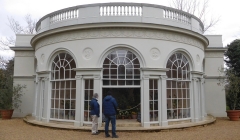
Garden House by Robert Adam at Osterley Park
Maybe because I share his name, I have grown to like and appreciate the architecture and interior decors created by the 18th century Robert Adam. However, you do not need to be called Robert Adam to enjoy Adam’s great works.
Last year, we visited Osterley Park on an extremely rainy day and were able to wander around the interior of Osterley Park House (https://adam-yamey-writes.com/2020/11/02/at-home-with-adam/). Built by the merchant and founder of London’s Royal Exchange Sir Thomas Gresham (c1519-1579) in about 1575, the house was extensively remodelled by the Child family, who owned it, during the 1760s and 1770s. The remodelling was to the detailed designs of Robert Adam.
When we visited the house on that rainy day in November 2020, we omitted walking around the house’s fine semi-formal gardens. On our recent visit, the house was not open because of covid19 prevention measures and there was no rainfall. So, we wandered around the lovely gardens. Like so many other 18th century landscaped gardens attached to stately homes, that at Osterley contains several buildings that were placed to add to the picturesqueness of the grounds.
The Doric Temple of Pan with four columns and four pilasters was built in the 18th century, probably to the design of the Scottish-Swedish architect William Chambers (1723-1796), who was born in the Swedish city of Gothenburg. Between 1740 and 1749, while in the employ of the Swedish East India Company, he made three voyages to China, where he learnt Chinese. A major rival of Robert Adam, he was an exponent of neo-classicism, of which the small Temple of Pan is a fine example. The interior of the temple, which we were unable to see because of covid19 prevention measures, contains, according to Nikolaus Pevsner and Bridget Cherry:
“… mid c18 interior plasterwork with Rococo flourishes and medallions of Colen Campbell and Sir Isaac Newton.”
The front of the temple faces across a lawn towards a structure, 175 yards away, designed by Chambers’ rival Robert Adam: The Garden House.
Adam designed the Garden House in about 1780. It has a semi-circular façade with five large windows within frames topped with semi-circular arches. Pevsner and Cherry describe these windows as “five linked Venetian windows”. A balustrade tops the façade and almost hides the conical roof. Between the windows, there are roundels containing bas-relief depictions of classical scenes with bucolic themes. The building was part of Mrs Child’s Flower Garden. The National Trust, which manages Osterley Park, notes in its website (www.nationaltrust.org.uk/osterley-park-and-house/features/the-garden-house-at-osterley-park-and-house) that the Garden House’s original purpose was:
“… a display house for the collection of rare trees and shrubs that were housed here in the 18thC. The main type of plant that we always grow and display in this building is lemon trees as we have historic evidence that 45 lemon trees were on show here in the 1780’s. We choose to have a mixed display of other interesting specimens alongside the lemons so as to give a greater display and range of interest for our visitors. All of these plants are known to have been either at Osterley in the 18thC or to have been available to grow at that time.”
Although it is not as spectacular as Adam’s interiors of Osterley Park, the Garden House is both delightful and elegant, a fine feature that enhances the appearance of the formal part of the gardens. This and other buildings designed by the same architect makes me proud to have been given, maybe accidentally, the name Robert Adam Yamey.






 yamey
yamey 