From India’s Punjab to London’s Primrose Hill

WHEN THE PUNJAB WAS divided (by the British) between Pakistan and India in 1947, its former capital, Lahore, became a Pakistani city and the Indian part of the region was left without a capital. Jawaharlal Nehru, the first Prime Minister of India, decided that instead of assigning an existing city to become the capital of India’s Punjab a new city should be created. It was to symbolise the birth of modern India. A team of architects led by the Swiss born Le Corbusier began designing the new city, Chandigarh, in the early 1950s. In late 1953, it became the capital of India’s Punjab, which was later further divided into Punjab and Haryana states.

Amongst those who were on the team designing Chandigarh was Le Corbusier’s cousin, the architect Pierre Jeanneret (1896-1967). He designed much of the furniture installed in the buildings created in Chandigarh. According to one source (www.worldofinteriors.com/story/pierre-jeanneret-and-le-corbusier-chandigarh-furniture):

“Pierre Jeanneret, was strongly influenced by local materials and craftsmanship, with a Modernist twist. Due to the vast scale of what needed to be created for an uninhabited city – from Palace of Assembly chairs to university cafeteria tables and and linen baskets – Jeanneret experimented with what was on hand. Iron Sikh Sarbloh bowls became lampshades; mango tree trunks became tables. Readily available materials such as bamboo, teak, rope and wicker were woven into the designs.”

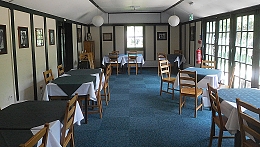
Recently, I saw a couple of examples of this furniture on display at a special exhibition at the Victoria and Albert Museum. Today, the 29th of October 2024, we visited an exhibition, “Syncretic Voices:Art & Design in the South Asian Diaspora”, in a private house near London’s Primrose Hill. What made it special for me is that there were many examples of Jeanneret’s Chandigarh furniture on display. The exhibition ends on the 1st of November 2024.

The house near Primrose Hill is owned by Rajan Bijlani, whose parents came from India to the UK in 1975. Rajan has been collecting Jeanneret’s Indian furniture for some time, and he showed it to us. Of particular interest was a table with a zinc table-top, which was once used in the Punjab University cafeteria in Chandigarh. Many of the other pieces on display were chairs and stools. There was also a shelving unit designed to hold files. Most of the furniture came from various government buildings in Chandigarh. Some of the pieces still have their original inventory numbers painted on them.

The furniture is in several rooms of the house. The walls of these rooms are decorated with attractive  modern artworks by several artists of Indian origin including Vipeksha Gupta, Rana Begum, Soumya Netrabile, Tanya Ling, Harminder Judge, and Lubna Chowdhary. Rajan told us that they were all for sale and he was holding them as consignments from various galleries. He is also selling some of his Jeanneret furniture. Rajan showed us around and was a perfect guide. It was a great pleasure and privilege to have been able to see his beautifully designed home and the fascinating furniture and other artworks displayed within it. If you wish to see this exhibition before it closes, visit: https://www.rajanbijlani.com/about

Modernism in Ghana and India in a museum in London’s South Kensington

UNTIL THE 22nd OF SEPTEMBER 2024, the Victoria and Albert Museum in London’s South Kensington is hosting an exhibition called “Tropical Modernism: Architecture and Independence”. It focuses on two countries: Ghana and India. It was the exhibits relating to India that interested me most, although those connected with Ghana were also intriguing.

The Royal Institute of British Architects describes Modernism as follows:

“Rejecting ornament and embracing minimalism, Modernism became the single most important new style or philosophy of architecture and design of the 20th century. It was associated with an analytical approach to the function of buildings, a strictly rational use of (often new) materials, structural innovation and the elimination of ornament.” (www.architecture.com/explore-architecture/modernism).

Modernism began both in the USA and Europe in the 1920s and 1930s. Its better-known pioneering exponents include Le Corbusier, Mies van der Rohe, Walter Gropius, Maxwell Fry, Louis Kahn, and Eero Saarinen. The Modernist architects, like the abstract painters of the early 20th century, broke with traditional approaches to form and style.

On the 15th of August 1947, India became independent. The country was no longer ruled by foreigners. Jawaharlal Nehru (1889-1964) became India’s first Prime Minister, a position he retained until his death. His vision for India was for it to shake off the shackles of the past (both colonial and traditional) to become a modern state. This extended to architecture in his new India. He invited Modernist architects including Le Corbusier and his cousin Perre Jeanneret to design a new city in the Punjab (following the loss of Lahore to Pakistan): Chandigarh. This is illustrated well in the V&A exhibition. Le Corbusier wanted to create his ideal of a city, which included forbidding street markets and cows to wandering in its streets. His pupil and collaborator, Balkrishna Vithaldas Doshi, who died in 2023, had a more human approach to architecture. Having seen some of his buildings, notably in Ahmedabad and Bangalore, I would say that Doshi developed an architectural opus, which might be loosely described as ‘user-friendly Corbusier’.  Incidentally, Doshi was also taught by Louis Kahn, who worked in India, notably in Ahmedabad.

A label in the exhibition noted that in 1959, at a conference about national identity in Indian architecture, Nehru urged Indian architects not to be “imprisoned by tradition”, but to experiment as had been done at Chandigarh (built between 1951 and 1956). Examples of this experimentation can be seen in the exhibition.

Naturally, since Nehru’s death, there have been many changes in India. I notice new changes every time we make our annual trips to the country. Nehru’s vision of a secular India has been replaced by a different vision in the minds of the leaders of the present Indian Government. Modernism’s internationalist aspects, which attracted Nehru and some of his successors, appear to have lost their appeal currently in India.

Immediately after gaining independence, both Ghana and India favoured Modernism in architecture. The exhibition at the V&A shows that even before independence, architects (almost all European) in Ghana had been building in the Modernist style, but specially adapted to cope with intense heat and high humidity. Ghana’s first leader, Kwame Nkrumah, encouraged the continuation of this architectural style. The exhibition includes a fascinating video about this. In India, Modernism seems to have been introduced post-independence. Both leaders wanted to project visions of a emerging modern countries, freed from the constraints of colonialism. Yet both promoted an architectural style developed largely by architects who came from countries that had had colonies in Asia and Africa.

Before ending this piece, I must not forget to mention two exhibits, which caricatured the great British colonial architect, Edwin Lutyens, who was certainly not a Modernist. One of them is a model of Lutyens’s head which has been combined with a model of one of his imperial buildings in New Delhi. The other, which is painted in the style of a Mughal miniature, shows Lutyens offering a model of the (British) Viceroy’s House (in New Delhi) to the Viceroy.

The exhibition was fascinating. Despite its rather obscure title, a good number of viewers were there during the Monday mid-afternoon when we visited it.

University College London and a jail in Calcutta

I FIRST MET THE GIRL who is now my wife at University College London (‘UC’). The college was founded in 1826 for Jews, atheists, dissenters, and women. Its principal founder was the philosopher Jeremy Bentham (1748-1832). His mummified body is on display in one the college’s buildings.

Several thousand miles from UC in the city of Kolkata is the now disused Alipore Jail, which was opened in 1864. It was within its walls that many Indian freedom fighters were interred and some executed, by the British when they were ruling India.

Today, the prison has been highly restored and is open to the public as a museum. Here one can see the cells in which, for example, Jawaharlal Nehru, Sri Aurobindo, and Subhas Chandra Bose, were incarcerated. Visitors flock to se the gallows and the autopsy room nearby. Other attractions include the prison hospital and the centrally located ‘watch tower’. As one explores the vast prison, the air is filled with patriotic songs, including “Vande Mataram” blasting out of loudspeakers.

The watch tower is an octagonal building with windows on each of its eight sides. It is an example of a panopticon, a structure invented by Jeremy Bentham in 1787. The panopticon was an institutional structure from which guards (of a prison or a mental asylum) could survey the whole institution. It was to be positioned so that the inmates/prisoners could all see the panopticon. It was designed so that the custodians could look out but the inmates could not see within it. Bentham’s idea was that if the inmates could not see into it, they could not know whether or not they were being watched. Thus, as few as one custodian could keep an eye on the whole institution and the inmates had to behave all the time as they had no idea whether they were under observation. I suppose the system worked because panopticons were constructed in many prisons including that at Alipore.

The panopticon was invented long before cctv and traffic speed cameras were even thought of. Like the panopticon, from which inmates could never be sure that they were not being observed, cctv and speed cameras can employ the ‘panopticon effect’. As you can never tell whether a cctv camera or a speed camera is switched on, when you spot one, it is wise not to do anything wrong, which can be detected by these devices.

When we visited the former prison, now museum, we had no idea that it had a connection with our alma mater, UC. Information panels on the walk of the watch tower include a portrait of Jeremy Bentham alongside some information about his invention. A visit to the jail is worthwhile but do not go on a Saturday afternoon when it is swarming with visitors. It is ironic that the sturdy bolts of the doors of the cells have to be kept locked, not to keep the inmates confined but to prevent the eager visitors from entering them.

Americans in Mayfair

MY UNCLE SVEN Rindl (1921-2007) was a structural engineer. He was involved in the construction of the building on the west side of Mayfair’s Grosvenor Square, which used to house the Embassy of the USA until recently. About yards south of the former embassy building, there is another place associated with the USA on South Audley Street. Far older than the embassy, this is the Grosvenor Chapel, whose foundation stone was laid in 1730 by Sir Richard Grosvenor (1689-1732), the local landowner. The relatively simple brick and stone church with some neo-classical features was ready for use in 1731. When the church’s 99-year lease ran out in 1829, it became adopted as a chapel-of-ease (i.e., a chapel or church within a parish, other than the parish church) to St George’s Hanover Square.

Until very recently, I had often passed the Grosvenor Chapel when going to and from The Nehru Centre, also on South Audley Street, but had never entered it. Yesterday (26th of August 2022), the doors were open and, being early for a dance performance at the Nehru Centre, I looked inside the chapel. Its interior is simply decorated. The wide nave lies below a barrel-vaulted, plastered ceiling. Galleries supported by columns with Ionic capitals flank the north and south sides of the nave. The chancel is separated from the nave by a screen with openings, each of which is flanked by pairs of Ionic columns. The screen was added by the architect John Ninian Comper (1864-1960) when he remodelled the church’s interior in 1912.Ionic columns with their bases on the gallery support the ceiling of the nave. Windows (with plain glass panes) on two levels, both below and above the galleries, give the chapel good natural illumination. In summary, the simple, white-painted chapel, though not large, feels spacious. Its simplicity is a complete contrast to its neighbour, the flamboyant Gothic Revival style Catholic Church of the Immaculate Conception.

An inscribed stone plaque on the west front of the chapel records its American connection. The words on it are:

“In this chapel the Armed Forces of the United States of America held Divine Service during the Great War of 1939 to 1945 and gave thanks to God for the Victory of the Allies”

The American General Dwight David Eisenhower (1890-1969) was amongst those who worshipped there during WW2. Many years before that, another person connected with the USA, John Wilkes (1725-1797) was buried in the chapel. Wilkes, a radical journalist and politician, was a supporter of the American rebels during the American War of Independence.

America (i.e., the USA) has been associated with Mayfair since it gained independence from the British. Its first embassy was in a house in Mayfair belonging to John Adams (1735-1786), who was the first US Minister to the Court of St James (between 1785 and 1788). The embassy’s Chancery moved several times before 1938, when it was housed in 1 Grosvenor Square, now the home of the Canadian High Commission. Thus, during WW2, it was close to the Grosvenor Chapel. The embassy building, in whose construction my uncle was involved, was designed by the architect Eero Saarinen (1910-1961), and completed in 1960. By January 2018, the embassy had shifted from Grosvenor Square to a newly constructed edifice across the Thames at Nine Elms.

Returning to the small chapel, a small note about its name. The place’s website (www.grosvenorchapel.org.uk) explained:

“It retains its title of Chapel because it is not, and never has been a parish church, and its continuing existence is entirely dependent upon the generosity of those who worship here regularly or visit from time to time.”

Honey for tea and death in Greece

THE SHORT-LIVED POET Rupert Brooke (1887-1915) lived outside Cambridge in the nearby village of Grantchester, where he rented a room in The Old Vicarage between 1909 and 1912. In May of 1912, Brooke was sitting in the Café des Westens in Berlin and feeling nostalgic about his life in Grantchester. He put pen to paper and composed his poem “The Old Vicarage, Grantchester.” Clearly fed up with Berlin, the poet begins the final verse of his poem with:

“God! I will pack, and take a train,        

And get me to England once again!       

For England’s the one land, I know,      

Where men with Splendid Hearts may go;                

And Cambridgeshire, of all England,     

The shire for Men who Understand;      

And of that district I prefer        

The lovely hamlet Grantchester…”

The final verse ends with the famous lines:

“The lies, and truths, and pain?… oh! yet          

Stands the Church clock at ten to three?     

And is there honey still for tea?”

Inside the old pavilion at the Orchard in Grantchester

Having recently visited Grantchester, I can sympathise with Brooke’s desire to return to this charming village whose meadows run along the bank of the winding River Cam. The parish church of St Mary and St Andrew contains structures created as early as the 12th century, but most of the building dates from the 14th and 15th centuries. The west tower is mainly early 15th century. The clock on it no longer stands at ten to three, but it was stuck at that hour during the era when Brooke was in Grantchester.

The Orchard, which lies across the High Street from the church and between it and the meadows by the river, was planted in 1868. Before moving into the Old Vicarage, Brooke had lodged in a house in The Orchard. In 1897, a group of Cambridge University students asked Mrs Stevenson of Orchard House if they could enjoy tea under the blossoming trees. Thus began The Orchard Tea Gardens, now a popular haunt of students and tourists. Because of the unreliability of the English weather, a wooden pavilion was built at the end of the 19th century. In case of rain, tea drinkers could sit in the pavilion and enjoy their tea without getting soaked. Rupert Brooke was one of those, who used this place often. The Orchard’s website (www.theorchardteagarden.co.uk/history-new/) noted:

In taking tea at the Orchard, you are joining an impressive group of luminaries including Rupert Brooke (poet), Virginia Woolf (author), Maynard Keynes (economist), Bertrand Russell (philosopher), Ludwig Wittgenstein (philosopher), Alan Turing (inventor of the computer), Ernest Rutherford (split the atom), Crick and Watson (discovered DNA), Stephen Hawking (theoretical physicist, cosmologist and author), Jocelyn Bell (discovered the first pulsar) and HRH Prince Charles (future King of England). There is a list of some of the famous people who have visited in a separate page on our web site, and there are photographs of many of them on the walls of the Rupert Brooke Room.”

The Rupert Brooke Room was constructed later than the pavilion. The famous visitors included several noteworthy Indians including Jawaharlal Nehru, Salman Rushdie, and Manmohan Singh. There is a whole host of other well-known personalities who have taken tea at The Orchard including a group of Cambridge students, who achieved notoriety for their involvement in espionage for the Soviet Union: Anthony Blunt, Guy Burgess, John Cairncross, Donald Maclean, and Kim Philby.

As for Brooke’s question “And is there honey still for tea?”, I forgot to ask during our far too brief visit to The Orchard.  Brooke was commissioned into the Royal Naval Volunteer Reserve force at the outbreak of WWI. In early 1915, he set sail with the British Mediterranean Expeditionary Force. In late February, he developed a serious infection following an insect bite and despite the efforts of surgeons on a French hospital ship moored near the Greek island of Skyros, he died. He was buried in an olive grove on the island. In the churchyard of St Mary and St Andrew, Brooke’s name in carved on the church’s simple war memorial.

THOSE MORONS

DR BR AMBEDKAR (1891-1956), lawyer and fighter for the rights of dalits (‘untouchables’), was the chief ‘architect’ of the Constitution of India ( adopted for use in late 1949). Highly educated, he had degrees from the Columbia University (USA) and the London School of Economics (LSE). While at the LSE, Ambedkar lived in a house near Primrose Hill, which has been preserved as a museum dedicated to his memory.

While walking along the splendid seaside promenade in Pondicherry, we visited a monument to Ambedkar, the Ambedkar Manimandapam. Opened in March 2008, this memorial complex contains a large statue of Ambedkar, some highly enlarged photos taken during his lifetime, and a small library.

The captions to the pictures are currently in the local language, Tamil, only. One huge painting depicting Ambedkar handing over a copy of the Constitution dated 1952 to various worthies including Jawaharlal Nehru and Maulana Azad had no caption identifying the persons in it. We asked a young lady, a Bengali, if she could name any of the men. She pointed at Motilal Nehru, Sardar Patel, and Rajagopalachari in addition to those we could identify ourselves. Pointing at Rajagopalachari, she said: “He must be some kind of ‘southie’.” He was a Tamil.

And then, pointing at the portraits, she added: “If it had not been for that bunch of morons, India would have become independent much sooner. They should have left it to Netaji.” She was referring to her fellow Bengali, the late Subhas Chandra Bose, whose Indian National Army gave the British an important jolt towards allowing India to leave the British Empire.

A quartet of heroes

MADAM CAMA ROAD IN BOMBAY is so named to commemorate the Indian pro-independence Mme Bikhaiji Cama, a Parsi who was born in Navsari in 1861 and died in 1936 in Bombay. Some of her bold exploits are described in my book “Ideas, Bombs, and Bullets”.

It is appropriate that in the street named after her, there are statues of two men who played significant roles in India’s fight for independence: Mahatma Gandhi and Jawarharlal Nehru.

A third statue in the street depicts another eminent Parsi born in Navsari: Jamsetji N Tata (1839-1904). Though not a freedom fighter, he did much to revolutionise industry in India. Starting with the cotton business, he soon became known as “the father of Indian Industry”.

In 1903, Tata opened the now famous Taj Mahal Hotel in Bombay. His successors, members of his family, established the variety of industries now known as the Tata Group. His family also fulfilled his ambition of creating educational institutions in his name with Tata money, for example The Indian Institute of Science in Bangalore.

It is appropriate that the statue of Jamsetji Tata is close to that of other important players in India’s independence movement, Gandhi and Nehru, because Tata was a keen supporter of the Swadeshi movement. That is to say, he encouraged the production of products made in India to reduce or prevent the need to import these same products. In Tata’s case, he set up cotton mills to produce cotton fabrics in India, reducing the need to import them from Manchester.

A plaque at the base of Jamsetji’s statue records that it was unveiled in 1912 by George Clarke (1848-1933), Governor of Bombay between 1907 and 1913. Incidentally, in 1907 he considered Vinayak Savarkar, future Hindu nationalist and father of Hindutva, to have been “one of the most dangerous men that India had ever produced” Clarke was a liberal, but became a supporter of fascism later in life (in the 1930s). I wonder what he thought about the Swadeshi movement as he unveiled the statue.

Madam Cama Road is not very long, yet it commemorates four people who in different ways helped India throw off the yoke of the British Empire.

Identity crisis

Don’t worry! This is not really a crisis. I used the word ‘crisis’ in the title to catch your attention! And, now that I have caught your attention, you might as well read on for a fewminutes because what I am about to tell you has a good chance of being interesting for you.

ALDWYCH

Since marrying a lady born in India, I have had many opportunities to visit India House on the western arm of the Aldwych in central London. Built 1928-30 and designed by Herbert Baker (1862-1946) with AT Scott, this stone building is profusely decorated with Ashoka lions and many circular, coloured emblems, which were those of the pre-Independence (and pre-Partition) colonial provinces (e.g. ‘Baluchistan’, ‘United Provinces’, ‘Burma’, ‘Madras’ and ‘North West Frontier’).

ALDWYCH 2

Looking upwards, there are two elaborate crests each topped with heraldic lions and including the mottos: “Honi soit qui mal y pense” and “Dieu et mon droit”. These are ‘souvenirs’ of the era when India was a British colony. Just as in post-Independence India there are still some statues of Queen Victoria standing– there is a fine example in Bangalore, these reminders of British imperialism remain attached to the building.

One side of India House faces India Place, which contains a bust of the Indian leader Jawaharlal Nehru (1889-1964), who became a barrister at the nearby Inner Temple. Close to a side entrance of India House, there is a monument to an off-duty policeman Jim Morrison, who was stabbed in December 1991 whilst chasing a handbag thief, who has never been caught. A ‘Friendship Tree’ was planted nearby in 1994 to commemorate the 125th anniversary of the birth of Mahatma Gandhi.

The India House, which now stands in the Aldwych, was NOT the first ‘India House’ in London. It had a predecessor in the north London suburb of Highgate. The earlier India House  stood at 65 Cromwell Avenue was a Victorian house that still exists. The Victorian house was named India House between 1905 and 1910 when it  was owned by Shyamji Krishnavarma who made it a hostel for Indian students and other Indians staying in London. The north London India House had a brief existence because it was under constant police surveillance on account of the anti-imperialist activities that went on within its walls (including producing anti-British propaganda, anti-British meetings, bomb-making, and arms smuggling).

Many Indian patriots, who wanted to force Britain to give its then colony India freedom, lived and congregated in Highgate’s India House. Their activities and often daring deeds are described in my new book about a lesser-known period in the history of India’s independence struggle: “Ideas, Bombs, and Bullets”.


“IDEAS, BOMBS, and BULLETS”

by Adam Yamey is available from on-line stores including:

Amazon, Bookfinder.com, Bookdepository.com, Kindle, and Lulu.com