Today, an artist would not portray an African this way

THE PAINTER REX WHISTLER (1905-1944) was commissioned by the Tate Gallery (now the Tate Britain) to create a mural for what was its refreshment room in 1926. Assisted by Katharine Ann West (1904–1930), it was completed by 1927. Completely surrounding the room, it illustrates a narrative, which has been summarised on the Tate’s website as follows:

Whistler’s mural depicts an expedition in search of rare food and drink, led by the fictional Duke of Epicurania. A hunting party sets off from the steps of the gallery. It travels across rivers and seas, through pastoral landscapes and wild forests. The group shoots at leopards and deer and meets unicorns and mermaids. They pass islands topped with Italian cities, encounter shipwrecks and ruins, and visit the Great Wall of China. They return home laden with spoils, greeted by a cheering crowd.

Usually, the former refreshment room and its mural are not open to the public. Recently, it has been opened and within it a large screen has been set-up. A short film is projected on the screen. The film has two actors, one playing the part of Rex Whistler, and the other of a fictional academic, Professor Shepherd, who discusses the mural with him. Unfortunately, because the film is being screened, the former dining room has subdued lighting, which makes it difficult to fully appreciate Whistler’s superbly painted mural.

Most of the mural is gloriously picturesque, and cannot give rise to any objections. However, if you look closely, there are two insensitive depictions of Black people that might easily cause offence to viewers today. Whether they would have upset the Tate’s visitors in the late 1920s, I do not know. The bulk of the dialogue in the film being screened in the room relates to the presence of these two frankly racist images on the mural. During the film, the fictional prof gives the artist a hard time about the way he represented the two Black people. I got the impression that the person who wrote the script wished to convey that Whistler could not see why the prof was upset by the way he had painted these figures.

The mural was painted eight years after WW1, during which Black and Asian soldiers fought and sacrificed their lives for the British who had colonised the countries from which they came. Whistler must have known about them. Only seven years before the mural was created, countless numbers of Indians were slaughtered at Jallianwala Bagh in the Punjab. Their massacre was ordered by Reginald Edward Harry Dyer. After he was reprimanded for this, and had returned to England, the public, regarding him as a hero rather than a murderer, raised over £26000 (approximately £1,485,000 today) for him. And that was after 1920. It might be a big leap, but it struck me that if the British public felt justified raising so much for such a man in the 1920s, maybe many of them would have seen nothing to complain about when seeing how Whistler portrayed people of colour in 1927.

A memorial to a lost artist at the Tate Britain art gallery

GRENFELL TOWER IN west London went up in flames on the evening of the 14th of June 2017. At least 72 people died in the conflagration. Amongst those unfortunates was the Gambian-British artistic photographer Khadija Mohammadou Saye (born 1992).

About a month before she died, she met the painter Chris Ofili (born 1968) in Venice (Italy), where they were both exhibiting their works.

In 2023, the Tate commissioned Ofili to create an artwork to decorate the grand north staircase of the Tate Britain. According to the Tate’s website, Ofili:

“…  considered the significance of painting directly onto the walls of a public building and wanted to choose a subject that affected us as a nation. ‘Requiem’ is a dream-like mural, resulting from his poetic reflections.”

Ofili said:

“I wanted to make a work in tribute to Khadija Saye. Remembering the Grenfell Tower fire, I hope that the mural will continue to speak across time to our collective sadness.”

“Requiem” covers three of the staircase’s large walls. On the middle wall, there is a portrait of the artist Khadija Saye. The website explained:

“Artist Khadija Saye is at the centre of an energy force, high up on the middle wall. She represents one of the souls. She holds an andichurai (a Gambian incense pot) to her ear, in a pose taken from her own artwork. This object was precious to Saye, as it belonged to her mother. It symbolises the possibility of transformation through faith, honouring Saye’s dual faith heritage of Christianity and Islam.”

At the top of the stairs, there are panels explaining the wall paintings. There is also one of Ms Saye’s photographs. Called “Andichrai”, it is from a series of photographs she created in the last year of her life. The photograph, which is a visually intriguing artwork, shows a woman holding an andichirai to her ear, It looks as if Ofili used this photograph to create his image of Khadija in his “Requiem” mural.

When I first looked at Ofili’s “Requiem”, I was reminded of the dramatic images of William Blake (1757-1827).  It is a wonderful memorial to an artist, who was cut-off in her prime. I do not know how long “Requiem” will remain on the staircase at the Tate. So, I recommend that you go and see it as soon as possible.

His last mural

THE SERPENTINE NORTH art gallery is housed in what was once a gunpowder store, built in 1805. Next to it, there is an elegantly curvaceous café created by the Iraqi-British architect Zaha Hadid (1950-2016). Until the 3rd of September 2023, there is an interesting exhibit behind the north side of the café. It is an abstract mural of brightly coloured, differently sized rectangles and squares. When I showed a photograph of this to our daughter, she said it reminded her of African printed textiles. Maybe, this should not be surprising suggestions because the mural was painted by a Ghanaian artist, Atta Kwami (1956-2021), who was born in Accra.

The mural, painted on wood, is titled “Dzidzɔ kple amenuveve”, which means ‘Joy and Grace’.

The Serpentine’s website noted:
“Its title is in Ewe, a West African language spoken by Kwami, and its composition characteristically plays with the colour and form improvisations distinctive to Ghanaian architecture and strip-woven textiles found across the African continent, especially kente cloth from the Ewe and Asante people of Ghana.”

Sadly, the mural is the last public work that Atta Kwami created. He died in the UK shortly after he completed it.

Built during a time of war

FROM THE OUTSIDE, the church of St Barnabas in Pitshanger Lane (Ealing) is not particularly attractive. Even though we visited it on a Sunday, it was locked up. However, we were fortunate to meet a lady, who had been in the church hall and happened to have the key to the church with her. Kindly, she unlocked the edifice, and we were able to enter. The church’s interior, unlike its exterior, is wonderful.

The church stands close to Brentham Garden Suburb, which was built largely between 1901 and 1915. I will write about the Suburb at a later date, but now I will concentrate on the church. Although the Suburb was built with a magnificent club house, there had been no plans to include a church. In 1907, a temporary church made from corrugated iron sheets, and dedicated to St Barnabas was constructed at the junction of Pitshanger Lane and Castlebar Park. Eventually, it was too small to accommodate its congregation in an area where plenty of housing was being constructed. For legal reasons, it was not possible to build a larger church on the site. So, in 1911 a larger plot was acquired at the corner of Pitshanger Lane and Denison Road (one of the streets within the Garden Suburb).

Ernest Shearman (1859-1939) was the architect chosen to build the larger St Barnabas Church, which can be seen today. After working in Buenos Aires and later at Sandringham, he moved to Winchester in 1907. From that year onwards, his work was mainly concerned with designing churches. According to a book by Hugh Mather about the centenary of the church of St Barnabas, all of Shearman’s churches:

“…are tall imposing buildings without spires, and their austere, simple architecture was designed so that elaborate furnishings and other adornments could be added subsequently …”

His churches represent “… almost the final flowering of the last phase of the Gothic Revival.”

All except one of his churches demonstrate Shearman’s fascination with rose windows and elaborate tracery. St Barnabas is a fine example of this.

The construction of the church began just before the start of WW1, in June 1914. It was completed in the middle of the war by June 1916, when it was consecrated.

The church has a spacious nave, which has a lovely timber ceiling. Although it was designed to reflect the heritage of the gothic era, the inside of the church feels almost contemporary. There is an enormous organ at the west end of the church. Made in 1851, it was made by the company of William Hill and  originally housed in St Jude’s Church in Southsea. It was moved to St Barnabas in 2011. Some of the pipes on the south side of the central tall organ pipes do not make sounds. They were added to the organ for purely aesthetic reasons. The current organ replaced an older, less reliable instrument, which was removed in 2010.

The apse is adorned by a large painting by James Clark (1857-1943), who was living in Bedford Park not far from the church when he created it. He was one of many artists residing in Bedford Park, which was an ancestor of the Garden Suburb movement. His painting in the apse depicts the three hierarchies of angels praising and adoring the Holy Trinity. It is a magnificent addition to the church.

As we did not want to delay the lady who opened the church for us, we did not have sufficient time to examine its interior in great detail, but it did demonstrate how wrong it was to, to rephrase a well-known saying, to judge a church by its cover.

Painting by hand on a brick wall

IN THE LATE 1930s, my mother studied commercial art at the Michaelis School of Art in Cape Town (South Africa). One of her earliest jobs after leaving college was hand-painting posters advertising cinema films. Many years later, long after her death, I began visiting India and have been making regular visits there since January 1994. During the first few years of making trips to India, I used to notice the huge hand-painted cinema posters both in and out of towns. I recall seeing men perched on precarious looking bamboo scaffolding painting these enormous images. To someone, like myself, used to seeing printed cinema posters, seeing these men in action was an eye-opener.

A few years ago, I was walking near Shepherds Bush in west London when I saw a group of men colouring in details of a poster beneath a railway bridge. Like the painters in India, their scaffolding also looked slightly precarious, given the current preoccupation with health and safety in this country.

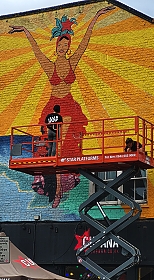
These memories of hand-painted posters came to mind a couple of days ago (late July 2002) while we were walking towards Lower Marsh (near Waterloo Station) from the Young Vic Theatre, where we had just watched a poorly acted, and badly written play called “Chasing Hares”. We spotted two ladies perched on a very adequate scaffolding device painting a colourful mural on a large expanse of brick wall above the Cubana Restaurant. It was good to see that in an age where machine produced images are common (and have largely replaced hand-painted adverts in India), traditional methods are still being used to create large images for attracting the public.

Poetry on a wall

Yesterday, Sunday the 15th of August 2021, we noticed an attractive wall painting not far from the large Liberty shop on Great Marlborough Street. It is the Soho Mural in Noel Street, the eastern continuation of Great Marlborough Street. With the title “Ode to the West Wind”, it was created in 1989 by Louise Vines and The London wall Mural Group, whose telephone number (on the circular blue patch) was then 01 737 4948 (now, the number would begin with 0207 instead of 01).

More information about this mural and its quote from the poet Percy Bysshe Shelley can be found at http://londonmuralpreservationsociety.com/…/ode-west-wind/