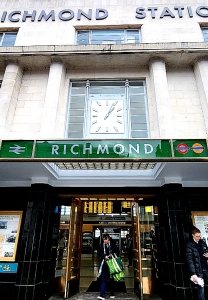
WE VISIT RICHMOND-ON-THAMES often, frequently arriving on the District Line of the London Underground. However, it was only yesterday, 31 October 2025, that, while waiting for a bus outside the station. I noticed that its façade is a fine example of the Art Deco style of Modernist architecture, which achieved popularity between the two world wars.
The first Richmond station was opened in 1846. The current station was built in 1937. It was designed by Southern Railway’s Chief Architect James Robb Scott (1882-1965), whose other works include the offices and Victory Arch at London’s Waterloo Station. Richmond station’s façade is mainly constructed with white Portland stone. The main entrance has black features constructed using polished black granite. Within the recently restored ticket hall, there is a green glass frieze that surrounds the hall and contains the original wording that indicates the various services offered within the large room. The walls of the hall are lined with travertine cladding and the light fittings hanging from the ceiling are of a Modernist design typical of the era during which the station was built.
Until 2025, many of the original Art Deco features of the station, both internal and external, were either hidden by modern panelling or were in poor condition. Between 2023 and 2025, the station was carefully restored to its original splendid state.
After catching our bus, I noticed that we passed several other Art Deco buildings near to the centre of Richmond. These were blocks of flats. Before returning to the station, we stopped outside one of these, Lichfield Court. This was designed in the Streamline Moderne style, a type of Art Deco, by George Bertram Carter (1896-1986), and completed in 1935. Incidentally, Carter had been a pupil in the office of Edwin Lutyens between 1919 and 1922. Apparently, this block of flats incorporates some innovative features, which we did not have time to see.
Until our most recent visit, I never associated Richmond with Art Deco architecture. On our next visit, I hope to wander around, examining the examples of this style in greater detail.
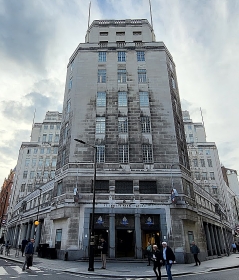
THE ARCHITECT CHARLES HOLDEN (1875-1960) designed many stations for the London Underground, mainly on its Piccadilly Line. Each of these incorporates features of Art Deco and Modernism. Holden designed a new headquarters building for the forerunner of London Underground, the Underground Electric Railways Company of London. Now known as 55 Broadway, it was built between 1927 and 1929. The Underground company occupied it from 1933 until 1984, when it became the headquarters of London Regional Transport, and then its successor Transport For London. After 2020, it has served other purposes. The ground floor is occupied by both a shopping arcade and the entrance hall to St James Park Underground Station.
55 Broadway is a tall, cruciform building surmounted by a clock tower. One of the reasons for this shape was to ensure that all of the offices within the cruciform tower, the bulk of the edifice, were close to the external walls, and therefore had access to plenty of daylight. Apart from looking impressive, the building is not highly decorative, and not as attractive as some of its architect’s designs for Underground stations. Having said this, it is not entirely devoid of decorative features.
What makes 55 Broadway of special interest is the set of sculptures attached to its exterior. Near to ground level, there are two large figurative works by the artist Jacob Epstein (1880-1959), one called “Day” and the other “Night”. When they were unveiled, prudish members of the public objected to them, as is revealed in an article on Wikipedia:
“The modernism and graphic nakedness of these sculptures created public outrage on their unveiling. Newspapers started a campaign to have the statues removed and one company director, Lord Colwyn, offered to pay the cost. Frank Pick, the managing director of the UERL at the time, took overall responsibility and offered his resignation over the scandal. In the end, Epstein agreed to remove 1.5 inches (38 mm) from the penis of the smaller figure on Day and ultimately the furore died down.”
Much higher up the building, between the fifth and sixth floors, there are bas-relief sculptures depicting the four winds. Two are by Eric Gill (1882-1940), one is by Samuel Rabinovitch (Samuel Rabin: 1903-1991), and another by Henry Moore (1898-1986). And within the Underground station, I noticed four mosaic panels. Called “Angels of History”, they were created by London-based Hannah Quinlan and Rosie Hastings, and installed in 2024.
What was once an important headquarters building is still a place where fascinating works of art can be seen, as well as being an example of Modernist architecture in London. Soon after 55 Broadway was completed, Holden designed the University of London’s Senate House. Like 55 Broadway, it impresses the viewer, but lacks the visual appeal of Holden’s Underground stations.
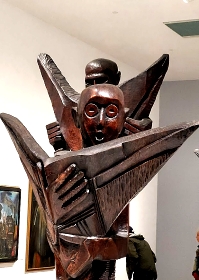
SEVEN CARVED WOODEN figures stand in a line at an exhibition in London’s Tate Modern gallery. Each of them is depicted holding something that looks like an book or a pair of wings. Their faces are all different, as are their expressions and heights. They were carved by the Nigerian artist Ben Enwonwu (1917-1994), and form part of a superb exhibition, “Nigerian Modernism”, which is showing until 10 May 2026.
Ben Enwonwu was born in Nigeria. His father was a traditional sculptor. Ben studied art first at Government College in Ibadan (Nigeria), and then at Government College Umuahia. At both places, he studied art under Kenneth Murray (1902-1972). In 1944, Ben was awarded a scholarship that allowed him to study both at The Slade School of Art in London and at The Ruskin School in Oxford. Also he undertook postgraduate studies in West African anthropology at the University of London. Thereafter, he taught art in Nigeria, where he created many of his sculptures and paintings. Since completing his education, Enwonwu has received international acclaim for his work.
In 1960, Ben proposed making a sculpture to commemorate Queen Elizabeth II’s visit to Nigeria in 1956. It was to be placed in the Nigerian House of Representatives in preparation for Nigeria’s independence in 1960. At the Tate’s exhibition, there is a photograph of Enwonwu working on this sculpture in the studio of his friend, the sculptor William Reid Dick (1878-1961), who was Sculptor in Ordinary for Scotland to Queen Elizabeth. At around this time, Ben received another commission in England.
The British newspaper, the Daily Mirror, commissioned Ben to create 7 sculptures for their headquarters. Carved in ebony, these are the works mentioned above. The diversity of their forms and expressions is supposed to represent the variety of people reading thepaper. According to a label in the exhibition, Enwonwu said:
“I tried … to represent the wings of the Daily Mirror, flying news all over the world.”
The statues were placed in the headquarters public courtyard in Holborn. Currently, they are in the Tate Modern, but after having been lost for several years, they were sold at public auction. They are now owned by Access Holdings PLC, a Nigerian company.
In addition to what I have already described, there are many more works by Enwonwu in the exhibition, both paintings and sculptures. Each one of them is wonderful. His works show the influence of European Modernism, but at the same time they reflect the artist’s African background and his involvement in the traditional art of his homeland. He was sympathetic to the Négritude movement, an anti-colonial cultural and political movement founded by African and Caribbean students in Paris in the 1930s, but was also affected by twentieth century artistic movements in Europe and the USA. It was fascinating to see how the modern art trends of the mid-twentieth century were successfully integrated with the artist’s desire to portray the life and traditions of Africa.
PORTUGAL PLACE IS a narrow winding lane that runs east from Bridge Street in Cambridge. It contains many picturesque old cottages and in the midst of them is one that looks as if its design was inspired by the Bauhaus school of design. Occupying numbers 5 to 7 Portugal Place it is a wonderful example of Modernist architecture.
Until 1933, numbers 5, 6, and 7 Portugal Place were Victorian cottages. In 1933. The three cottages were sold by auction to Samuel Bostock. In 1935, the publisher Gordon Fraser (1911-1981) bought the properties, and demolished them. In their place, he had the present Modernist edifice constructed, which was completed by 1939. The new building served as a bookshop and a gallery for prints.
Today, this well-lit, spacious place is home to an art gallery called ArtSpace 5-7. It hs been in this Modernist building for at least 10 years. Although I have been visiting Cambridge regularly since the 1960s, I had never walked along Portugal Place until May 2025. Finding this elegant Modernist building in that tiny thoroughfare was a wonderful surprise.
UNTIL THE 22nd OF SEPTEMBER 2024, the Victoria and Albert Museum in London’s South Kensington is hosting an exhibition called “Tropical Modernism: Architecture and Independence”. It focuses on two countries: Ghana and India. It was the exhibits relating to India that interested me most, although those connected with Ghana were also intriguing.
The Royal Institute of British Architects describes Modernism as follows:
“Rejecting ornament and embracing minimalism, Modernism became the single most important new style or philosophy of architecture and design of the 20th century. It was associated with an analytical approach to the function of buildings, a strictly rational use of (often new) materials, structural innovation and the elimination of ornament.” (www.architecture.com/explore-architecture/modernism).
Modernism began both in the USA and Europe in the 1920s and 1930s. Its better-known pioneering exponents include Le Corbusier, Mies van der Rohe, Walter Gropius, Maxwell Fry, Louis Kahn, and Eero Saarinen. The Modernist architects, like the abstract painters of the early 20th century, broke with traditional approaches to form and style.
On the 15th of August 1947, India became independent. The country was no longer ruled by foreigners. Jawaharlal Nehru (1889-1964) became India’s first Prime Minister, a position he retained until his death. His vision for India was for it to shake off the shackles of the past (both colonial and traditional) to become a modern state. This extended to architecture in his new India. He invited Modernist architects including Le Corbusier and his cousin Perre Jeanneret to design a new city in the Punjab (following the loss of Lahore to Pakistan): Chandigarh. This is illustrated well in the V&A exhibition. Le Corbusier wanted to create his ideal of a city, which included forbidding street markets and cows to wandering in its streets. His pupil and collaborator, Balkrishna Vithaldas Doshi, who died in 2023, had a more human approach to architecture. Having seen some of his buildings, notably in Ahmedabad and Bangalore, I would say that Doshi developed an architectural opus, which might be loosely described as ‘user-friendly Corbusier’. Incidentally, Doshi was also taught by Louis Kahn, who worked in India, notably in Ahmedabad.
A label in the exhibition noted that in 1959, at a conference about national identity in Indian architecture, Nehru urged Indian architects not to be “imprisoned by tradition”, but to experiment as had been done at Chandigarh (built between 1951 and 1956). Examples of this experimentation can be seen in the exhibition.
Naturally, since Nehru’s death, there have been many changes in India. I notice new changes every time we make our annual trips to the country. Nehru’s vision of a secular India has been replaced by a different vision in the minds of the leaders of the present Indian Government. Modernism’s internationalist aspects, which attracted Nehru and some of his successors, appear to have lost their appeal currently in India.
Immediately after gaining independence, both Ghana and India favoured Modernism in architecture. The exhibition at the V&A shows that even before independence, architects (almost all European) in Ghana had been building in the Modernist style, but specially adapted to cope with intense heat and high humidity. Ghana’s first leader, Kwame Nkrumah, encouraged the continuation of this architectural style. The exhibition includes a fascinating video about this. In India, Modernism seems to have been introduced post-independence. Both leaders wanted to project visions of a emerging modern countries, freed from the constraints of colonialism. Yet both promoted an architectural style developed largely by architects who came from countries that had had colonies in Asia and Africa.
Before ending this piece, I must not forget to mention two exhibits, which caricatured the great British colonial architect, Edwin Lutyens, who was certainly not a Modernist. One of them is a model of Lutyens’s head which has been combined with a model of one of his imperial buildings in New Delhi. The other, which is painted in the style of a Mughal miniature, shows Lutyens offering a model of the (British) Viceroy’s House (in New Delhi) to the Viceroy.
The exhibition was fascinating. Despite its rather obscure title, a good number of viewers were there during the Monday mid-afternoon when we visited it.
MY INTEREST IN the Olympic Games is limited, but that did not stop me from visiting the Fitzwilliam Museum in Cambridge, where an exhibition is being held to celebrate the 1924 Olympic Games, which were held in Paris. The exhibition, “Paris 1924: Sport, Art, and the Body”, is on until the 3rd of November 2024. Paris was, and still is, an appropriate place to hold the Olympic Games, because the man who revived this ancient Greek festival of sport, Pierre de Coubertin (1863–1937), was born in that city. The exhibition is well laid-out. Naturally, it contains many items of interest to enthusiasts of sport and the Olympic Games. Most of these are relevant to the 1924 Paris event, which was held only 10 years after the outbreak of WW1. The exhibits which interested me most were some of the paintings.
The Paris Olympics of 1924 took place during an exciting era of artistic experimentation and development. Most of the paintings in the exhibition provide evidence of that exciting period of twentieth century art. There is a painting of a gymnast by the German artist George Grosz (1893-1959), which was painted in about 1922. Works by the Italian Futurists Gino Severini (1883-1966), Enzo Benedetti (1905-1993), and Umberto Boccioni (1882-1916), figure in the exhibition. There is also a painting by Jack Butler Yeats (1871-1957), who was a brother of the famous poet William Butler Yeats. An interesting almost Cubist painting of a tennis player caught my eye. It was created in 1917 by an artist I had not heard of: André Lhote (1885-1962). A modernistic portrayal of a female runner by Willi Baumeister (1889-1955) fitted in well with the theme of the exhibition.
The paintings and sculptures chosen for the show were what made the exhibition enjoyable for me. One painting amongst them was for me the greatest surprise. It is a huge portrait depicting the face of the tennis player Mrs Helen Wills Moody (1905-1998), created in pastels in 1930. She had won two gold medals in the Olympics of 1924. I do not know why, but it was with great surprise that I saw that the artist was the Mexican Diego Riviera (1886-1957). Although the portrait is large, I had always associated Riviera with huge murals, rather than portraits and smaller paintings, of which, I have recently discovered, he created many.
I am pleased that I have seen the exhibition at the Fitzwilliam not because it has increased my interest in the Olympic Games, but because it included some fine paintings, which I had not seen before.
WHEN TRAVELLING BETWEEN London and Cornwall, we often stop at the small town of Wincanton in Somerset. Close to the A303 trunk road, it has retained a certain ‘ye olde worlde’ charm. Once. It was a town with many coaching inns, but although many of these have closed, the buildings that housed them are still recognizable. One of the buildings on the main street houses a small museum of Wincanton. Amomgst the exhibits, there was a glass case containing old objects connected with the ‘Cow and Gate’ dairy products company. Amongst these, there were two glass feeding bottles used for feeding milk to babies.
The Cow and Gate company began life in 1882 as the ‘West Surrey Central Dairy Company’. In 1904, Dr Killick Millard developed a powdered milk, which in 1908 was marketed by the company as ‘Cow & Gate Pure English Dried Milk’. In 1929, the West Surrey Central Dairy Company Limited was renamed ‘Cow and Gate’. None of this information was available in the form of a label or information notice next to the Cow and Gate exhibit. So, I asked the lady looking after the museum why there were Cow and Gate exhibits in the museum. She explained that until (before [?]) the 1990s. Cow and Gate had a large factory in Wincanton, which had its own railway line, a branch of the now closed (in 1966) Somerset and Dorset Joint Railway.
We strolled downhill to the south of the old part of the town, and came across the former Cow and Gate factory. With three storeys, a centrally located clock tower. and windows fitted with Crittall frames, it is a fine example of interwar Modernist industrial architecture. Today, many of the windowpanes are broken and the building has a deserted, neglected appearance. Boards with the name of Myakka – a design company – are attached, but there was no sign of life within the building and the yard surrounding it. We could not enter the old factory, but Myakka have posted pictures of its interior on it company website (https://blog.myakka.co.uk/home/myakka-architecture/). Although nobody seems to remember who designed it, it is a well-known landmark in Wincanton. Everyone we asked directions to it, knew it well.
Over the years, Cow and Gate expanded, and needed a fleet of vehicles to transport its products all over the country. This led to them founding a logistics company, ‘Wincanton’, which is still thriving more than 70 years after it was formed. In 1958, Cow and Gate merged with United Dairies to become ‘Unigate’, which was taken over by Irish foods firm Greencore in 2011. As for the derelict Modernist factory in Wincanton, nobody seems to know what will become of it.
AT GROUND LEVEL, London’s Oxford Street is lined with numerous retail outlets, many of which can be seen on shopping streets and in malls all over England. Raise your eyes above ground level, and you will notice that the shops are beneath buildings designed in a bewilderingly wide range of styles. Today (the 22nd of May 2024), I spotted a Modernist style building, number 219 Oxford Street, which is on the corner of Oxford Street and Hill Street. Its ground floor has become part of a Zara shop’s showroom.
The upper floors of the five-storeyed number 219 retain their 20th century Modernist style architectural features, and its Oxford Street facade is adorned with three bas-relief plaques. One of them, at the fourth-floor level bears the date ‘1951’ and a logo. Despite its date, the building has remarkably clean lines and an elegant simplicity. There is much information on the Internet about this edifice, but even though I have walked past it many times, it was only today that it caught my attention.
“… was designed by Ronald Ward and Partners in 1950 for the landlord Jack Salmon, who took the second-floor suite for himself. The scheme was revised in February 1951, but was not built until after August 1951 (explaining the plaques celebrating the Festival of Britain – an event which was held in the summer of that year), and appears not to have been completed until 1952, as evidenced by the dated tile near the door to the upper floors. Despite the delay in its construction the building was among the very earliest post-war commercial buildings to be put up in the capital.”
Another website (https://lookup.london/219-oxford-street-history/) provided some detail about what is depicted on the plaques. The plaque with the date 1951 also contains the (1951) Festival of Britain logo. Above this, the top plaque shows the Royal Festival Hall and next to it the Shot Tower from Lambeth Lead Works, which stood close to the Hall, but was demolished in 1962 to make way for the Queen Elizabeth Hall. The lowest plaque depicts the Skylon, which was also part of the Festival of Britain complex of structures (on the South Bank), but no longer exists.
Number 219 was threatened with demolition in 2004, but luckily for us it escaped this fate, and is now protected as a Grade II Listed Building.
OUR FRIEND MIKAEL is an accomplished creative quilter (maker of quilts). Some of her artistic quilting is on display alongside works by other quilters in London’s Swiss Cottage Library until the 26th of July 2023. I must admit that when I learned that we were going to see an exhibition of quilts, my heart sank a bit. However, I am glad we went. I had no idea how creative and imaginative quilt makers can be. Well displayed in Swiss Cottage Library, there is a collection of extremely artistic contemporary quilts, which are well worth seeing. Far from simply being scraps of material stitched together, the quilters have used their imaginations and skills to create artworks which are not only beautiful but superbly innovative.
Until I entered Swiss Cottage Library today, I cannot recall having been inside it since about 1965 when I left the nearby Hall School, aged 13. I have passed its distinctive exterior often but never bothered to go inside. I was at the school between 1960 and 1965, and I remember visiting the then new library after it opened in November 1964. It was designed in the Modernist style by Basil Spence (1907-1976), who was born in Bombay. He based his library on the design of several that he had visited in Scandinavia. All that I can recall of the new library was that its shelves contained a far better range of books than our local library in Golders Green. Being a pupil in the area, I was able to borrow books from the Swiss Cottage Library, which I used to visit often because I found it to be so wonderful.
Although I can remember the superb collection of books that existed in 1964-1965, I could not recall the appearance of the library’s interior. It was only today when we visited the quilting show that I appreciated what a superb job had been done by Basil Spence and his team. Even though it was designed in the early 1960s, the style of the well-lit spacious interior has not dated at all. The interior of the library is far more intelligently conceived than most new British buildings created in the last few years. It is uplifting to wander around the various peaceful spaces within the library. If it were nearer home, it would be a place where I would want to go regularly to read and write.
I am grateful that Mikael invited us to see the quilting exhibition not only because it contained aesthetically pleasing works of art but also because I got to go back inside the library. Although I was not particularly interested in architecture when I was 11, my fascination with it began to grow a few years later. There was even a brief period in my life when I toyed with the idea of becoming an architect. Even though I did not pursue that profession, my love of good architecture – both modern and historical – has persisted. I believe that now, in my retirement, my appreciation of great buildings (such as Swiss Cottage Library) is greater than it has ever been. Even if you miss the quilting exhibition, it is worth making a detour to see Spence’s wonderful creation – both inside and outside.
BETWEEN HAMPSTEAD AND Belsize Park, there is a narrow footpath running north from Tasker Road. One side of it is lined with a terrace of low buildings known as Mall Studios. Built in 1872 by Thomas Battersby, they were designed as artists’ studios. Each of them contained small waiting rooms; costume rooms; and a lobby. Each studio had three skylights and large north facing windows to capture the kind of light favoured by many artists. Following the advice of the artist Walter Sickert, who had lived there, the artist John Cecil Stephenson (1889-1965) settled into number 6, Mall Studios in March 1919. It was to remain his home until he died. In 1927, Barbara Hepworth became his neighbour in number 7, and at around that time, the influential art critic and writer Herbert Read moved into number 3. Nearby, Parkhill Road became home (for various lengths of time) to other artists including Henry Moore, Ben Nicholson, Naum Gabo, Piet Mondrian, Hans Erni, and other artists who have since become famous.
By John Cecil Stephenson
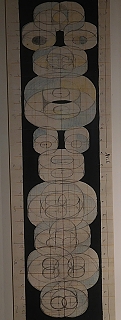
Whether it was the proximity of his artistic neighbours, who were pioneers of 20th century modernist art, or something else in his artistic evolution, Stephenson departed from his previous ‘straightforward’ portraiture and landscape painting and created works characteristic of what is now known as the ‘Modernist’ style. Although some of his works created after the late 1920s are to some extent figurative, most of his output was mainly abstract and constructivist. During WW1, Stephenson left London’s Slade School of Art temporarily to work in munition factories in Bishop Auckland (County Durham), the town where he was born. His experiences of working with industrial machinery and observing the efficiency and speed of the mechanised production processes is reflected in some of the paintings he produced later.
Stephenson, son of a grocer, was less well known than his neighbours. He produced art that bears favourable comparison to the works produced by them. Until the 18th of September 2022, there is a wonderful small exhibition of his works in a gallery within Hampstead’s charming Burgh House. The catalogue, edited by Sacha Llewellyn, Paul Liss, and George Richards, not only contains a fine collection of photographs of the exhibits but also provides a superb introduction – better than others I have seen – to the story of the pioneering role of Hampstead in the evolution of modern art in England. Burgh House, which contains several rooms comprising a museum of the history of Hampstead, also hosts excellent exhibitions such as the current survey of Stephenson’s works. Its well illuminated Peggy Jay Gallery provides a space for contemporary artists, many of them local, to display their works. Beneath the two storeys of cultural experiences, the basement of Burgh House is home to a pleasant café where anything from a cup of coffee to a wholesome meal can be obtained. And amongst the interesting range of books in the small bookshop, you can find copies of my book “Beneath a Wide Sky: Hampstead and its Environs” on sale (if they have run out, tell them to ask me for more, and then get your copy from Amazon).



 yamey
yamey 