Two in one at South Kensington

SOUTH KENSINGTON STATION has two street entrances connected by an arcade with a glazed roof. Its subsurface ticket office and foyer gives access to three of London’s Underground Lines: Circle, District, and Piccadilly. But this has not always been the case. People standing outside the southern entrance to the arcade will notice that to its right there is a building faced with the blood red glazed terracotta tiles typical of many London Underground stations. Above the façade are the words “South Kensington Station”, but there is no public entrance to this building.

The arcade used to be the entrance to the station at which passengers could embark and disembark from trains operating on the District and Circle lines, which were part of the Metropolitan Railway. This station was opened in 1868. In 1906, a station on the Great Northern, Piccadilly and Brompton Railway (now the Piccadilly line) was opened at South Kensington. Its platforms are far deeper beneath the surface than those of the District and Circle lines. Lifts inside the building with the red façade carried passengers to and from the Piccadilly line platforms. This building was then the entrance to the Piccadilly Line station, which was separate from that (with the arcade) which led to the shallower subsurface Circle and District platforms.

In the early years of the 1970s, the lifts to the Piccadilly Line were replaced by escalators. Access to these was made from the concourse that serves the District and Circle line platforms, and then the entrance via the building with the blood red façade was taken out of use. So, what had been two stations became one.

You can read much more about South Kensington in my book “Beyond Marylebone and Mayfair: Exploring West London” (see: https://www.amazon.co.uk/BEYOND-MARYLEBONE-MAYFAIR-EXPLORING-LONDON/dp/B0B7CR679W/)
A mansion in Marylebone

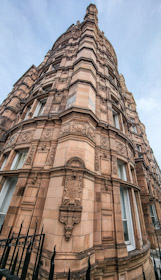
A HIGHLY DECORATIVE BLOCK of flats stands on the southeast corner of the intersection of Wimpole and New Cavendish Streets. Bearing the date 1892, one of its large bricks was laid by Mary Mason Lithgow.

Mary was the mother of the person who commissioned the building, the lawyer and property developer Samuel Lithgow (1860-1937). Samuel was born in Marylebone and after qualifying as a solicitor, he practised at 42 Wimpole Street. Politically inclined, he represented the West St Pancras ward of the London County Council between 1910 and 1913. A philanthropist, he founded the Stanhope Institute for Men in 1891. In addition, he was a governor of the North West London Polytechnic (founded 1896).

Wimpole House was designed by Charles Worley (1853-1906) in the so-called Belgian Renaissance Style. It is a very florid addition to an area filled with buildings displaying a wide variety of decorative flourishes

A chance meeting in north London

During the late 1990s, our then young daughter had a baby-sitter called Bridie. Although Bridie was already well into her eighties when we first met her, she was a remarkably sprightly lady. Born in a rural part of the west of Ireland, she came to England in her late teens. On arrival in England, she and her husband were cared for by the Salvation Army in exchange for taking a pledge never to drink alcohol again. Bridie never reneged on this promise.  To earn a living in London, where she settled, she became a domestic servant. Hearing that I had been brought up in northwest London’s Golders Green, she told me the following story.

War memorial clocktower in Golders Green

Sometime before WW2, Bridie was employed as a maid in a Jewish household in Golders Green. She looked after the family’s children and carried out many household duties. Even though it was not a particularly wealthy family, Bridie recalled that she wore uniforms when on duty. There was one outfit that she wore in daytime and in the evening, she changed into another. As she did with our daughter, Bridie became fond of the family’s two young sons.

Many years later, when Bridie had become a grandmother and our daughter’s baby-sitter, she used to spend her spare time travelling around London by bus (making use of her old age free bus pass).  One day, she was waiting for a bus at the stop closest to Golders Green’s Sainsbury’s (on the site of the Ionic cinema), when a well-dressed late middle-aged man in the queue said to her:

“Goodness! Is it you, Bridie? We have not seen each other for so many years.”

After a moment, Bridie realised that she was being addressed by one of the two boys, whom she had looked after in the house in Golders Green before the War. Just then, a bus arrived, and as her former charge was about to embark, he shouted:

“This is my bus. Are you taking it, Bridie?”

Bridie misheard what he had said, and by the time she realised, the bus had pulled away, leaving her at the bus stop. She told me that if she had known he was taking that bus, she would have joined him. As far as I know, she has never seen him again.

A slave owner in central London

THE TALL GREY GRANITE drinking fountain that stands on the southeast corner of London’s Lincoln’s Inn Fields is no longer in use. The inscription carved on its base reads:

“In memory of Philip Twells. Barrister at law of Lincolns Inn and sometime Member of Parliament for the City of London. 8 May A.D. 1880”

Born the son of a banker John Twells (1776-1866), Philip (1808-1880) attended Oxford University and then was called to the bar at Lincoln’s Inn in 1834. His father was a partner in the private bank of Spooner Attwood & Co. In 1863, that bank was taken over by Barclay, Bevan & Tritton & Co, a precursor of the modern Barclays Bank. It was then that Philip became a partner in the enlarged banking concern. He was MP for the City of London from 1874 to 1880.

A website (www.layersoflondon.org/map/records/philip-twells-mp-banker-and-slave-owner-of-stoke-newington-church-street) recorded that Philip Twells owned 252 slaves in Jamaica, and added:

“The Slavery Abolition Act of 1833 had made the ownership of slaves illegal within the British Empire although servitude was replaced by ‘apprenticeship’ for at least five years. The 1837 Slave Compensation Act provided compensation to owners for the loss of their business assets.”

Another website (http://wwwdepts-live.ucl.ac.uk/lbs/person/view/46210) noted that Philip Twells was:

“Awarded part of the compensation for the Islington estate in St Mary Jamaica with his brother Rev. John Twells …”

The slave-owner compensation awarded to Philip was £4207, which is worth well in excess of £300,000 in today’s money. On his death, Pholip left a substantial fortune to his wife.

The fountain commemorating Twells in Lincoln’s Inn Fields was a gift of his widow, and was erected in 1882. Sadly, this memorial to a former owner of slaves can no longer refresh the passer-by. However, during weekdays, food and drinks can be obtained at a café in the middle of Lincolns Inn Fields. And while you are in the area, do not miss seeing the magnificent Sir John Soane’s Museum on the north side of the Fields.

Art Deco in Victoria

I HAVE WALKED past London’s Victoria Coach Station many times without looking at it particularly carefully. Yesterday, the 28th of September 2022, I was early for a meeting at the Embassy of Albania, which is not far from Victoria Station. So, I walked slowly, stopping to look at the Coach Station. I had never noticed before that it is a fine example of Art Deco architecture.

The Coach Station, which opened for use in March 1932, was designed by Wallis, Gilbert, and Partners.

I suppose that my interest in Art Deco buildings was initiated by visits to Bombay (Mumbai), where there are many splendid examples of this style of architecture. Gradually, I am discovering that London also has a rich collection of Art Deco buildings. The Coach Station is a fine and well-maintained example.

A Persian carpet and a Socialist

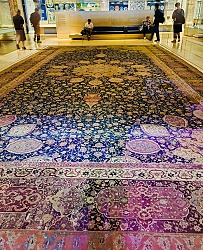
The Victoria and Albert Museum houses a huge, antique carpet from Ardibil (in Persia).It was made in about AD 1539, and is one of the oldest accurately dated carpets.

You will need to read my book “Beyond Marylebone and Mayfair: Exploring West London” to discover the link between this carpet and a Socialist activist, who lived in Hammersmith.

Buy your copy of my book at Lutyens & Rubinstein (Kensington Park Road) OR from Amazon (https://www.amazon.co.uk/BEYOND-MARYLEBONE…/dp/B0B7CR679W/)

Greek in north London’s Golders Green

IN THE EARLY 1960s, the first proper self-service supermarket opened on the corner of Golders Green Road and a small service road called Broadwalk Lane. I cannot recall the name of this store, but it was soon taken over by the Macfisheries company. Later, it became a supermarket where many imported foods, especially products from Israel, were sold. Now, it has become a Tesco Express.

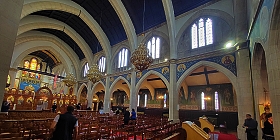
Facing the supermarket (across Golders Green Road) is a gothic revival style church. It has been used by a Greek Orthodox (Christian) congregation since 1968. Now, the The Greek Orthodox Cathedral of the Holy Cross & St. Michael, it was constructed as the Church of England’s ‘St Michael’s Church’ in 1914 to the design of JT Lee. A clock tower, surmounted by a delicate cupola supported by thin columns, was added to the church in 1960. On one of its walls, there is a bas-relief of St Michael with one foot on a serpent. On the northeast corner of the church, there is a plaque listing people who died in WW1. Near this, there is a crucifix standing in the garden next to the church. Its design, typical of C of E crucifixes, predates the arrival of the Greek congregation.

Although the interior of the church maintains some of its original Cof E fittings, such as stained-glass windows, the font designed in a mock mediaeval style, and some wall mounted memorials in English, a great deal of effort has been made to create the atmosphere of a Greek Orthodox place of worship. The walls of the side aisles have been painted with religious scenes. There is a decorated iconostasis and several framed icons. Elaborate chandeliers hang above the nave. Despite the additions to convert the church for Greek Orthodox worship, the original gothic revival features of the building’s interior are evident, but harmonise well with the later additions.

A pretty perambulation

LONDON’S KENSINGTON GARDENS is bounded to the north by Bayswater Road and to the south by Kensington Gore (overlooked by the Royal Albert Hall and the Albert Memorial), which becomes Kensington Road.  Within the park and running almost parallel with its southern boundary is the South Flower Walk (also known as The Flower Walk). The Northern Flower Walk, which runs near and parallel to Bayswater Road was once used by royalty. According to a document published on the Royal Parks website, this was:

“… a delicious and appealing place to stroll for the monarch on the way to … the site of the Bayswater ‘Breakfasting House’…”

The breakfasting house no longer exists. I am not sure whether the South Flower Walk can boast of such an illustrious past. However, when it is in full bloom, it outdoes its northern counterpart in colourfulness and variety of its flora.

Although the whole of Kensington Gardens makes for a pleasant place to stroll, a walk along the South Flower Walk provides and exceedingly pretty perambulation.

Macchiavelli and spicy masala meat dishes

RAAVI KEBAB BEGAN serving Pakistani and Punjabi food in the mid-1970s. It is located on Drummond Street, close to London’s Euston Station. This unpretentious eatery with barely any internal decoration except some mirrors with Koranic verses engraved on them in Urdu script, is next door to the Diwana Bhel Poori House. It was at the latter that we used to enjoy Indian vegetarian dishes when we were undergraduate students at nearby University College London during the first years of the 1970s. In those days, Raavi, named after the river that flows through the now Pakistani city of Lahore, did not yet exist. It was only in the early 1990s that a friend visiting from Bombay suggested that we ate with him at Raavi’s. When the grilled kebabs arrived at our table, it was love at first bite. We have been returning to Raavi’s ever since.

Raavi’s with Diwana in the backround

Yesterday (1st of September 2022), we made yet another visit to Raavi’s. As we sat down, I noticed a thick wad of photocopies held together with a bulldog clip. They were resting on top of a neatly folded shawl. Out of curiosity, I looked at the top sheet, which was a page copied from a book with annotations added in red ink. I looked more carefully and noticed that the printed text was in Italian. The page was headed “<De ingratitudine> Joanni Folci Niccolaus Maclavellus”. It is a chapter (‘The ingratitude of Joanni Folci’) from a book by Niccolò Machiavelli (aka Maclavellus), who lived from 1469 to 1527. The rest of the text on the photocopied page appeared to be a learned commentary on Macchiavelli’s chapter.

I do not know why, but I felt that Raavi’s was the last place I would expect to find scholarly papers lying about so casually. I associate the place, as do most of its many customers, with grilled meat and spicy masalas. I asked the waiter about the papers. He shrugged his shoulders and said that someone must have left them behind after eating, and that he had no idea whether anyone would return to retrieve them.