Pictures at an exhibition

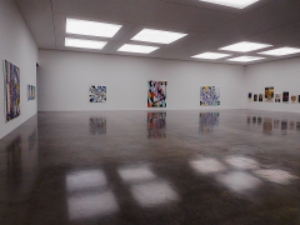
Overlooked by The Shard,the White Cube Gallery in Bermondsey Street, near to London Bridge Station, provides wonderful expanses of well-lit exhibition space. One can explore works of contemporary art in an uncluttered, airy environment. This is so much better than many traditional exhibition spaces such as in 19th century galleries, or even in the relatively recently constructed Tate Modern. Visiting the White Cube in Bermondsey is a worthwhile experience not only because of its wonderful spaciousness but also because it often displays exciting works of art. And when you have had your fill of art, there are plenty of places in Bermondsey Street where you can find a wide variety of food and drink.

Here is some information about the building from https://www.dezeen.com/2011/10/14/white-cube-bermondsey-by-casper-mueller-kneer/:

144–152 Bermondsey Street is an existing warehouse and office building, set back from Bermondsey Street via an entrance yard. The building dates from the 1970s and has a modernist industrial appearance, with long horizontal window bands and a simple cubic shape. The outer walls of the building are constructed from dark brown engineering brick, with a concrete and steel framed internal structure…

The new gallery spaces were inserted as self-supporting freestanding volumes, barely touching the envelope of the existing building.The powerfloated concrete floors can take loadings up to 100 KN/m2. Walls and ceilings are constructed as steel cages allowing art to be installed at almost any point within the space. Structural exclusion zones allow the punching through of walls at selected locations to allow entry points into the exhibition spaces to be coordinated with the ever-changing displays.”
The first of its kind in England

THE ARCHITECT JOHN Soane (1753-1837) was skilled in designing buildings with features to permit natural light to reach parts of them that were far away from their exteriors. Good examples of this were the two homes he designed for himself, one in Lincolns Inn Fields, now the Soane Museum, and the other in Ealing, the recently restored Pitzhanger Manor. Another superb example, which we visited recently (December 2021) is the Dulwich Picture Gallery in south London. Completed and opened in 1817, it became the first picture gallery in England that was open to the public.

Light enters Soane’s galleries at Dulwich from above via overhead sky lights. These were placed in such a way that they illuminate the hanging spaces without allowing direct sunlight to hit the paintings on the walls. This system has since been adopted in many other art galleries. Newer rooms, lit entirely by artificial lighting, are used for temporary exhibitions including that of the woodcuts of the American artist Helen Frankenthaler (1928-2011), which we saw on our latest visit. Compared with Soane’s galleries, these newer ones are far less impressive, and despite the modern lighting they feel claustrophobic and rather gloomy.

The permanent collection of old masters, which is hung in Soane’s original galleries, is fabulous. Some of the paintings were parts of collections made before the 19th century. Others were supplied by the artist Sir Francis Bourgeois (1753–1811) and his business partner, the art dealer and collector, Noël Desenfans (1744–1807). Together they ran an art dealership in London and were commissioned in 1790 to purchase a collection of paintings for the then King of the Commonwealth of Poland and Lithuania, Stanisław August Poniatowski (1732-1798). It took them five years to do this but by 1795, the Commonwealth had been dissolved. The collection remained in England. After Desenfans died, Bourgeois inherited the collection and then commissioned Soane to design a gallery to house it. The superb gallery at Dulwich came into existence. Soane included within it a small circular mausoleum in which the remains of both Desenfans and Bourgeois have been placed. Rather irreverently, I felt, it was being used to screen a video about the artist Helen Frankenthaler.

In 1944, during WW2, the western façade of Soane’s gallery was badly damaged by bombing (a German V1 flying bomb) but it has been well-restored. Later, in 1999, a new café and other facilities in a modern style were built to the designs of the architect Rick Mather (1937-2013).

As for the exhibition of works by Frankenthaler, this was a delightful surprise. It is a collection of colourful abstract woodcuts that are the result of years of the artist’s complex and imaginative experimentation. Many of the works reminded me of, but were not identical to, the subtleties of Japanese ceramic glazes. Despite being displayed in galleries far less satisfactory than those designed by Soane, this as an art show well worth visiting before it ends on the 18th of April 2022.

Venice observed


Venice is a special place in many ways. This meeting place of oriental and occidental art is bathed in light of a special quality. Maybe this is due to the fact that there is so much water reflecting the daylight and thereby increasing its intensity. Maybe, it is something else, but whatever it is, part of the beauty of Venice is its lovely light.

Artists have long been attracted to portraying Venice. Canaletto portrayed the city almost photographically in his paintings.  Guardi captures the city brilliantly by using an almost impressionistic technique. Ruskin captured the beauty of the Venetian architecture scholarly yet attractively. Other artists such as Manet, Monet, Moran, and Turner have also portrayed some of the ‘essence’ of Venice’s attractiveness.

Yesterday, I visited an exhibition of new paintings inspired by Venice by the British contemporary artist Joe Tilson (born 1928). Each of his deceptively simple canvases capture several aspects of what makes Venice attractive for me. Architectural details, coloured patterning like tiles or brickwork, and moonlit skies  conspire to evoke the special light an appearance of Venice. His painting is both simple and subtle, and above all visually satisfying.


The exhibition is at Marlborough Fine Art, 6 Albermarle Street, London W1S 4BY until 18th May 2019

The first fly

Fly on wood


The first fly of this year flew into my room just after the short warm spell we had in London over the Easter weekend. It was not the first fly that I have seen this year because the first couple of months of this year I spent in India. However, the fly in question, which arrived in late April, was the first fly that has tried to annoy me in London.

Although its buzzing and endless fly-passes can become annoying, there is another sensation that seeing and hearing the insect evokes in me. It reminds me of summer, a season I love. So, despite it annoying me, seeing this first plump fly also makes me joyful and gives me the feeling that warm, long bright days are not far off in London.