Comparing kebab rolls in London’s Soho with those in Kolkata

ACCORDING TO ITS website, the small restaurant in Soho’s Poland Street called The Kati Roll Company (‘KRC’):

“… serves authentic street Kati Rolls just like the ones in Kolkata, India.”

The restaurant is attractively decorated, with its wall covered with fragments of Hindi film posters and a corrugated iron ceiling. It has several tables and chairs. Food is ordered from a counter at the far end of the rectangular dining area, and is delivered a few minutes later. I could not see the kebabs being prepared, but if they are truly kati kebabs, they should have been grilled on bamboo skewers. The roll, wrapped in paper consists of a spicy meat or vegetarian filling enclosed in a rolled-up roti, which the restaurant described as a ‘paratha’.

Kati Roll Company, London

KRC was, according to its website, started:

“… by Payal Saha shortly after she moved from her hometown of Kolkata to New York City. Without any experience running a restaurant, she let her desire for authentic kati rolls drive her passion.”

Well, it was with great interest that today, 3 September 2025, I visited and ate at KRC in Poland Street. I was curious to see how their rolls compared with those at Nizams in central Kolkata. I have written quite a lot about this restaurant in my latest book “88 Days in India: A Journey of Memory and Discovery”. Here is a short excerpt from my description of the rolls at Nizams:

“The kathi roll consists of a kebab (usually chicken or mutton, or potato for vegetarians) wrapped, with or without a cooked egg (like an omelette), in a rolled up flaky paratha. Onions and chillies can also be included in the roll. The paratha is heated in a large amount of oil on a tava (a circular, concave metal hotplate). It is the same one that was installed when the restaurant first opened. According to an article in The Telegraph Online (dated August 2024), the tava weighed 185 Kg in 1932, but through constant use it has lost weight. By 2024, it weighed 80 Kg. Until 1964, the kebabs were grilled on iron skewers. After that, the metal skewers were replaced by cheaper bamboo sticks, known in Bengali as ‘kathi’. The rolls have always been served, wrapped up in paper so that the customers (often in the early days, British men out on the town with Indian ladies) did not get grease on their fingers whilst consuming them. Interesting as the history is, it pales into insignificance when you bite into one of Nizam’s kathi rolls. I do not know how they achieve it, but the taste of Nizam’s kebab filled rolls surpasses that of every other kebab roll I have eaten. Year after year, Nizam’s manages to maintain the high quality and magical flavour of their products.”

After having eaten at Nizams many times, I waited with great interest for the 4 kathi rolls we had ordered in Poland Street to be served.

The fillings in the KRC rolls were tasty enough, and if you have never eaten at Nizams, you would think that they taste pretty good. The so-called parathas in which KRC’s rolls are wrapped seemed more like rotis than what I was expecting. In contrast, the parathas that enclose the fillings at Nizams are, as mentioned above, flaky, almost as much as Malabar or Kerala parathas, but oilier.  Although I enjoyed the rolls at KRC, and will happily eat there again, they are not nearly as satisfying and tasty as those at Nizams. However, it is much easier and quicker for us to reach KRC in Soho than it is for us to get to Nizams in Kolkata.

PS: My book, which contains a chapter about eating in Kolkata, is available from Amazon:

Bungalows of historical interest in Birchington (Kent)

DURING OUR RECENT visit to east Kent, we spent two nights in a bed and breakfast (‘B&B’) on Spencer Road at Birchington. Despite visibility being restricted by torrential rain when we arrived at the accommodation, I was able to see that there was an attractive sgraffito frieze around the house at the level of the first floor. Even in the poor light, I could make out that frieze was created in the Arts and Crafts Style, which was popular in the last quarter of the nineteenth and first quarter of the twentieth centuries. Our B&B was called The Old Coach House, and I will explain why soon.

Visitors to English coastal towns will have seen the huge numbers of bungalows (single-storey dwellings) that they contain. What many people might not know is that “… England’s first bungalow was built in Westgate in 1867” (www.birchingtonheritage.org.uk/articles/bungalows.htm). Birchington, which is a few miles from Westgate was home to the country’s first bungalow estate. This comprises five bungalows, each with its own watch tower. They are next to Coleman Stairs, which is a steep path leading down from the clifftop to the seashore. The bungalows, close to the cliff edge, were ready for use in 1880 and are accessed via a private lane from Spenser Road.

Each of the bungalows was provided with its own coach house, which accommodated the householder’s servants, carriages, and horses. Our B&B was one of the coach houses. It has been converted into a residence. Our first-floor bedroom would have once been one of the servant’s rooms. A small staircase leads from the ground to the first floor. This was added long after the building ceased to be a coach house. Before this was added, the servants accessed the first floor by an outside staircase, which no longer exists,

The sgraffito friezes on each of the three former stable blocks that we saw are in good condition. The coach houses were built in about 1882 and designed by John Pollard Seddon (1827-1906), who was closely associated with the Pre-Raphaelite group of artists. The sgraffito work on the coach housed is said to have been created by the sculptor George Frampton (1860-1928), whose other works include the Peter Pan statue in Kensington Gardens and a statue of Queen Victoria in the grounds of the Victoria Memorial in Kolkata. An article published in the Thanet Times in the 1970s revealed:

“Frampton as a youth was a friend of the artist Solomon J. Solomon, a well known artist of his day, who had bought the annex, “The Porch,” in Spencer Road, Birchington, which was the coach house to his main house called “Whitecliff” – one of the famous Tower Bungalows.  George Frampton came to live with the Solomon’s when he was a penniless sculptor, fresh from years of apprenticeship to his profession.  Solomon wanted to help Frampton and suggested that he might create frescoes round the upper part of his new house.  Frampton made this a labour of love.  He was 22 years old at the time – 1882 ,,, But the name of his benefactor is almost forgotten – but not Frampton’s frescoes.” (www.birchingtonheritage.org.uk/)

When we booked the B&B, we had no inkling of its historical interest. We had a comfortable stay there, and were well looked after by Tim, our friendly host. His affectionate dog Louie added to our enjoyment of the place.

Recycling in nineteenth century Kolkata (Calcutta) and London

THE GWALIOR MONUMENT stands on the bank of the Hooghly River in Kolkata (Calcutta). The monument commemorates British officers and their men, who died in the Gwalior War of 1843. Constructed in 1847 by the then Governor General of India, Lord Ellenborough, its roof is made of metal.

Several thousand miles away near London’s Hyde Park Corner and the towering Hilton hotel, there is a statue of the ancient hero Achilles. It commemorates the victories of Arthur Wellesley, 1st Duke of Wellington, and his men who helped achieve them. Standing on a granite plinth, Achilles is made of metal.

These two distantly spaced British memorials both contain metal in their construction. They have one more thing in common. The metal on the roof of the Gwalior Monument and that used to make Achilles is recycled. In each case, the metal was obtained by melting down the canons of the defeated armies. In the case of the Gwalior Monument, the metal was derived from the cannons of the defeated Marath army, and in the Achilles statue, it was derived from the enemy’s cannons captured at the battles of Salamanca, Vittoria, Toulouse, and Waterloo.

I wonder how the defeated armies would have felt if they had known that their weapons were being melted down to celebrate their opponents’ victories.

A shared taxi and Greeks buried in Kolkata (Calcutta)

Having visited the Jewish cemetery in Kolkata, we hailed an autorickshaw to carry us to College Street. There was already one passenger in the three-wheeler that stopped for us. He moved from his seat in the rear of the vehicle to make room for us, and then sat next to the driver on his seat. After going a short distance, our driver stopped to pick up another passenger, who squeezed into the seat alongside us. She disembarked after we had driven a few blocks further, and handed the driver a few rupees. After we left the autorickshaw and paid the driver a modest fee, the other passenger continued his journey in the vehicle. Like most autorickshaws in Kolkata, the one we had just taken was a shared cab that ran on a pre-determined route.

On the way, our autorickshaw rushed past a gateway on Narkeldanga Main Road, which I noticed was marked “Greek Cemetery”. Established in 1777, it is India’s only Greek cemetery. In Henry Cotton’s encyclopaedic “Calcutta Old and New” (published in 1907), he noted that the first “eminent” Greek settler in Kolkata was Hadjee Alexios Argyree, who arrived in Bengal in 1750, and worked as an interpreter. Other Greeks in Kolkata were involved in trade and commerce. The city’s only Greek church was erected in 1780, and still stands near Kalighat on Shyama Prasad Mukherjee Road, along which we often travel between central Kolkata and Tollygunge to the south of it. The well-maintained building is neo-classical in style, and Greek Orthodox services are held there regularly.  Today, there are few if any Greeks left in Kolkata, and the cemetery in Narkeldanga, home to about 300 graves, is in a sad state of disrepair (according to a report in the online Times of India, dated March 2018).

A museum of money in Kolkata (Calcutta)

BY TAKING A SHORT walk north of Kolkata’s 18th century Church of St John one reaches number 8 Council House Street, now home to the Reserve Bank of India (‘RBI’) Museum. In an interesting article published online, Sudabhip Mukherjee wrote that the museum is housed in what was originally the building constructed for the now non-existent Alliance Bank of Shimla, which flourished from 1874 until 1923. In 2019, the ground floor of this elegant Victorian building constructed in red brick with white stone facings was converted to become the RBI Museum.

The aim of the museum is to give visitors an understanding of all aspects of money and banking from the beginning of time until the present. It achieves this very well using imaginatively designed displays, which render the subject of interest to visitors of all ages. Rather than being a dull museum with conventional display cabinets, the designers of this place have produced displays that are both original and artistic. The visually exciting features begin as soon as you enter the building. For example, the pillars in the entrance hall are decorated with patterns made using out-of-date Indian currency coins, and in the centre of one of the larger display rooms, there is a dramatic sculpture that depicts the circulation of money across the globe. Had we not walked past the entrance to this museum after visiting St Johns Church on a Friday morning in late December 2024, I doubt we would have got to know about it. Many of our friends in Kolkata had never heard about the place.

An artist who depicts nature only naturally

AJIT KUMAR DAS was born in 1957, son of a laundry man (washer man). From an early age, he became fascinated with the wonderful  colours of the textiles that his father washed. He became involved with traditional fabric printing and design. Today, Das is recognised as one of India’s foremost natural dye painters.


Das paints on cloth using natural dyes, rather than artificially created colours. He uses dyes derived ed from sources such as, for example,  pomegranate rind, turmeric, fermented iron solution, indigo, and madder. He applies them using bamboo brushes and handmade quills. The colours are fixed using alum as mordant. With decades of experience and experimentation,  he is able to use the natural dyes to produce interesting colourful effects.


At his exhibition held in a  magnificent gallery in the Kolkata Centre for Creativity, we were able to view more than 20 of his paintings. All of them feature closely observed natural objects, such as foliage, birds, and fish, all arranged in patterns on the textiles. Some of these compositions are naturalistic. In others, Das has arranged the details from nature to produce lovely patterns.


We were fortunate to have been at the inauguration of the exhibition, during which the soft-spoken Das discussed his works with a panel of invited guests. From what I could gather, the panellists were more interested in the current state of natural dye crafts than the artist’s works on display. I am pleased that we made the journey from central Kolkata to the outlying district of Anandapur to see the exhibition and to learn a little about the use of natural dyes in traditional methods of textile making.

A truly exciting and creative experience in a suburb of Kolkata

THE KOLKATA CENTRE for Creativity (‘KCC’) was established by the businessman Radhe Shyam Agarwal,  executive chairman of the Emami Group. He commissioned architect Pinakin Patel to build the arts centre that stands in Kolkata’s Anandapur district. Inaugurated in late 2018, it has 70,000 square feet of floor space for art, artists, and art lovers. This includes an auditorium, gallery spaces, an elegant café, shops, a dance studio, and a library.

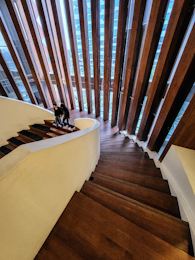
 The building is a superb example of contemporary architectural design, both externally and internally. Inside, it is spacious and well-lit. The building, which serves its various purposes well, is in itself a work of art: a functional sculpture, one might say. We attended the inauguration of an exhibition, which was held in the auditorium,  which forms part of the gallery space. I will describe the exhibition in another piece, but suffice it to say,  the KCC, although distant from central Kolkata,  is worth visiting.

An artist who works and lives in Kolkata

WHEN VIEWING ARTWORK or listening to music, my reaction  to, and enjoyment of it is governed by my initial visceral feelings that it evokes. If these feelings are satisfactory, my interest and enjoyment of the art increases, and I might begin to delve more deeply into understanding what the creator is trying to convey with his or her work.


My initial reaction to the oil paintings and ink drawings by Kolkata based artist Debajyoti Roy were very positive. Each of his works on display appealed to me. Many of the images are in black ink on white paper. A couple of larger paintings were more colourful, created with oil colours and inks.


 Some of the works in ink reminded me a little of Chinese or Japanese calligraphy. The works are both abstract and at the same time somewhat figurative. Yet, as I studied them, they gave me the feeling that they are abstractions of reality, often of biological phenomena.  As Roy explained in the exhibition catalogue:

“When someone engages with a piece of art, it is inevitable to interpret its visual aspects. Still, the essence lies in deeper inquiries that provoke interpretation of the perception and reality.”

I felt that this was certainly the case with what I saw of his creations.


Debajyoti Roy has created a set of images that are intriguing both visually and intellectually. It is a shame that his exhibition at the Jogen Choudhury Centre for Arts in south Kolkata is ending soon (on 11 January 2025). If you happen to be in Kolkata before it ends, it is well worth viewing.

An evening prayer offering by the water of the River Ganges

THE WORD AARTI is from the Sanskrit language. It means ‘something that removes darkness’. In many pujas (Hindu ceremonies), an aarti is performed: it involves presenting a flame to appease the deity or deities. 


One evening, we were walking along the bank of the Hooghly (a part of the holy Ganges river that flows through Kolkata) just after sunset. We came across rows of plastic chairs facing the river at Babughat (one of the stepped landings used by people bathing in the river). Between them and the water there was a row of altars. We asked someone the reason for the chairs. We were informed that they were set up so that people could watch the daily Ganga Aarti, which was due to happen at 530 pm. Our daughter,  who had witnessed a Ganga Aarti at Varanasi, persuaded us to wait and watch the forthcoming aarti.


We sat down and joined the other spectators. While we waited, several hawkers walked along the rows of chairs, selling snacks of various kinds, both packaged and prepared to order (for example, jhal muri – puffed rice with flavourings). One hawker carried a tray on which a small lamp (a diya) was flickering. For a small cash offering, he blessed the ‘customer’ and placed some prasad (blessed food) into his or her right hand. Meanwhile, rotating spotlights and piped music added to the festive atmosphere. Gradually,  all the seats were occupied,  and many people were standing nearby on the sides of the ghat.


At 5.30 pm, priests dressed in shiny gold robes with wide sashes over their left shoulders began assembling, one in front of each of the altars. The latter were illuminated with hoops carrying brightly lit electric light bulbs. Then,  the ceremony began.


A pandit, dressed in white, speaking into a handheld microphone chanted prayers in Sanskrit. As he was doing this, the gold clad priests performed several visually exciting activities. These included moving containers emitting clouds of smoke. They swung them and moved them in circles, each man in synchrony with the others. After this, they did much the same thing with candelabras each carrying many small flaming oil lamps (diyas). These were then replaced by larger flaming lamps, each of which had handles shaped like cobras ready to attack.  After the balletic flame movements, the flaming lamps were carried down to the water’s edge. I could not see whether they were immersed in the river.


In addition to the movements with the flaming lamps, large conch shells were washed through with water, some of which was sprinkled on the crowd. The conches were also blown to produce a sound indistinguishable from the horns on the locomotives of the trains running every few minutes on the suburban railway track that was a few feet behind where the ceremony was being performed. 


I am very pleased we waited to watch the Ganga Aarti. Apart from being more spectacular than many theatrical performances I have seen, it was very moving. It is yet another example of how much more vibrant and fervent religious ceremonies are in India than they are in most parts of Europe.

A mosque in south Kolkata and one of the heroes of India

THE TOLLYGUNGE CLUB in South Kolkata stands on land, which was once the home of members of the family of Tipu Sultan (1751-1799). He fought first the Marathas, and then the British valiantly until his death at Srirangapatnam. Had Tipu not been defeated,  the British might have had great difficulty maintai g a foot in India.


Four years before Tipu’s death, his youngest son Ghulam Muhammad Sultan Sahib (1795-1872) was born in Srirangapatnam. In 1806, he and the rest of his family were deported to Calcutta by the British, and were settled in Tollygunge, south of the city. Where they lived is now occupied by the Tollygunge Club (founded 1895).


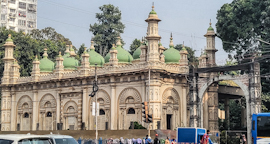
About 900 yards north of the Tollygunge Club’s clubhouse and across a very busy road, there is a mosque (on the corner of Deshparan Sasmal Road and Prince Anwar Shah Road). It stands within its own peaceful compound.


One of the first details I noticed when visiting the mosque and its grounds was that all of its outdoor lighting stands use old cannons for their bases. Maybe this is not surprising because this mosque is one of two  in Kolkata named after Tipu Sultan. The Tollygunge Tipu mosque was constructed in 1860 by Tipu’s youngest son, Ghulam Muhammad Sultan Sahib. It is designed in the Indo-Islamic style. Its exterior is attractive,  but its interior has very few visual attractions.


In the garden of the mosque, there is a raised rectangular platform. Upon this, there are five or six unmarked graves, each one looking dilapidated. One of these marks the burial place of Tipu’s youngest son. The walls of the platform have a few plaques engraved with words in a script resembling Urdu or Arabic. I  was told that these words are of religious significance,  rather than the names of the deceased.


At the east end of the compound, there are a few steps leading to a deep depression that was once a pond or small lake. An elderly caretaker told us that never in his long life had he ever seen water in it.


A review of the mosque on the TripAdvisor website described the place as not being somewhere in Kolkata that “must be seen”. This is correct, but as we often stay at the Tollygunge Club and have visited Srirangapatnam several times, I was keen to view the place with such an interesting link to Tipu Sultan.