Painted in blue and displayed at Kew

THE SHIRLEY SHERWOOD Gallery of Botanical Art is a relatively new addition to the buildings dotted around London’s Kew Gardens. It is an attractive clean lined contemporary edifice containing several interconnected exhibition spaces of varying sizes. Until 23 March 2025, it is housing an exhibition of mostly enormous ceramic objects, which were created by Felicity Aylieef, Professor of ceramics and glass and research at the Royal College of Art, London.

The enormous ceramic objects, which look like grossly magnified jars and vases, were handmade by craftsmen in China, whose names were not prominently displayed (if at all) in the exhibition. Ms Aylieff has painted attractive designs on the vessels using blue paint containing cobalt oxide. The painted ceramic objects are then placed back into enormous kilns, and fired once again to fix the painted designs and to glaze them. Undoubtedly, what she creates is impressive, but maybe pointless. However, the art historian John-Paul clarifies things a bit:

“These are objects to be encountered physically, peered at anear, admired from afar. They may derive from utilitarian vessels, but as objects they are architectural, sculptural even, in their forms. Painterly, we might also say, for the manner in which their surfaces are articulated with glazes”. (Quoted from a label at the show).

I enjoyed seeing these gigantic ceramic objects, but kept wondering whether the great effort (especially physical) to make them was worthwhile.

The handkerchief tree and pollination

ONE OF THE characteristics of a living organism is the ability to reproduce itself. Pollination of plants is an important stage in maintaining the survival of a species.

Yesterday (the 15th of May 2024), we saw a curious tree at Kew Gardens. It looked as if it had both green and white leaves. It is a Handkerchief tree (Davidia involucrata). The white appendages are not leaves but bracts. They form for about a fortnight each year, and serve to increase the chances of the tree’s flowers being pollinated.

Art amongst the plants at the Royal Botanic Gardens at Kew

I ENJOY VIEWING sculpture displayed in the open-air. Seeing sculpture ‘al-fresco’ is for me much more pleasant than viewing it in a gallery. From time to time, the Royal Botanic Gardens at Kew hosts outdoor sculpture displays. In the past, I have seen exhibitions of works by Henry Moore and Dale Chihuly. This year (2024), there are several sculptures by Marc Quinn dotted around the gardens. Quinn, who was born in the UK in 1964 is an adventurous creator, whose works sometimes give rise to controversy. I do not believe that the collection of his works now on display in Kew will give rise to much, if any, controversy.

Except for several bronze sculptures depicting larger than life bonsai trees, which have been placed in the Temperate House, the rest of the sculptures are made in highly reflective stainless steel. Appropriately for their setting, these sculptures are derived from the shapes of plants, leaves, and flowers. Because they are so reflective, they reflect the plants and trees growing near them. This helps to camouflage them, or make them seem as if they are merging with the surrounding vegetation. Although they contrast dramatically with their surroundings, their reflective nature softens the contrast when viewed from certain angles.

When I see sculpture next to nature, I often feel that however well the artwork has been created, it often palls when compared to what Nature has created. Quinn’s work at Kew has this effect, but somehow, probably because it reflects the plants around it, the comparison between what he created and what has been growing naturally is not too marked, and did not disturb me.

A visit to Kew Gardens is always enjoyable, and seeing the place with Quinn’s work in situ was a good experience. The exhibition will continue until the 29th of September 2024.

A pioneering bridge

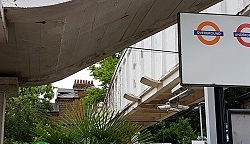
THE CONCRETE PEDESTRIAN bridge over the railway tracks at Kew Gardens Station cannot be described as attractive. In fact, it is rather ugly. However, on a recent visit to the station, I spotted a notice attached to the bridge that provides interesting information about it.

The bridge was opened in 1912. It is one of the earliest examples of the use of reinforced concrete in Britain. The technique used to construct this bridge was that pioneered by François Hennebique (1842-1921). The first building made in Britain using his method of reinforcing concrete with wrought iron beams was the Weaver Building in Swansea (in 1897). An article in Wikipedia related that between 1892 and 1902, over 2000 structures were made using Hennebique’s method. This makes me wonder why the plaque on the bridge at Kew is described as a “rare example” of this kind of structure. Maybe, what is meant is that it is a rare surviving example of his construction method. In any case, the bridge at Kew incorporates two features that were designed to protect users of the bridge from the smoke produced by steam engines that used to travel beneath it. One feature is the high wall on each side of the pathway over the bridge. The other are small projections over the railway lines, which were designed to deflect smoke from the bridge.

Kew Gardens station was opened in 1869. It is the only station on the London Underground network to have a pub attached to it. In the past, this pub, now known as The Tap on the Line, had an entrance directly from the London bound platform. In addition to the bridge described above, there is also an underground pedestrian passageway running beneath the tracks. The main reasons to use this station are to visit the National Archives and/or Kew Gardens. If you are coming from central London to visit the gardens, you will have to cross the tracks. So, why not cross them on a bridge that, although ugly, is a landmark of engineering history?

Great exhibition at Kew Gardens

Well worth seeing: a visually and philosophically fascinating exhibition by Zadok Ben-David at Kew Gardens until 27th of March 2022. See more at:

https://www.kew.org/kew-gardens/whats-on/zadok-ben-david-natural-reserve.

The artist uses delicate models of the natural world to illustrate that life simultaneously has its dark and light aspects. This innovative exhibition has to be seen to be believed. It makes for an intriguing accompaniment to the lovely botanical gardens.

Glass, iron, and Syon

KEW GARDENS CONTAINS several magnificent Victorian plant houses made mainly of glass and iron. These include: The Palm House built 1844-1848; The Waterlily House built 1852; and The Temperate House built in about 1859. Although they are early examples of massive glass and iron structures for the cultivation of plants, they are not the earliest. The conservatory in the gardens of nearby Syon House predates them, having been built in 1827, ten years before Queen Victoria came to the throne. As a work of architecture, it rivals the best of those Victorian ‘glasshouses’ that can be seen at Kew.

The Grand Conservatory at Syon

We had parked in the grounds of Syon House several times before we visited its gardens in April 2021 and each time, I noticed the large glass and iron dome towering over the high garden walls. Until we entered the gardens, I had not realised that this splendid dome is attached to one of the most attractive plant conservatories that I have ever seen.

The extensive gardens of Syon House were landscaped by Lancelot ‘Capability’ Brown (1716-1783) in 1760 but were replanned in the 19th century.  The architect Charles Fowler (1792-1862), who designed the market buildings in London’s Covent Garden, designed The Great Conservatory at Syon Park. It was built for Hugh Percy the Third Duke of Northumberland (1785-1847), who served as Lord Lieutenant of Ireland under the Duke of Wellington from 1829 to 1830 (https://en.wikipedia.org/wiki/Hugh_Percy,_3rd_Duke_of_Northumberland).

Writing in 1876, James Thorne, author of “Handbook to The Environs of London”, noted:

“The Great Conservatory designed by Fowler is in the form of a wide crescent, with pavilions at the extremities, and a lofty central dome. The centre, 100 feet long, is a tropical house, and is said to contain the finest collection of tropical plants in any private establishment in England. It is noteworthy that here only in this country has the cocoanut palm fully ripened …”

Thorne also noted that the vases on pedestals on the terrace in front of the conservatory were carved by Grinling Gibbons (1648-1721). The circular pool in front of the conservatory has a statue of Hermes (Mercury), which is a copy of one by the Italian sculptor Giambologna (1529-1608).

Although we were unable to enter The Great Conservatory, we could see most of it through its clean windows. The central dome is supported by a ring of perforated semi-circular arches held aloft by slender iron pillars. Even without entering it, the central area of the building can be seen to be a beautifully designed, airy space. Though not as crowded with plants as the conservatories at Kew Gardens, the one at Syon contains a collection of palms, cactuses, and other warm weather plants, mostly large and well-established. Unlike the glasshouses at Kew, much of the rear wall of The Great Conservatory is constructed with brickwork instead of glass and iron.

Much time can be spent enjoyably exploring the lovely gardens at Syon House, but despite their beauty, the pièce-de-rèsistance is without doubt The Great Conservatory, an impressive and beautiful example of construction in glass and iron. It is well worth purchasing an admission ticket even if only to see and admire this great work of Regency architecture.

The dragons return

WHEN I FIRST VISITED Kew Gardens, I was a teenager, the entrance fee was sixpence (2.5 pence), and you entered via a metal turnstile. I did not visit Kew often in those days because it was a long way from my family home in northwest London. Recently, we have been exploring the delights of Kew Gardens occasionally with our friends who live in the heart of nearby Richmond town. During our most recent visit, whilst drinking coffee outside the former Orangery, now café, I stared at the nearby red brick building, Kew Palace, and began wondering about the history of the site, where the botanical gardens now stand, before Kew Gardens were opened to the public in 1840.

Kew Palace, which is also known as the ‘Dutch House’, now within the botanical gardens, was built on the site of a 16th century house, the ‘Dairy House’, in 1631. It is one of the oldest of the buildings standing by the Thames and was built for Samuel Forterie (1567-1643), a merchant of Dutch descent. After King George II (reigned 1727-1760) came to the throne, the building was used as a residence by various members of the royal family including King George III during some of his periods of illness.

For a long time, Kew Palace was not the only royal residence in what is now Kew Gardens. Before the Dutch House, now Kew Palace, was built by Forterie, a close friend of Queen Elizabeth I, Robert Dudley (1532-1588), 1st Earl of Leicester, lived in its predecessor. His house was close to one owned by the Keeper of the Privy Seal, Sir John Puckering (1544-1596), which Elizabeth visited both in 1594 and 1595.

Kew Palace was opposite a much larger building, Kew House, also known as the ‘White House’. Originally built in the Tudor era, it was first owned by Richard Bennet, son of the Lord Mayor of London Sir Thomas Bennet (1543-1627).  Richard’s daughter and heir, Dorothy, married Sir Henry Capel (1638-1696) and they lived in Kew House. After Dorothy was widowed, she continued living at Kew House until her death in 1721. The next owner of the house was the astronomer and politician Samuel Molyneux (1689-1728), who married a grandniece of Lord Capel.

Two years after Molyneux died, Frederick (1707-1751), Prince of Wales, father of King George III, leased Kew House from the Capel family. He and his wife, Princess Augusta (1719-1772) lived at Kew House, and employed the great designer William Kent (1685-1748) to decorate the house and to lay out the grounds. After Frederick died, Augusta began the creation of the ‘Exotic Garden’, the forerunner of the present Kew Gardens. The architect Sir William Chambers (1723-1796) was put in charge of the works. In addition to the well-known pagoda (erected 1761-62) and still in existence, he oversaw the building of at least twenty structures in the garden. Many of these have been demolished, but amongst those still standing are The Orangery (1757-61), The Ruined Arch (1759), The Temple of Bellona (1760), and The Temple of Aeolus (1763).

After Augusta died, King George III (reigned 1760-1820) used Kew House and then bought its freehold in 1799. The King enjoyed improving the grounds of the property and ploughed up some of the neighbouring Richmond Deer Park to create an enlarged garden. Some of the work was entrusted to the garden designer ‘Capability’ Brown. The King received visits from the botanist Joseph Banks (1743-1820), who brought him seeds and plants for his gardens.  By 1802, Kew House was falling to pieces, and was demolished in preparation for a new palace, which was never built.  A sundial in Kew Gardens marks the site of the house. On a map drawn by John Roque in 1754, the former Kew House is labelled ‘The Princess of Wales House at Kew’ and the Dutch House (Kew Palace) is labelled ‘His Royal Highness the Prince of Wales House at Kew’. The map also includes drawings of three follies: ‘The Hermitage’, ‘Dairy House’, and ‘Merlin’s Cave’.

When George III was in residence at Kew House, he led an unsophisticated existence as described by Madame D’Arblay (aka Frances [‘Fanny’] Burney; 1752-1840). She wrote in Volume 3 of her published diary that the King lived there in:

“… a very easy, unreserved way, running about from one end of the house to the other without precaution or care … There is no form or ceremony here of any sort …They live as the simplest country gentlefolks. The King has not even an equerry with him; nor the Queen any lady to attend her when she goes her airings.”

This suggests to me that the King was careless about how he dressed (if at all) at his country retreat.

Kew Palace (the Dutch House) was separated from Kew House by a public road. Queen Charlotte (1744-1818), George III’s wife, took over its lease and then bought its freehold in 1781, and eventually died there. As mentioned already, her husband spent time at Kew Palace during his periods of illness.

In 1840, the botanical gardens, the ancestor of what we now enjoy, were opened to the public. Had it not been for the enthusiasms of the area’s earlier owners, some of whom I have described above, the location of this establishment might have been at another site. The main attractions of Kew Gardens today are the plants and some of the magnificent houses built for them during this century and the two preceding it. However, it is of interest to see Kew Palace and the few remaining garden follies created by Sir William Chambers several decades before the foundation of the present botanical gardens.

The Pagoda, which is tall enough to be seen from outside the confines of Kew Gardens is an attractive feature of the place. Writing in 1876 in his guidebook, James Thorne remarked that:

“… It is in 10 storeys, each storey diminishing a foot in diameter and height, and each having a balcony and projecting roof. Originally a Chinese dragon crawled over every angle of each roof, but these have all taken flight.”

The Pagoda remained without dragons until 2018, when its restoration was completed. It was then that these creatures, looking extremely well groomed, returned to their original perches.