Six-pointed stars in Kochi (Kerala)

SIX-POINTED STARS IN KOCHI

MY FIRST VISIT TO Fort Kochi (Fort Cochin) in Kerala was in 1994. By then, I already knew that there was one or more Jewish communitis in Fort Kochi (‘Kochi’). As we drove into Kochi, I noticed many six-pointed stars, all identical to Jewish Stars of David (‘Magen David’). For a while I was amazed by the sight of so many of what I believed then to be Jewish shops and other establishments. Not long after this, I became aware that like the Om and the swastika, the six pointed star is a commonly used Hindu symbol. For example, the Canara Bank, not a Jewish outfit, uses the six pointed star as its logo.

Several communities of Jewish people lived in Jew Town, which is in the district of Mattancherry. Today, flocks of tourists visit the area to explore its numerous handicraft shops and the beautifully preserved Dutch (Paradesi) Synagogue, whose floor is paved with blue and white tiles made many centuries ago in Holland.

Apart from the much-visited synagogue, there are very few other buildings that have recognisable marks that indicate their former Jewish connections. On previous visits, I spotted what must have been another synagogue; a house bearing Magen Davids; and a locked up, well maintained Jewish cemetery.

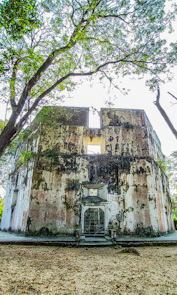
Today, the 10th of February 2023, I spotted a building with Hebrew lettering above its main door. This edifice, which is undergoing restoration, is close to the Masjid Aisha on Jew Street, and about 0.5 miles south of the Dutch Synagogue. In need of much work, this is what remains of the Kadavumbhagam Mattancherry Synagogue (constructed by 1544 AD).

Kadavumbhagam Synagogue under restoration

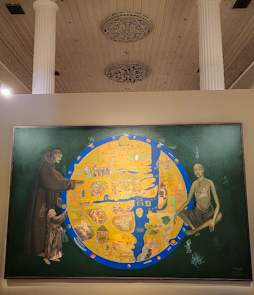
Another building with well-documented Jewish connections, but no obvious marks, is currently being used to house exhibitions contemporary with the 2022/23 Kochi Muziris Art Biennale. Called the Kashi Hallegua House, this grand dwelling is about 150 yards south of the Dutch Synagogue. Above its carved wooden framed front door is the date 1761. This was during the period that the Dutch were the dominant European presence in the area: they were intimately connected with Kochi between 1663 and 1814.

For over 250 years, the Dutch house, formerly known as Krathi Veedu, was home to many generations of the Hallegua family. From where they originated, I have not yet found out but they were Paradesi – European Jews who arrived in Kerala from abroad, as opposed to Jewish people whose origins were other than European (no one knows from where they arrived in Kerala).

The last Jewish residents of the house, 85 year old Mrs Juliet Hallegua and her daughter Yael, left for Israel in 2019. The place was then purchased by Edgar Pinto, who converted the huge family home into an art gallery. Although the furnishings used by the Hallegua family have been removed, many of the original wooden window frames and cupboard doors are in place. The kitchen, now a gallery space, has a huge oven and a special carved stone workspace used for grinding food ingredients with a stone rolling pin.

The two Hallegua women were amongst the last of the Kochi Jews living in the town. There was another, Sarah Cohen (1922-2019) who lived very close to the Dutch Synagogue. Until she was in her nineties, she had a shop selling tablecloths and other handmade cloth items, many of them with Jewish decoration. Today, the only Jews in Kochi’s Jew Town are visiting Jewish tourists, a few of whom might have had ancestors who lived there.

Since our last visit in 2019, a couple of shops have opened. Named Shalom, their signboards bear the Jewish six pointed star. The company sells ready-made garments, but I suspect that apart from the name, it has no Jewish connections … but I might be wrong!

Cloud with a silver lining

AFTER A VERY DISAPPOINTING experience at a café we have often enjoyed when staying in Fort Kochi, we went to another eatery, which had been recommended by our friend Sharada S , when we visited Kochi at Christmas in 2019.

Our friend had introduced us to Oceanos. In this pleasant but unpretentious restaurant, we have enjoyed some of the best prepared sea food in Kochi. The dishes served at Oceanos are not only tasty but also authentic, by which I mean that they are not prepared to be ‘fine dining’ fancy; instead they give a good experience of genuine Keralan food.

Currently (February 2023), In addition to an á la carte menu, there is a seafood set lunch – a seafood thali. This included deep fried mackerel; clams (vongole) out of their shells; Aleppey fish curry; roasted prawn curry; sardine steamed in a banana leaf; Malabar paratha; rice; chhaas (buttermilk); and payasam (a local dessert). Every item was exquisitely prepared and tasted very fresh. This wonderful, faultless meal was 390 INR (£3.90) per head. We plan to explore the rest of the menu at Oceanos in the next few days.

Had it not been for the incompetent management at Kashi Art Café today, we would have eaten lunch there. However, as we had not been served our food for almost one our after ordering it, we asked for an explanation of the delay, and were told that there was a problem with the gas in the kitchen. Having been told that we would have our food “in about 10 minutes”, we walked out. If we had been served our food sooner, or been given an explanation without having to ask for one, we might have missed out on the superb lunch at Oceanos.

A statue and an art biennale

SUBHASH CHANDRA BOSE Park, formerly named Irwin Park, runs parallel to the seashore at Ernakulam in Kerala. At the south end of this pleasant open space, there is a tall statue depicting Sri Sir Rama Varma GCIE, LLD, Maharaja of Cochin (c1861-1941). He reigned between 1932 and 1941. The statue was unveiled in January 1939 by the then Viceroy of India, Lord Linlithgow during a visit to the city. He was Viceroy from 1936 to 1943.

Rama Varma

While visiting Ernakulam that day, the Maharajah arranged for him to watch a display of Bharatnathyam dancing (https://www.cochinroyalhistory.org/). This was held before tea in the grounds of the Maharaja‘s nearby Durbar Hall. The statue was unveiled after tea.

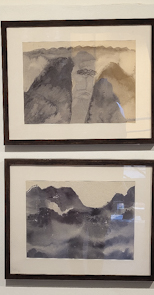
The Durbar Hall was constructed over 100 years ago in extensive grounds owned by the Maharajahs of Cochin. For many years, it has been used as an art gallery. Beautifully restored by the organisation that runs the Kochi Muziris art biennale, it serves as one of the art festival’s venues during the 4 months that the Biennale runs. The current 2022/23 event in the Durbar Hall is a show called “Idam” which contains a variety of visual art exhibits, all of which have been created by 34 Malayali artists. Overall, it is an enjoyable exhibition by artists displaying an exciting variety of interesting imaginative ideas, all expressed in well executed artworks.

The works in the Durbar Hall are in stark contrast to the Maharaja‘s statue that stands in the hot sun not too far away. Unlike the Maharajah, who was probably unwilling to break out of his comfortable colonial mould, the artists are showing that they are willing to attempt to escape from prevailing convention

India to St Ives

ST IVES IN CORNWALL is chock full of art galleries apart from the better-known Tate St Ives (highly overrated), the Penwith, and the splendid Barbara Hepworth house. Many of these galleries are best bypassed because they contain artworks of pedestrian workmanship and often poor aesthetic qualities. Last year, we visited a mediocre exhibition in the Crypt Gallery below the St Ives Society of Artists, which is housed in a deconsecrated church. So, when we passed the gallery today, I was reluctant to enter until I spotted that the exhibition was entitled ‘Cornwall and India’. The artist whose works were on display is called Paul Wadsworth.

Born in East Anglia in 1964, Paul studied at the art school in Falmouth (Cornwall). He told us that he has made three lengthy visits to India. One trip was to Rajasthan, another to Goa, and a third to Kerala. While in India, he commissions lovely leather-bound books to be made in Pushkar (Rajasthan). He fills these with line drawings and painted sketches. These visual records become the basis for his paintings inspired by his observations of India. Some of his Indian paintings are completed in India and others in his studios in Cornwall. To my eye, Paul captures the essence of India well: its colours and vibrancy.

Some of the paintings on display were those inspired by India. Others that involve skilful application of paints with a palate knife depict the spirit of the landscape of Cornwall. These paintings, Paul explained, are not done from photographs or preliminary sketches, but straight from true life. Given how the sky often changes so quickly in Cornwall, the artist has done a great job of seizing the moment and recording it on canvas.

Circus is another subject that attracts Paul. Some of his vivid depictions of life in the circus arena were on display. Complementing these, his sketch books have many lovely images created whilst he spent time with Kathakali dancers in India. Some of these sketches have been translated into paintings.

Paul spent time with us, patiently answering our numerous questions as well as showing us his works. He has the gallery for three weeks, starting 20th September 2020 and has filled it not only with his artworks but also the materials that he uses to create his works of art. He has created an exhibition within what he will use as his temporary studio.

I am truly glad that I entered the Crypt Gallery despite initial misgivings. If I had not, I would have missed out a highly enjoyable collection of good quality, well-executed art and meeting Paul, its affable creator.

Be reasonable

Booking

Last year, we were booking our daughter into a simple home-stay by the sea in Kerala, India. While we sat in the owner’s office, I spotted a framed certificate issued by the Booking.com website. It showed that the home-stay had earned a 9.8 out of 10 satisfaction rating. I congratulated the owner for achieving this. Sadly, he told me, the latest rating was now 9.4.

“That’s still pretty good,” I said.

“Maybe,” the owner replied, “but it keeps going down. The problem is the Indian guests who stay at my place.”

“Why?” I asked.

“When foreigners come and pay £10 per night, they know what to expect,” the owner began, “but when Indians come here they expect accomodation worth £100 even when they are only paying £10”

“The problem is,” he continued, ” that Indians arrive expecting included breakfast, a swimming pool, and other facilities, for which they would usually have to pay £100 or more. These are not available at £10 per night. So, when they write their reviews on Booking.com, they give us a low rating, which is not fair given how little they have to pay. These low ratings bring down my overall rating.”

I sympathised with the man, who then admitted:

“I would rather have no Indians staying here. I prefer the foreigners because they know what to expect of budget accommodation.”

When I stay at places that I have booked on Booking.com, I tend to be over generous with my rating unless there is something very seriously bad about the place. Also, when choosing where to stay, I am not put off by ratings of just over 6 out of 10. I have often found hotels with lowish ratings to have been under-rated because people have been over-critical about minor defects.

So, when you next rate a place you have visited, try to be fair and reasonable with your ratings.

Dining in Kerala

gecko

While eating our dinner one tropical evening in a lovely restaurant in Fort Cochin (Kerala, India), I looked up and noticed that high up on the wall overlooking us there was another diner, definitely not a vegetarian.

Clinging to the wall

An insect in its jaws:

A gecko stares at me

The Old year in flames

The ending of the old year and beginning of the new one is celebrated all over the world in a variety of ways and at different times of the modern calendar. For example, the Chinese, the Gujaratis, the Parsis, the Jewish people, and the Russian Orthodox all celebrate the start of a new year on different dates. People, whatever their personal beliefs, also celebrate the end of the year on the 31st of December.

Cochin, which is a historic port in the southern Indian state of Kerala, was a Portuguese colony for a while in the 16th and 17th centuries. The Papaanji (spelling varies!) is named after a Portuguese word meaning ‘old man’.

Every year, a giant Papaanji is erected in a centrally located open space in historic Fort Cochin. During the afternoon of New Year’s Eve, the Papaanji is stuffed full of dry straw and fireworks. The roads around the open space are closed to motorised traffic. Despite this, a few youths on motor bikes manage to enter illegally.

After sunset and during the evening of the 31st of December, the area around the Papaanji fills with vendors and ever increasing numbers of people. Some of these merrymakers wear masks and others wear glowing red devil’s horns.

During the few minutes before midnight on the 31st, unbelievable numbers of people gather. The strong tide of people resembles a powerful surge of water such as you might expect if a large dam has just been breached. The crowd adds much noise to the cacophony of sound being relayed over various loudspeakers. Several times, I was almost knocked over by this human tsunami.

At midnight, the crowd became even noisier when flames began leaping from the ignited Papaanji. First, I could only see billowing clouds of smoke. Soon, frightening flames became visible. Then, bursts of stars appeared as the fireworks exploded.

Within minutes, the conflagration and fireworks ended. The old year, represented by the Papaanji, had been burnt out to make way for the new one. The crowds began to thin out a little, but despite that, it was quite hazardous trying to leave the area.

For an hour or two after midnight, boisterous revellers created much noise in the streets. The whole affair seemed to be generally good natured.

I am glad that I have seen the Papaanji aflame, but once in a lifetime is enough for me.

Indian way of worship

Over and over again, I am impressed by the “Indian-ness” of worshipping in India. I will illustrate what I mean by this by describing a small Orthodox Christian chapel I visited on Bazaar Road in the Mattancherry district of Cochin (“Kochi”) in Kerala.

Outside the chapel, there stands a carved stone stand with indentations for oil lamps (diyas). It looks just like any diya stand that you could find in a Hindu temple, except that it is surmounted by a Christian cross.

The crucifix that stood above a small high altar within the chapel was draped with flower garlands (malas). Again, these are commonly found draped around effigies of Hindu deities.

I saw a brass diya stand with burning oil lamps directly in front of the crucifix. Like the lamp stand by the entrance, this one was also topped with a Christian cross.

If one were to replace the crucifix with an effigy of a Hindu deity and were to remove the crosses from the diya stands, the chapel would become identical to a Hindu temple.

The use of diyas and also agarbati sticks (incense sticks) is not confined to Hindu temples. I have seen them used in Christian as well as Islamic (especially Sufi) and Jain places of worship.

At a Sufi shrine at Sarkej Rauza on the edge of Ahmedabad in Gujarat, I have seen tulsi leaves being sold. These are commonly associated with Hinduism, but the vendor in the Sufi shrine told me that they were also used by worshippers who came to the shrine.

I have seen threads tied around the trunks of peepal trees by pious Hindu women hoping to have their wishes granted. I have also seen threads tied by women around pillars in Moslem shrines for the same reason.

Hinduism was probably one of the earliest religious belief systems to become evident in the Indian subcontinent. Christianity and Islam were relatively recent arrivals. Many Hindus converted to these two religions, but, I imagine, they were reluctant to abandon their Hindu heritage completely. Hence, the Hindu-ness or Indian-ness of some aspects of other religions in India.

What do you expect?

We have been staying in a medium priced, by no means cheap or low-budget, guest house at a popular place in the southwest of India.

For several mornings, there was no hot water coming from the taps in our bathroom. Usually, the problem was resolved after mentioning the it to the man looking after our guest house. We were paying an amount per night at which it was reasonable to be able to have hot water without first having to ask for it.

One morning, we asked a fellow guest, an Indian, whether there was hot water in his bathroom. He said that there was none. When we said to him that in accommodation of this calibre hot water should be available as a matter of routine, he said: “There must be a problem. These things happen occasionally.” After a few moments, he added: “What do you expect? This is India.”

His bland acceptance of low standards and feeling that these were to be expected of his country do little to move India forward in a positive way.