VISITORS TO LONDON (and residents of the city) should not miss visiting Kenwood House, which is in north London between Hampstead and Highgate. Not only does it contain a magnificent collection of Old Master paintings that can be compared favourably with what can be seen in Britain’s finest public art galleries, but it also has a beautiful library.
In my book about Hampstead, “Beneath a Wide Sky: Hampstead and its Environs”, I wrote:
“The first house to stand on the site of the present one was built in brick by John Bill (1576-1630), printer to King James I. He bought the Kenwood Estate (which was known as ‘Caen Wood’) in 1616. After several changes in ownership, the Estate was bought in about 1747 by a former Prime Minister and King George III’s close associate, John Stuart, third Earl of Bute (1713-1792). In 1754, Bute sold the property to the lawyer and law-reformer William Murray (1705-1793), who became the First Earl of Mansfield, and was Lord Chief Justice of the King’s Bench from 1756 to 1788. In 1778, he was a supporter of the Roman Catholic Relief Bill that led to the violent protests described above. During the First Earl’s stay in the House, he employed the architect Robert Adam (1728-1792) to make improvements.”
The library was one of the improvements that Robert Adam created at Kenwood. The library or Great Room was constructed between 1764 and 1774. It was intended both as a reception room and a library, which might explain why so little of this large room’s wall space is occupied by bookshelves. Most of the wall space is occupied by mirrors and windows. Lord Mansfield would have been used to host guests, hold dinners, and for music performances.
The library’s architecture is based on that of Roman public bath houses. John Summerson (1904-1992), the architectural historian, wrote of its design in his “The Iveagh Bequest, Kenwood : a short account of its history and architecture” (published 1988):
“This is one of the finest Adam rooms in existence … The shape of the room, with its curved ceiling leading into two apsidal ends, on the chords of which are pairs of columns, is one which Adam used for several of his most stately interiors. Apart from the plan, a great innovation for England was the flat arched ceiling which Adam frankly describes as ‘extremely beautiful …”
Although the library is the finest of Adam’s creations at Kenwood, there are others that deserve to be admired. These include the orangery, the entrance hall with its magnificent stucco ceiling, and the library’s anteroom. In this piece I have concentrated on the interior of Kenwood House, but a visit to this wonderful place should be accompanied by a stroll in the place’s superb, landscaped gardens.
KENWOOD HOUSE IN north London is a place I visit regularly, and have been doing so since the early 1960s. Its magnificent gardens were landscaped by Humphry Repton (1752-1818). Repton, who is considered successor to the great landscape designer Capability Brown was born in Suffolk. He died in Essex.
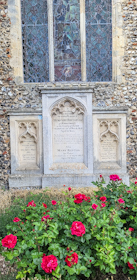
While visiting the small town of Aylsham in Norfolk, we came across the burial place of Humphry Repton. It is outside the southeast corner of the town’s large parish church.
Repton had many connections with Norfolk. His choice of Aylsham as his burial place was because his parents were buried in the church. We had stopped in Aylsham because it has an attractive market square. Until we visited the church we had no idea that the designer of the garden at Kenwood lies buried here.
KENWOOD IN NORTH London (next to Hampstead Heath) is a delightful place to visit at all times of the year. Amongst its attractions are a collection of fine paintings within Kenwood House; architectural features designed by Robert Adam; beautiful grounds with a lake; some modern sculptures; and a refreshment complex housed in the former servants’ quarters and stables. Close to the cafeteria, there are some toilets for use by visitors.
After visiting the ‘gents’ toilet, I looked down at the floor of the passageway leading to it, and saw a square, metal manhole cover. It had some lettering on it. Amongst the lettering, I noticed the following “KIC-INDIA”. Seeing this made me wonder if this manhole cover in north London had been made in India.
When I returned home, I looked at the Internet to see whether I could find out anything about the connection of this manhole cover with India. KIC-INDIA refers to an ironworks in India called KIC Metaliks Ltd (www.kicmetaliks.com), whose office is in Calcutta (Kolkata) in West Bengal. The company website revealed:
“K I C Metaliks Limited, founded in 1986 and headed by entrepreneur Radhey Shyam Jalan, is a leading pig iron manufacturer in West Bengal headquartered in Kolkata. Publicly listed on the BSE, the company has over 35 years of experience catering to hundreds of satisfied customers using cutting-edge technology. Its factory in Durgapur produces pig iron with a current capacity of 2,35,000 MTPA. The company takes a prudent yet ambitious approach to capacity expansion to become a dependable pig iron supplier.”
The company was formerly known as ‘Kajaria Iron Casting Limited’, and its plant is at Durgapur, 100 miles northwest of Calcutta. While searching the Internet, I came across other examples of KIC manhole covers in the British Isles, including at Bangor (County Down), South Shields (Tyne and Wear), and Plymouth (Devon).
Often when I am out walking, I look down at manhole covers. Sometimes they have interesting designs on them. When I spotted the KIC manhole cover at Kenwood today (6th of November 2024), it was the first time I had seen one made in India set into a floor in England.
INSIDE KENWOOD HOUSE (in north London), the visitor can see a glorious collection of paintings by famous artists such as (to name but a few): Vermeer, Rembrandt, Constable, Gainsborough, Reynolds, Cuyp, Romney, and Van Dyck. These works are part of the Iveagh Bequest, which was the collection of paintings bought by the art collector, Irish brewing magnate, and philanthropist Edward Cecil Guinness, 1st Earl of Iveagh (1847-1927).
In the grounds of Kenwood House, there are two sculptures created after Iveagh’s death. They are both by sculptors, who are considered as some of the greatest British artists of the 20th century. One of them, which is near the house, is by Barbara Hepworth (1903-1975), and the other, which we examined when we walked past it today, illustrated above, is by Henry Moore (1898-1986). His large bronze sculpture is called “Two Piece Reclining Figure No. 5”, and was completed in 1963-1964. It has been lent to Kenwood by the Tate Gallery.
Apart from being superb sculptors and having works at Kenwood, Hepworth and Moore have other things in common. Both studied at the Leeds School of Art, where they met. And both lived in Hampstead, which is close to Kenwood, for a while between the two World Wars. While they were in Hampstead, they had studios close to each other: Hepworth in Mall Studios, and Moore in nearby Parkhill Road. You can find out more about their lives in Hampstead in my book “Beneath a Wide Sky: Hampstead and its Environs”.
I HAVE VISITED Kenwood House and its grounds innumerable times since my childhood, but it was only today (the 21st of March 2024) that I have been able to enter a part of it that has always been locked up whenever I have been there before. I am referring to a small building known as “The Bath House”. It is close to the courtyard where there are tables and chairs for visitors to use while enjoying refreshments.
A short staircase leads down to the door of the Bath House, which was probably already in existence when the Mansfields bought Kenwood and its grand house in 1754. The interior of the small edifice contains a circular pool. The wall around the marble-lined pool has several alcoves, and the concave ceiling is a plastered circular dome. What can be seen today is that is a faithful reconstruction of what had been there originally.
The pool used to be filled with cold water from one of the many iron-rich chalybeate springs in the area. In the 18th century, the chalybeate springs in nearby Hampstead were almost as famous and as much visited as those in Royal Tunbridge Wells (in Kent). The inhabitants of Kenwood House used to plunge themselves into the cold water because it was considered to be beneficial for health reasons in the 18th century.
It was only the select few who had the luxury of taking the plunge in such an elegant pool as can be seen in Kenwood. The other locals living in Hampstead had to make do with bathing in the many ponds that can still be seen dotted around Hampstead Heath. Within Kenwood House today, we saw a painting by John Constable (1776-1837) that depicts one of these ponds being used by bathers. For many years, the artist lived in Hampstead.
Small though it is, it was exciting to see within the Bath House at long last. For many decades, I have wondered what was within it, and now my curiosity has been satisfied.
KENWOOD HOUSE IS NEAR both Hampstead and Highgate in north London. It offers the visitor the chance to view not only its lovely grounds and fine interiors designed by the architect Robert Adam (1728-1792), but also a fabulous collection of paintings, many by world famous artists including, to mention but a few, Rembrandt, Frans Hals, Van Dyck, Vermeer, Reynolds, and Gainsborough.
Merlin (painted by Gainsborough) and the invalid cahir he invented
One of the paintings by Thomas Gainsborough (1727-1788) is a portrait of the inventor John Joseph Merlin (1735-1803). The latter was born in Huy (Belgium), and as a young man, he worked in Paris making clocks and mathematical instruments. In 1760, he moved to England to work as a technical advisor to the then new Spanish Ambassador to London. By 1766, he was working with the London jeweller James Cox. Then, he was creating mechanical toys including the Silver Swan, an automaton, still working, that can be seen at the Bowes Museum in Barnard Castle (Durham).
In addition to these ‘toys’, Merlin invented some useful items. These included roller skates; various clocks including one that was powered by changes in atmospheric pressure; improvements to keyboard musical instruments; playing cards for blind people; prosthetic devices; and a self-propelled wheelchair known as ‘the Gouty Chair’. There is an example of this ingenious wheelchair on display beneath Merlin’s portrait in Kenwood House. In my book about Hampstead and its environs, I described it as follows: “Two handles at the ends of its armrests are connected by rods and cogwheels to some wheels on the floor below the chair. The occupant of this chair could rotate the handles, and thereby propel this early form of wheelchair around the room.”
In the same room as the invalid’s chair, there is another of Merlin’s creations: a skeleton clock made by him in 1776. This kind of timepiece is one, whose working parts are not concealed by casing or any other features that usually hide them.
The portrait of Merlin, painted in 1781 by his friend Gainsborough, shows him in a red jacket, holding a small beam balance in his left hand. Apparently, this was one of his creations. This precision instrument is the only clue that the subject of the painting had anything to do with jewellery or instrument making. His right hand is tucked into his jacket:
The painting hangs in Kenwood House because it, like many of the others on display there, were part of the collection of the philanthropist and brewer (of the Guinness beverage) Edward Cecil Guinness, 1st Earl of Iveagh (1847-1927), who bought the house in 1927, and bequeathed it and his collection of paintings housed within it to the nation. You can discover more about Kenwood and nearby Highgate village in my book “Beneath a Wide Sky: Hampstead and its Environs” (https://www.amazon.co.uk/dp/B09R2WRK92 OR https://www.bookdepository.com/BENEATH-WIDE-SKY-HAMPSTEAD-ITS-ENVIRONS-2022-Adam-Yamey/9798407539520 )
AT SCHOOL, MY CHOSEN SPORT was cross-country running. Twice a week I spent an hour or so doing this in the grounds of Kenwood and the part of Hampstead Heath near to Highgate in North London. I have written about this before (https://adam-yamey-writes.com/2020/06/14/my-sporting-life/), but there is one aspect of it that I did not cover. Once a year, those who did cross-country running were accompanied by a teacher, Mr Bowles, who believed that getting covered in mud was an essential part of this form of exercise. I did not share his odd belief. There was one place on the Heath where filthy red coloured mud was guaranteed. This was at a point 410 yards south east of the centre of the grand south facing façade of Kenwood House and a few yards northwest of The Stock Pond, one of the series of Highgate Ponds.
The reason that this spot, favoured by Mr Bowles, was and still is, always sodden is that it surrounds a natural spring, which issues from a cylindrical stone well-head covered with stone carvings. These include depictions of a squirrel, a fish, and the head of a man with a luxuriant moustache. The water issues from a pipe emerging from the man’s mouth and then drops into a carving of a scallop shell before some of it falls into a drainage grid and the rest all over the place.
This well head is called Goddisons Fountain. It was constructed in 1929 (https://insearchofholywellsandhealingsprings.com/2019/04/19/the-healing-springs-of-hampstead/) and named in honour of Henry Goddison, who campaigned vigorously for saving Kenwood and Hampstead Heath from being built on and for preserving it for the use of the public. It is not known whether there was a spring on this spot prior to 1929, but it is not unlikely that there was.
Goddisons Fountain is the last surviving spring issuing chalybeate (iron rich) water in the Hampstead/Highgate area. Prized for its supposed curative properties, especially during the 18th century, there were several springs issuing this kind of mineral water in Hampstead. A fine example of a now disused spring well-head can be seen at the eastern end of Well Walk in Hampstead. It was for public use and located across the road from the Hampstead spa that thrived during the 18th century (https://adam-yamey-writes.com/2021/01/15/a-house-a-spa-and-grays-anatomy/).
If, unlike many who stroll on the Heath, you do not wish to try the chalybeate water issuing copiously from Goddisons fountain, the next nearest source of this once highly prized water is about 47 miles south east in The Pantiles at Royal Tunbridge Wells in Kent.
The water flowing from Goddisons Fountain is one of many sources of the water in the Highgate Ponds, which include (descending the slope from Kenwood) the Wood Pond; the Thousand Pound Pond with the trompe l’oeil bridge designed by Robert Adam; the Stock Pond which is directly below Goddisons Fountain; the Ladies’ Bathing Pond; the Bird Sanctuary Pond, where I spotted a heron; the Model Boating Pond, where I saw no boats; the Men’s Bathing Pond; and Highgate Number 1 Pond. The water from the topmost pond flows through the lower ones sequentially. Most of these ponds were dug before the 18th century as reservoirs for London’s water. They were kept full by damming the Hampstead Brook, a tributary of the now hidden River Fleet, in 1777. In addition, numerous streams in the grounds of Kenwood and on Hampstead Heath were diverted to keep them topped up. Now, the ponds form a valuable publicly accessible leisure amenity. Hardy souls gain great enjoyment in swimming in the gender segregated open-air ponds, whose waters are not subjected to any purification or disinfection procedures. During the present covid19 ‘lockdown’, it is only wildfowl that can enjoy their water.
As we looked at Goddisons Fountain today in late January 2021, I recalled my muddy encounters with it in the company of Mr Bowles and realised that I had not seen it since early 1970, that is just over half a century ago. And it was not until I wrote this that I learned that the fountain is the last surviving chalybeate spring in the part of the world, where I was brought up.
EVERY SCHOOLDAY MORNING between 1965 and 1970, I boarded a single-decker, route 210 bus at Golders Green Station. First, we travelled up North End Road southwards to Jack Straws Castle, near Whitestone Pond. Then rounding the Hampstead war memorial, our direction changed from south to north-east as the bus travelled along the straight Spaniards Road, just a few yards more than half a mile in length. Invariably, the bus slowed down near the Spaniards Inn, where the road narrows because of the presence of a disused, historic tollhouse directly across the road from the inn. During my five years of travelling this route, I never wondered about the history of the Spaniards Inn, the tollhouse, and the area around them. Now, many years after leaving Highgate School, to which I was heading every morning on the 210, my interest in historical matters has been fired up, as has my desire to share that with anyone who has time to read what I write.
Spaniard’s Inn on right, tollhouse on left
Spaniards Road and its eastern continuation beyond the tollhouse, Hampstead Lane, have long comprised an important route connecting Highgate and Hampstead. Spaniards Road, unlike Hampstead Lane, runs level without inclines or declivities. It runs along a ridge between the south and north facing slopes of Hampstead Heath. At its western end near the former Jack Straws Castle pub, it reaches the highest point in Hampstead, about 440 feet above sea level. At its eastern end by the Spaniards Inn, it is three feet lower. East of the inn, Hampstead Lane descends considerably and only begins to rise again within about three hundred yards of the centre of Highgate Village.
The tollhouse, the cause of an almost continuous traffic bottleneck, narrows the road width considerably so that it is only broad enough to admit one vehicle at a time. The tollhouse was built in the 18th century to collect tolls from those passing through the western entrance to the Estates of the Bishops of London, which they owned for almost 1400 years. Because of its tendency to slow the traffic, the idea of demolishing it or moving it a few yards from the road was mooted in the last century. The debate about shifting the tollhouse even reached the House of Lords, where on the 2nd of February 1966, Lord Lindgren (George Lindgren: 1900-1971) suggested:
“My Lords, to move this building two yards would, I think, be a tremendous waste of time, effort and labour. In actual fact, the lorries going by day by day remove the brick, and if we leave it long enough it will not be there.”
Luckily, the small building remains intact and although not particularly attractive, it adds to the charm of the area.
The Spaniards Inn, across the narrow stretch of road from the tollhouse, is believed to have been established in about 1585. It stands on the old boundary between Finchley and Hendon. Today, the Inn is in the Borough of Barnet and the tollhouse is in that of Camden. In former days, the inn marked the entrance to the Estates of the Bishops of London. The building that houses the inn is 17th century brickwork with some wooden weatherboarding, which is best viewed from the pub’s carpark. It is according to the historicengland.org.uk website:
“An altered building, but one that still has great character.”
The origin of the pub’s name is not known for certain. One suggestion is that the building was once owned by a family connected with the Spanish Embassy. Another is that at some stage, the house was taken by a Spaniard and converted to a house of entertainment. Edward Walford, writing in the 1880s, relates that whilst the Spanish Ambassador to King James I (ruler of England from 1603 to 1625) was residing there, he complained:
“…that he and his suite had not seen very much of the sun in England.”
The Spaniards Inn was the scene of an event during the Gordon Riots in mid-1780. The causes of the riots were several, but they included anti-Catholic sentiments following the passing of an act of Parliament passed in 1778, which ‘emancipated’ the Roman Catholics. At that time, Kenwood House, which is just east of the Spaniards Inn was one of the homes of William Murray, 1st Earl of Mansfield (1705-1793), an important lawyer, reformer (his reforms included objections to slavery), and politician. He was Lord Chief Justice when the act was passed and just prior to the outbreak of rioting, he had treated a Catholic priest leniently in a court of justice. A group of rioters attacked and burned Mansfield’s home in Bloomsbury Square:
“The furniture, his fine library of books, invaluable manuscripts, containing his lordship’s notes on every important law case for near forty years past … were by the hands of these Goths committed to the flames; Lord and Lady Mansfield with difficulty eluded their rage, by making their escape through a back door … So great was the vengeance with which they menaced him, that, if report may be credited, they had brought a rope with them to have executed him: and his preservation may be properly termed providential.”
Not happy with burning down Mansfield’s London home and its owner’s escape from their clutches, rioters set off towards Kenwood where they planned to destroy his rural retreat. They made their way to the Spaniards Inn, which was then kept by a publican called Giles Thomas. This shrewd fellow was quick to assess the reason for the rabble’s arrival and being a man of quick thinking, he opened his house and his cellars to the mob, offering them unlimited refreshment before they continued to undertake their planned work of devastating Kenwood House. As soon as they began enjoying Thomas’s generous hospitality, the canny publican sent a messenger to a local barracks to raise a detachment of the Horse Guards. At the same time, he arranged for other rabble-rousers to be supplied with liberal amounts of strong ale from the cellars of Kenwood House. A Mr William Wetherell, who was on the spot, encouraged the rioters to adjourn to the Spaniards Inn. By the time that the military arrived, the rioters were in no fit state to either resist the soldiers or to carry out their planned attack on Mansfield’s residence, which was a good thing not only for Mansfield but also for posterity because by 1780, the house had already been worked on by the architect Robert Adam, who had made improvements of great artistic value.
The Spaniards Inn stands amongst a cluster of historic buildings. Its next-door neighbour is a plain building, Erskine House (also once known as ‘Evergreen Hill’). This stands on the site of an earlier house of the same name built in about 1788. It was the home of the lawyer and Whig politician Thomas Erskine (1750-1823), Lord High Chancellor of Great Britain between 1806 and 1807. By all accounts, he was a brilliant man. He was involved in many important trials. One of these that attracted me because of my interest in Indian history was during the impeachment proceedings (in 1785) against Warren Hastings after his time as Governor General of Bengal. Mr Stockdale, a publisher in Piccadilly, issued a pamphlet by John Logan which defended Hastings, and following that was tried for libel expressed against the chief opponents of Hastings, Charles Fox and Edmund Burke. Stockdale was defended successfully by Erskine in a case that helped to pave the way to the passing of the Libel Act 1792, which:
In addition to being involved in many other important cases, Erskine was an animal lover as well as a great wit. For example, when he saw a man on Hampstead Heath hitting his miserable-looking sickly horse violently, so Edward Walford recorded, he admonished the cruel fellow. The latter replied:
“Why, it’s my own; mayn’t I use it as I please?”
Hearing this, Erskine began beating the miscreant with his own stick. When the victim remonstrated and asked him to stop using his stick, Erskine, who could not suppress making a witty remark, said:
“Why, it’s my own; mayn’t I use it as I please?”
Erskine’s former home was located between the Spaniards Inn and a house, which still stands today, Heath End House, which was occupied by Sir William Parry (1790-1855), the Arctic explorer. The sign on its outer gate reads ‘Evergreen Hill’. Later, it was a home of Henrietta Barnett (1851-1936) and her husband Canon Samuel Barnett (1844-1913). Both were deeply involved with the creation of Hampstead Garden Suburb. Although I lived in the ‘highly desirable’ Suburb, I would have much preferred to have lived in the Barnett’s lovely house by the Spaniards Inn. Had I lived there in amongst that historic cluster of houses, maybe I would have walked to school instead of boarding the 210 bus in Golders Green.
IN CASE YOU ARE WONDERING, this piece is not all about me, Adam Robert Yamey. My father, a well-known economist, was all for calling me ‘Adam Smith Yamey’, in honour of the famous Scottish economist and author of “The Wealth of Nations”, Adam Smith (1723-1790), but my mother was against this. My ‘Robert’ might have been chosen because my mother had a brother called Robert, but maybe they chose the name because they knew about a more celebrated Robert, the Scottish architect and Adam Smith’s contemporary, Robert Adam (1728-1792). Lately, we have visited two buildings whose appearances owe much to Adam the architect. One is Osterley House, west of London, and the other Kenwood House in north London.
Ceiling of Etruscan Room at Osterley
According to a mine of information, “Handbook to the Environs of London” by James Thorne (published in 1876), the manor of ‘Osterlee’ belonged to John de Osterlee in the reign of Edward I (lived 1239-1307). Through the years it moved through the hands of men such as John Somerseth (died 1454), Henry Marquis of Exeter (1498-1538), Edward Seymour (Protector Somerset 1500-1552), Augustin Thaier, and then Sir Thomas Gresham (1519-1579).
Gresham was, according to Thorne, was “… the prince of merchants”. An able financier, he worked on behalf of King Edward VI, Queen Mary I, and Queen Elizabeth I, and was also the founder of the Royal Exchange in London. In 1857, the economist Henry Dunning Macleod, used Thomas’s surname to name a law of economics, namely ‘bad money drives out good’. By 1577, Gresham enclosed Osterley Park and constructed a magnificent mansion. Although there are no surviving images of this building, its architectural style can be imagined by looking at the Tudor stable block (c1560) that stands next to the present Osterley House.
After Gresham’s death, the building began to decline even while his widow, Anne (née Ferneley), continued to dwell in it. After her death in 1596 at the age of 75, Osterley House and its grounds were owned by a series of people until about 1713, when the banker Sir Francis Child (1642-1713) bought the property.
Sir Francis left the place to his sons Robert (1674-1721), Francis (1684-1740), and Samuel (1693- 1752). It was the latter’s son, the third Francis Child (1735-1763), who engaged the fashionable architect Robert Adam to make improvements to Osterley House. His was employed in the 1760s to modernise Gresham’s house. The most obvious of Adam’s works can be seen before you enter the house, the neo-classical portico supported by two rows of six Ionic columns that evokes memories of the Propylaeum of the Parthenon in Athens, which Adam might well have known about after his Grand Tour of Europe undertaken between 1755 and 1757, which, incidentally, included a visit to the ruins at Split (now in Croatia). The portico joins two wings of the building that Child inherited.
In addition to the magnificent portico that contrasts with the Tudor brickwork of the rest of the building, Adam redesigned the entire interior of the building, creating a series of beautifully decorated rooms, most of which have eye-catching ornate ceilings. One room, which does not have a decorated ceiling is the Long Gallery which was used to house some of the large collection of paintings that used to hang in the Child’s London home, which they sold in 1767. Most of these artworks were removed from the house when Lord Jersey gifted the house to the National Trust in 1949, and then lost in a fire. They have been replaced by other fine paintings. Many of the chairs and sofas and other furnishings in the Long Gallery (and other rooms) were designed by Robert Adam, who took great interest in every detail of what he created. The absence of ceiling decorations, it was explained to us, was intentional; the ceiling was left unadorned so that viewers of the paintings were not distracted by decorative features above them. In the other rooms, the ceilings rival other aspects for the viewer’s attention. From the grand entrance hall onwards, the visitor is faced with a series of rooms that compete for his or her admiration. Amongst these marvels of interior decoration, I was particularly impressed by the Drawing Room that drew inspiration from the Temple of the Sun at Palmyra (destroyed by ISIS in 2009), the Tapestry Room, and the delicately decorated Etruscan Dressing Room. I have singled out these rooms, but the others are also magnificent. Adam’s creations make a visit to Osterley Park a breath-takingly exciting visual experience.
As the crow flies, Kenwood House is ten miles northeast of Osterley House, or about 15 miles by road. Osterley House was completely remodelled by Robert Adam. Beneath his modifications, its structure is basically the Tudor mansion that the Child family purchased. The situation is different at Kenwood.
In 1755, the lawyer and politician William Murray (1705-1793), who was to become First Earl of Mansfield, bought Kenwood House. In 1764, he commissioned Robert Adam to remodel the house, giving him freedom to do it however he wished. Adam did the following (as quoted in www.english-heritage.org.uk/visit/places/kenwood/history-stories-kenwood/history/):
“… addition of a new entrance on the north front in 1764, which created the existing full-height giant pedimented portico … modernised the existing interiors, notably the entrance hall (1773), Great Stairs and antechamber, and built a new ‘Great Room’ or library (1767–9) for entertaining. The ground-floor rooms on the south front all received Adam’s new decorative schemes. These social spaces for the family included a drawing room, parlour and ‘My Lord’s Dressing Room’ … designed the south front elevation in 1764, but changed it in 1768 in order to insert attic-storey bedrooms.”
So, he added to the existing building rather than working within its original ‘footprint’. The ‘pièce de résistance’ of Adam’s work at Kenwood is without doubt the Library. It must be seen to be believed. Reluctantly, because I was really impressed by his creations at Osterley, this library exceeds the splendour of all the rooms at Osterley. The South façade of Kenwood is also a successful modification of the building, more effective aesthetically than the portico added to the north side of the house.
Seeing Adam’s Library at Kenwood House is just one of the good reasons to visit the place. The other attractions include the wonderful gardens and the collection of masterpieces of British and European painters that are on display. Including works by Vermeer, Rembrandt, Bols, Turner, Guardi, Reynolds, and many more celebrated artists, the paintings are part of the collection of the Irish businessman and philanthropist, Edward Cecil Guinness, 1st Earl of Iveagh (1847-1927), which he left to the nation following his death.
Those enamoured by the works of Robert Adam must visit the two houses already described, which are open to the public. There is another place in London, Home House in Portman Square, once the home of Sir Anthony Blunt and the Courtauld Institute and now a private members’ club (Home House Club), whose Adam interiors, which I have seen, are also spectacular examples of his creative powers. If you are not fortunate enough to know a member of this club, you will have to satisfy yourself by visiting Kenwood and Osterley Houses, but you will not be disappointed.
I BELIEVE THAT SOUND travels well over water. I do not know if that is scientifically proven, but I like to think that it is the case.
Yesterday, we visited Kenwood in north London. The neo-classical mansion, remodelled by Robert Adam (1728-1792) and completed in about 1780, contains a superb collection of fine art (the Iveagh Bequest), mostly paintings. Because of the Coronavirus pandemic, Kenwood House was closed, but its extensive grounds were open. Although the official car park was fully occupied, there was no sense of crowding in the grounds.
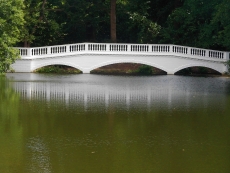
A wide terrace at the rear of the mansion overlooks a sweeping panorama including a lake at the bottom of the grassy slope that falls away from the terrace. From this vantage point, the viewer can see what looks like a fine bridge with balustrades and three arches at the eastern end of the body of water. However, what meets the eye is not a bridge, but a sham, a trompe-l’oeil, made in wood to produce a picturesque view. It was designed by Robert Adam and constructed in about 1767 and fully restored in the late 20th century.
The bridge has survived the progression of time, but another structure that was a notable feature on the side of the lake furthest from the House has not. This was an edifice shaped like the quarter of a sphere. Within this shelter, a whole symphony orchestra could be comfortably seated with their instruments. On summer evenings, orchestras used to play music that travelled across the lake to huge audieces seated on the grassy slope leading down to the water.
I used to attend these concerts occasionally during my younger days. They were, as I can recall, often on Saturday evenings. Two kinds of tickets were available. The costlier ones allowed a person to sit on one of the deckchairs arranged in rows on the part of the slope closest to the lake. The cheaper ones permitted holders to sit on the grass above the rows of deckchairs. Many people, who sat on the grass, brought rugs and picnics, which they enjoyed whilst listening to the music. I have never liked sitting on the floor and always preferred to experience the concert in a comfortable deckchair.
It was delightful sitting outside hearing well-performed music whilst the sun set slowly, and the twilight enveloped us all. The acoustics were good, but the first halves of many concerts were subject to the frequent the competition from noisy aeroplanes passing overhead. Usually, by the second half of the performance, there were few interruptions by ‘planes.
When we returned to Kenwood yesterday, the orchestra ‘dome’ was not visible. Where it had been has been replaced by bushes and trees. There is not a trace of it left. It looks as if it had never existed and I worried that maybe my memory had played a trick on me. We stopped a couple of elderly women and asked them about the concerts. They remembered them well and told us that they had been stopped a few years ago because, incredibly, local residents had complained about being disturbed by the noise (and increased traffic) during the few events that occurred each summer.
The lakeside concerts were held every year between 1951 and 2006, the year the English Heritage was forced to put an end to what had been a lovely annual event and an important money-spinner for them. I remember those concerts with fondness and hope that the wealthy inhabitants who live around the area, quite distant from the lake, will one day relent to allow music lovers to enjoy fine music wafting across the water. Well, as often is the case, money has more clout than culture.




 yamey
yamey 