THREE YEARS AGO, I published a book about west London past and present. In it, I made a brief mention of a pub, the Windsor Castle, which is near to Notting Hill Gate. This is what I wrote in the book:
“At the western end of Peel Street, there is another pub, The Windsor Castle. Unlike the Peel Arms, this is a working establishment, now popular with the locals, most of whom are definitely not poorly paid labourers. The hostelry was originally built in about 1826, and then remodelled in 1933. The pub contains much of its original late Georgian building fabric and is a Grade II listed place.”
A tiny door
Although the pub is a mere 5 minutes’ walk away from our home, where I have been living for more than three decades, I only entered it for the first time today, the 24th of August 2025. On entering, we were given a warm welcome by the pub’s manager before we sat at a table in the shade of a tall tree that overlooks the hostelry’s enclosed garden.
Within the pub, the furnishings look quite old. A notice on the wall draws the attention of visitors to some very low doorways in the wooden screens that divide the interior into separate rooms. The notice relates that in the seventeenth, eighteenth, and nineteenth centuries, families ran pubs. The children of the landlord and landlady used to work in the pubs, delivering food and drinks. They would enter and exit the areas where the customers were enjoying food and drinks through the tiny doors such as still can be seen at the Windsor Castle, closing the doors behind them. The pub’s patrons were not allowed to use these little doors. They had to stay in the sections of the pub that were reserved for their social status: the public bar, the private bar, the sherry bar, and so on.
Just as I had never entered the Windsor Castle before, I had never seen these tiny doorways in any of many pubs I have visited.
SHOPS IN LONDON’S High Street Kensington are forever changing hands. And each time a new lessee takes over a shop, he or she brings in builders to alter the shop’s appearance. Today (in July 2025), I passed a currently empty shop undergoing a change in the appearance of its façade. The front of the shop had been stripped down, and as a result the name of one of the businesses that had formerly used the premises had been revealed. The old shop sign at number 13 High Street Kensington read “Blooms (1920) Ltd.”.
When I tried looking this up on Google, by entering various combinations of search words, I was shown a list of flower shops, none of which are at 13 High Street Kensington. And, sadly, nothing came up that revealed any information about Blooms Ltd, which had once occupied the premises. So, if anyone knows anything about the business conducted by Blooms (1920) Ltd, do please let me know.
AT THIS TIME OF the year (April), many walls in London are partly hidden behind the exuberant bunches of flowers sprouting from the twisted trunks of Wisteria plants.
The Wisteria was originally grown in China, Japan, Korea, Vietnam, southern Canada, the north of Iran, and in the east of the USA. The first Wisteria plant to be grown in Britain was imported from Canton in China in 1816, This was a Wisteria sinensis plant. In 1830, another variety was introduced from Japan. Both varieties have both mauve flowers and white flowers.
In and around London’s Kensington, where I live, although both colours of flower can be seen, the mauve outnumbers the white.
THE ARTIST LS LOWRY (1887-1976) often gives prominence to street lamps in his paintings and drawings. In a few of his pictures, he includes overthrow lamps. These are lamps held by semicircular cast iron hoops above gateways or entrances.
An overthrow lamp drawn by Lowry
In his book “Lowry’s Lamps”, Richard Mayson noted that overthrow lamps were Georgian in origin and are more likely to be found in front of elegant houses Bath or London than in Manchester, where Lowry created most of his compositions. Manchester did not have many of these smart dwellings. The few examples of this kind of lamp in Manchester were usually to be found at public spaces, such as parks and cemeteries.
Mayson noted that Kensington Square in London is rich in these lamps. Today, I visited the Square, and found that what he wrote is accurate. By the way, his book is an excellent appreciation of Lowry and his work.
SEVERAL MONTHS AGO, I watched a wonderful film set in Japan and directed by Wim Wenders: “Perfect Days”. Set in Tokyo, the main character is a man who cleans the city’s public toilets. Each of the public conveniences he cleans is of a different design. And each of them, like so many things designed in Japan, is a beautiful work of art. Making things and places look special and visually pleasing seems to be an important feature of the Japanese philosophy of life, and has been since time immemorial. Yet, unlike many other countries, Japan has not yet established a dedicated national design museum.
Until the 8th of September 2024, the Japan House in High Street Kensington is hosting an exhibition called “Design Discoveries”. The website of the Japan House (www.japanhouselondon.uk/whats-on/design-discoveries-towards-a-design-museum-japan/) explained:
“This exhibition brings together seven major designers, from filmmakers to architects, to consider what they would put into a permanent collection of design treasures. Their personal responses capture Japan’s regional diversity and 10,000 years of history.”
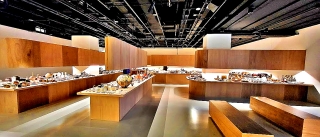
The beautifully laid out exhibition is not merely educational but also a feast for the eyes. Examples of Japanese design (and technology) dating from about 4500 years ago to the present century are beautifully displayed and intelligently explained.
Should the Japanese eventually get around to creating a museum of design, I am certain that visiting it would be a very exciting experience. Meanwhile, if you can get to Japan House – a beautifully designed place – you should not miss visiting the exhibition in its basement.
Here is a brief excerpt from my illustrated book “BEYOND MARYLEBONE AND MAYFAIR: EXPLORING WEST LONDON”. It concerns a curiously shaped building constructed in the early 1960s in Kensington:
“Returning to High Street Kensington, the eastern wall of the Melbury Court block of flats bears a plaque commemorating the cartoonist Anthony Low (1891-1963), who lived in flat number 33. Set back from the main road, and partly hidden by two hideous cuboid buildings, stands an unusual glass-clad building with an amazing, distorted tent-shaped roof made of copper. This used to be the Commonwealth Institute. Built in 1962 (architects: Robert Matthew Johnson-Marshall & Partners), I remember, as a schoolboy, visiting the rather gloomy collection of ethnographic exhibits that it contained shortly after it opened.
The Institute closed in late 2002, and the fascinating building stood empty until 2012, when it was restored and re-modelled internally. In 2016, it became the home of the Design Museum. Like the architecturally spectacular Guggenheim Museum in Manhattan, the building competes with the exhibits for the viewer’s attention but wins over them easily. The displays in the Design Museum are a poor advert for the great skills of British designers, whereas the building’s restored interior is a triumph. This is a place to enjoy the building rather than the exhibits. One notable exception to this comment is the sculpture by Eduardo Paolozzi (1924-2005), which stands outside the front of the museum.”
You can discover much more about Kensington and many places west of it by reading my book, which is available (as a paperback and a Kindle) from Amazon:
THERE IS A SHORT crescent lined with elegant residential houses near to the Kensington Temple church close to the centre of London’s Notting Hill Gate. A few yards west of this there is a short cul-de-sac called Horbury Mews. The crescent also bears the name Horbury. Although I have passed them often, it was only today that I wondered about ‘Horbury’.
Both the Crescent and the Mews were built on land that was leased to William Chadwick in 1848 by Felix Ladbroke, heir of the property developer and landowner James Weller Ladbroke (died 1847). William, a developer, built many houses on the Ladbroke Estate in Kensington. His heir WW Chadwick constructed the houses on Horbury Crescent between 1855 and 1857. The mews nearby bear the date 1878, which is prominently displayed on one of its buildings. The mews was constructed on a former nurseryman’s grounds. They served to house horses and servants of the nearby houses. Today, they are homes for the well-off.
The name Horbury derives from the nearby Kensington Temple, which was built in 1848-49, and was then called ‘The Horbury Chapel’. The name was chosen because the hometown one of its first deacons was Horbury in Yorkshire.
So, two street names in a little part of Kensington commemorate a small town in Yorkshire. I did not expect to discover that.
ALTHOUGH IT IS NEAR where we live, I had never heard of the Cosmic House at 19 Lansdowne Walk near Holland Park. Recently, our daughter went to a special event there and was so impressed by the place that she very kindly gave me admission tickets for my Father’s Day gift.
Cosmic House, initially called ‘Thematic House’, was designed by the American born writer, theorist, and architect Charles Jencks (1939-2019). It is a heavily modified building first erected in the early 1840s. Jencks purchased it in 1978 and had completed most of its many dramatic alterations by 1983. It is a song of praise to Post Modernism. Because Jencks was fascinated by cosmology, the house’s various rooms and other spaces have been designed with cosmological ideas in mind. For me, the most exciting element of this house is the spiral staircase from which all the rooms on various levels can be accessed. Each room contains a riot of decorative motifs. Jencks let his imagination run wild. Some of the rooms, such as the library and the jacuzzi area (inspired by a dome designed by Borromini), are extremely effective. Some of the other rooms, are, as Jencks can be heard admitting in a film we were shown, a bit ‘over the top’.
The shapes of the rooms and the various spaces in Cosmic House show that Jencks was a great architect. However, I felt that they were somewhat disguised by the flamboyant interior décor, which was designed mainly by Jencks. With natural light accessing the building in many ingenious ways and the profusion of objets d’art in many of the rooms, we were reminded a bit of the ‘atmosphere’ of the Sir John Soane Museum in London’s Lincolns Inn Fields.
As a Father’s Day gift, a visit to Cosmic House was certainly original. It is a place worth visiting, possibly on the same day as a visit to another highly original edifice nearby – Leighton House.
JOHN LINNELL (1792-1882) painted the Kensington gravel pits in about 1811. The picture hangs in London’s Tate Britain These pits lay alongside Bayswater Road and Notting Hill Gate. They provided gravel for building projects in England and as far away as Imperial Russia.
Today, the pits no longer exist. They have been built over, but street names such as St Petersburg Place and Moscow Road commemorate the fortunes made by selling gravel from these pits to Russia.
You can discover more about this and much more about Paddington and Kensington and points further west in my book “BEYOND MARYLEBONE AND MAYFAIR: EXPLORING WEST LONDON” (see https://www.amazon.co.uk/gp/aw/d/B0B7CR679W/
CONSTRUCTED IN 1974, it was 221 feet tall. It overshadowed the homes of many people including many of the wealthier inhabitants of West London’s Kensington. And I imagine that the wealthy inhabitants of the elegant crescents and other thoroughfares near it did not appreciate the views from their windows being spoiled by this Brutalist block of flats containing less well-off people, about whom they would rather not think. Between 2015 and 2016, the block was refurbished and made less of an eyesore by the addition of cladding – ostensibly to improve insulation – to its exterior.
On the afternoon of the 13th of June 2017, I was walking around North Kensington, taking photographs as usual. I stopped to take pictures of the recently built Kensington Leisure Centre and its near neighbour the Kensington Aldridge Academy – both are interesting examples of contemporary architecture. While I was taking these photos, I had my back to the tower block I have just described. Had I looked at it then, I would have thought that it would have been of little interest to me. How wrong I was.
Just after midnight on the following day, a fire broke out in that tall block – Grenfell Tower – that edifice which overlooked the homes of the wealthy residents of Kensington. The fire spread rapidly because of the highly inflammable nature of the cladding used to make the tower more attractive to its neighbours. Seventy-two people died in the conflagration; many were injured; and all the surviving residents were not only badly scarred psychologically, but also lost their homes and possessions.
From wherever you looked in a large area around Grenfell, including from the homes of the prosperous residents of Holland Park and Notting Hill, one could see the horrifically charred tower block – a fear-inspiring eyesore – the result of local government officialdom ignoring repeated warnings about the already known potential fire hazards that the cladding presented and inadequate planning for escape during a fire. I felt – and I am not alone in thinking this – that the local council hardly cared for a few impecunious residents in a tower block. What was more important was to save money so as not to impose high local taxes on people who could have easily afforded to pay them.
Soon after the fire, the charred tower was covered with protective wrapping to assist forensic investigations and to contain debris, which might otherwise have flown away and dropped in the neighbourhood. It also removed from sight the scarred, charred remains of the building – a 24 hour a day reminder of the avoidable, tragic loss of life, which was not altogether disconnected with civic and possibly criminal negligence. The remains of the tower are still covered up. Before the heart-rending remains of the conflagration were covered up, filmmaker Steve McQueen (born 1969 not far from Grenfell Tower) made a short film about the tower. It is currently on show at the Serpentine South Gallery in Hyde Park until the 10th of May.
The film is without words in its soundtrack and without any captions. It looks as if it might have been filmed with a drone or a camera held within a helicopter. It begins with a flight over beautiful countryside far beyond the edge of London. The camera moves above the scenes of rural serenity and slowly the city of London comes into view. We pass over London’s sprawling suburbs, and then the charred Grenfell Tower begins to be seen in the centre of the screen. The camera moves closer and closer to the blackened building, and then slowly circles around it many times. Each time the tower is slowly encircled, and the camera moves closer to it, more and more details of the destruction entered my consciousness, and my understanding of the horror of what had befallen Grenfell and its inhabitants gradually increased. As the camera moved around the wreck, you could catch glimpses of the parts of London surrounding it – the houses and flats of those who must have witnessed the fire, but were not affected by it, at least not physically. As the camera moved, one could see trains moving on nearby tracks and vehicles travelling along roads. I felt that I was witnessing life going on as usual at the same time as witnessing the horrors of a disaster. The absence of commentary added to the powerful impact that seeing these images of a lethal incineration simultaneously with scenes of normality made on me. There was a soundtrack, which consisted of recordings of everyday sounds – both natural and man-made. However, while the camera encircled the tower of death, there was no sound at all. I wondered whether this signified the fact that the victims, who had died, will no longer be able to enjoy the sounds of everyday life.
McQueen’s film is a sophisticated and solemn memorial to an event that could easily have been avoided. Without a soundtrack or explanations, the viewer is left to ponder the tragedy in his or her own way.