MOST PEOPLE ASSOCIATE Varanasi (Benares) with Hindu temples and practices. However, the city is important to other religions, notably Islam.
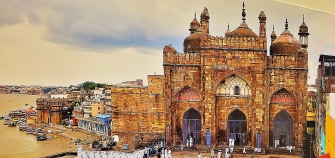
The largest mosque in Varanasi
Recently, we viewed an exhibition called “Mughal Banaras” at SOAS Gallery in London. It was a collection of excellent photographs taken by architect and photographer Jateen Lad who collaborated with historian Malavika Kasturi.
In a Hindu math (monastery) which existed during the time when the city was under Mughal rule, there is a collection of Mughal firmans (official documents) on display, including one written by Dara Shikoh, who was murdered by his brother Aurangzeb).
We were fortunate to have met Jateen at the exhibition, and he showed us around. His superb commentary brought the pictures to life, and discussed the historical importance of, and the current circumstances of the Muslims in the city.
A DARGAH IS a shrine enclosing the grave of a (usually) Sufi saint or ‘pir’ (a Sufi spiritual guide). During my travels in India, I have visited many dargahs. Today (27 November 2025), we came across a dargah close to the Imli Ghat and the city wall by the shore of Pichola Lake in Udaipur.
The tree growing within the dargah
The dargah was contained in a decoratively perforated stainless steel enclosure. Part of the shrine is the trunk of a tall, growing tree. A gentleman who has a shop nearby showed me that part of the trunk is hollowed out. This space is covered by a decorated cloth such as can often be found draped on Muslim gravestones. Fresh flowers were scattered at various places in the dargah.
What interested me is something I have noticed before in dargahs. That is the presence of smoking agarbatti (incense sticks), similar to those used at Hindu religious shrines and temples.
In the case of the dargah near the Imli Ghat, another feature that caught my attention was the tree growing within it. Maybe, it was not significant, but it reminded me of the multitude of Hindu shrines located around the trunks of trees.
In my book “CORACLES AND CROCODILES: 101 TALES OF INDIA”, I have written about practices shared by both Hindus and Muslims in India. Although the two religions differ considerably, it seems to me that some rituals (rather than beliefs) are commonly used by Indian adherents of both of them. Some other commonalities related to religious rituals are also described in my book.
THE LETTERS ‘CITU’ stand for the Centre of Indian Trade Unions, which was founded in 1970. Its ‘logo’ includes the hammer and sickle, a symbol first used on some Chilean coins as early as 1894. However, it became widely recognised after 1917 when it was used as a symbol during the Russian Revolution, and long after it was over.
Today, I spotted a small street stand erected in Pondicherry by the CITU. It is located on the corner of Rue du Bazar St Laurent and Beach Road (Goubert Avenue), which runs along the seafront. It has three white hammer and sickles, each on a red background. One of these symbols faces in the opposite direction to the other two.
Now, here is what interested me. Two of the Communist symbols decorate the stone supports of a short table or bench. Running along the length of the bench and slightly above it, there is a row of religious images. Four of them depict Hindu deities, three of them are images of Christianity, and one, showing two mosques and the Holy Koran, is connected with Islam.
I suppose that this might reflect the fact that local members of the CITU are adherents of these three religions. But, I am only guessing.
SEI VUI IS OUR favourite Chinese restaurant in Kolkata. It is located on Black Burn Street that runs through what remains of the city’s old Chinatown. Black Burn Street runs off a busy main thoroughfare: Khirode Vidya Binode Avenue. On Friday, the 27th of December 2024, we walked to Sei Vui from Dalhousie Square at just after midday.
When we arrived at Khirode Vidya Binode Avenue, we saw something we had never observed before. There were many Muslim men in rows of four or five lining the north side of the road for many hundreds of yards. They were all facing the same direction. Some of these rows had many more men and extended into side streets including Black Burn Lane. Each man was barefooted and had his own prayer mat. This long line of men were performing Friday prayers. Every now and then they prostrated themselves on their mats, and then stood up again.
Our host and friend at Sei Vui explained that the local mosque is too small to accommodate the large number of Muslim men in the area. So, they pray in the street, facing the mosque. He said that he thought that what we had seen was a phenomenon unique to Kolkata. He believed that most other Muslims would not consider worshipping out on a busy street. On special occasions, there are so many worshippers that Khirode Vidya Binode Avenue has to be closed to vehicular traffic during the prayers.
It so happens that Khirode Vidya Binode Avenue runs in a mainly east/west direction. Also, the east end of the avenue is very slightly south of its west end. This being the case, by facing westward, as the worshippers were doing, one is looking approximately towards Mecca, which is west of Kolkata and slightly north of it.
We had an excellent lunch at Sei Vui. After we had finished, the prayers were over, the worshippers had left, and the avenue was back to normal.
IN MY BOOK “Coracles and Crocodiles: 101 Tales of India”, I have described how practices associated with Hinduism can sometimes be seen in Indian mosques. This is particularly true in the Sufi dargah (shrine) in Ajmer, where Khawaja Gharib Nawaz (1143 – 1236), also known as ‘Muʿīn al-Dīn Chishtī’, buried. According to Wikipedia, he was:
“… one of the first major Islamic mystics to formally allow his followers to incorporate the “use of music” in their devotions, liturgies, and hymns to God, which he did in order to make the ‘foreign’ Arab faith more relatable to the indigenous peoples who had recently entered the religion.”
The shrine is in a large compound containing a mosque and other shrines in the heart of Ajmer.
The dargah compound is much visited, not only by Muslims but also by adherents of other religions: Hindus, Sikhs, etc. Visiting the dargah is considered to be a very special auspicious event. Visitors of all religions buy baskets of red petals to place on the various shrines in the complex. In many places, there are Muslim clerics who bless you by tapping your head with what looks like a large peacock feather duster. In exchange for this benediction, the recipient is expected to leave a financial donation. If the donation is large enough, it and your name will be recorded in a ledger, and you will receive a receipt. If it is insufficient, the cleric appears to pocket it.
Apart from the groups of musicians playing and singing qawwalis (قوّالی). surrounded by appreciative pilgrims seated around them, there were several other things that interested me. All of these can be found in Hindu places of worship. They include burning incense sticks (agarbatti); lighting diyas (oil lamps) and placing them in holders such as can be found in Hindu temples; and tying threads to parts of the shrines. Another activity that I found unusual in a Muslim place of worship was blessing of pieces of cloth that were then tied around the pilgrim’s head.
The atmosphere in the dargah compound was lively and festive. People seemed happy to be there. And surprisingly for someone like me, who is not particularly religious, I felt that the place seemed very holy. This might be because those around me were at the dargah not as an obligatory ritual but because they believed strongly in its holiness.
IT IS THE AMBITION of many Muslims to make a pilgrimage to Mecca. Part of this involves visiting a sacred black stone, the Ka’abah, which is cuboidal in shape. One part of the annual pilgrimage, the Haj, involves pilgrims circling the Ka’abah seven times clockwise – a ceremony known as the ‘Tawaf’.
The artist and physician Ahmed Mater, who was born in Saudi Arabia in 1979, has created artworks based on the pattern created by the pilgrims circling the Ka’abah, as seen from above. Some of these are aerial photographs, but others are based on magnetism. Those who have studied physics even at an elementary level will be familiar with the demonstration of the shapes of magnetic fields that can be achieved by scattering iron filings near a magnet on a sheet of paper. The magnet arranges the filings in a pattern that corresponds to the shape of its magnetic force field.
What Ahmed Mater did was to create a cubic magnet in the shape of the Ka’abah. Then he scattered iron filings around it on a sheet of paper. The filings then arranged themselves according to the magnetic field of the cuboid magnet. Next, the artist gave the magnetic miniature Ka’abah a twist. This caused the filings to rearrange themselves into swirls, which when viewed from above, resemble the pilgrims encircling the sacred stone in Mecca.
This simple artwork demonstrates not only the fascination of magnetism, but also the spiritual magnetism of the Ka’abah, which draws Muslims to Mecca. In discussing this work of art, Tim Mackintosh-Smith makes an interesting point:
“But Ahmed Mater’s magnets and that larger, Meccan lodestone of pilgrimage can also draw us to things beyond the scale of human existence, and in two directions at once – out to the macrocosmic, and in to the subatomic. In the swirl of Ahmed’s magnetized particles and the orbitings of the Mecca pilgrims are intimations of the whirl of planets, the gyre of galaxies.” (www.ahmedmater.com/essays/magnetism-tim-mackintosh-smith).
The artworks based on magnetism and the Tawaf, are just a small selection of the intriguing, beautiful works by Ahmed Mater, which are currently being exhibited at Christies in King Street (London) until the 22nd of August 2024.
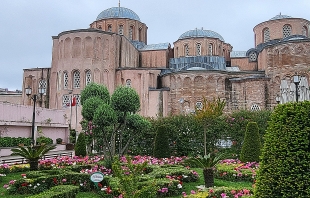
THE MOLLA ZEYREK mosque stands high on one of Istanbul’s seven hills. From its garden, which has a pleasant café, you can enjoy a wide panorama that includes views of the Bosphorus, the Golden Horn and bridges crossing it, the Galata Tower, the great Suleymaniya Mosque, and many other historic buildings around it. Turn your back on the view, and look across the well-kept flower garden, then you will see what looks like a large Byzantine church with three apses and several domes. However, as you stroll around this building, you will soon notice that it has its own minaret. This mosque was a church before 1453 when the Ottomans captured Constantinople/Istanbul.
As is the case with many other places of historic interest in Istanbul, there is an informative notice outside the mosque, written in three languages (Turkish, Arabic, and English). It outlines the history of the mosque. The building, designed by the architect Nikeforos, was built in the 12th century by Eirene (died 1134), the wife of Emperor Ioannis II Komnenos (ruled 1118-1143). Her father was King Laszlo I of Hungary. The edifice which is, in fact three churches joined in one building were the churches of the large Pantokrator Monastery. This institution included a 50-bed hospital, a library, an old-age home, a sanctuary for lepers, a medical school, a pharmacy, and a holy spring. The triple church was exceptional because:
“Except for the Church of the Holy Apostles, no other Byzantine building received as many imperial burials. John II (1118-43) and Eirene (Piroska of Hungary), their son Manuel I (1143–1180), and his wife Bertha of Sulzbach, were buried there, as were the Palaiologan emperors Manuel II and John VIII in the 15th century. In front of Manuel’s black marble sarcophagus was the Stone of Unction (a marble slab on which Christ’s body laid after his crucifixion), which Manuel brought from Ephesus around 1170. The large funerary chapel of the Archangel Michael is described by the typikon as a heroon – the shrine of a hero later used for the imperial mausoleum of Constantine and his imperial successors at the Church of the Holy Apostles.” (www.thebyzantinelegacy.com/pantokrator-monastery)
These monuments can no longer be found in the building.
Soon after Mehmet the Conqueror captured Istanbul, the monastery was converted into a madrassa. It became the first educational establishment created by the Ottomans in Istanbul. The monastery’s monk cells became cells for the madrassa and the triple church, suitably modified with a minaret, a mimbar, a mihrab, and other Islamic features, became a mosque with two classrooms for religious instruction. One of the new establishment’s professors was Molla Mehmed Efendi, nicknamed ‘Zeyrek’ – now, part of the mosque’s name. This learned man not only offered education to those who were already Muslim, but also to those who converted to Islam. In addition, he was instrumental in persuading many local people to convert to his religion.
Apart from the former church complex, now mosque, the other monastery/madrassa buildings have disappeared. This century, what had become an unusable, badly dilapidated structure was restored, and is now back in use as a mosque. The mosque occupies the southernmost of the three chapels. The other two chapels, although attractively painted, were empty spaces. One of these once served as the Byzantine Imperial mortuary chapel.
The Molla Zeyrek Mosque was formerly a Byzantine church. When the Ottomans took Istanbul, rather than destroying the places of worship of their Christian enemies, they recycled or repurposed them – they modified the churches and converted them to become mosques. Probably, the best-known example of this is Istanbul’s enormous Ayasofya-i Kebir Cami-i Şerifi (i.e., the ‘Hagia Sophia Grand Mosque’), constructed in the 6th century. Apart from Ayasofya, which we walked past almost every day during our recent 16-day visit to Istanbul, The Molla Zeyrek mosque was one of the most impressive and largest former Byzantine churches that we saw in the city. However, my favourite of these recycled churches was near where we were staying: the Kucuk Ayasofya Mosque, in whose charming walled garden we enjoyed numerous glasses of tea, met many friendly Turks, and watched the antics of the garden’s large feline population.
I have visited many cities in America, Asian and Europe. Many of them are fascinating, but now I can safely say that amongst these wonderful places, Istanbul has become my favourite because here the past, present, and future blend together with an exciting vibrance.
ON OUR LAST visit to Istanbul at least 15 years ago, we visited a small but attractive mosque in Üsküdar (the Asian part of Istanbul). During our present holiday in the city (in April 2024), we hoped to see this mosque again, but we had forgotten its name.
After having waited for the midday Friday prayers to be over at the Atik Valide Mosque, we looked around this edifice that was designed by the famous architect Mimar Sinan in 1583-1584. Incidentally, to reach this building, we climbed a steep staircase with 114 steps – a so-called short cut. Apart from its fine architectural form, the mosque is adorned with several lovely tiled plaques covered with Arabic calligraphy intertwined with the occasional flower.
As we were leaving the mosque’s enclosed compound, a man stopped us, and told us in broken English that we should visit another mosque in the neighbourhood. He said it had beautiful tiling, and it’s name is Çinili. When we heard the name, we remembered that was the mosque, whose name we had forgotten.
Çinili mosque
After climbing another hill, we reached the Çinili mosque. Completed in 1640, it is not as fine architecturally as buildings by Sinan. However, it’s interior is lined with intricately decorated tiling. Unfortunately, the mosque was locked up, but by peering through the windows we got a good impression of the magnificent tiling. The wall of the covered porch in which the main entrance can be found is also covered with beautiful tiling. What we saw was what we remembered from our first visit there at least 15 years ago. We were very grateful that a complete stranger reminded us of the name of the place that we remembered, but whose name we could not recall.
PS both mosques mentioned above were connected with a Valide Sultan – that is with the mother of a reigning Sultan.
IN 1492 THE ANDALUSIAN Arabs were thrown out of Spain. Just like some of the Jewish people who were expelled at the same time, some of the Arabs came to Istanbul, which had been under the rule of the Islamic Ottomans since 1453, when they captured the city from the Byzantine rulers.
In 1475, Fatih Sultan Ahmed converted a church in Beyoglu to a mosque, known as the Galata Mosque. Today, this mosque, whose interior feels (but does not resemble) more like that of church, is now known as the ‘Arap Camii’ (Arab Mosque). This is because the Arabs forced to leave Andalusia settled in the area around the mosque, and used it for worship.
From the outside, the mosque could easily be mistaken for a church. This is because of its shape and what had once been a tall square bell tower. The tower is now topped with a conical feature, such as is found on the tops of most minarets. However at the Arap Camii, the conical object could be mistaken for a church steeple.
We visited this large mosque. The interior is rich in timber features, and looks as if it has been recently restored or renovated. An informative sign outside the mosque stated that when the building was repaired in 1913, Christian gravestones commemorating the deaths of people from Genoa (Italy) were discovered, and placed in a museum of archaeology.
We would have been unlikely to have visited this interesting mosque had we not taken a wrong turning. As the saying goes ‘every cloud has a silver lining ‘.
THE HAZIRA MAQBARA is an impressive octagonal structure in Baroda (Gujarat). It was built in about 1586 in the Mughal style of architecture, such as can be found in Delhi. This beautiful mausoleum houses the graves of Qutb-ud-din Muhammad Khan who was the tutor of Salim, son and successor of Akbar, and also that of his son Naurang Khan who held important posts in Gujarat under Akbar. There are other graves within the building and also nearby on land near it.
The various graves are covered with colourful cloths upon which red rose heads are placed. The roses are replaced daily, and the cloths every Thursday. This we were told by an elderly man who had been praying loudly within the main central chamber of the mausoleum.
Apart from the beauty of the building and its wonderful jaalis (latticework window screens), I was impressed by some things that I have noticed in many other Muslim mausoleums in India.
Incense stick near some gravestones
Within the mausoleum and close to the graves outside it, there were incense sticks (agarbatti) burning, releasing small clouds of fragrant smelling smoke. Within the mausoleum, I spotted at least two oil lamps (diyas), each with small flickering flames.
Agarbatti and diyas are commonly found in Hindu temples, and often at the beginning of the day in shops, restaurants, etc. I first noticed them being used in Islamic settings in India in Sufi dargahs (shrines containing graves) in Bangalore when going on excellent guided walks led by my friend Mansour Ali. Later I begun noticing these things, which I had initially assumed were only associated with Hinduism, in places associated with Islam. I have discussed this commonality of Hindu and Muslim practices in one chapter of my new book about travels in India, which is available from Amazon (eg https://www.amazon.co.uk/HITLER-LOCK-OTHER-TALES-INDIA/dp/B0CFM5JNX5/ ) AND if you live in India, from https://store.pothi.com/book/adam-yamey-hitler-lock-and-other-tales-india/ .
Other chapters in my book about my experiences of visiting India cover a wide variety of subjects. The book, which is aimed both at those who ‘know’ India and those who do not, is both informative and entertaining.





 yamey
yamey 