A pavilion for Ramadan

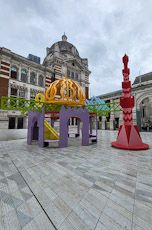
IN 2023 RAMADAN WILL occur between about the 22nd of March and the 21st of April. To celebrate this holy Islamic month, a colourful pavilion has been erected in the courtyard of the Exhibition Road entrance to the Victoria and Albert (‘V&A’) museum. It has been designed by Shahed Saleem and set up by The Ramadan Tent Project and the V&A. According to the museum’s webpage (www.vam.ac.uk/event/ok1kLZm29xJ/ramadan-pavilion-march-may-2023), the pavilion:
“…draws inspiration from the V&A’s Prints and Drawings collection to represent the history of the mosque and Muslims in Britain.”

Another webpage (https://www.vam.ac.uk/blog/museum-life/the-ramadan-pavilion-by-shahed-saleem) contains some interesting information about the history of Islamic edifices in the UK. The first mosque in Britain was built in 1889 in Liverpool by 20 British converts to Islam. It was housed in a Georgian terraced house. Since the arrival of many Muslim migrants in the UK im the 1950s and ‘60s, there is now a sizeable Muslim population in the country, and they worship in Britain’s approximately 1800 mosques. The earliest of these were in converted buildings, but now there are plenty of purpose-built mosques. Of these, one of the most beautiful and original is the mosque in Mill Road, Cambridge.

Shahed Saleem is an architect who specialises in designing mosques. Apparently, his pavilion at the V&A is the result of years spent studying mosques in Britain. With his Ramadan Pavilion, Saleem hopes that it will encourage people, who have never entered mosques, to explore mosque architecture and encourage them to enter these holy places to discover more about them. Well, that is an admirable aim, but from what I have seen of the pavilion, it is unlikely to fulfil that aim.

Undoubtedly, Saleem’s pavilion incorporates elements of mosque architecture and design. Sadly, it looks to me more like a children’s play area than a homage to Islamic architecture. I love Islamic architecture, but feel that the multi-coloured pavilion, which resembles something made with over-sized Lego bricks, does not respect the great beauty, delicacy, and intricateness that can be found in mosques both old and modern.

DEFACED TO DEFY: an exciting exhibition in Cambridge

POLITICAL PROTEST AND CONFLICT can be expressed in a wide variety of ways. Defacement of commonplace items is one of these. It forms the basis of a temporary exhibition, “Defaced!”, being held at the Fitzwilliam Museum in Cambridge (Cambridgeshire) until the 8th of January 2023.

Many of the exhibits on display are banknotes that have been defaced or altered in design to express a political message or protest.  One example of this is a five-dollar US banknote with the words “All Lives Can’t Matter until Black Lives Matter” embossed on its portrait of Abraham Lincoln. Another is a five hundred Indian rupee note with a coloured picture of an endangered rare bird printed over it. Yet another banknote is designed to look like a British £20 note at first sight, but it soon becomes apparent that it is not what it seems: it has been modified to include a portrait of ex-Prime Minister Boris Johnson and the words “The ruling class. We own you.” It also includes the words “We were born to lead, you were born to follow.” Other banknotes have been redesigned so that they appear to be valueless: e.g. zero Japanese Yen and zero US Dollars. The diversity of altered banknotes and parodies of actual banknotes on display is staggering.

Occasionally banknotes lose their value during periods of hyperinflation. The exhibition includes several examples of objects, such as wallets, made using trashed valueless notes. Particularly striking is a life-size sculpture of a hand grenade made using shredded PRC ten Yuan banknotes.

There are also many coins on show. They have all been altered to express protest and/or political sentiments. One dramatic example of this is a coin issued in France during the reign of Napoleon III. This was altered by carefully cutting around and removing the portrait of Napoleon III from the coin, leaving the rest of the coin intact. There are several coins and medals on display that depict political events such as the American Revolution and the Peterloo Massacre. A few coins relate to the unrest in Northern Ireland. One of them is a 1970 Republic of Ireland fifty pence coin with the words “Ulster is British” stamped on it.

The show at the Fitzwilliam does not confine itself to the defacement and parody of currency for political and protest purposes. It also includes currency either modified or specially created for special purposes. Simple examples of these are overprinting of low value notes during hyperinflation and modification of currency for use by the military or in POW camps. There are also coins, notes, and certificates created for specific purposes, for example for use in the Siege of Mafeking and for use by Boer prisoners imprisoned by the British in India.

Although most of the exhibits are related to currency (coins and notes), one room is dedicated to a spectacular sculptural exhibit, an installation called “Big Bang 2. Debt in transit”. A video is projected onto a wall. It shows a Ford Transit van being blown up by explosives. As it flies into pieces, bits of paper all marked with the word ‘debt’ float down like snowflakes. The film is projected in a room in which the fragments of the van are suspended from the ceiling so that the viewer appears to be seeing a still from the video but in three dimensions. The installation, which is a protest on the exorbitant interest on payday loans, makes a very powerful visual impact. (SEE my video of this posted on YouTube: https://youtu.be/7MgdDTfBivw)

Seeing things differently

I DOUBT THAT Auguste Rodin (1840-1917) would have ever imagined that a copy of his sculpture “The Kiss” (created 1901-1904) could have ended up being displayed bound up in one mile of string. Situated in the lower ground floor foyer of London’s Tate Britain gallery, that is what can be seen currently (August 2022). The British artist Cornelia Parker (born 1956) decided to wrap-up/tie-up a replica of “The Kiss” as described. You might wonder why. I cannot tell you, but make the observation that we all perceive things differently. And one of the skills that has united artists over the centuries is that they can express to other people the way they perceive and understand the world they observe. Rodin’s bound sculpture stands close to the entrance of an exhibition dedicated to works by Ms Parker, which runs until the 16th of October 2022.

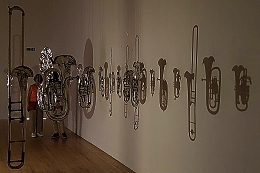
Part of “Perpetual Canon” by Cornelia Parker

The exhibition consists of artworks of varying sizes including visually dramatic installations, each large enough to fill a spacious room in the gallery. All the works are labelled. These labels explain how they were created and the concepts, some of them with political aspects, that the artist intended to express. When I look at works of art, I am primarily stimulated by their appearance and the visceral emotions they evoke in me. I am less interested in the concepts being portrayed and the artist’s explanations. Therefore, amongst the exhibits in the Parker exhibition, it was the installations that both interested me and excited me most.

The installation “Thirty Pieces of Silver” consists of domestic silver plate items that were squashed beneath a steam roller. Each piece is suspended above the ground by fine threads attached to the ceiling. They are arranged in thirty separate groups and lit from above. The shadows of the silver objects are projected on the floor below them. This delicate-looking installation’s name is taken from the 30 pieces of silver, which Judas received for betraying Jesus.

A spectacular installation, “Cold Dark Matter: An Exploded View”, is housed in another room. Parker arranged with the Army School of Ammunition to use Semtex (as used by terrorists) to blow-up her garden shed (filled with tools and other stored objects). Then, all the fragments were recovered, and one by one they were suspended from the ceiling of the gallery in such a way that the ensemble resembles a still from a film made whilst the shed was exploding. In the middle of all the suspended debris, there is a single light bulb shining. This throws the distorted shadows of the blackened fragments onto the gallery’s walls.

In another room, there was an installation, which also made effective use of reflections projected on to its walls. “Perpetual Canon” consists of a collection of silvered brass instruments, which have been flattened. Each of them is suspended from the ceiling by a fine thread, and they are arranged in a circle which surrounds a centrally located light. The light throws shadows of the instruments onto the four walls surrounding them. Like the two previously described works, this provides a very effective and intriguing visual experience.

Another installation, “The War Room”, impressed me least amongst this category of Parker’s works on display. One of the last rooms in the exhibition houses an installation called “Island”. This consists of a common design of garden greenhouse. Its floor consists of worn floor tiles that used to line the corridors of The House of Commons. The glass panes are covered with white dots made from cliff chalk. They are related to Parker’s reaction to Brexit. Contained within the glasshouse, there is a light whose brightness pulses like that of a lighthouse: increasing gradually, and the slowly diminishing. This causes the shadows of the dots and the frame of the greenhouse to be projected on to the walls of the room containing it. Like the light producing them, the intensity of the shadows pulsates gradually.

As already mentioned, the exhibits’ labels explain what Parker is trying to express. Interesting as that is, it was the visual impact of these installations that impressed me most. Parker, like all great artists, has interesting ideas expresses them most imaginatively and effectively.

The elephant in the …

THE ELEPHANT IN the room is something about which we prefer not to speak. This is not the case for the herd of over one hundred elephants that can be found in London’s Green Park today. This is not a change in the creatures’ habitat caused by global warning, because the elephants are not real. They are life-size models of the creatures, constructed with strips of Lantana camara, an invasive weed that thrives in the tropics. Despite being made of strips of this woody material, each one is a fine representation of an elephant. From afar, the sculptures look quite lifelike. Some of the elephants have models of birds found in the UK perched on their backs.

The elephants, so we were informed by a helpful volunteer from Goa who is working for an organisation called Coexistence, are manufactured by local craftsmen living the district of Gudalur in the Nilgiri Hills of Tamil Nadu state in the south of India. By using the Lantana, the craftsmen not only create the models but also clear deleterious plants from their land.

Apart from looking great, the model pachyderms have arrived with a message. Known as the ‘Coexistence Herd’, the beasts have arrived:

“… at a unique moment in time when a global reduction in human activity has had a positive effect on wildlife. Elephants may be giants but they tread softly. This 100-strong herd reminds us that when we lighten our footprint, wildlife bounces back.” (https://elephant-family.org/coexistence/)⁠⁠

So, it seems that the herd has not arrived merely to enhance our enjoyment of Green Park but also to heighten our awareness of the desirability of humans living in harmony with the rest of the animal kingdom.

Green Park is not the only site in London where these elephants from India can be spotted. There are others currently on display at places such as Berkeley Square and St James Park. The elephants are all for sale. The proceeds of the sales:

“…will be directed to grass-roots organisations across India that allow people and wildlife to live together more peacefully.” (https://coexistence.org/elephant-shop/).

Whether or not you are concerned about the message that is supposed to be conveyed by these superb models of elephants, it unlikely that you will be disappointed by seeing them.